
Rice Protein Isolate for Non-Dairy Sports Recovery RTD Shakes: A Formulator’s Guide
The Rise of the Upcycled Food Ingredient: What It Means for Modern Food Manufacturing
May 29, 2026
General - Articles
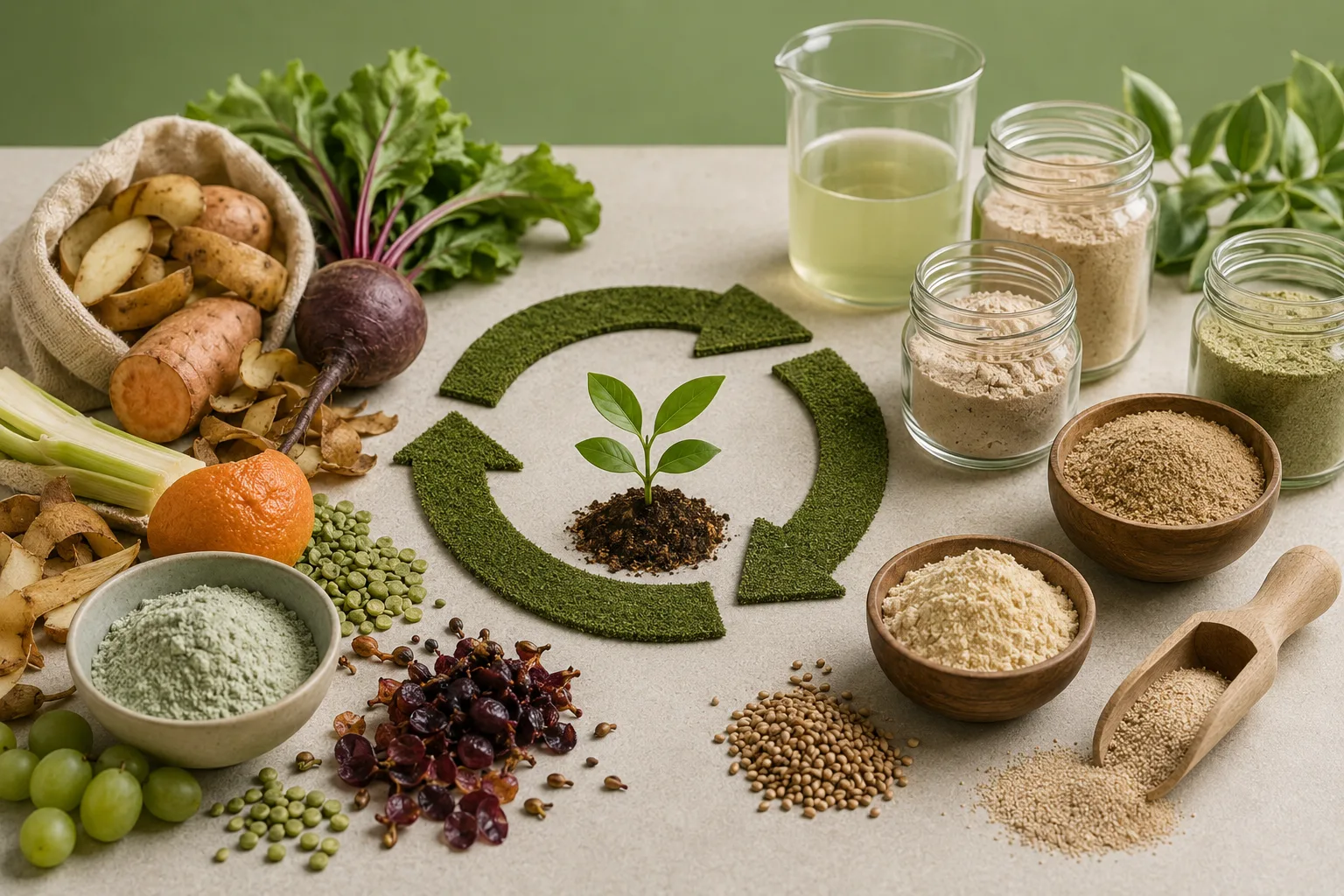
The global food system wastes nearly 40% of everything it produces every year. That is an extraordinary number — one that represents not just lost food, but squandered resources, unnecessary emissions, and missed nutritional potential. Into this gap steps one of the most compelling ideas reshaping the food and beverage industry today: the upcycled food ingredient.
For food manufacturers, formulators, and brand developers, upcycled ingredients are no longer a niche curiosity. They are quickly becoming a strategic advantage — and understanding them is essential for anyone serious about building products that are both future-ready and genuinely good for people.
What Exactly Is an Upcycled Food Ingredient?
An upcycled food ingredient is any ingredient derived from food by-products, surplus crops, or processing co-streams that would otherwise go to waste — but are instead recovered, refined, and reintegrated into the human food supply. The definition matters, because upcycling is not the same as simply recycling or repurposing scraps.
According to the Upcycled Food Association, upcycled foods must use ingredients that otherwise would not have entered human consumption, be produced using verifiable supply chains, and demonstrate a measurable positive environmental impact. In practice, this means ingredients like fiber recovered from starch processing, proteins extracted from crop co-products, and functional carbohydrates derived from agricultural by-streams.
What makes this concept so compelling from a manufacturing standpoint is the dual benefit: reducing waste while simultaneously creating ingredients with genuine nutritional value. It is, in the truest sense, converting a cost into a contribution.
Why the Industry Is Taking Upcycling Seriously Right Now
This is not a passing trend. The upcycled ingredients market reached approximately USD 371 million in 2024 and is projected to grow steadily at a compound annual growth rate of around 5.65% through 2032. Menu appearances of upcycled ingredients grew by 39% in the year leading into 2026 alone — and the category is still in its early stages, meaning brands that move now have a genuine first-mover window.
Several forces are converging to drive this momentum:
- Consumer expectations have shifted. More than half of consumers globally say they are willing to pay a premium for products from brands that actively reduce food waste. Sustainability is no longer a soft differentiator — it influences purchasing decisions.
- Supply chain pressures are real. Ingredient shortages, price volatility in commodity crops, and ESG compliance requirements are pushing manufacturers to diversify and rethink sourcing models.
- Regulatory landscapes are tightening. The EU Green Claims Directive and similar frameworks now require brands to substantiate sustainability claims with verifiable data, raising the bar for what qualifies as genuinely circular.
For food and beverage manufacturers across Asia and beyond, this creates a clear signal: sourcing from a sustainable food ingredient Indonesia-based producer with documented supply chains is not just ethical positioning — it is sound business strategy.
The Nutritional Case: Upcycled Does Not Mean Compromised
One of the most persistent myths around upcycled ingredients is that they represent a step down in quality. The science says otherwise. Research consistently shows that many upcycled ingredients retain — and in some cases even concentrate — the nutritional properties of their source materials.
Take fiber as an example. Resistant dextrin, produced through controlled enzymatic processing of starch co-products, is one of the most rigorously studied functional fibers available to food manufacturers today. A review published in Nutrients (PMC8621223) confirmed that resistant dextrins possess robust prebiotic properties — regulating gut microbiota composition, increasing satiety, and improving metabolic parameters — without significantly affecting the taste or texture of finished products.
Similarly, plant proteins extracted from crop processing streams have been shown in peer-reviewed research to retain complete or near-complete amino acid profiles, making them fully viable alternatives to primary-source proteins for functional food applications. Far from being second-tier, these ingredients often deliver targeted nutritional benefits with greater efficiency than their commodity counterparts.
The nutritional case for upcycled functional ingredients is strong. The challenge for manufacturers lies in identifying reliable, certified supply partners who can deliver these ingredients at scale and with consistency.
Key Upcycled Ingredient Categories and Their Applications
Understanding where upcycled ingredients come from — and what they can do in a formulation — is the starting point for any product development conversation.
Prebiotic Fibers from Starch Processing
When starches are processed for food-grade applications, enzymatic reactions produce a range of co-products that can be refined into highly functional soluble dietary fibers. Resistant dextrin is the standout example: a low-viscosity, water-soluble fiber that reaches the colon intact, where it selectively feeds beneficial gut bacteria.
For formulators, resistant dextrin as a prebiotic fiber offers exceptional versatility. It dissolves cleanly in beverages, adds no off-flavour to bakery products, and can be incorporated into dairy alternatives, snack bars, and RTD formats without altering mouthfeel. As a resistant dextrin prebiotic fiber manufacturer, working with this ingredient opens doors to a growing category of gut-health-positioned products — one of the fastest-growing claims in the global F&B market.
Plant Proteins from Agricultural Co-Streams
Pea protein and rice protein represent two of the most scalable and well-documented examples of upcycled plant protein in commercial use today. Both are derived from processing streams that generate significant biomass — and both, when properly extracted and purified, deliver impressive functional and nutritional profiles.
As an upcycled plant protein supplier, the ability to offer pea protein isolate — with its 80–85% protein content, neutral flavour profile, and complete amino acid coverage when blended — opens applications across dairy alternatives, plant-based meat, sports nutrition, and infant nutrition. Rice protein, meanwhile, brings hypoallergenic credentials and excellent thermal stability, making it a go-to for RTD protein beverages and baked goods where processing resilience matters.
Research published in Foods (2024, PMC10855059) highlights that pea and brown rice protein isolates both exhibit functional properties well-suited to food manufacturing applications — supporting the case for these ingredients far beyond their sustainability story.
Functional Carbohydrates and Natural Sweeteners
Agricultural processing also generates functional carbohydrates — maltodextrins, syrups, and modified starches — that can be derived from rice, pea, and tapioca sources. These ingredients serve as carriers, texturisers, and sweeteners in formulations, often with cleaner label positioning than their synthetic counterparts.
Tapioca syrup and rice syrup, for example, offer alternatives to high-fructose corn syrup with recognisable, consumer-friendly ingredient names. Pea maltodextrin and rice maltodextrin provide encapsulation and carrier functions in spray-dried formats, making them particularly relevant for nutraceutical and functional food applications.
What to Look for in an Upcycled Food Ingredients Manufacturer
Choosing the right manufacturing partner for upcycled ingredients involves a different set of criteria than sourcing conventional commodity inputs. The integrity of the supply chain matters enormously — both for regulatory compliance and for the authenticity of sustainability claims.
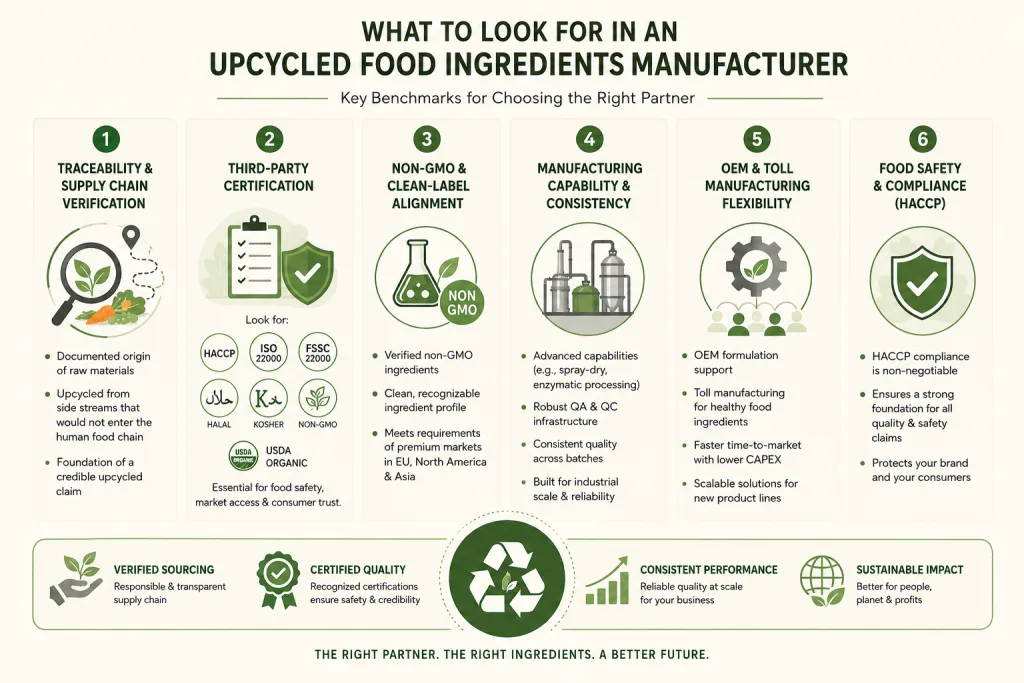
When evaluating an upcycled food ingredients manufacturer, these are the benchmarks that should carry the most weight:
- Traceability and supply chain verification. Can the manufacturer document where raw materials originate and demonstrate that they would not otherwise have entered the human food chain? This is the foundation of any credible upcycled claim.
- Third-party certification. Look for HACCP, ISO 22000, and FSSC 22000 as baseline food safety credentials. For markets with specific requirements, certifications such as Halal, Kosher, Non-GMO, and USDA Organic signal rigorous standards. A halal certified food ingredient supplier with these credentials is particularly valuable for brands targeting Southeast Asian, Middle Eastern, and global Muslim consumer markets.
- Non-GMO and clean-label alignment. As a non-GMO food ingredient manufacturer Asia, the ability to supply verified non-GMO ingredients is increasingly table-stakes for brands selling into European, North American, and premium Asian markets.
- Manufacturing capability and consistency. Bulk supply for industrial customers demands consistency across batches. A facility with dedicated spray-dry, enzymatic processing, and quality assurance infrastructure is not the same as a blending operation. The difference matters when formulating to specification.
- OEM and toll manufacturing flexibility. For brands developing proprietary formulations, access to an OEM food ingredient manufacturer Indonesia partner with toll manufacturing healthy food ingredient capabilities means faster time-to-market and lower capital requirements for new product lines.
Food ingredient contract manufacturing HACCP compliance is not optional in this context — it is the foundation on which every other quality claim rests.
Southeast Asia as a Strategic Source for Upcycled Ingredients
Indonesia and the broader Southeast Asian region occupy a unique position in the global upcycled ingredient landscape. Rich agricultural biodiversity, proximity to major crop processing operations for rice, tapioca, and legumes, and a rapidly maturing food manufacturing infrastructure make this region a natural hub for sustainable ingredient production.
Brands sourcing from a pea protein isolate manufacturer Indonesia or a tapioca-based fiber supplier in the region benefit from shorter supply chains to Asian end markets, competitive manufacturing costs, and access to agricultural co-streams that are genuinely abundant. The key is identifying partners who have invested in the science, infrastructure, and certification needed to transform those raw co-streams into food-grade, specification-consistent ingredients.
Translating Upcycled Ingredients into Consumer-Facing Product Stories
Ingredient sourcing decisions made at the manufacturing level ultimately translate into product narratives at the shelf. Consumers are increasingly attuned to sustainability claims — and increasingly skeptical of vague ones. Research published in PMC (2025) shows that while consumer attitudes toward upcycled foods are broadly positive, awareness remains low and purchasing translation is not automatic. The implication is clear: the ingredient story needs to be told clearly and credibly.
For food and beverage brands, this means a few things in practice:
- Use certification marks and traceability narratives on packaging to make the upcycled sourcing visible.
- Lead with the nutritional benefit — gut health, protein content, blood sugar support — and let sustainability be the bonus story, not the only story.
- Partner with manufacturers who can provide documentation and communication assets, not just ingredients.
The brands winning on upcycled positioning in 2026 are those that treat it as a functional advantage backed by science, not a marketing overlay applied after the fact.
Innovate Your Formulation with Ingredients Built for What Comes Next
The food industry is at an inflection point. The brands and manufacturers who recognise upcycled food ingredients not as a compromise but as a category of precision-engineered, science-backed, sustainably sourced inputs are the ones building product lines with genuine longevity.
Whether your next formulation calls for a prebiotic fiber that supports gut health without altering texture, a plant protein that delivers a complete amino acid profile with a clean label, or a functional sweetener that replaces refined sugar without sacrificing consumer appeal — the ingredients exist. The question is whether your supply chain is aligned to deliver them.
If you are ready to explore how innovative, healthy food ingredients can elevate your next F&B product, connect with a manufacturer whose entire portfolio is purpose-built around exactly that mission. Explore the full range of upcycled-aligned functional ingredients — from resistant dextrin and pea protein isolate to rice syrup and tapioca-based functional carbohydrates — and discover what world-class integrated food manufacturing solutions can do for your formulation.
References
- Aschemann-Witzel, J., Varela, P., & Peschel, A. O. (2023). Upcycled food: Consumer acceptance, willingness to pay, and the role of information. Food Quality and Preference, 104, 104744. https://doi.org/10.1016/j.foodqual.2022.104744
- Burghardt, K., Craven, T., & Pearce, J. M. (2024). Towards sustainable protein sources: The thermal and rheological properties of alternative proteins. Foods, 13(3), 448. https://doi.org/10.3390/foods13030448
- da Conceição das Mercês, Z., Salvadori, N. M., Evangelista, S. M., Cochlar, T. B., Strasburg, V. J., da Silva, V. L., & de Oliveira, V. R. (2024). Effectiveness, challenges, and environmental impacts of new food strategies with plant and animal protein products. Foods, 13(20), 3217. https://doi.org/10.3390/foods13203217
- Institute of Food Technologists. (2025, April). Upcycling: The future is now. Food Technology Magazine. https://www.ift.org/news-and-publications/food-technology-magazine/issues/2025/april/columns/sustainability-upcycling-the-future-is-now
- Institute of Food Technologists. (2024, September). Upcycled foods break new ground. Food Technology Magazine. https://www.ift.org/news-and-publications/food-technology-magazine/issues/2024/september/features/upcycled-foods-break-new-ground
- Muñoz-Tebar, N., Perez-Alvarez, J. A., Fernandez-Lopez, J., & Viuda-Martos, M. (2021). Efficiency of resistant starch and dextrins as prebiotics: A review of the existing evidence and clinical trials. Nutrients, 13(11), 3808. https://doi.org/10.3390/nu13113808
- Sokołowska, B., Choromańska, A., & Śliżewska, K. (2024). Impact of a fruit–vegetable preparation fortified with potato starch resistant dextrin on selected health indicators in overweight children. Nutrients, 16(15), 2396. https://doi.org/10.3390/nu16152396
Featured News
Category
Get a Promo and Keep Updated