
Rice Protein Isolate for Non-Dairy Sports Recovery RTD Shakes: A Formulator’s Guide
Food Ingredient Supplier Australia: A Buyer’s Guide to Sourcing Functional Ingredients That Meet Compliance and Innovation Needs
July 21, 2026
General - Articles

Australia’s food and beverage manufacturers are under more pressure than ever to deliver products that are both label-friendly and genuinely functional. Consumers want fiber, protein, and clean-label sweeteners, but procurement teams still need to hit cost, compliance, and supply chain targets. Finding the right food ingredient supplier Australia businesses can rely on is rarely just about price anymore.
That shift has pushed many R&D and procurement leads to look beyond domestic sourcing. Offshore manufacturers with strong certifications, transparent documentation, and flexible order volumes are increasingly part of the conversation. So what should you actually look for, and where do ingredients like resistant dextrin or pea protein isolate fit into an Australian product roadmap? Let’s break it down.
Why Australian F&B Brands Are Rethinking Their Ingredient Sourcing Strategy
Australia’s functional food category has grown quickly, driven by demand for gut health, high-protein, and reduced-sugar products. That growth has outpaced what some local supply chains can comfortably support, especially for specialty functional ingredients used at scale.
Many manufacturers now split sourcing between a bulk food ingredient supplier Australia companies use for staple inputs, and specialist partners overseas for functional actives. This hybrid approach helps control costs while still accessing innovation-driven ingredients that aren’t always produced domestically in volume.
There’s also a compliance angle. Any food ingredient exporter to Australia has to meet biosecurity import conditions before food safety rules even apply. According to the Department of Agriculture, Fisheries and Forestry, all imported food intended for sale in Australia must be safe and meet Australia’s food standards, and all food imports must first meet biosecurity import conditions. A supplier who understands this process in advance saves buyers significant time.
Cost pressure plays a role too. Freight, currency shifts, and raw material volatility have all made procurement teams more deliberate about who they partner with long term. A supplier relationship that survives a few price cycles, rather than one chosen purely on a single quote, tends to be the one that actually protects margin over time.
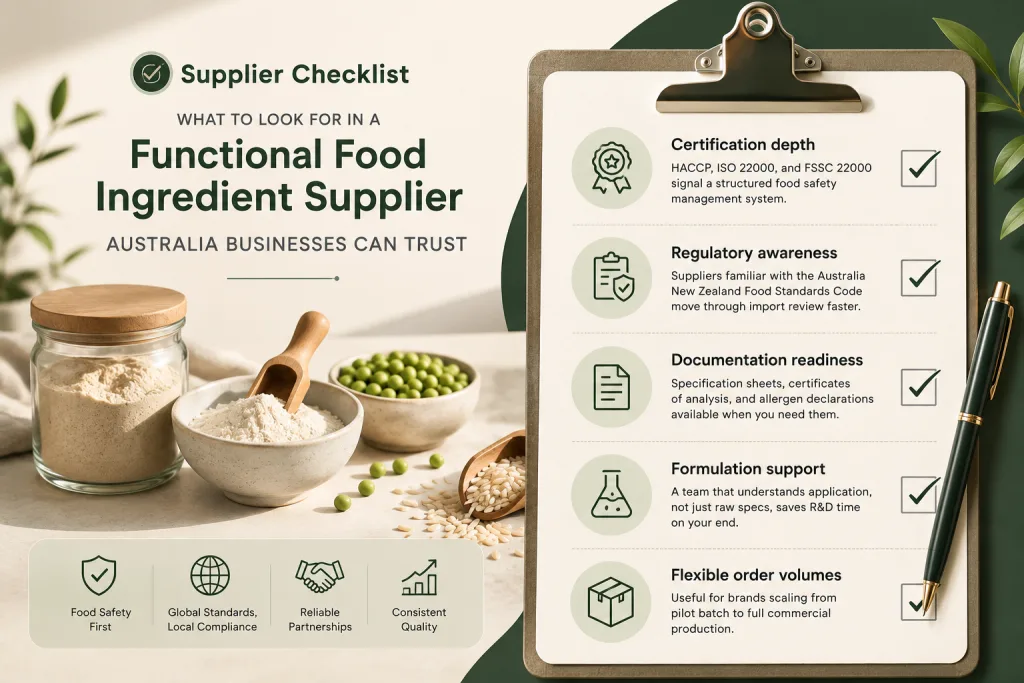
What to Look for in a Functional Food Ingredient Supplier Australia Businesses Can Trust
Not every overseas manufacturer is set up to serve the Australian market well. Before shortlisting a functional food ingredient supplier Australia teams should confirm a few non-negotiables, since gaps here tend to surface later as costly delays.
Key criteria worth checking:
- Certification depth – HACCP, ISO 22000, and FSSC 22000 signal a structured food safety management system, not just a one-time audit.
- Regulatory awareness – Suppliers familiar with the Australia New Zealand Food Standards Code move through import review faster.
- Documentation readiness – Specification sheets, certificates of analysis, and allergen declarations should be available before you ask twice.
- Formulation support – A team that understands application, not just raw specs, saves R&D time on your end.
- Flexible order volumes – Useful for brands scaling from pilot batch to full commercial production.
A HACCP certified food ingredient supplier isn’t simply ticking a compliance box. As the FAO explains, the HACCP approach is internationally recognized as essential to ensuring the safety and suitability of food for human consumption, and it enhances the potential for international trade. That trade dimension matters directly to Australian importers relying on consistent, well-documented supply.
Understanding Australia’s Import and Food Safety Requirements
Every food ingredient manufacturer Australia works with needs to clear two separate regulatory layers: biosecurity, then food safety. Skipping ahead in the wrong order is one of the most common reasons shipments get delayed at the border.
Food Standards Australia New Zealand (FSANZ) sets the rules that apply once biosecurity is cleared. Per FSANZ, foods imported for sale in Australia must comply with the Australia New Zealand Food Standards Code, and all imported foods must also comply with strict biosecurity requirements. Importers, not suppliers, carry ultimate legal responsibility for this compliance, which is exactly why supplier documentation quality matters so much.
FSANZ itself functions as the standards-setting body behind this system. It’s described by the Australian Government as an agency that develops standards regulating the use of ingredients, processing aids, colourings, additives, vitamins and minerals, as well as the composition of some foods and foods developed using new technologies. Buyers working with a wholesale food ingredients Australia supplier should ask directly whether the supplier has prior experience navigating this Code, since first-time exporters often underestimate the documentation load.
Timing matters more than most buyers expect. Biosecurity clearance and food safety inspection happen in sequence, not in parallel, so a shipment held up at the first stage automatically delays the second. Building in a documentation review window before goods leave the country of origin is one of the simplest ways to avoid unplanned warehouse gaps.
Resistant Dextrin: A Functional Fiber Worth Sourcing Carefully
Resistant dextrin has become one of the most requested soluble fibers in functional food development, and for good reason. It blends into beverages, bars, and bakery formats without altering taste or texture significantly, which makes it a practical choice for reformulation projects.
The research behind it is fairly robust. One clinical study found that supplementation with resistant dextrin for 12 weeks alleviates insulin resistance and improves determinants of metabolic syndrome in overweight men, while a separate trial showed that resistant dextrin supplementation increases the abundance of the beneficial gut bacterium Parabacteroides distasonis in healthy women. For brands building a fiber-forward product line, this evidence base supports genuinely functional label claims rather than vague “added fiber” language.
Sourcing a resistant dextrin supplier Australia manufacturers can depend on means checking more than the spec sheet. Solubility, viscosity behavior under heat, and consistent batch-to-batch performance all affect how well the ingredient performs once it’s in a finished product — details best confirmed through sample trials before committing to bulk orders.
Tolerance data matters too. Buyers formulating for sensitive categories, such as clinical nutrition or children’s snacks, should ask suppliers for dosage tolerance studies rather than relying on general fiber guidance, since gastrointestinal comfort varies noticeably between resistant dextrin sources.
Plant Protein Ingredients: Pea Protein Isolate and the Growing Demand for Alternatives
Plant protein ingredient supplier Australia partnerships have become central to product development, especially as more brands move away from dairy-based formulations. Pea protein isolate, in particular, has built a strong reputation for both nutritional performance and formulation flexibility.
Research backs up much of the appeal. A review of pea protein isolate research summarized that it may assist with reducing cholesterol levels, lowering blood pressure, improving satiety, and increasing muscle. Separate animal research also found that combining pea protein with inulin fiber helped preserve muscle mass over time, suggesting real potential for products targeting healthy aging.
For manufacturers evaluating a pea protein isolate supplier Australia distributors can compete with, a few formulation factors are worth testing directly:
- Solubility in the target application (beverage vs. powder vs. baked format)
- Flavor neutrality, since some pea protein sources carry a noticeable earthy note
- Amino acid completeness for protein-content label claims
- Blending compatibility with rice or other complementary plant proteins
This is also where an Asia Pacific food ingredient supplier with regional manufacturing experience can offer an advantage — shorter shipping lanes, familiarity with APAC labeling norms, and often more competitive landed costs than European or North American alternatives.
OEM and Private Label: An Efficient Path for Australian Product Development
Not every brand needs to manage raw ingredient sourcing and formulation in-house. An OEM food ingredient manufacturer for Australian market brands increasingly serves as a full-service partner, handling formulation, production, and packaging under one roof.
This model appeals particularly to smaller or fast-growing F&B businesses that don’t have in-house food science teams. Working with a private label food ingredient supplier Australia companies trust allows a brand to launch a functional product line without the capital investment of building manufacturing infrastructure from scratch.
The trade-off is supplier selection rigor. Since your brand name sits on the finished product, verifying the manufacturer’s certifications, quality systems, and track record matters more here than in standard bulk ingredient purchasing. A few extra weeks of due diligence upfront is a reasonable trade for years of consistent supply.
It’s also worth mapping out how the relationship scales. A supplier that handles a 500kg pilot run well doesn’t automatically handle a multi-tonne reorder the same way. Ask about production capacity, lead times at volume, and whether formulation support continues once a product moves from trial to full commercial rollout.
Halal, Non-GMO, and Other Certifications That Matter to Australian Buyers
Certification requirements in Australia are shaped by both regulation and consumer demand. A Halal certified food ingredient supplier Australia brands can market to Muslim consumers opens access to a growing segment of the market, particularly in packaged snacks, bakery, and beverage categories.
Non-GMO status carries similar weight. A Non-GMO food ingredient supplier Australia buyers select often does so because retail buyers and private label programs increasingly request this documentation before listing approval, not just because of end-consumer preference. FSANZ’s own labeling standards touch on this directly, since the Food Standards Code regulates the use of ingredients, additives, and minerals, and includes requirements around genetically modified foods.
Buyers should request certificates directly rather than relying on a supplier’s website claims. A credible food ingredient exporter to Australia will have these documents ready as part of standard onboarding, along with expiry dates and issuing body details for verification.
Explore Functional Ingredient Solutions Built for Global Food Manufacturers
Sourcing decisions like these are rarely made in isolation — they connect directly to product formulation, certification strategy, and long-term supply reliability. If your team is evaluating functional ingredients for an Australian product line, it’s worth reviewing options that combine certified manufacturing with formulation flexibility.
Satoria Nutrisentials manufactures a range of functional ingredients — including Resistant Dextrin, Pea Protein Isolate, Rice Protein Isolate, and Tapioca Syrup — backed by Halal, Non-GMO, ISO 22000, and FSSC 22000 certifications. Explore the full product range or reach out to discuss formulation support for your next project.
References
- Department of Agriculture, Fisheries and Forestry. (2025). Importing food into Australia. Australian Government. https://www.agriculture.gov.au/biosecurity-trade/import/goods/food
- Food and Agriculture Organization of the United Nations. (n.d.). Food safety through HACCP: The FAO approach. https://www.fao.org/4/v9723t/v9723t0e.htm
- Food Standards Australia New Zealand. (n.d.). Imported foods. https://www.foodstandards.gov.au/consumer/imported-foods
- Australian Government Department of Health, Disability and Ageing. (2023). Food Standards Australia New Zealand (FSANZ). https://www.health.gov.au/contacts/food-standards-australia-new-zealand-fsanz
- LiberEat. (2025). What is the role of Food Standards Australia New Zealand (FSANZ)? https://libereat.com/2025/08/what-is-the-role-of-food-standards-australia-new-zealand-fsanz/
- Zhu, L., et al. (2020). Resistant dextrin improves high-fat-high-fructose diet induced insulin resistance. National Center for Biotechnology Information. https://www.ncbi.nlm.nih.gov/pmc/articles/PMC7227367/
- Neyrinck, A. M., et al. (2022). Diet supplementation with NUTRIOSE, a resistant dextrin, increases the abundance of Parabacteroides distasonis in the human gut. PMC. https://pmc.ncbi.nlm.nih.gov/articles/PMC9287035/
- Center for Research on Ingredient Safety. (2025). Pea protein isolate. Michigan State University. https://cris.msu.edu/news/trending/pea-protein-isolate/
Featured News
Category
Get a Promo and Keep Updated