
Rice Protein Isolate for Non-Dairy Sports Recovery RTD Shakes: A Formulator’s Guide
Synbiotic Formulation: A Manufacturer’s Guide to Pairing Prebiotics and Probiotics for Functional Food
July 23, 2026
General - Articles
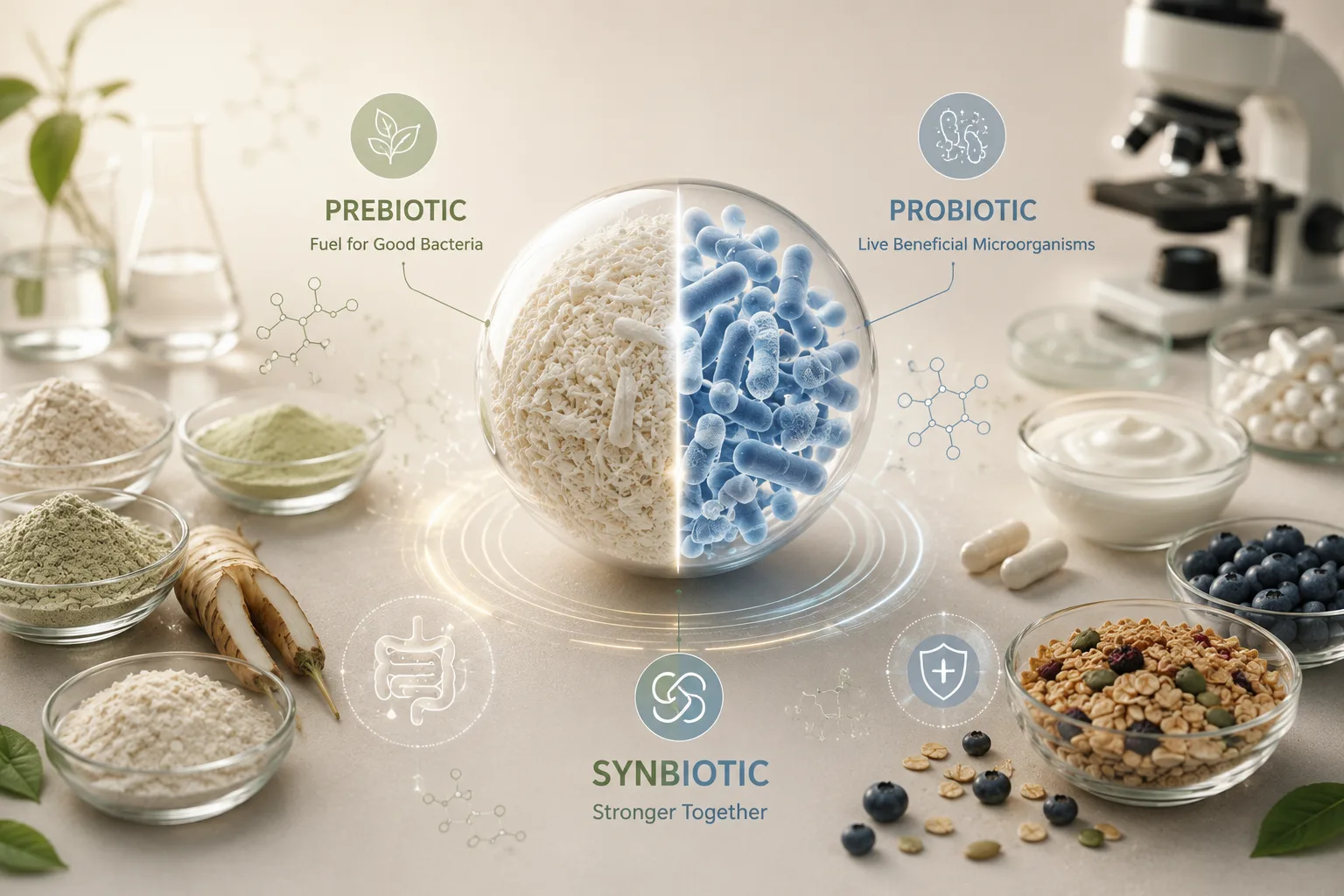
Walk down any supplement aisle or scroll through a wellness feed and you’ll notice gut health has stopped being a niche interest. It’s become a baseline expectation. For food and beverage manufacturers, that shift has put synbiotic formulation squarely on the innovation roadmap, and for good reason — pairing the right microorganisms with the right substrate can do more for a product’s efficacy story than either ingredient could achieve alone.
But here’s the catch: not every prebiotic-probiotic pairing deserves the synbiotic label, and not every ingredient combination performs the way a spec sheet promises once it hits real production conditions. If you’re scoping this category for your next product launch, it helps to understand what actually separates a well-built synbiotic formulation from a trend-chasing ingredient swap — and which prebiotic partners hold up best once formulation, processing, and shelf life enter the picture.
What Is a Synbiotic Formulation, Anyway?
At its simplest, a synbiotic formulation combines live microorganisms with a substrate those microorganisms can actually use. The International Scientific Association for Probiotics and Prebiotics (ISAPP) formalized this in 2020, describing a synbiotic as a mixture of live microbes and substrates selectively utilized by host organisms that together confer a health benefit (Swanson et al., 2020).
In practical terms, that means a prebiotic and probiotic combination ingredient — think a fiber or fermentable carbohydrate paired with a probiotic strain — working together rather than simply sitting side by side on an ingredient list. This is the foundation of functional food synbiotics, and it’s why the category has moved well past yogurt into bars, beverages, dairy alternatives, and clinical nutrition formats.
For manufacturers, understanding this definition matters more than it might seem. Products marketed as synbiotic but built without real functional reasoning behind the pairing tend to underdeliver on the health claims consumers are increasingly scrutinizing. A well-reasoned synbiotic formulation, by contrast, gives you both a defensible label story and a genuine mechanism of action worth communicating.
Synergistic vs. Complementary Synbiotics: Why the Distinction Matters
Not all synbiotics are built the same way, and the synergistic synbiotic vs complementary synbiotic distinction is one every formulator should understand before sourcing ingredients. A complementary synbiotic simply combines a probiotic and a prebiotic that each independently meet their own evidence standards — they don’t need to have been designed to work together (Swanson et al., 2020).
A synergistic synbiotic goes a step further. Here, the substrate is specifically selected because it’s utilized by the accompanying microorganism, creating a designed, cooperative effect rather than a coincidental pairing. This is a higher formulation bar, but it also tends to produce a more compelling, more defensible product story.
Which approach fits your product depends on your goals, your budget, and your timeline. A complementary synbiotic formulation is often faster and less costly to bring to market, since it can lean on ingredients with independently established evidence. A synergistic approach demands more upfront formulation and stability work, but it can differentiate a product meaningfully in a crowded gut-health category. Either way, the pairing logic should be intentional, not incidental.
Why Functional Food Synbiotics Are Having a Moment
Consumer interest in digestive wellness has been building for years, but it’s accelerated as more people connect gut health to immunity, mood, and metabolic wellbeing. Synbiotic diets that combine probiotics and prebiotics are increasingly positioned to support gut microbiota balance, metabolic health, and immune function through complementary biological mechanisms (News-Medical, 2025).
That consumer pull is translating into commercial demand. Analysts tracking the category note that food and beverage applications already represent a leading share of the broader synbiotics market, driven by interest in immunity, digestion, and cardiovascular wellness (The Brainy Insights, n.d.). For F&B brands, this creates real pressure — and real opportunity — to move beyond single-function ingredients toward formulations that tell a fuller wellness story.
It also means the bar for credibility is rising. Shoppers researching gut-health products are more label-literate than they were even a few years ago, which rewards brands that can back up a synbiotic claim with real formulation science rather than a trend-chasing ingredient swap.
What Makes a Synbiotic Formulation Actually Work
Good intentions aren’t enough here — synbiotic formulation is genuinely technical work, and a few variables determine whether a product performs the way it’s marketed.
Strain Viability and Shelf Stability
Probiotic strains are living organisms, and they’re sensitive to heat, moisture, oxygen, and pH throughout processing and storage. The prebiotic fiber for synbiotic products you choose can actually help here: certain fibers create a more hospitable microenvironment that supports strain survival through manufacturing and shelf life, rather than just adding fermentable substrate.
Matrix Compatibility
A synbiotic ingredient for functional food needs to behave predictably inside the base product, whether that’s a low-moisture bar, an acidic beverage, or a baked good exposed to high heat. Ingredients with clean solubility and thermal stability profiles make this integration far easier for formulators working against tight production tolerances.
Dose and Delivery Format
Meaningful health benefits depend on delivering an effective dose of both the microorganism and its substrate, which means format matters. Capsules, sachets, and functional foods each carry different practical limits, and the substrate needs to be usable at the concentrations your intended benefit actually requires.
Where Synbiotic Formulation Shows Up Across the Aisle
Synbiotic formulation isn’t confined to one category anymore — it’s spreading across formats as manufacturers look for new ways to deliver gut-health benefits.
Synbiotic Dairy Product Formulation
Dairy remains the most established home for synbiotics, and synbiotic dairy product formulation continues to expand beyond traditional yogurt into kefir, cultured beverages, and functional dairy snacks. Fortified functional foods such as yogurt and frozen desserts are commonly built with specific probiotic strains alongside prebiotic fibers like inulin or FOS (News-Medical, 2025). The category’s familiarity with fermentation makes it a natural fit for synergistic pairings.
Dietary Supplements and OEM Synbiotic Manufacturing
Supplements represent one of the fastest-growing synbiotic formats, particularly through OEM synbiotic supplement manufacturing arrangements where a brand partners with a manufacturer to develop capsules, sachets, or powders. A synbiotic formulation for dietary supplements typically demands tighter control over moisture and stability than food applications, since there’s less protective matrix around the probiotic strain.
Functional Beverages and Bars
Ready-to-drink beverages and nutrition bars are newer territory, and both formats present real formulation puzzles around acidity, water activity, and heat exposure during processing. A synbiotic formulation for food manufacturers working in these categories often leans on more heat-stable, shelf-stable prebiotic components to protect the finished product’s functional claims.
Choosing the Right Prebiotic Partner: Why Resistant Dextrin Fits
Not every prebiotic performs equally well across formats, and this is where ingredient selection becomes a genuine competitive advantage. A resistant dextrin synbiotic ingredient brings a few practical qualities to the table: it’s a soluble fiber with mild flavor, high water solubility, and a stability profile that holds up well across heat, acid, and extended shelf life.
At Satoria NutriSentials, Resistant Dextrin — sold commercially as Fiberfit® — is built for exactly this kind of formulation flexibility. As a soluble dietary fiber, it’s already recognized for feeding beneficial gut bacteria in a prebiotic capacity, which makes it a logical substrate choice when a synergistic pairing with a specific probiotic strain is the goal (Satoria NutriSentials, n.d.).
Beyond fiber, a well-rounded synbiotic formulation often benefits from complementary functional ingredients that support texture, protein content, or sweetness without disrupting the microbial component. Satoria’s broader catalogue — including Pea Protein Isolate and Rice Protein Isolate for protein fortification, and SweetSentials® for sugar reduction — gives formulators room to build a more complete functional profile around the core prebiotic-probiotic pairing, all without reaching for a long list of separate suppliers.
Formulation and Label Considerations Worth Planning For
Beyond the science, a few practical realities shape how smoothly a synbiotic formulation moves from concept to shelf. Regulatory framing is one of the biggest: because “synbiotic” isn’t a legally defined term in most markets the way “organic” or “gluten-free” is, the substantiation burden falls on the manufacturer to ensure claims match the evidence behind the specific pairing used.
That makes documentation an early-stage priority, not an afterthought. Formulators should be prepared to explain why a given prebiotic fiber for synbiotic products was selected relative to the accompanying probiotic strain, particularly if the product is positioned as a synergistic rather than complementary synbiotic. Retailers and export markets increasingly ask for this reasoning during listing reviews.
Labeling also needs to reflect what the product actually delivers. Overstating a synbiotic gut health ingredient’s benefit — implying clinical-level outcomes from a food-format serving size — is one of the fastest ways to draw regulatory or retailer scrutiny. A more conservative, well-supported claim tends to hold up better over a product’s lifecycle than an aggressive one that invites challenge.
Finally, consider how the finished product will be positioned relative to existing category leaders. Dairy-based synbiotics face different consumer expectations than a supplement sachet or a shelf-stable bar, so the same underlying ingredient pairing may need different substantiation language depending on format and market.
What to Look for in a Synbiotic Ingredient Supplier
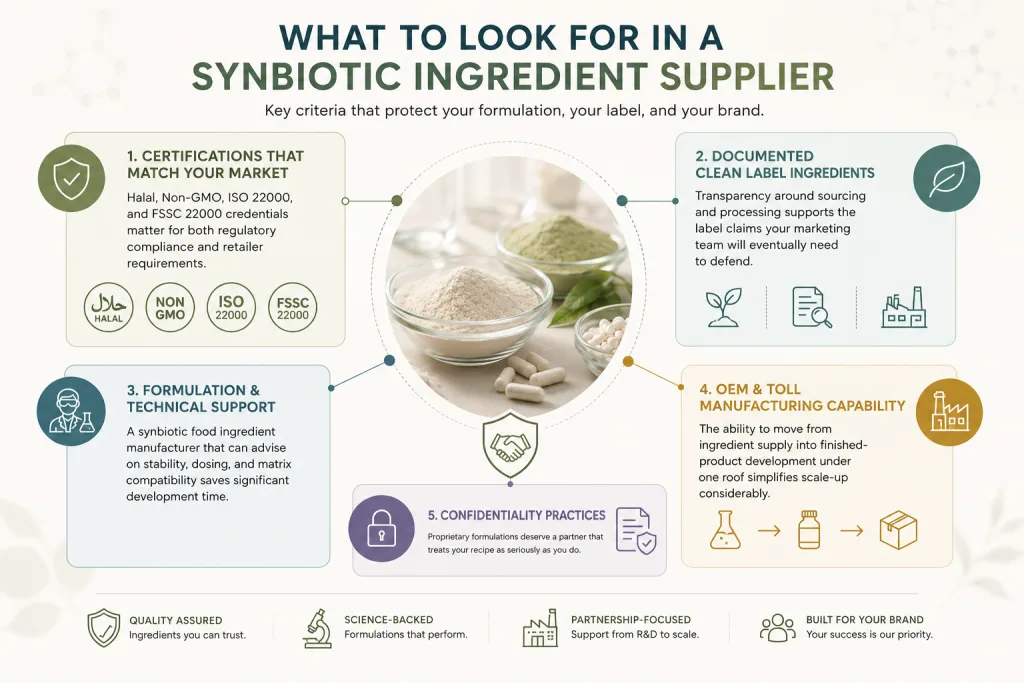
Sourcing decisions carry real weight in this category, since ingredient quality directly affects both product performance and label credibility. A few criteria are worth prioritizing when evaluating a synbiotic ingredient supplier:
- Certifications that match your target market — Halal, Non-GMO, ISO 22000, and FSSC 22000 credentials matter for both regulatory compliance and retailer requirements.
- Documented clean label ingredients — transparency around sourcing and processing supports the label claims your marketing team will eventually need to defend.
- Formulation and technical support — a synbiotic food ingredient manufacturer that can advise on stability, dosing, and matrix compatibility saves significant development time.
- OEM and toll manufacturing capability — the ability to move from ingredient supply into finished-product development under one roof simplifies scale-up considerably.
- Confidentiality practices — proprietary formulations deserve a partner that treats your recipe as seriously as you do.
Vetting suppliers against this list early tends to prevent costly reformulation later, particularly for brands moving quickly to capture consumer interest in the category.
Ready to Build Your Next Functional Food Formulation?
Satoria NutriSentials has spent years helping F&B businesses translate ingredient science into products people actually want to buy, backed by HACCP, ISO, Halal, and FDA-recognized manufacturing standards. Whether you’re exploring a synbiotic dairy product formulation, a supplement line, or a new functional beverage, our Fiberfit® Resistant Dextrin and complementary protein and sweetener ingredients offer a practical starting point for your formulation team.
Our team works alongside food scientists and product developers to think through matrix compatibility, dosing, and stability before a single production run happens, so surprises at scale-up are far less likely. That kind of early technical partnership tends to save both time and budget compared to troubleshooting a formulation after launch.
Explore our full product range or reach out to discuss OEM and toll manufacturing support tailored to your synbiotic project — your unique formula stays exactly that: yours.
References
- Mordor Intelligence. (n.d.). Synbiotic products market size, share & industry analysis.
- Mottawea, W., Sultan, S., Landau, K., Bordenave, N., & Hammami, R. (2020). Evaluation of the prebiotic potential of a commercial synbiotic food ingredient on gut microbiota in an ex vivo model of the human colon. Nutrients, 12(9), 2669. https://www.ncbi.nlm.nih.gov/pmc/articles/PMC7551822/
- News-Medical. (2025, November 11). Synbiotic diets: The combined power of probiotics and prebiotics for gut health.
- PMC. (2024). Synbiotics as potent functional food: Recent updates on therapeutic potential and mechanistic insight. https://pmc.ncbi.nlm.nih.gov/articles/PMC10771572/
- Swanson, K. S., Gibson, G. R., Hutkins, R., Reimer, R. A., Reid, G., Verbeke, K., Scott, K. P., Holscher, H. D., Azad, M. B., Delzenne, N. M., & Sanders, M. E. (2020). The International Scientific Association for Probiotics and Prebiotics (ISAPP) consensus statement on the definition and scope of synbiotics. Nature Reviews Gastroenterology & Hepatology, 17(11), 687–701. https://www.ncbi.nlm.nih.gov/pmc/articles/PMC7581511/
- The Brainy Insights. (n.d.). Synbiotics market, industry size forecast report.
- tom Dieck, H., Schön, C., Wagner, T., Pankoke, H. C., Fluegel, M., & Speckmann, B. (2021). A synbiotic formulation comprising Bacillus subtilis DSM 32315 and L-alanyl-L-glutamine improves intestinal butyrate levels and lipid metabolism in healthy humans. Nutrients, 14(1), 143. https://www.ncbi.nlm.nih.gov/pmc/articles/PMC8747176/
Featured News
Category
Get a Promo and Keep Updated