
Rice Protein Isolate for Non-Dairy Sports Recovery RTD Shakes: A Formulator’s Guide
Maltodextrin Carrier for Flavor and Probiotics: A Formulator’s Guide to Encapsulation Performance
August 21, 2026
General - Articles
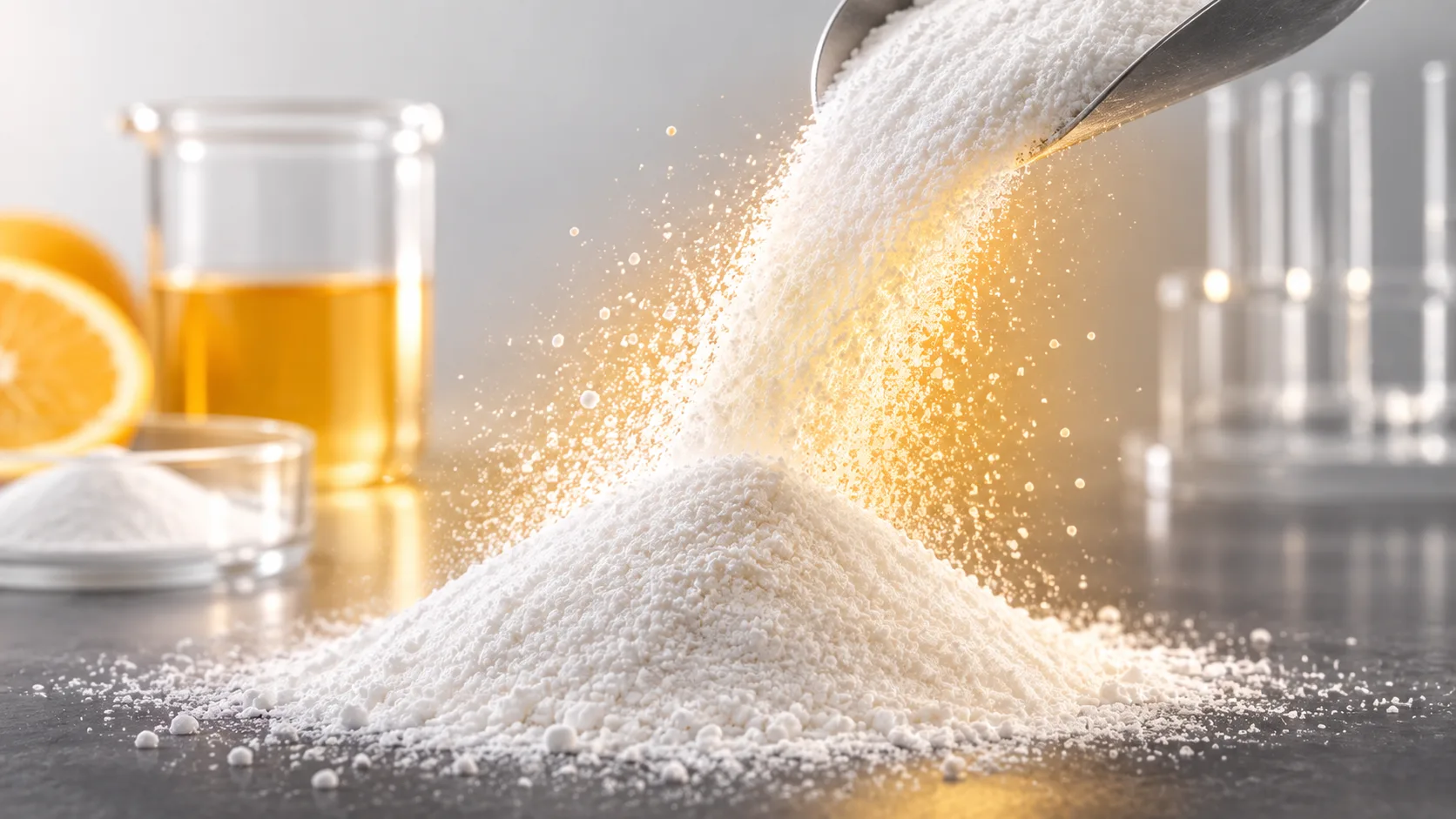
If you’ve ever wondered how a powdered drink mix locks in its citrus punch, or how a probiotic supplement survives months on a shelf without losing its potency, the answer often comes down to one unglamorous ingredient working quietly behind the scenes. That ingredient is maltodextrin, and its job isn’t to sweeten or bulk up a product — it’s to protect what’s inside it.
For food and beverage manufacturers, choosing the right maltodextrin carrier for flavor and probiotics can be the difference between a powder that performs consistently on the production line and one that clumps, degrades, or loses its active compounds before it ever reaches a consumer’s cup. This matters more than ever as demand grows for shelf-stable functional foods, powdered supplements, and flavor systems that need to travel further and last longer without refrigeration.
Formulators are under pressure to hit tighter viability and stability targets while keeping production costs manageable, and the carrier agent sits right at the center of that balancing act. Let’s unpack why this humble ingredient has become a workhorse in encapsulation, and how to choose the right specification for your formulation.
What Makes Maltodextrin a Reliable Carrier Agent
Maltodextrin as a carrier agent earns its place in formulation labs for a simple reason: it does its job without getting in the way. It’s neutral in flavor and aroma, highly soluble in water, and relatively inexpensive compared to specialty gums — three qualities that matter enormously when you’re trying to protect a sensitive compound at industrial scale (Zhang et al., 2018).
Structurally, maltodextrin is a partial hydrolysate of starch, meaning it’s broken down just enough to dissolve easily while still forming a stable matrix when dried. That matrix is what does the actual protective work in a maltodextrin wall material encapsulation system — it forms a coating around a core substance, whether that’s a flavor oil, a vitamin, or a live microorganism, shielding it from heat, oxygen, and moisture.
This is also why maltodextrin shows up so often in spray-dried powders. Its ability to form a low-viscosity solution at high solids content makes it easy to pump and atomize during processing, which keeps production efficient without sacrificing product quality. For manufacturers scaling up flavor or probiotic lines, that processing behavior often matters as much as the ingredient’s protective function.
How Maltodextrin Works in Flavor Encapsulation
When it comes to maltodextrin carrier for flavor encapsulation, the goal is to trap volatile aroma compounds inside a dry, stable shell so they survive processing, packaging, and storage without evaporating or oxidizing. This process, sometimes called maltodextrin flavor fixation, typically happens through spray drying, where a flavor-and-carrier emulsion is atomized into hot air and dried in seconds.
During that rapid drying, the outer surface of each droplet forms a “skin” before the core has fully evaporated, trapping the flavor compound inside a solid matrix. Research on volatile encapsulation has shown that the carrier’s molecular characteristics directly influence how much flavor is retained during this skin-formation stage (Zhang et al., 2018).
The results speak for themselves in application. Powdered beverage mixes, dry seasoning blends, and instant soup bases all rely on this principle to deliver consistent taste months after production. Without an effective carrier, volatile top notes — the citrusy, herbal, or floral compounds that make a flavor recognizable — would simply evaporate before the product reaches a consumer.
Manufacturers producing spray-dried flavor encapsulation ingredients for retail or industrial use rely on this same fundamental mechanism, whether the finished product is a maltodextrin carrier for powdered flavors sold to a flavor house or a proprietary blend used in-house. The principle holds for maltodextrin encapsulation flavor oils too — citrus, mint, and other essential oils behave similarly to synthetic flavor compounds once emulsified into a carrier solution and dried.
A few formulation factors tend to influence flavor retention outcomes:
- The polarity and volatility of the specific flavor compound being encapsulated
- The concentration of maltodextrin relative to the flavor oil
- Inlet and outlet temperatures during spray drying
- The dextrose equivalent (DE) of the maltodextrin used, which we’ll cover shortly
Maltodextrin’s Role in Probiotic Microencapsulation
Flavor isn’t the only sensitive cargo that benefits from a protective carrier. Maltodextrin probiotic encapsulation has become standard practice across the functional food and supplement industry, where the goal shifts from preserving aroma to preserving living cells.
Probiotic strains are fragile. Heat, moisture, and gastric acid can all reduce their viability before they ever reach the gut where they’re meant to work. Encapsulation creates a physical buffer against these stresses, and maltodextrin is frequently chosen as part of that buffer because of its thermoprotective effect during drying, helping preserve cell membrane integrity through the dehydration stresses of spray drying.
One well-documented study on synbiotic legume-based beverages tested maltodextrin, gum acacia, and xanthan gum as carrier agents for encapsulating Lacticaseibacillus casei. The maltodextrin-coated powders achieved the highest overall powder yield of the three carriers tested, making it a practical choice when production efficiency is a priority alongside viability (Chaturvedi & Chakraborty, 2022).
This makes maltodextrin coating for probiotic stability a common baseline choice in maltodextrin in probiotic supplement manufacturing, particularly for teams that need to balance cell survival with production yield and cost. Identifying which carrier — or carrier blend — supports the best probiotic viability during spray drying often takes formulation trials specific to the strain in question, since different bacterial species respond differently to the same drying stresses.
Why Blended Carrier Systems Often Perform Best
In practice, many formulators don’t rely on maltodextrin alone. Pairing it with a prebiotic fiber or a gum can improve both encapsulation efficiency and probiotic survival, since each material contributes a different structural or protective property to the finished matrix (Enciso-Huerta et al., 2022). This is especially relevant for synbiotic products, where a prebiotic and a probiotic are formulated together — a carrier agent for synbiotic powder formulation needs to support both components without compromising either one.
Choosing the Right DE Value for Your Application
Not all maltodextrin is created equal, and the spec that separates one grade from another is its dextrose equivalent, or DE. This number reflects the degree to which starch has been broken down — a lower DE means longer glucose chains and a higher molecular weight, while a higher DE means shorter chains and more sweetness.
For encapsulation purposes, maltodextrin DE for encapsulation typically falls in the 10 to 20 range, a window that balances solubility with film-forming strength (Li et al., 2020). Products with a DE of 20 or higher tend to be sweeter and more hygroscopic, which can be a liability in applications where moisture uptake needs to stay low during storage.
DE 10 vs DE 20 for Encapsulation: What Changes
The practical differences between these two common grades matter more than they might initially seem:
- Lower DE (around 10): Higher molecular weight, higher glass transition temperature, and generally better protection against oxidation and volatile loss — but higher solution viscosity, which can complicate spray drying at high solids concentrations.
- Higher DE (around 20): Lower viscosity and easier processing, with faster solubility, but somewhat reduced barrier protection and greater sensitivity to humidity during storage.
Formulators typically test both ends of this range, and sometimes blends in between, to find the sweet spot for a specific flavor compound or probiotic strain. This is where working with a maltodextrin DE value supplier that can offer multiple grades — rather than a single fixed spec — gives R&D teams more room to optimize.
Maltodextrin vs Other Carrier Agents
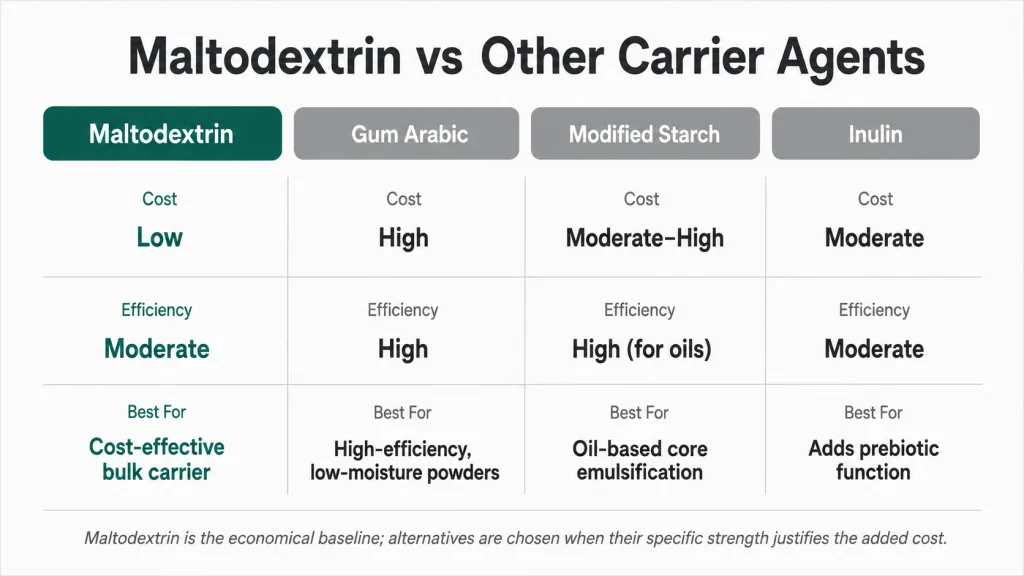
Maltodextrin isn’t the only carrier option on the table, and understanding how it stacks up against alternatives helps clarify when it’s the right choice.
In a maltodextrin vs gum arabic encapsulation comparison, gum arabic often shows better encapsulation efficiency and lower moisture content in finished powders, largely due to its emulsifying properties (Chaturvedi & Chakraborty, 2022). However, gum arabic is considerably more expensive and less consistently available at scale, which is why many manufacturers default to maltodextrin as the economical backbone of a formulation and reserve gum arabic for applications where efficiency justifies the cost.
Maltodextrin vs modified starch carrier decisions often come down to processing behavior — modified starches can offer stronger emulsification for oil-based cores, but at higher viscosity and cost. Meanwhile, a maltodextrin vs inulin encapsulation comparison highlights a different trade-off entirely: inulin brings prebiotic functionality to the finished powder, which can be valuable in synbiotic products, but it typically underperforms maltodextrin on pure processing yield.
In many commercial formulations, the most effective approach isn’t choosing one carrier exclusively but blending two or three to capture complementary strengths — cost-effective bulk from maltodextrin, efficiency from a gum, and functional benefit from a prebiotic fiber.
Rice Maltodextrin: A Clean-Label Advantage
For manufacturers targeting allergen-friendly or clean-label positioning, the starch source behind a maltodextrin matters as much as its DE value. Rice maltodextrin for spray drying offers a hypoallergenic alternative to the corn-derived maltodextrin that dominates much of the global supply, making it a fit for gluten-free, non-GMO, and allergen-conscious product lines.
Beyond the allergen profile, rice-sourced maltodextrin tends to carry a milder taste and a clean dissolution profile, which is particularly useful in flavor-sensitive applications where any background off-note could compete with the encapsulated flavor compound itself. For brands formulating infant nutrition, sports nutrition, or premium functional beverages, this distinction is often a deciding factor in ingredient sourcing.
For manufacturers exporting into Halal-certified or Southeast Asian markets, working with a food-grade maltodextrin supplier Indonesia can also simplify supply chain logistics and documentation, particularly when a single supplier can provide both the carrier agent and complementary functional ingredients under one set of certifications.
This is where Satoria Nutrisentials’ Rice Maltodextrin fits naturally into a formulator’s toolkit — enzymatically processed from rice starch, it offers the functional carrier properties formulators need for flavor and probiotic encapsulation, with the clean-label story that corn maltodextrin can’t always deliver. Pea Maltodextrin, also part of Satoria’s functional carbohydrates range, offers a similar allergen-friendly profile for teams formulating around specific dietary claims.
What to Look for in a Maltodextrin Supplier
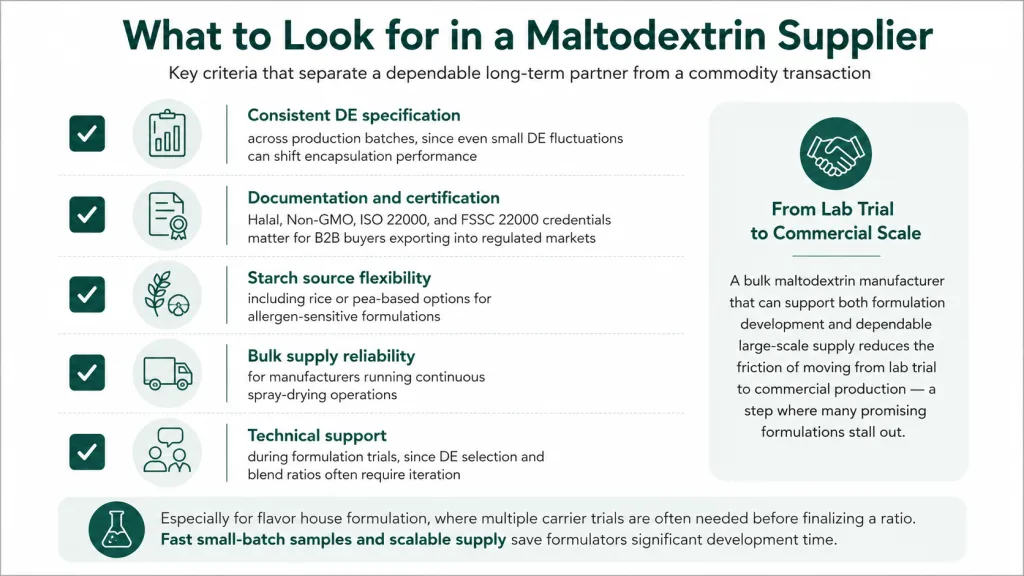
Sourcing decisions for a maltodextrin supplier for encapsulation go well beyond price per kilogram. A few criteria tend to separate a dependable long-term partner from a commodity transaction:
- Consistent DE specification across production batches, since even small DE fluctuations can shift encapsulation performance
- Documentation and certification — Halal, Non-GMO, ISO 22000, and FSSC 22000 credentials matter for B2B buyers exporting into regulated markets
- Starch source flexibility, including rice or pea-based options for allergen-sensitive formulations
- Bulk supply reliability for manufacturers running continuous spray-drying operations
- Technical support during formulation trials, since DE selection and blend ratios often require iteration
A bulk maltodextrin manufacturer that can support both formulation development and dependable large-scale supply reduces the friction of moving from lab trial to commercial production — a step where many promising formulations stall out.
This is particularly true for a maltodextrin for flavor house formulation project, where fragrance and flavor developers often work through multiple carrier trials before landing on a final ratio. A supplier that can turn around small-batch samples quickly, alongside larger production volumes once a formulation is finalized, tends to save formulators significant development time compared to working with a single-scale commodity source.
Partner With Satoria Nutrisentials for Your Next Formulation
Whether you’re developing a flavor system that needs to survive a year on the shelf or a probiotic powder that has to maintain viability through spray drying and beyond, the carrier agent you choose sets the ceiling on what your finished product can achieve. Satoria Nutrisentials supplies Rice Maltodextrin and Pea Maltodextrin engineered for exactly this kind of functional performance, backed by Halal, Non-GMO, and internationally recognized food safety certifications.
Our team works alongside R&D and procurement teams to match DE specifications and starch sources to your specific application, and our OEM and toll manufacturing capabilities mean we can support you from early-stage trials through full commercial-scale production. If you’re ready to explore how the right carrier agent can strengthen your next formulation, download our product catalogue or get in touch with our team to start the conversation.
References
- Ahmadi, F., Suleria, H. A. R., & Dunshea, F. R. (2025). Physicochemical characterization, storage stability behavior, and intestinal bioaccessibility of clove extract encapsulated using varying combinations of gum Arabic and maltodextrin. Foods, 14(2), 237. https://doi.org/10.3390/foods14020237
- Chaturvedi, S., & Chakraborty, S. (2022). Comparative analysis of spray-drying microencapsulation of Lacticaseibacillus casei in synbiotic legume-based beverages. Food Bioscience, 50, 102139. https://doi.org/10.1016/j.fbio.2022.102139
- Enciso-Huerta, H. A., Ruiz-Cabrera, M. A., Lopez-Martinez, L. A., Gonzalez-Garcia, R., Martinez-Gutierrez, F., & Saavedra-Leos, M. Z. (2022). Evaluation of two active system encapsulant matrices with quercetin and Bacillus clausii for functional foods. Polymers, 14(23), 5225. https://doi.org/10.3390/polym14235225
- Li, K., Pan, B., Ma, L., Miao, S., & Ji, J. (2020). Effect of dextrose equivalent on maltodextrin/whey protein spray-dried powder microcapsules and dynamic release of loaded flavor during storage and powder rehydration. Foods, 9(12), 1878. https://doi.org/10.3390/foods9121878
- U.S. Food and Drug Administration. (n.d.). 21 CFR § 184.1444 — Maltodextrin. eCFR. https://www.ecfr.gov/current/title-21/chapter-I/subchapter-B/part-184/subpart-B/section-184.1444
- Vivek, K., Mishra, S., Pradhan, R. C., Nagarajan, M., Kumar, P. K., Singh, S. S., Manvi, D., & Nanje Gowda, N. A. (2023). A comprehensive review on microencapsulation of probiotics: Technology, carriers and current trends. Applied Food Research. https://www.sciencedirect.com/science/article/pii/S2772502222002037
- Zhang, L., Zeng, X., Fu, N., Tang, X., Sun, Y., & Lin, L. (2018). Maltodextrin: A consummate carrier for spray-drying of xylooligosaccharides. Food Research International, 106, 383–393. https://doi.org/10.1016/j.foodres.2018.01.004
Featured News
Category
Get a Promo and Keep Updated