
Rice Protein Isolate for Non-Dairy Sports Recovery RTD Shakes: A Formulator’s Guide
Prenatal and Menopause Nutrition Ingredients: Formulating for Two Very Different Life Stages
August 24, 2026
General - Articles

Pregnancy and menopause sit at opposite ends of a woman’s reproductive life, yet ingredient suppliers often lump both into one generic “women’s health” category. That’s a formulation mistake. A pregnant body is building new tissue and needs gentle, well-tolerated nutrient density. A menopausal body is losing bone mass and shifting metabolically, and needs targeted structural and metabolic support instead. For food and beverage brands serious about either category, or both, the sourcing decisions look genuinely different.
This piece breaks down what current research says about prenatal and menopause nutrition ingredients, and what that means when choosing a functional food ingredients for women’s health partner that can formulate credibly for both stages, without collapsing them into one interchangeable blend. It also lays out, stage by stage, which fiber and protein sources have the tolerability data and clinical backing to justify a place in either formulation.
Why These Two Life Stages Need Separate Formulation Playbooks
It’s tempting for brands entering the women’s health space to build one “female-friendly” formula and stretch it across every life stage. But prenatal and menopause nutrition solve fundamentally different physiological problems. Pregnancy formulation supports rapid fetal and maternal tissue growth without introducing anything that could interact with a delicate system. Menopause formulation slows bone loss, buffers metabolic shifts, and compensates for what declining estrogen no longer protects on its own.
Because the two markets call for different label claims, different ingredient tolerances, and different clinical backing, a B2B nutrition ingredients Indonesia / Asia supplier needs real formulation depth in both categories, rather than one crossover blend repackaged twice. A fiber level that is comfortably tolerated by a postmenopausal digestive system, for instance, is not automatically the right starting dose for a first-trimester consumer, and treating the two as identical risks both efficacy and consumer trust. That is also why demand for functional food ingredients for women’s health has splintered into life-stage-specific sourcing briefs instead of one broad “women’s wellness” ask. Brand teams increasingly want pointed answers on trimester safety, bone-density-relevant clinical data, and OEM women’s health functional food formulation capacity before they commit to a supplier relationship at all.
What the Research Actually Says About Fiber and Protein in Pregnancy
The Fiber Gap Nobody’s Closing
Fiber intake during pregnancy is measurably inadequate almost everywhere researchers have looked. The commonly cited adequate intake target sits around 28 grams a day, yet most pregnant women fall well short of it, and low fiber intake has been associated with higher rates of gestational diabetes, pre-eclampsia risk, and excess gestational weight gain (Pretorius & Palmer, 2021). That gap is not a minor dietary footnote. It is a documented, population-level shortfall with real downstream implications for both mother and baby, which makes fiber fortification one of the more evidence-backed opportunities in prenatal product development today.
Protein Needs That Rise Sharply by Trimester
Protein requirements also climb substantially as pregnancy progresses, particularly through the second and third trimester, when the body accelerates cell division and tissue growth to support the developing fetus and placenta (Institute of Medicine [US] Committee on Nutritional Status During Pregnancy and Lactation, 1990). For a formulator, the message is refreshingly uncomplicated: pregnancy nutrition products succeed by closing a real, well-documented nutrient gap, not by promising something dramatic. A snack, beverage, or powder that reliably delivers meaningful fiber and complete protein in a pregnancy-safe format is solving a problem that already exists in the data, which is a far easier sell to a formulation or regulatory team than a novel claim.
Sourcing Pregnancy-Safe Fiber and Protein Ingredients
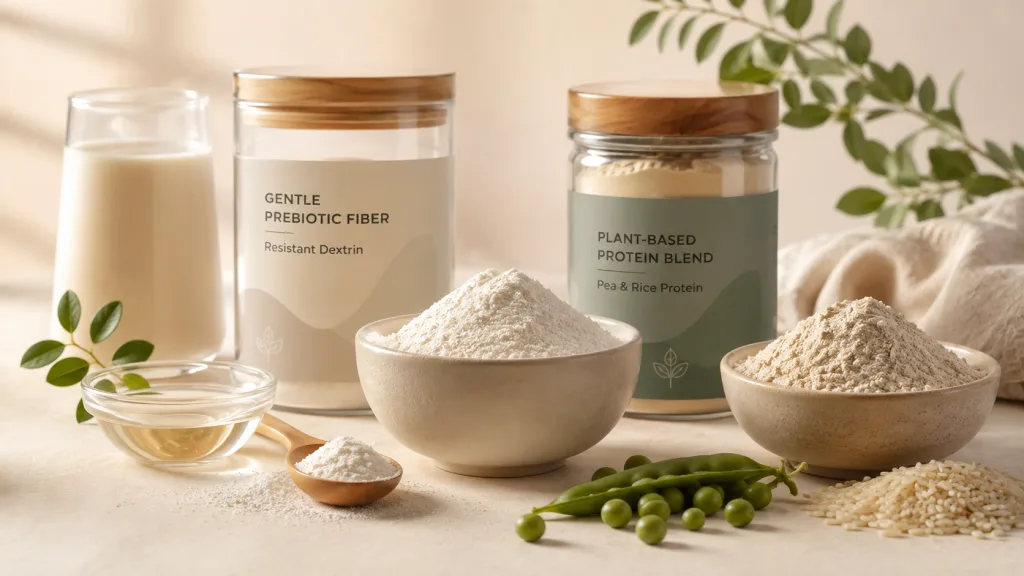
Translating that research gap into an actual product means sourcing fiber and protein that are gentle on a pregnant digestive system, low-glycemic, and backed by a track record of tolerability. This is where resistant dextrin for prenatal fiber fortification earns its place: it is well tolerated in small, incremental doses, does not spike blood sugar, and blends into beverages, bars, or powders without disrupting taste or texture. That is a meaningful advantage over fiber sources that cause bloating or urgency in a body already managing pregnancy-related digestive discomfort.
Protein sourcing calls for similar care. Pea protein isolate for prenatal protein fortification is a practical option because it is plant-based, allergen-friendlier than soy or dairy for some consumers, and pairs well with rice protein to round out its amino acid profile. Pea and rice protein blends can reach a near-complete amino acid score when combined in the right ratio, since each source complements the other’s limiting amino acids (Hertzler et al., 2020). For a brand vetting a resistant dextrin supplier for prenatal supplements, or sourcing a functional fiber ingredient for pregnancy-safe formulation more broadly, tolerability data and dosing flexibility matter just as much as the nutrition panel itself.
Menopause Is a Metabolic and Skeletal Shift, Not Just Hot Flashes
Menopause formulation conversations tend to start and end with hot flashes, but the more consequential changes happening are structural and metabolic. As estrogen declines, women lose bone density at an accelerated rate, and postmenopausal osteoporosis has become the most common bone disorder in the developed world (Alabadi et al., 2024). Menopause also triggers a genuine metabolic shift: fat storage redistributes toward the abdomen, and both subcutaneous and visceral adipose tissue develop changes tied to reduced insulin sensitivity (Abildgaard et al., 2021).
That combination, declining bone density alongside a less favorable metabolic environment, is a far bigger formulation opportunity than symptom relief alone, and it remains underserved relative to how crowded the vasomotor-symptom segment already is. Brands that formulate specifically for bone and metabolic outcomes, rather than chasing the same hot-flash claim as everyone else, are addressing the changes most likely to affect a woman’s long-term health. A functional beverage women’s midlife nutrition product built around bone and metabolic support has more room to differentiate and more consistent evidence to stand on. It also maps more directly onto ingredients a food-grade manufacturer can actually formulate with, namely fiber, protein, and minerals, rather than botanical extracts that sit closer to supplement territory than food science.
Formulating for Bone and Metabolic Health After Menopause
The Calcium-Fiber-Protein Triangle
Calcium remains the best-studied nutrient for postmenopausal bone health, but it does not work in isolation; protein and fiber both play supporting roles worth building into a formulation. Adequate protein intake helps preserve the muscle mass that protects metabolic health as insulin sensitivity declines, which is exactly where rice protein isolate for menopause functional foods becomes a useful formulation tool alongside calcium and vitamin D.
Fiber’s role is less obvious but increasingly well documented. Prebiotic fiber supports the gut microbiome in ways that appear connected to calcium absorption and bone metabolism, and one randomized trial found measurable shifts in calcium status and bone turnover markers after twelve weeks of daily probiotic supplementation in postmenopausal women (Harahap et al., 2024). That gut-hormone axis fiber ingredient connection is exactly why Fiberfit prebiotic fiber for menopause gut health belongs in a bone-support formulation conversation, not just a digestive-health one.
What the Isoflavone Evidence Really Shows
Soy isoflavones and other phytoestrogens functional food ingredients get significant attention in menopause formulation, largely because of their estrogen-like structure. But the evidence is genuinely mixed. A well-designed two-year randomized trial of 200 milligrams of daily soy isoflavones found no significant difference in bone mineral density between the isoflavone and placebo groups, and it noted a higher rate of hot flashes and constipation in the isoflavone group (Levis et al., 2011). That does not rule soy isoflavones functional beverage applications out entirely, but it is a good reason not to lean on a single “hero” compound. A calcium magnesium fortification bone health approach, layered with fiber and complete protein, rests on considerably more consistent evidence than isoflavones do on their own.
Konjac and Functional Fiber Across Both Life Stages
Some ingredients earn their place in both categories rather than just one. Konjac ingredients for women’s health formulation are a good example: konjac’s glucomannan fiber adds viscosity and satiety support useful in pregnancy-safe snacking formats, while its gut-motility benefits and low-glycemic profile carry over directly into menopause-focused digestive and metabolic products.
The practical advantage for brands is sourcing simplicity. A soluble fiber ingredient bone health formulation for a menopause SKU and a fiber-fortified prenatal snack can often draw from the same konjac or resistant dextrin supply chain, reducing the number of separate ingredient relationships a brand has to manage. For manufacturers building a plant protein ingredient hormonal health products portfolio across multiple life stages, that kind of cross-category ingredient efficiency is often the difference between a formulation that ships on schedule and one that gets stuck waiting on a niche supplier for a single SKU.
What to Look for in a Prenatal and Menopause Ingredient Manufacturer
Sourcing for either life stage, let alone both, comes with a higher bar than a typical functional food ingredient decision, given how closely pregnancy and midlife health claims get scrutinized by regulators, retailers, and increasingly skeptical consumers alike. Brands evaluating a prenatal nutrition ingredients supplier or a menopause nutrition ingredients manufacturer should look for a partner that offers:
- Halal certification, particularly for a halal certified prenatal ingredient supplier Indonesia serving Southeast Asian and Middle Eastern markets where this is a baseline requirement, not a differentiator.
- Non-GMO sourcing and full documentation, especially for non-GMO functional ingredients women’s health OEM programs where retailers increasingly require complete traceability back to raw material.
- OEM and toll manufacturing capacity, so a brand can move from formulation to production without switching partners mid-project. Toll manufacturing women’s health functional food Indonesia capacity in particular shortens that runway considerably.
- Clean label formulation support for a clean label fiber ingredient menopause food and beverage launch, where consumers increasingly scrutinize every line of the ingredient panel before buying.
- Documented tolerability and dosing data specific to pregnancy or menopause populations, not just general adult safety data that does not account for either life stage’s particular sensitivities.
A supplier that can check all of these boxes for both life stages, rather than specializing narrowly in one, gives a brand room to expand its women’s health line later without re-vetting an entirely new ingredient partner every time it adds a new life-stage product. That kind of continuity also tends to shorten development timelines, since a supplier already familiar with a brand’s formulation standards can move a second or third SKU through R&D faster than a brand-new relationship would allow.
Talk to Satoria Nutrisentials About Your Next Women’s Health Formulation
Satoria Nutrisentials formulates fiber, protein, and functional ingredient solutions built around the physiology of specific life stages, not generic “women’s wellness” claims. Whether you are developing a fiber-fortified prenatal beverage, a bone-support snack for menopausal consumers, or a broader women’s health line spanning both, our technical team can walk through dosing, tolerability, and label-claim considerations before you commit to a formulation direction.
If you are evaluating ingredients for an upcoming prenatal or menopause launch, reach out to discuss sample requests, technical data sheets, and OEM production timelines. Halal-certified, non-GMO, and backed by ISO 22000 and FSSC 22000 manufacturing standards, Satoria’s ingredient portfolio is built to support formulation decisions your quality and regulatory teams can stand behind with confidence.
References
- Abildgaard, J., Ploug, T., Al-Saoudi, E., Wagner, T., Thomsen, C., Ewertsen, C., Bzorek, M., Pedersen, B. K., Pedersen, A. T., & Lindegaard, B. (2021). Changes in abdominal subcutaneous adipose tissue phenotype following menopause is associated with increased visceral fat mass. Scientific Reports, 11(1), 14750. https://doi.org/10.1038/s41598-021-94189-2
- Alabadi, B., Civera, M., Moreno-Errasquin, B., & Cruz-Jentoft, A. J. (2024). Nutrition-based support for osteoporosis in postmenopausal women: A review of recent evidence. International Journal of Women’s Health, 16, 693–705. https://doi.org/10.2147/IJWH.S409897
- Harahap, I. A., Moszak, M., Czlapka-Matyasik, M., Skrypnik, K., Bogdański, P., & Suliburska, J. (2024). Effects of daily probiotic supplementation with Lactobacillus acidophilus on calcium status, bone metabolism biomarkers, and bone mineral density in postmenopausal women: A controlled and randomized clinical study. Frontiers in Nutrition, 11, 1401920. https://doi.org/10.3389/fnut.2024.1401920
- Hertzler, S. R., Lieblein-Boff, J. C., Weiler, M., & Allgeier, C. (2020). Plant proteins: Assessing their nutritional quality and effects on health and physical function. Nutrients, 12(12), 3704. https://doi.org/10.3390/nu12123704
- Institute of Medicine (US) Committee on Nutritional Status During Pregnancy and Lactation. (1990). Nutrition during pregnancy. National Academies Press. https://www.ncbi.nlm.nih.gov/books/NBK235217/
- Levis, S., Strickman-Stein, N., Ganjei-Azar, P., Xu, P., Doerge, D. R., & Krischer, J. (2011). Soy isoflavones in the prevention of menopausal bone loss and menopausal symptoms: A randomized, double-blind trial. Archives of Internal Medicine, 171(15), 1363–1369. https://doi.org/10.1001/archinternmed.2011.330
- Pretorius, R. A., & Palmer, D. J. (2021). High-fiber diet during pregnancy characterized by more fruit and vegetable consumption. Nutrients, 13(1), 35. https://doi.org/10.3390/nu13010035
Featured News
Category
Get a Promo and Keep Updated