
Rice Protein Isolate for Non-Dairy Sports Recovery RTD Shakes: A Formulator’s Guide
Dietary Fiber Health Claim Regulation: A Formulator’s Guide to FDA, EFSA, and Global Compliance
August 26, 2026
General - Articles
If you’ve ever tried to figure out whether “supports digestive health” is a legal statement or a lawsuit waiting to happen, you already know that dietary fiber health claim regulation is anything but simple. Between the FDA, EFSA, Codex Alimentarius, and country-specific systems like Japan’s FOSHU, what counts as fiber — and what you’re allowed to say about it — depends entirely on which market a product ships to.
Why Fiber Health Claims Face Such Heavy Scrutiny
Fiber sits at an unusual intersection in food regulation. It’s one of the most well-documented nutrients for human health, yet also one of the most contested when it comes to labeling. Regulators want claims tied to specific, measurable physiological outcomes — not vague wellness language — so a phrase like “good for digestion” can trigger very different rules depending on where the product ships.
Part of the complexity comes from fiber itself. Unlike a vitamin with one clear chemical structure, “dietary fiber” is a category covering dozens of soluble and insoluble carbohydrates, each with its own digestion profile and evidence base. A resistant dextrin behaves differently in the gut than a beta-glucan or a psyllium husk, so agencies evaluate them separately rather than approving “fiber” as one blanket ingredient.
For B2B ingredient buyers — formulators, R&D teams, procurement — this matters long before a product reaches a shelf. The claim a brand wants to make upstream determines which fiber source is fit for purpose, what dosage is required, and what documentation needs to travel with the ingredient. Getting this wrong late in development is expensive; getting it right starts with understanding the regulatory frameworks themselves.
It also affects timelines. A claim built around an authorized health claim or a FOSHU submission can add months to a launch schedule, while a structure/function or nutrient content claim moves much faster. Knowing which category a target claim falls into — before formulation locks — lets a brand plan realistically instead of discovering the compliance gap during label review.
How the FDA Regulates Dietary Fiber Health Claims
In the United States, dietary fiber health claims FDA oversight runs through several layers of Title 21 of the Code of Federal Regulations, each carrying its own evidentiary bar and its own risk if used incorrectly.
Authorized Health Claims Under 21 CFR 101.76 and 101.81
FDA authorized health claims dietary fiber fall under 21 CFR 101.76 fiber (fiber-containing grain products, fruits, and vegetables and cancer risk) and 21 CFR 101.81 soluble fiber (soluble fiber from certain foods and coronary heart disease). These sit in the strongest claim category, requiring “significant scientific agreement” among qualified experts. The soluble fiber health claim FDA pathway under 101.81 currently recognizes sources such as beta-glucan soluble fiber from oats and barley and psyllium husk, each tied to a minimum daily intake threshold linked to demonstrated cholesterol-lowering effects.
Qualified Health Claims and the 2026 Fiber Labeling Landscape
Below authorized claims sit qualified health claims dietary fiber, which allow a softer “some evidence suggests” framing when significant scientific agreement hasn’t been reached. Layered on top of both is FDA’s separate, highly consequential decision about what even counts as “dietary fiber” for nutrition labeling. Since a 2016 rulemaking and a 2018 industry guidance, FDA fiber labeling regulations recognize isolated or synthetic non-digestible carbohydrates only once the agency determines they carry a “physiological effect that is beneficial to human health” — a separate scientific bar from the health claims themselves.

How the EU and EFSA Regulate Fiber Claims
In the European Union, EFSA dietary fiber health claims operate under the EU Nutrition and Health Claims Regulation fiber framework — formally Regulation (EC) No 1924/2006. Every claim, whether on a label, a spec sheet, or a company website, must appear on the EU Register of authorised claims before it can be used commercially.
Content claims come first: a product can be labeled a “source of fiber” if it contains at least 3 g of fiber per 100 g (or 1.5 g per 100 kcal), while “high in fiber” requires at least 6 g per 100 g (or 3 g per 100 kcal). This EFSA “source of fiber” vs “high in fiber” claim distinction is one of the most common fiber nutrient content claim requirements formulators run into during EU dossier prep, and it applies before any health claim can even be considered.
Health claims themselves are stricter still. EFSA’s 2010 scientific opinion found insufficient evidence to authorize a general claim for “dietary fiber” as a category, but it has separately authorized specific claims for individual fibers — barley grain fiber and oat fiber contributing to increased faecal bulk, and beta-glucans supporting normal blood cholesterol levels, among others.
This is a useful pattern to remember: the EU doesn’t reward broad, feel-good fiber language. It rewards specificity. A claim tied to a named fiber source, a defined intake level, and a registered health relationship will clear review; a generic “fiber is good for you” statement, however true, simply isn’t a claim EFSA has authorized for use.
Codex Alimentarius: The Global Baseline for Defining Fiber
Codex Alimentarius dietary fiber definition work, set out in the Codex Guidelines on Nutrition Labelling (CAC/GL 2-1985, revised over subsequent sessions), underpins how many national regulators — including the EU — define fiber for labeling purposes. Codex defines dietary fiber as carbohydrate polymers with ten or more monomeric units that resist digestion in the small intestine, while leaving the decision on shorter-chain carbohydrates (three to nine units) to individual national authorities.
That flexibility explains why FDA, EFSA, and other agencies don’t always agree on which specific ingredients qualify. A fiber source approved in one market may need additional data — or simply won’t qualify — in another, which is precisely why market-entry planning for fiber-forward products should start with the applicable regulatory definition, not just the intended health claim.
This is also why Codex functions less like a single rulebook and more like a shared reference point. Countries building or updating their own food labeling systems tend to anchor their definitions to it, then layer on national health-claim requirements. For a supplier or brand shipping into multiple regions at once, that shared foundation is genuinely helpful — it means the underlying fiber definition rarely needs to be re-argued from scratch in each new market, even when the claim process itself differs.
Japan’s FOSHU System and Fiber Claims Across Asia-Pacific
Japan takes a fundamentally different approach. Rather than one overarching claims regulation, Japan’s Ministry of Health, Labour and Welfare oversees Foods for Specified Health Uses (FOSHU) — a pre-market approval system dating to 1991 that requires clinical evidence and government review before a product can carry a specific health statement.
A FOSHU fiber health claim Japan approval typically covers gut-related functions: indigestible dextrin, polydextrose, guar gum, and psyllium seed coat are among the principal fiber ingredients recognized for foods that modify gastrointestinal conditions. Since 2015, a lighter-touch alternative — Foods with Function Claims — has also let companies self-notify claims backed by scientific evidence without full FOSHU pre-approval, giving formulators targeting the Japanese market two distinct compliance paths depending on timeline and risk tolerance.
Not All Fibers Are Equal: Ingredient-Specific Claim Considerations
Because regulators evaluate fiber sources individually, the practical question for most B2B buyers isn’t “is fiber good for you” — it’s “does this specific ingredient qualify for the claim I want to make.” A resistant dextrin health claim, for example, depends on whether the ingredient meets FDA’s added-fiber criteria; resistant maltodextrin/dextrin was one of eight non-digestible carbohydrates FDA recognized as meeting its dietary fiber definition through 2018 guidance, following citizen petitions built on postprandial blood glucose and triglyceride response data. Is resistant dextrin considered dietary fiber by FDA? Yes — but only when it’s sourced and documented to match the recognized ingredient profile.
Other ingredients follow the same pattern. A beta-glucan soluble fiber heart disease claim requires meeting the specific intake thresholds in 21 CFR 101.81, and a psyllium husk FDA health claim carries its own separate minimum soluble fiber requirement. Meanwhile, prebiotic fiber claim regulation is still evolving — most prebiotic and gut-microbiome statements fall under structure/function or qualified claims rather than authorized ones — and a fiber and blood glucose health claim or fiber and cholesterol reduction claim each demands its own body of clinical substantiation. The takeaway for formulators: choose the ingredient based on the claim you need, not the other way around.
This ingredient-by-ingredient reality also shapes formulation categories that don’t look like obvious “fiber products” on the surface — fortified cereals, high-protein dairy, prebiotic beverages, and meal replacements among them. In each case, the fiber source has to satisfy both the technical formulation requirements (solubility, viscosity, heat stability) and the regulatory requirements for whatever claim sits on the front of pack, which is why claim strategy and ingredient selection really have to happen in the same conversation, not sequentially.
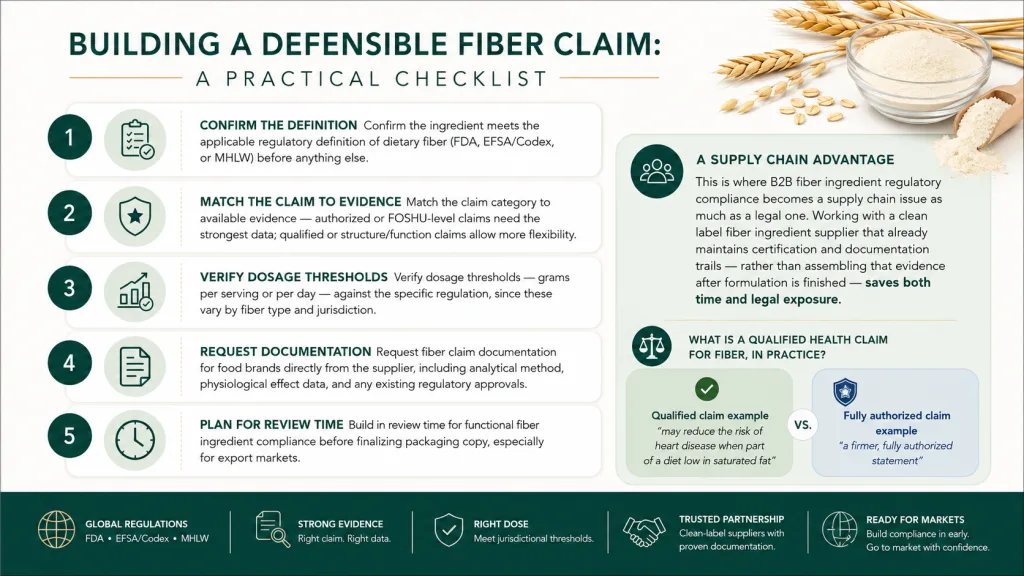
Building a Defensible Fiber Claim: A Practical Checklist
For B2B teams navigating fiber labeling requirements for food manufacturers, the process of learning how to substantiate a fiber health claim generally follows the same sequence regardless of market:
- Confirm the ingredient meets the applicable regulatory definition of dietary fiber (FDA, EFSA/Codex, or MHLW) before anything else.
- Match the claim category to available evidence — authorized or FOSHU-level claims need the strongest data; qualified or structure/function claims allow more flexibility.
- Verify dosage thresholds — grams per serving or per day — against the specific regulation, since these vary by fiber type and jurisdiction.
- Request fiber claim documentation for food brands directly from the supplier, including analytical method, physiological effect data, and any existing regulatory approvals.
- Build in review time for functional fiber ingredient compliance before finalizing packaging copy, especially for export markets.
This is where B2B fiber ingredient regulatory compliance becomes a supply chain issue as much as a legal one. Working with a clean label fiber ingredient supplier that already maintains certification and documentation trails — rather than assembling that evidence after formulation is finished — saves both time and legal exposure. What is a qualified health claim for fiber, in practice? It’s the difference between “may reduce the risk of heart disease when part of a diet low in saturated fat” and a firmer, fully authorized statement — a nuance worth confirming with regulatory counsel before publication either way.
Formulate With Fiber Ingredients Built for Global Compliance
Navigating dietary fiber health claim regulation is easier when the ingredient itself already carries a documented compliance profile. Satoria Nutrisentials’ functional ingredient range — including Fiberfit® Resistant Dextrin, alongside plant-based proteins, functional carbohydrates, and natural sweeteners — is produced under FSSC 22000, HACCP, ISO, Halal, Kosher, BPOM, and FDA-recognized certifications, giving formulators a documented starting point rather than a blank page.
Whether the goal is a US authorized claim, an EU-registered health claim, or a FOSHU-style submission for the Japanese market, explore Satoria’s product range to find the fiber source that fits both the formulation and the labeling strategy, or reach out to the team directly to discuss documentation support for an upcoming launch.
References
- U.S. Food and Drug Administration. (n.d.). 21 CFR 101.81 – Health claims: Soluble fiber from certain foods and risk of coronary heart disease. eCFR. https://www.ecfr.gov/current/title-21/chapter-I/subchapter-B/part-101/subpart-E/section-101.81
- U.S. Food and Drug Administration. (2024). Questions and answers on dietary fiber. https://www.fda.gov/food/nutrition-food-labeling-and-critical-foods/questions-and-answers-dietary-fiber
- U.S. Food and Drug Administration. (2018). The declaration of certain isolated or synthetic non-digestible carbohydrates as dietary fiber on Nutrition and Supplement Facts Labels; Guidance for industry. Federal Register. https://www.federalregister.gov/documents/2018/06/15/2018-12867/the-declaration-of-certain-isolated-or-synthetic-non-digestible-carbohydrates-as-dietary-fiber-on
- European Food Safety Authority. (2010). Scientific opinion on the substantiation of health claims related to dietary fibre. EFSA Journal, 8(3), 1735. https://efsa.europa.eu/en/efsajournal/pub/1735
- European Commission. (n.d.). Nutrition and health claims. Food Safety. https://food.ec.europa.eu/food-safety/labelling-and-nutrition/nutrition-and-health-claims_en
- Food and Agriculture Organization of the United Nations, & World Health Organization. (2015). Guidelines on nutrition labelling (CAC/GL 2-1985, Rev. 1-1993, amended). Codex Alimentarius Commission. https://www.fao.org/input/download/standards/34/CXG_002e_2015.pdf
- Ministry of Health, Labour and Welfare (Japan). (n.d.). Food with health claims, food for special dietary uses, and nutrition labeling. https://www.mhlw.go.jp/english/topics/foodsafety/fhc/02.html
- Health claims on functional foods: The Japanese regulations and an international comparison. (2003). PubMed. https://pubmed.ncbi.nlm.nih.gov/19087392/
Featured News
Category
Get a Promo and Keep Updated