
Rice Protein Isolate for Non-Dairy Sports Recovery RTD Shakes: A Formulator’s Guide
Rice Protein Isolate for Non-Dairy Sports Recovery RTD Shakes: A Formulator’s Guide
October 16, 2026
Protein & Nutritional Enhancers - Articles
Walk down any sports nutrition aisle and you’ll notice the ready-to-drink shelf is getting greener. Plant-based recovery shakes have moved from niche health stores into gym fridges, convenience chillers and online subscriptions. For brands, the question is no longer whether to launch a dairy-free option, but how to make one people genuinely want to drink after a hard session.
That’s where rice protein isolate for non-dairy sports recovery RTD shakes earns its place. It is hypoallergenic, clean-label friendly and backed by human training studies. It also brings real formulation headaches, from sedimentation to earthy flavor notes. This guide walks through the science, the processing challenges and the sourcing decisions behind a rice protein isolate RTD that performs in the bottle and in the body.
Why the Plant-Based RTD Protein Market Is Turning to Rice
Demand for dairy-free protein is no longer driven by vegans alone, and the plant-based RTD protein market reflects that broader audience. Lactose intolerance, dairy allergy, digestive comfort and sustainability all push shoppers toward plant options. Many of them are active people looking for a post-workout vegan protein shake they can simply grab and go, which explains much of the vegan RTD protein market growth brands have been chasing.
Among the sports nutrition beverage trends shaping 2026, a few stand out for formulators:
- Clean label protein shake ingredients with short, recognizable ingredient lists
- Allergen-free protein ingredient choices that avoid dairy, soy and gluten
- Multi-source plant protein RTD formats that improve amino acid balance
- Halal, kosher and non-GMO credentials that keep export doors open
Rice fits neatly into all four. As a hypoallergenic protein for beverages, it sidesteps the allergen labeling issues that come with soy or dairy. It also pairs well with other plant proteins, which matters because the most competitive plant-based sports nutrition ingredients are rarely used alone. For the wider commercial picture, Satoria’s overview of the rice protein market makes a useful companion read.
Can Rice Protein Really Support Muscle Recovery?
This is the first question every R&D lead asks, and it’s a fair one. Whey has decades of research behind it, and athletes are understandably loyal to what they know works. So, is rice protein good for muscle recovery? Current human trials say yes, provided the dose and amino acid profile are right.
Rice Protein vs Whey for Muscle Protein Synthesis
In an eight-week trial with resistance-trained men, participants took 48 g of either rice protein isolate or whey protein isolate after each workout. Both groups gained lean mass, strength and power, with no significant differences between them, including in perceived recovery and soreness (Joy et al., 2013).
A later study tested a more realistic 24 g daily dose of rice or whey protein concentrate over eight weeks. Changes in body composition and performance were again similar between groups (Moon et al., 2020). For RTD developers, that matters because it reflects the serving sizes consumers actually buy.
Rice Protein Leucine Content and BCAAs
Leucine is a key trigger for muscle protein synthesis. The International Society of Sports Nutrition suggests each dose provide roughly 700–3,000 mg of leucine within 20–40 g of protein (Jäger et al., 2017). Independent analyses place rice protein leucine content at around 7–8.5% of total protein (Gorissen et al., 2018; Moon et al., 2020).
Gorissen and colleagues estimated that about 37 g of brown rice protein supplies the 2.7 g of leucine found in 25 g of whey. The practical takeaway? A slightly larger serving, a smart blend, or both, closes most of the gap, while the BCAA in rice protein still pull their weight.
The Pea and Rice Protein Blend Advantage
Every plant protein has a limiting amino acid. Rice is relatively low in lysine but rich in methionine, while pea is the reverse. Gorissen et al. (2018) measured 2.4% lysine and 2.5% methionine in brown rice protein, compared with 5.9% lysine and just 0.4% methionine in pea protein.
Combine the two and you get a far more complete plant protein amino acid profile. It’s the classic case of complementary plant proteins, with lysine and methionine gaps filled by each partner. The same study showed that a 50/50 blend needs much less total protein to meet essential amino acid requirements than either source on its own.
Protein quality scores tell the same story. Rice pea protein PDCAAS and DIAAS values are generally higher for a well-designed blend than for either protein alone. DIAAS is now the FAO’s recommended method for rating protein quality, because it measures amino acid digestibility at the end of the small intestine (FAO, 2013).
Pea protein has also matched whey for muscle thickness gains in a 12-week training study (Babault et al., 2015). That makes a pea and rice protein blend a strong base for any multi-source plant protein RTD, which is why Satoria’s Pea Protein Isolate and Rice Protein Isolate are so often specified together.
Getting Solubility and Stability Right
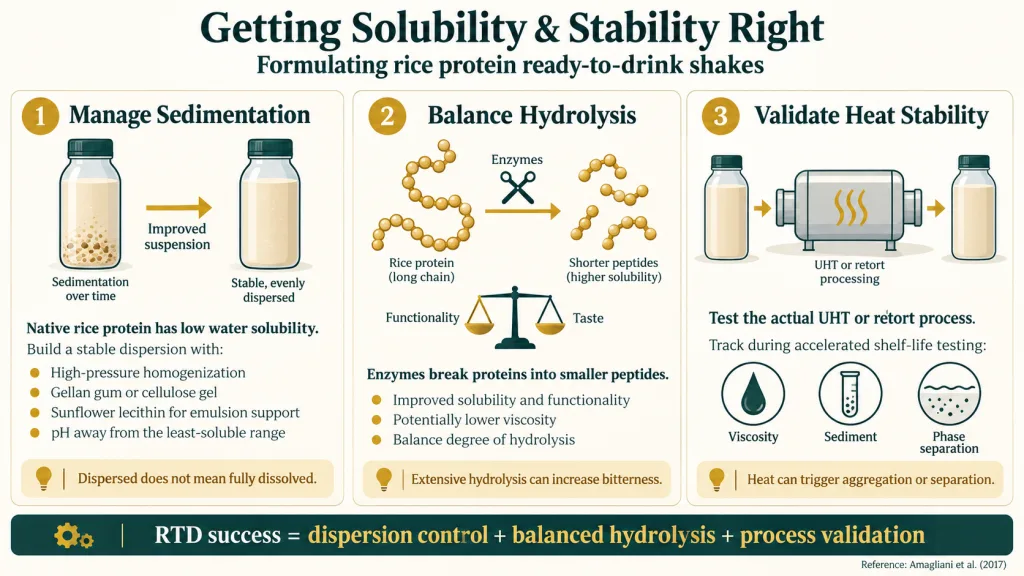
Here’s the honest truth: a rice protein ready-to-drink shake is harder to make than a powder. Native rice proteins are dominated by glutelins, which have poor water solubility (Amagliani et al., 2017). In a bottle, that shows up as chalkiness, sediment and a texture consumers notice immediately.
Managing Rice Protein Sedimentation in RTD Formats
So, does rice protein dissolve in water? Not fully, at least in its native form. Rice protein solubility in beverages depends heavily on particle size, pH and processing, and rice protein sedimentation in RTD shakes is usually controlled with several tools working together:
- High-pressure homogenization to shrink particle size and stabilize the dispersion
- Hydrocolloids such as gellan gum or cellulose gel to keep particles suspended
- Emulsifiers like sunflower lecithin to support emulsion stability in plant protein drinks
- Formulating away from rice protein’s least-soluble, mildly acidic pH range
Hydrolyzed vs Native Rice Protein for Drinks
Enzymatic hydrolysis breaks proteins into smaller peptides, and hydrolyzed rice protein shows clearly better functionality than intact protein (Amagliani et al., 2017). Lower viscosity and better suspension make it the usual RTD choice, though heavy hydrolysis can add bitterness, so the degree of hydrolysis needs balancing.
Rice Protein Heat Stability in UHT and Retort
Heat can push poorly stabilized proteins to aggregate, thicken or separate. Run pilot batches through your real UHT or retort profile, then track viscosity, sediment and phase separation through accelerated shelf-life testing. A shelf-stable plant protein beverage formulation succeeds or fails on those results, so build that testing into your timeline from day one.
Taste and Texture: Making Recovery Something to Look Forward To
Even a perfectly stable shake will fail if it tastes like wet cardboard. Improving rice protein texture is largely about reducing grittiness at the particle level. Finely milled isolates combined with homogenization give a noticeably smoother mouthfeel, and a small amount of fat helps coat the palate.
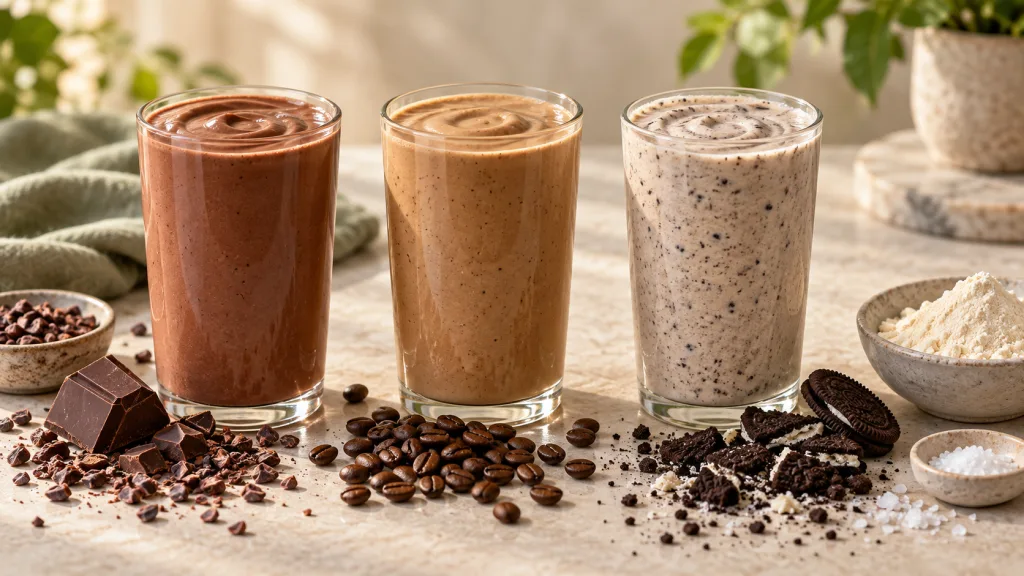
Masking earthy off-flavor in rice protein calls for a layered approach. Its mild cereal and earthy notes are barely noticeable in chocolate, yet they stand out quickly in vanilla or unflavored bases. Strategies that consistently help include:
- Leaning on robust flavor systems such as chocolate, coffee, mocha or cookies-and-cream
- Using a touch of salt and balanced sweetness to round off bitter edges
- Building in natural masking flavors early, rather than as a late fix
Sweetness deserves attention too. Many recovery shakes are moving away from added sugar as consumers read labels more closely. A sugar alternative such as SweetSentials can help brands manage calories without losing the indulgent taste that brings customers back for a second bottle. After all, the best recovery shake is the one athletes actually finish.
Building a Complete Dairy-Free Recovery Formula
Recovery isn’t about protein alone. After endurance or high-volume sessions, carbohydrate helps restore muscle glycogen. The ISSN also notes that adding protein during or after intense endurance exercise may reduce muscle damage markers and feelings of soreness (Jäger et al., 2017). A good dairy-free protein drink formulation reflects both needs, rather than treating protein as the whole story.
A typical high protein RTD vegan recovery framework might include:
- A pea and rice protein blend delivering 20–30 g of protein per serving
- A clean-label carbohydrate such as Rice Maltodextrin for glycogen replenishment
- A natural sweetener or Rice Syrup for flavor and extra energy
- Electrolytes such as sodium and potassium for rehydration
- Stabilizers, emulsifiers and flavors tuned to your process
Because every component on that list is dairy-free, the finished product also works as a lactose-free sports drink and a soy-free dairy-free protein option, reaching consumers with multiple sensitivities. Satoria’s guide to high protein meal replacement formulation covers related decisions if your range extends beyond recovery.
What to Look for in a Rice Protein Isolate Supplier
Not every rice protein behaves the same way in a bottle, and two isolates with identical protein content can perform very differently in a shake. When assessing a rice protein isolate supplier or manufacturer, request a full technical data sheet and samples for bench trials, then compare:
- Protein content, with brown rice protein isolate 80% grades the norm and 90% grades offered by some producers
- Processing method, including native versus hydrolyzed rice protein
- Particle size, dispersibility and viscosity in your target matrix
- Non-GMO rice protein isolate status, plus halal rice protein and kosher rice protein certification
- Contaminant testing, including heavy metals, which buyers of rice ingredients routinely check
- Reliable bulk rice protein powder wholesale capacity and consistent lot-to-lot quality
As one example, Satoria Nutrisentials produces its Rice Protein Isolate from brown rice through enzymatic extraction, with protein content exceeding 80%. Its plants operate under FSSC 22000, HACCP and ISO standards, and its certifications include halal, kosher and non-GMO, which simplifies documentation for brands selling across multiple markets.
Frequently Asked Questions
Is rice protein good for muscle recovery?
Yes. Two eight-week trials found rice protein produced gains in lean mass and strength similar to whey when doses were matched (Joy et al., 2013; Moon et al., 2020).
Does rice protein dissolve in water?
Native rice protein disperses rather than fully dissolving. Hydrolyzed grades, fine particle size, stabilizers and homogenization greatly improve how it behaves in a ready-to-drink shake.
How much leucine is in rice protein isolate?
Typically 7–8.5 g per 100 g of protein, so a 30 g serving supplies roughly 2.1–2.6 g, well within the ISSN’s recommended range per dose.
Can rice protein be used in UHT beverages?
Yes, with the right grade and stabilizer system. Hydrolyzed protein, homogenization and hydrocolloids help prevent aggregation and sediment after UHT or retort processing.
Rice protein vs pea protein for drinks: which is better?
Each has strengths. Pea offers more lysine, while rice brings methionine and a gentle allergen profile. For most recovery shakes, a blend beats either alone. Satoria’s guide to pea or rice protein powder explores the comparison in more depth.
Unleash the Potential of Your Next Plant-Based Recovery Shake
Creating a rice protein isolate RTD that tastes great, stays stable on the shelf and genuinely supports recovery comes down to two things: the right ingredients and the right development partner. Get both right and a dairy-free shake stops being a compromise and becomes a genuine reason for health-conscious customers to switch from whey.
Satoria Nutrisentials has helped hundreds of F&B businesses with innovative, healthy food ingredients tailored to their needs. Its team of food scientists can support your bench trials, from choosing a protein blend to pairing it with the right carbohydrate and sweetener. And your formula stays confidential from first sample to final batch.
Ready to start? Explore Satoria’s Rice Protein Isolate and Pea Protein Isolate, or contact the team to request samples, a product catalogue and technical data for your next RTD project. Your next best-selling recovery shake could begin with a single conversation.
References
- Amagliani, L., O’Regan, J., Kelly, A. L., & O’Mahony, J. A. (2017). The composition, extraction, functionality and applications of rice proteins: A review. Trends in Food Science & Technology, 64, 1–12. https://research.ucc.ie/en/publications/the-composition-extraction-functionality-and-applications-of-rice/
- Babault, N., Païzis, C., Deley, G., Guérin-Deremaux, L., Saniez, M.-H., Lefranc-Millot, C., & Allaert, F. A. (2015). Pea proteins oral supplementation promotes muscle thickness gains during resistance training: A double-blind, randomized, placebo-controlled clinical trial vs. whey protein. Journal of the International Society of Sports Nutrition, 12, 3. https://doi.org/10.1186/s12970-014-0064-5
- Food and Agriculture Organization of the United Nations. (2013). Dietary protein quality evaluation in human nutrition: Report of an FAO expert consultation (FAO Food and Nutrition Paper No. 92). https://openknowledge.fao.org/items/c1db9994-e6f7-4e6d-8fbf-f3d528f3f216
- Gorissen, S. H. M., Crombag, J. J. R., Senden, J. M. G., Waterval, W. A. H., Bierau, J., Verdijk, L. B., & van Loon, L. J. C. (2018). Protein content and amino acid composition of commercially available plant-based protein isolates. Amino Acids, 50(12), 1685–1695. https://doi.org/10.1007/s00726-018-2640-5
- Jäger, R., Kerksick, C. M., Campbell, B. I., Cribb, P. J., Wells, S. D., Skwiat, T. M., Purpura, M., Ziegenfuss, T. N., Ferrando, A. A., Arent, S. M., Smith-Ryan, A. E., Stout, J. R., Arciero, P. J., Ormsbee, M. J., Taylor, L. W., Wilborn, C. D., Kalman, D. S., Kreider, R. B., Willoughby, D. S., . . . Antonio, J. (2017). International Society of Sports Nutrition position stand: Protein and exercise. Journal of the International Society of Sports Nutrition, 14, 20. https://doi.org/10.1186/s12970-017-0177-8
- Joy, J. M., Lowery, R. P., Wilson, J. M., Purpura, M., De Souza, E. O., Wilson, S. M. C., Kalman, D. S., Dudeck, J. E., & Jäger, R. (2013). The effects of 8 weeks of whey or rice protein supplementation on body composition and exercise performance. Nutrition Journal, 12, 86. https://doi.org/10.1186/1475-2891-12-86
- Moon, J. M., Ratliff, K. M., Blumkaitis, J. C., Harty, P. S., Zabriskie, H. A., Stecker, R. A., Currier, B. S., Jagim, A. R., Jäger, R., Purpura, M., & Kerksick, C. M. (2020). Effects of daily 24-gram doses of rice or whey protein on resistance training adaptations in trained males. Journal of the International Society of Sports Nutrition, 17, 60. https://doi.org/10.1186/s12970-020-00394-1
Featured News
Category
Get a Promo and Keep Updated