
Rice Protein Isolate for Non-Dairy Sports Recovery RTD Shakes: A Formulator’s Guide
Breakfast Cereal Fortification: A Manufacturer’s Guide to Fiber, Protein, and Sugar Reduction
July 24, 2026
General - Articles
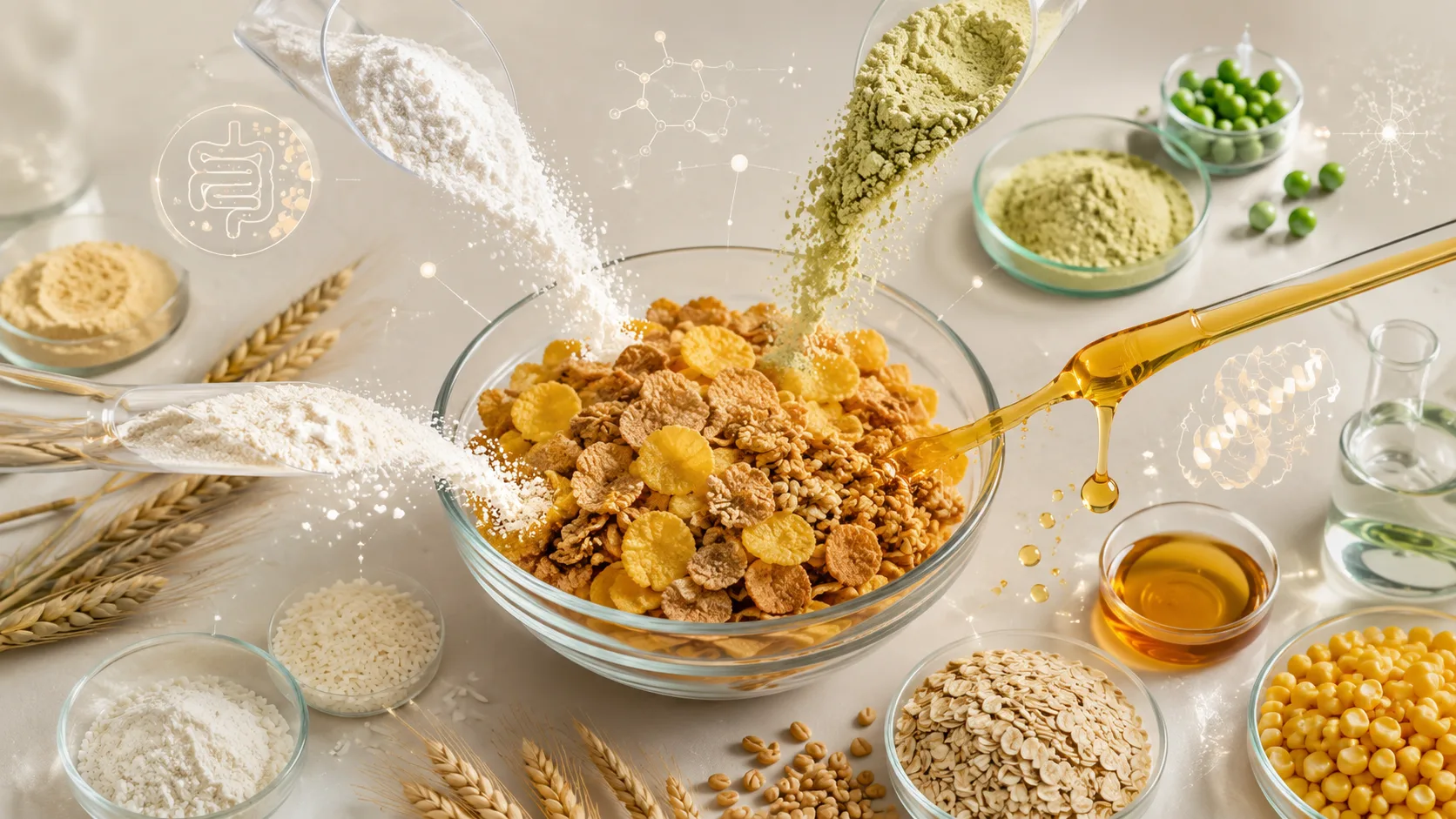
Walk down any cereal aisle today and you’ll notice something has shifted. Nearly every box now promises to be “fortified,” “enriched,” or “packed with” something good. Breakfast cereal fortification isn’t new, but the way forward-thinking brands approach it has changed considerably. Today’s formulators aren’t just stirring a vitamin premix into the mix and calling it done — they’re building better nutrition into the flake itself, using fiber, protein, and smarter sweeteners. Whether you’re refreshing a legacy cereal line or building a private label product from scratch, understanding your fortification options matters more now than ever.
What Is Breakfast Cereal Fortification, Exactly?
At its simplest, breakfast cereal fortification means adding nutrients that either weren’t originally present in the grain or were lost somewhere during processing. Think iron, zinc, folic acid, B vitamins, or dietary fiber. It’s a deliberate formulation choice, not an accidental byproduct of the recipe.
Global health authorities have long recognized fortification as one of the most effective tools for closing nutrient gaps in everyday diets. The World Health Organization’s guidance on flour fortification has shaped how iron and B-vitamin fortification standards are set across the food industry, including breakfast cereal manufacturing (World Health Organization, 2016).
For manufacturers, that means fortification decisions aren’t purely a marketing exercise — they carry real public health weight. Getting vitamin and mineral fortification for cereal right requires understanding not just which nutrients to add, but how much, and how those nutrients hold up through extrusion, baking, and toasting without degrading or tasting metallic.
It’s also worth remembering that fortification isn’t limited to vitamins and minerals anymore. Increasingly, it includes functional additions like fiber and protein — ingredients that change how satisfying, and how genuinely healthy, a bowl of cereal actually is.
Why Health-Conscious Consumers Are Paying Closer Attention
Cereal has had a rocky reputation over the past decade. Sugar content, ultra-processing, and misleading “heart healthy” claims have made shoppers more skeptical of the cereal aisle than ever. So why does fortification still matter? Because when it’s done thoughtfully, it can genuinely improve a category that people are otherwise cutting back on.
Breakfast, and ready-to-eat cereal specifically, remains one of the biggest contributors to daily micronutrient intake in children and adolescents, particularly for B vitamins (Giménez-Legarre et al., 2020). That’s a meaningful opportunity — and responsibility — for manufacturers who want to keep cereal relevant to health-conscious households.
There’s also a broader shift toward functional breakfast cereal ingredients that do more than restore lost nutrients. Consumers now expect whole grain cereal fortification, added fiber, and cleaner sweetener systems as standard, not premium add-ons. Whole grain intake itself has been linked to meaningfully lower cardiovascular disease and all-cause mortality risk in large-scale prospective studies (Aune et al., 2016), which gives whole grain, fiber-forward cereals a genuine health story to tell — not just a marketing one.
For manufacturers, this is the opening: cereal fortification, built on real functional ingredients, can meet consumers where their expectations already are.
Cereal Enrichment vs. Fortification: What’s the Difference?
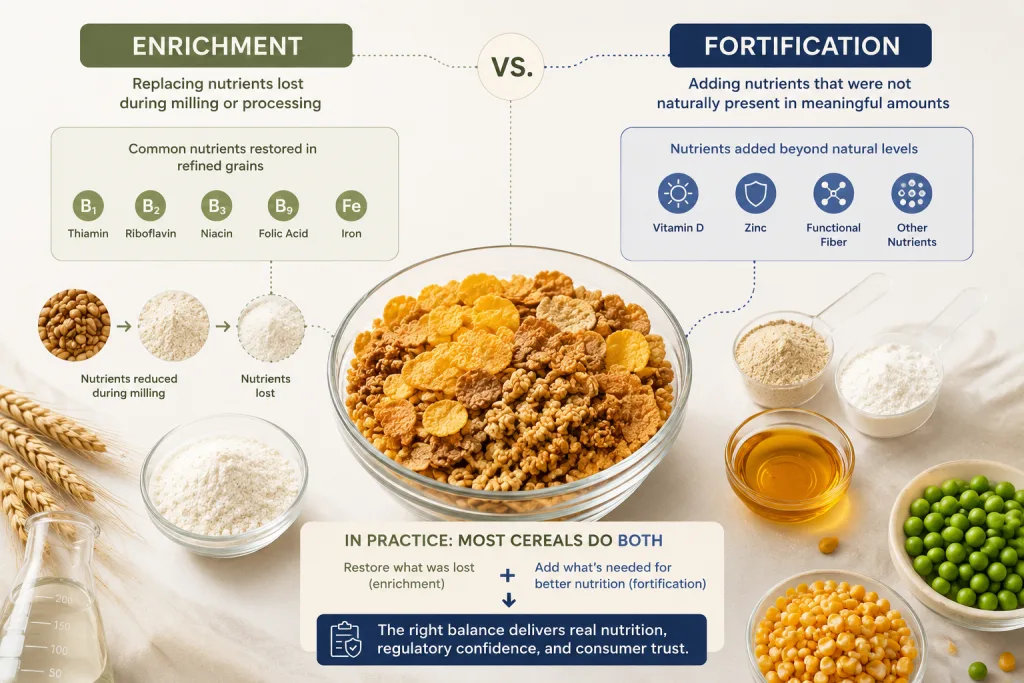
These two terms get used interchangeably, but they’re not quite the same thing — and knowing the difference matters when you’re labeling and formulating. Enrichment specifically refers to replacing nutrients that were lost during milling or processing, most commonly thiamin, riboflavin, niacin, folic acid, and iron in refined grains.
Fortification, on the other hand, is broader. It means adding nutrients that weren’t necessarily present in meaningful amounts to begin with, whether that’s vitamin D, zinc, or a functional fiber that wouldn’t naturally occur in a corn flake. Understanding cereal enrichment vs fortification helps you communicate accurately with regulators, retailers, and increasingly savvy consumers who read ingredient panels closely.
In practice, most modern cereals do both at once. A micronutrient premix for cereal manufacturers might restore B vitamins lost in extrusion while simultaneously adding iron and zinc fortified cereal ingredients at levels well above what the raw grain ever contained. Getting both pieces right, restoration and addition, is what separates a technically compliant product from one that genuinely delivers on its nutrition claims.
Fiber Fortified Cereal Manufacturing: The Gut Health Opportunity
If there’s one fortification category with real momentum right now, it’s fiber. Most people don’t get nearly enough of it, and cereal is a natural, high-volume vehicle to help close that gap. Fiber fortified cereal manufacturing has moved from a niche health-food feature to something mainstream brands are actively formulating around.
Resistant dextrin for cereal fortification is one of the more versatile options available to manufacturers. As a soluble prebiotic fiber, it feeds beneficial gut bacteria while remaining largely neutral in taste and texture, which makes it easier to incorporate into a cereal matrix than coarser, grittier fiber sources. Clinical research has linked resistant dextrin intake to improved fasting blood glucose and glycemic markers (Nutrition Journal, 2026) as well as measurable support for healthy body weight in overweight adults (Chang et al., 2017).
Beyond glucose control, prebiotic fiber breakfast cereal formulations support broader gut health breakfast cereal ingredients trends, since fermentable fibers like resistant dextrin help feed a diverse gut microbiome without disrupting digestive comfort when dosed appropriately (Bordier et al., 2022). For manufacturers exploring high fiber breakfast cereal formulation, resistant dextrin’s mild flavor profile and processing stability make it one of the more practical starting points on the market.
Protein Fortified Cereal Ingredients: Building a More Satisfying Bowl
Fiber isn’t the only macronutrient getting attention. Protein fortified cereal ingredients are increasingly showing up in formulations aimed at consumers who want breakfast to actually keep them full until lunch, not just until 10 a.m. That shift has pushed plant protein for cereal fortification into the spotlight, particularly as more shoppers look for dairy-free, allergen-friendly options.
Rice protein isolate for breakfast cereal offers a hypoallergenic, gluten-free protein source, though on its own it tends to run a bit short on lysine. Pea protein isolate cereal application solves that gap nicely, since pea protein is naturally rich in lysine and branched-chain amino acids. Blended together, the two create a more complete amino acid profile than either delivers alone, an approach supported by research showing pea-rice protein blends produce a stronger postprandial amino acid response than a single plant source used by itself (Reidy et al., 2024).
That complementary pairing is exactly why so many manufacturers are moving toward blended plant protein systems rather than relying on a single isolate. It’s a practical way to boost protein content, satiety, and label appeal all at once, without reaching for animal-derived ingredients that alienate a growing share of shoppers.
Low Sugar Fortified Cereal Formulation Without Sacrificing Taste
Sugar is where fortification conversations get complicated. You can add all the fiber and protein you want, but if a cereal still delivers a sugar bomb per serving, health-conscious buyers will notice. The World Health Organization recommends keeping free sugar intake below 10% of total energy, with additional benefits below 5% (World Health Organization, 2015) — a benchmark that’s increasingly showing up in how retailers and regulators evaluate cereal formulations.
That’s pushed sugar reduction in breakfast cereal to the top of many R&D priority lists. The challenge is that sugar isn’t just about sweetness; it affects browning, texture, and mouthfeel too. This is where a well-chosen natural sweetener for fortified cereal earns its place, whether that’s a lower-glycemic syrup or a plant-derived sugar alternative that mimics sucrose’s functional properties more closely than artificial sweeteners do.
Low sugar fortified cereal formulation tends to work best as a systems approach rather than a single swap. Combining a natural sweetener with added fiber, which itself can round out sweetness perception and improve texture, often gets formulators closer to their sugar-reduction targets without the flavor compromises that plagued earlier “diet” cereals.
Clean Label, Halal, and Non-GMO: The New Fortification Standard
It’s not enough anymore for a cereal to simply be fortified — shoppers want to know what’s behind that fortification, too. Clean label cereal fortification has become a baseline expectation, meaning recognizable ingredient names, minimal processing aids, and transparency about where functional ingredients come from.
Certifications carry real weight here as well. Halal certified cereal fortification ingredients open doors to markets where religious dietary compliance is non-negotiable, while non-GMO cereal fortification ingredients answer a different but equally persistent consumer concern about how raw materials are sourced and grown.
For manufacturers exporting across multiple regions, these aren’t nice-to-haves; they’re often the deciding factor in whether a formulation clears retail or regulatory review in a given market. Ingredient suppliers who hold recognized certifications, Halal, Non-GMO, ISO food safety standards, and similar credentials, make it considerably easier to build a fortified cereal that satisfies both the label-reading consumer and the compliance department.
Documentation matters just as much as the certification itself. Buyers increasingly ask for traceable sourcing records and audit trails before they’ll commit to a functional ingredient, especially when that ingredient is going into a product marketed toward children or health-conscious adults. Building those expectations into your supplier vetting process early saves considerable back-and-forth once a formulation is closer to launch.
Choosing the Right Cereal Fortification Ingredients Supplier
Formulation decisions are only as good as the ingredients backing them, which makes supplier selection one of the most consequential choices in the whole process. A reliable cereal fortification ingredients supplier should offer consistency batch to batch, documented quality systems, and enough technical understanding of your process to troubleshoot alongside you, not just ship a spec sheet and walk away.
This is where working with an established B2B cereal ingredient supplier pays off, especially one with a genuinely diversified functional ingredient portfolio. Satoria Nutrisentials, for example, manufactures resistant dextrin (branded as Fiberfit®), rice and pea protein isolates, rice and pea maltodextrin, and natural sweetener systems like SweetSentials® and tapioca or rice syrup, all manufactured under Halal, Non-GMO, ISO 22000, and FSSC 22000 certification.
For teams that need more than raw ingredients, private label fortified cereal manufacturer and OEM breakfast cereal formulation services add another layer of value, since they let brands move from concept to shelf-ready product without building manufacturing infrastructure from scratch. Whether you’re sourcing a single functional ingredient or need end-to-end formulation support, the right supplier relationship can shorten development timelines considerably while keeping quality and compliance consistent across every production run.
Ready to Formulate a Better Bowl of Cereal?
Fortification done well isn’t about chasing a trend; it’s about giving your customers a genuinely better product, one with real fiber, thoughtfully sourced protein, and sugar levels that match what health-conscious households are actually looking for. If you’re rethinking your next breakfast cereal fortification project, the ingredient choices you make now will shape how that product performs on the shelf and in the body.
Satoria Nutrisentials’ team of food scientists works alongside manufacturers to explore functional ingredient options, from Resistant Dextrin and plant protein isolates to natural sweetener systems, tailored to your specific formulation goals. Every ingredient is backed by Halal, Non-GMO, ISO 22000, and FSSC 22000 certification, so quality and compliance travel with the product no matter which market it lands in.
Whether you’re refining an existing cereal line or developing a private label product from the ground up, it helps to have a manufacturing partner who understands both the science and the shelf. Explore the full product range or reach out to download the product catalogue and start the conversation about what a fortified cereal built for today’s consumer could look like for your brand.
References
- Aune, D., Keum, N., Giovannucci, E., Fadnes, L. T., Boffetta, P., Greenwood, D. C., Tonstad, S., Vatten, L. J., Riboli, E., & Norat, T. (2016). Whole grain consumption and risk of cardiovascular disease, cancer, and all cause and cause specific mortality: Systematic review and dose-response meta-analysis of prospective studies. BMJ, 353, i2716. https://www.ncbi.nlm.nih.gov/pmc/articles/PMC4908315/
- Bordier, V., Teysseire, F., Schlotterbeck, G., Senner, F., Beglinger, C., Meyer-Gerspach, A. C., & Wölnerhanssen, B. K. (2022). Effect of a resistant dextrin on intestinal gas homeostasis and microbiota. Nutrients, 14(22), 4783. https://www.ncbi.nlm.nih.gov/pmc/articles/PMC9654059/
- Chang, F. Y., Lee, S. C., Chuang, J. F., & Chang, M. J. (2017). Effects of resistant dextrin for weight loss in overweight adults: A systematic review with a meta-analysis of randomized controlled trials. Journal of the Chinese Medical Association. https://www.ncbi.nlm.nih.gov/pmc/articles/PMC5434557/
- Giménez-Legarre, N., Miguel-Berges, M. L., Flores-Barrantes, P., Santaliestra-Pasías, A. M., & Moreno, L. A. (2020). Breakfast characteristics and its association with daily micronutrients intake in children and adolescents: A systematic review and meta-analysis. Nutrients, 12(10), 3201. https://www.ncbi.nlm.nih.gov/pmc/articles/PMC7589686/
- Nutrition Journal. (2026). Effects of resistant dextrin on glycemic traits: A systematic review and meta-analysis of randomized controlled trials. https://link.springer.com/article/10.1186/s12937-026-01292-z
- Reidy, P. T., Nyberg, J., Roberts, F. B., & Kimball, S. R. (2024). Postprandial plasma aminoacidemia and indices of appetite regulation following pea-rice blend, pea isolate and whey protein ingestion in healthy young adults. British Journal of Nutrition. https://www.ncbi.nlm.nih.gov/pmc/articles/PMC11557286/
- World Health Organization. (2015). Guideline: Sugars intake for adults and children. https://www.who.int/publications/i/item/9789241549028
- World Health Organization. (2016). Guideline: Fortification of maize flour and corn meal with vitamins and minerals. https://www.ncbi.nlm.nih.gov/books/NBK402395/
Featured News
Category
Get a Promo and Keep Updated