
Rice Protein Isolate for Non-Dairy Sports Recovery RTD Shakes: A Formulator’s Guide
Fiber Trends 2026: What They Mean for Food and Beverage Formulators
August 25, 2026
General - Articles
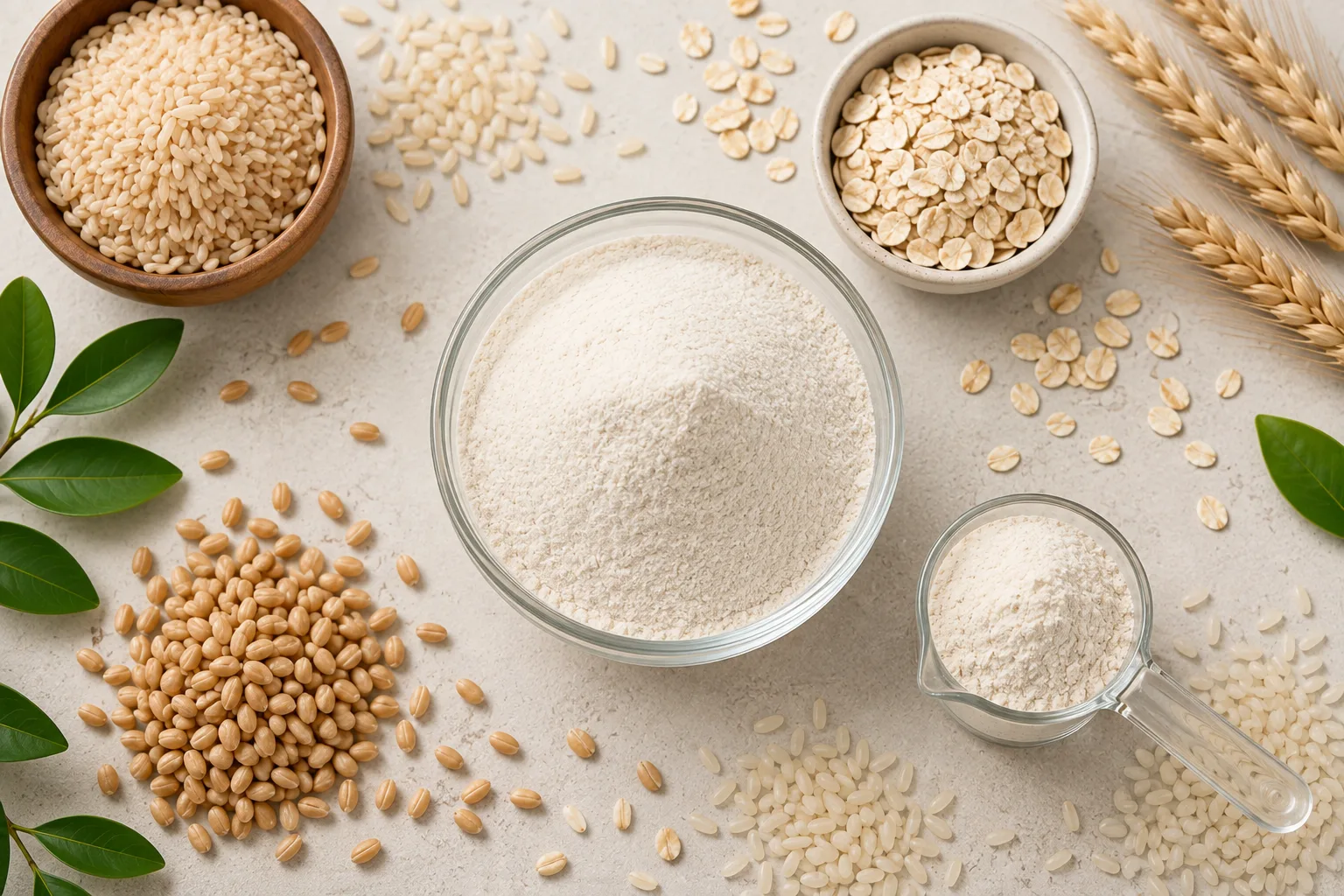
Fiber has quietly become the ingredient everyone in food and beverage wants to talk about. After years of protein dominating reformulation briefs, fiber trends 2026 headlines are finally translating into real product development budgets. For manufacturers watching this shift from the sourcing side, the question isn’t whether to add fiber — it’s which fiber, at what dose, and from which supplier.
Why Fiber Is Having a Moment in 2026
The numbers explain the urgency. Most adults worldwide still fall well short of recommended fiber intake, and researchers have described the shortfall as a genuine public health gap rather than a minor dietary quirk. That gap is exactly why dietary fiber market trends have shifted from a niche wellness story to a mainstream retail and foodservice priority this year.
Decades of research now link low fiber intake to higher rates of cardiovascular disease, type 2 diabetes, and digestive discomfort, while higher intake is consistently associated with better outcomes across dozens of health measures. That weight of evidence is exactly why brands are racing to close the gap through fortified products rather than waiting for consumers to eat more whole grains and vegetables on their own.
For formulators, this isn’t just a marketing opportunity. It’s a technical one. Consumers want fiber, but they still expect their favorite snack, beverage, or bakery item to taste and feel the same as it always has. That tension between functional fiber ingredients 2026 demand and sensory performance is where ingredient selection starts to matter more than raw fiber content alone.
Regulatory bodies and health authorities have reinforced this urgency too, with public dietary guidance repeatedly flagging fiber as a nutrient of concern rather than a nice-to-have. For a category that once relied on consumer willpower to close the gap, that kind of institutional backing gives brands a much stronger foundation for fiber-forward product claims heading into next year.
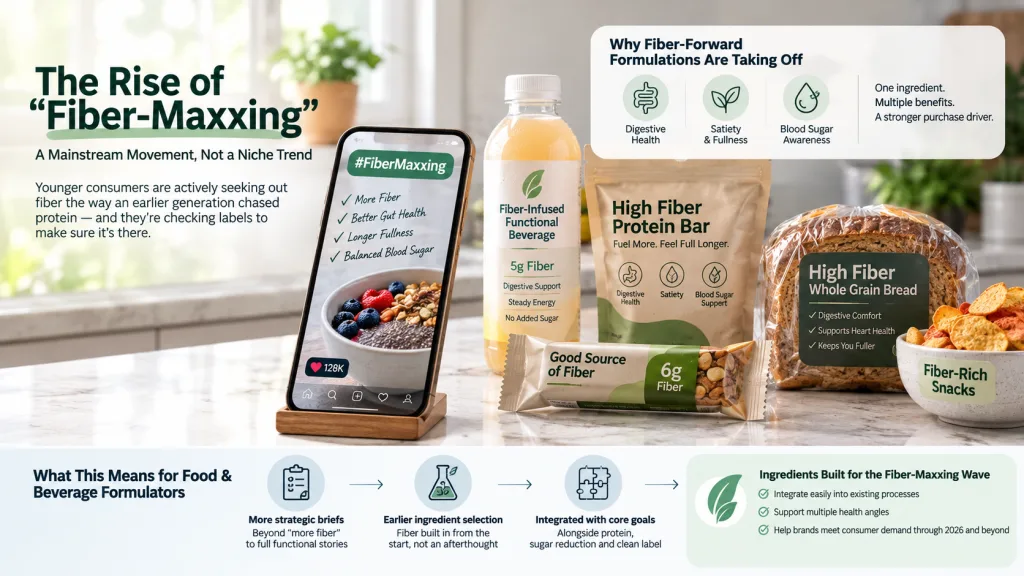
The Rise of “Fiber-Maxxing” and What It Means for Formulators
Social media has given this trend a name: fiber-maxxing. Younger consumers, in particular, are actively seeking out fiber the way an earlier generation chased protein grams, and they’re checking labels to confirm it. That shift is pulling fiber-forward food formulation out of the specialty aisle and into mainstream bars, beverages, breads, and snacks.
What makes this moment different from earlier fiber pushes is the pairing with other trends. Digestive health, satiety, and blood sugar awareness are converging into a single purchase driver, so a single ingredient that can support several of those angles at once has an obvious advantage over one that only checks a single box.
This convergence is also changing how marketing teams brief their formulation counterparts. Instead of asking for “more fiber,” brand teams are increasingly specifying the functional story they want to tell — satiety, digestive comfort, blood sugar support — which pushes ingredient selection earlier into the development process rather than treating fiber as an afterthought.
For manufacturers, that means fiber fortification is no longer an isolated line item. It’s increasingly built into core formulations alongside protein, sugar reduction, and clean-label goals. Ingredients that integrate cleanly into existing processes, without demanding a full reformulation or new processing equipment, are the ones best positioned to ride this wave through 2026 and beyond.
Resistant Dextrin Trends 2026: From Supporting Ingredient to Category Anchor
Among soluble fibers, resistant dextrin has moved from a behind-the-scenes processing aid to a genuine category anchor. It’s derived by modifying starch into a form that resists digestion, which gives it the soluble fiber properties formulators want without many of the handling headaches associated with older fiber sources.
That practicality is exactly why resistant dextrin trends 2026 point toward wider adoption across categories that previously avoided fiber fortification altogether, including beverages, dairy, and bakery. A resistant dextrin manufacturer with consistent particle size and solubility gives product developers a predictable input, which matters enormously once a formulation moves from pilot batch to commercial scale.
Sourcing patterns are shifting too. Buyers increasingly want a resistant dextrin supplier Asia can rely on for both capacity and cost stability, particularly as demand outpaces the output of legacy European producers. That regional diversification is quickly becoming a standard part of ingredient risk management for global brands managing multiple manufacturing sites.
There’s also a growing appetite for transparency around how resistant dextrin is produced. Buyers are asking more detailed questions about starch source, processing method, and non-GMO status than they did even a year or two ago, treating those answers as a baseline requirement rather than a bonus differentiator when shortlisting suppliers for a new formulation project.
Resistant Dextrin vs. Inulin and Soluble Corn Fiber: Choosing the Right Soluble Fiber
Not all soluble fibers behave the same way in a formulation, and this is where a lot of reformulation projects stall. Comparing resistant dextrin vs inulin, the two differ meaningfully in fermentation rate and tolerance: inulin tends to ferment more quickly in the gut, which can increase the likelihood of bloating at higher inclusion levels, while resistant dextrin ferments more gradually and is generally better tolerated at comparable doses.
The comparison of resistant dextrin vs soluble corn fiber follows a similar pattern. Both are well tolerated at moderate doses, but resistant dextrin’s low-viscosity soluble fiber profile makes it easier to work into thin, pourable formats like beverages and dressings without altering mouthfeel the way thicker fiber sources can.
Cost and availability also factor into the decision. Soluble corn fiber pricing has fluctuated with corn commodity markets, while resistant dextrin sourced from rice or tapioca starch offers a different, sometimes more stable, cost base — an increasingly relevant consideration for procurement teams building multi-year supply agreements rather than sourcing opportunistically.
For teams prioritizing label simplicity, a clean label soluble fiber ingredient with a straightforward ingredient statement is increasingly the deciding factor over marginal cost differences. Formulators are learning that the “best” fiber isn’t universal — it depends on the finished product’s texture, processing conditions, and label goals, which is why side-by-side technical comparisons are now a standard part of ingredient selection rather than a final checkbox.
Where Fiber Fortification Is Showing Up Across the Aisle
Fiber fortification ingredients B2B demand is no longer concentrated in a handful of categories. Bakery has long been a natural fit, but a fiber ingredient for bakery application now needs to hold up through high-heat baking without compromising crumb structure, and resistant dextrin’s stability under thermal processing has made it a common substitute for older bulking agents in bread, biscuits, and baked snacks.
Beverages have become an equally active category. A fiber ingredient for beverage formulation has to dissolve cleanly, stay stable through pasteurization, and avoid clouding or sedimentation, all while contributing meaningfully to a “good source of fiber” claim on the label. That combination of technical and marketing requirements has narrowed the field considerably for beverage developers working within tight timelines.
Protein-forward snacks are following close behind. A fiber ingredient for protein bars needs to support texture and moisture retention as much as fiber content, since bars are notoriously sensitive to ingredient interactions and can turn gritty or overly firm with the wrong fiber source. Getting that balance right is often the difference between a bar that survives a full shelf-life test and one that doesn’t.
Add in rising interest from a gut health ingredient supplier and growing prebiotic fiber for food manufacturing programs across dairy alternatives, sauces, and even confectionery, and it’s clear fiber has moved well past its original bakery-and-cereal footprint into nearly every aisle of the store.
Solving the Formulation Problems That Have Held Fiber Back
Fiber has a reputation problem, and it’s not entirely undeserved. Older fiber additives have long been associated with gritty texture, chalky mouthfeel, and off-flavors strong enough to undercut an otherwise good product. Any gritty texture fiber ingredient solution worth considering in 2026 needs to solve that problem at the ingredient level, not just mask it with flavor systems or added sweeteners.
Digestive tolerance is the other recurring concern. A digestive tolerance fiber ingredient that can be dosed at functional levels without triggering the discomfort associated with highly fermentable fibers gives formulators more room to hit fiber claims without risking consumer complaints, negative reviews, or product returns down the line.
This is where buyers evaluating a resistant dextrin alternative to Nutriose tend to focus their technical due diligence: viscosity behavior, solubility across pH ranges, and consistency from batch to batch. Those variables matter more than headline fiber percentage, because an ingredient that performs unpredictably in production can quietly erode margins through rework and quality holds.
A soluble fiber ingredient for food manufacturers that performs predictably across these variables reduces reformulation risk considerably, which matters just as much as the ingredient’s fiber content on a spec sheet. Suppliers who can share third-party lab data and application-specific case studies tend to move faster through technical evaluation than those relying on marketing claims alone.
What This Means for Sourcing a Fiber Ingredient Supplier in 2026
As fiber fortification scales, sourcing decisions are becoming more strategic. Brands running multiple SKUs need bulk resistant dextrin supply they can count on year-round, not a spot-market ingredient subject to seasonal shortages or price swings tied to a single region’s harvest.
This is also pushing more brands toward an OEM fiber ingredient manufacturer that can handle formulation support alongside raw ingredient supply, shortening the path from concept to shelf. Partnering with a functional fiber ingredient supplier Indonesia based operations can offer diversifies a supply chain that has historically leaned heavily on European and North American producers, while often bringing competitive lead times into Asia-Pacific and Australian markets.
Private label and contract manufacturers have specific needs here too. A fiber ingredient manufacturer for private label programs needs to support smaller minimum order quantities and flexible packaging without compromising on certifications like Halal, Kosher, or Non-GMO status that many export markets now require as a condition of entry.
Ultimately, the brands succeeding with fiber trends 2026 are the ones treating their B2B functional food ingredient supplier relationship as a formulation partnership, not just a transaction. That means involving suppliers earlier in the development process, sharing application context openly, and expecting technical support that goes beyond a certificate of analysis.
Ready to Build Your 2026 Fiber Strategy? Talk to Satoria Nutrisentials
Fiber isn’t a passing trend — it’s becoming a baseline expectation across categories, and the brands that move early on formulation will have a real head start over competitors still relying on legacy ingredients. Satoria Nutrisentials has built its Resistant Dextrin around exactly the challenges outlined above: solubility, tolerance, and consistency at scale, backed by HACCP, ISO, Halal, and FDA-recognized manufacturing standards.
Whether you’re exploring resistant dextrin for the first time or comparing suppliers for an existing fiber-fortified line, our team can walk through technical specifications, sample availability, and bulk supply options for your specific application. Explore our Resistant Dextrin product page, or reach out through OEM & Toll Manufacturing to discuss a formulation partnership tailored to your 2026 fiber roadmap.
References
- Daley, S. F., & Shreenath, A. P. (2026). The role of dietary fiber in health promotion and disease prevention: A practical guide for clinicians. In StatPearls. StatPearls Publishing. https://www.ncbi.nlm.nih.gov/books/NBK559033/
- Hobden, M. R., Commane, D. M., Guérin-Deremaux, L., Wils, D., Thabuis, C., Martin-Morales, A., Wolfram, S., Diaz, A., Collins, S., Morais, I., Rowland, I. R., Gibson, G. R., & Kennedy, O. B. (2021). Impact of dietary supplementation with resistant dextrin (NUTRIOSE®) on satiety, glycaemia, and related endpoints, in healthy adults. European Journal of Nutrition, 60, 4635–4643. https://www.ncbi.nlm.nih.gov/pmc/articles/PMC8572182/
- Mathers, J. C. (2023). Dietary fibre and health: The story so far. Proceedings of the Nutrition Society, 82(2), 120–129. https://pubmed.ncbi.nlm.nih.gov/36786062/
- Pugh, J. E., Cai, M., Altieri, N., & Frost, G. (2023). A comparison of the effects of resistant starch types on glycemic response in individuals with type 2 diabetes or prediabetes: A systematic review and meta-analysis. Frontiers in Nutrition, 10, 1118229. https://doi.org/10.3389/fnut.2023.1118229
- Thompson, H. J. (2021). The Dietary Guidelines for Americans (2020–2025): Pulses, dietary fiber, and chronic disease risk—A call for clarity and action. Nutrients, 13(11), 4034. https://pmc.ncbi.nlm.nih.gov/articles/PMC8621412/
- Veronese, N., Gianfredi, V., Solmi, M., Barbagallo, M., Dominguez, L. J., Mandalà, C., Di Palermo, C., Carruba, L., Solimando, L., Stubbs, B., Castagna, A., Maggi, S., Zanetti, M., Al-Daghri, N., Sabico, S., Nucci, D., Gosling, C., & Fontana, L. (2025). The impact of dietary fiber consumption on human health: An umbrella review of evidence from 17,155,277 individuals. Clinical Nutrition, 51, 325–333. https://pubmed.ncbi.nlm.nih.gov/40651334/
Featured News
Category
Get a Promo and Keep Updated