
Rice Protein Isolate for Non-Dairy Sports Recovery RTD Shakes: A Formulator’s Guide
IBS Friendly Prebiotic Fiber Formulation: A Manufacturer’s Guide to Low-FODMAP Ingredient Selection
August 10, 2026
Resistant Dextrin - Articles

Fiber fortification has become a default move for F&B brands chasing gut-health claims, but not every prebiotic fiber belongs in an IBS-friendly product. Fast-fermenting fibers like inulin, FOS, and GOS can trigger the same bloating and discomfort that IBS-conscious consumers are trying to avoid, which turns a wellness claim into a returned product.
This gap between a fiber’s marketing story and its actual digestive impact is becoming harder to ignore as low-FODMAP and gut-sensitive product categories grow. Formulators who treat all prebiotic fibers as interchangeable risk building a product that undermines the very claim it is trying to make, and buyers sourcing ingredients for this segment need a way to evaluate fiber sources beyond a generic prebiotic label.
This guide covers what actually makes a prebiotic fiber IBS friendly, how resistant dextrin fits into low-FODMAP formulation, and the practical dosing, sourcing, and application choices manufacturers need to get right before launch.
Why IBS-Friendly Formulation Is Becoming a Commercial Priority
Irritable bowel syndrome affects a substantial share of the global population, and roughly three in four of those individuals see meaningful symptom relief when they adopt a low-FODMAP eating pattern (Magge & Lembo, 2012). That single statistic explains why low-FODMAP callouts have moved from a niche dietetic tool into a mainstream retail category spanning bars, beverages, and supplements.
For manufacturers, this creates a formulation problem as much as a marketing opportunity. A product can carry a high-fiber or prebiotic claim and still be unsuitable for the IBS-conscious shopper it is trying to reach, simply because the fiber source ferments too quickly and produces excess gas in the colon (Ispiryan et al., 2022). Getting the fiber selection right is what separates a genuine IBS-friendly product from one that only sounds like one on the label.
The commercial case is reinforced by how often IBS-sensitive consumers report being disappointed by products that never disclosed a FODMAP profile in the first place. Shoppers managing IBS tend to read ingredient panels closely and remember which brands worked for them, which means a formulation that genuinely delivers on an IBS-friendly claim can build the kind of category loyalty that generic gut-health products rarely achieve.
What Makes a Prebiotic Fiber IBS-Friendly
Fermentation Speed and Gas Production
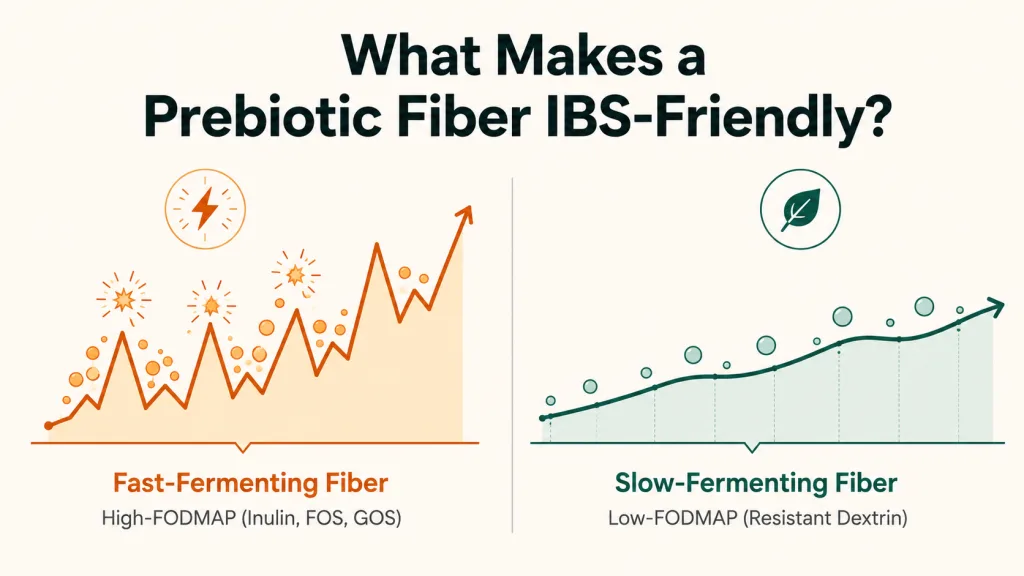
The core issue for IBS-sensitive consumers is not fiber itself, but how quickly a fiber ferments in the gut. Rapidly fermentable prebiotics such as chicory inulin and short-chain fructo-oligosaccharides produce a burst of gas as gut bacteria break them down, and that burst is exactly what drives the bloating, cramping, and distension associated with IBS flare-ups (Ispiryan et al., 2022).
Slow-fermenting fibers spread that same fermentation process out over a longer stretch of the colon, which produces short-chain fatty acids gradually rather than all at once. This slower profile is the mechanism behind most fibers marketed as gentle or low-FODMAP, and it is the first thing to check before selecting a prebiotic for a digestive-wellness formulation.
Molecular weight and branching structure both influence how quickly a fiber reaches the colon and how evenly it is fermented once it gets there. Fibers built from longer, more complex chains tend to resist rapid breakdown better than short-chain oligosaccharides, which is one reason resistant dextrin, a larger and more structurally complex molecule than inulin or FOS, tends to be gentler on a sensitive gut.
Low-FODMAP Certification Explained
FODMAP stands for fermentable oligosaccharides, disaccharides, monosaccharides, and polyols, and the low-FODMAP diet works by identifying and limiting the specific carbohydrate fractions that trigger symptoms in sensitive individuals (NCBI Bookshelf, 2026). Monash University, which developed the diet, also runs a certification program that manufacturers can pursue for finished products or ingredients, giving formulators and consumers a verifiable low-FODMAP claim rather than a self-declared one.
Not every soluble fiber qualifies. Ingredient selection at the raw-material stage determines whether a finished product can realistically pursue that certification later, which makes this a formulation decision, not just a labeling one.
It is worth distinguishing between an ingredient that has been independently certified low-FODMAP and one that is simply described as such in marketing materials. Buyers evaluating suppliers should ask for testing data or certification documentation up front, since a self-declared low-FODMAP claim on a raw material carries far less weight with retailers and regulators than one backed by third-party analysis.
Resistant Dextrin as a Low-FODMAP Fiber Solution
Clinical Evidence for Tolerance and Prebiotic Effect
Resistant dextrin has one of the better-documented tolerance profiles among soluble fibers used in food manufacturing. Randomized, placebo-controlled trials have shown that resistant dextrin supplementation increases beneficial gut bacteria such as Bacteroides and Parabacteroides while suppressing less desirable species, without the intensity of gas production seen with faster-fermenting prebiotics (Frontiers in Nutrition, 2026; PubMed, 2012).
A separate randomized trial testing resistant starch and other gut-targeted supplements in people diagnosed with IBS under the Rome IV criteria found favorable shifts in fecal short-chain fatty acid levels and stool pattern, reinforcing that slow-fermenting fiber sources can support gut health goals without working against an IBS-sensitive digestive system (PMC, 2025).
This combination of prebiotic activity and gentle fermentation is what makes resistant dextrin a practical starting point for manufacturers building an IBS-friendly product line, rather than trying to reformulate around an inulin or FOS base that was never suited to that audience.
Comparing Resistant Dextrin to Inulin, FOS, and GOS
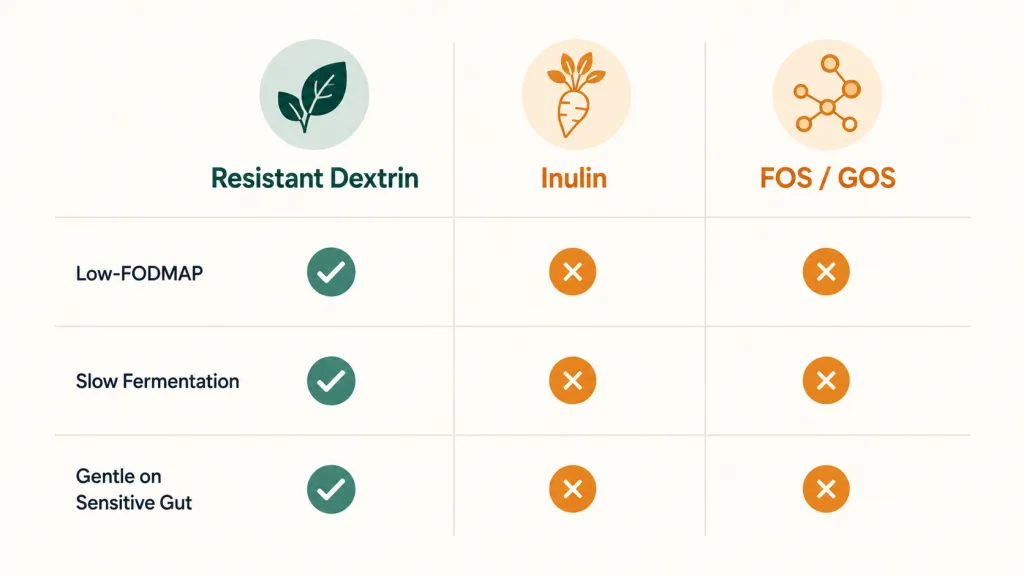
Inulin, FOS, and GOS are effective prebiotics and remain useful in general gut-health formulations, but all three sit on the high-FODMAP side of the ledger and are commonly restricted during the elimination phase of a low-FODMAP protocol (NCBI Bookshelf, 2026). Including them in a product marketed toward IBS-sensitive consumers works against the claim the product is trying to make.
Resistant dextrin, by contrast, is generally classified as low-FODMAP because its fermentation is slow and its FODMAP-contributing fractions are minimal after processing. For manufacturers already using resistant dextrin for sugar reduction, fat replacement, or general fiber fortification, extending that same ingredient into an IBS-friendly line is often a smaller formulation lift than introducing an entirely new fiber system.
Formulation Considerations for IBS-Friendly Products
Dosing and Gradual Introduction
Even a well-tolerated, slow-fermenting fiber can cause discomfort if introduced at too high a dose too quickly. Clinical dosing in resistant dextrin studies has generally ranged from roughly 8 to 20 grams per day, with tolerance improving when intake is built up gradually rather than delivered as a single large serving (PubMed, 2012).
For finished products, this points toward moderate per-serving fiber levels paired with clear usage guidance, rather than maximizing fiber content per serving to support an aggressive front-of-pack claim. A product that delivers a well-tolerated dose consistently will outperform one that delivers a larger dose inconsistently.
Application Across Food and Beverage Formats
Resistant dextrin’s neutral flavor, high solubility, and heat stability make it workable across a wide range of formats relevant to an IBS-friendly line, including beverages, bars, dairy and dairy-alternative products, baked goods, and powdered supplement formats. Because it does not carry the sweetness or viscosity of some competing soluble fibers, it typically requires less reformulation of the base recipe than switching in a gum- or starch-based fiber system.
Manufacturers evaluating a low-FODMAP line should also confirm that any accompanying ingredients, sweeteners, and flavor systems in the formulation are FODMAP-appropriate, since a single high-FODMAP ingredient elsewhere in the recipe can disqualify the finished product from certification even when the fiber source itself is compliant.
Sourcing and Quality Considerations
Verifying Supplier Documentation
Because an IBS-friendly claim depends on the specific processing method used to produce a fiber, not just its generic category name, sourcing documentation matters more here than in a standard fiber-fortification project. Buyers should request certificates of analysis, FODMAP testing results where available, and processing details that confirm the degree of hydrolysis and purity of the resistant dextrin being supplied.
Batch-to-batch consistency is equally important. A resistant dextrin source that varies in its degree of polymerization from lot to lot can shift its fermentation profile enough to affect tolerance, which is a bigger risk for an IBS-friendly product than for a general-purpose fiber-fortified item where a small variance in gas production is unlikely to be noticed.
Halal, Non-GMO, and Clean-Label Alignment
Many manufacturers building IBS-friendly or low-FODMAP lines are also targeting broader clean-label and allergen-conscious positioning at the same time. Confirming that a resistant dextrin supplier can support halal, non-GMO, and allergen-free documentation alongside its FODMAP profile avoids having to source a second fiber system later to satisfy a different claim on the same label.
Positioning IBS-Friendly Products in the Market
IBS-friendly and low-FODMAP labeling is still a relatively underserved shelf category compared to general high-fiber or gut-health positioning, which gives early movers room to build credibility with a specific, underserved audience (Ispiryan et al., 2022). Clear labeling that names the low-FODMAP status, avoids vague gut-health language, and where possible references third-party certification tends to build more trust with this consumer group than broad wellness claims.
It is also worth segmenting messaging by IBS subtype where relevant, since IBS-D and IBS-C consumers respond differently to fiber type and dose (Monash FODMAP, n.d.). A product that is explicit about who it works well for, rather than positioning itself as universally gut-friendly, is more likely to earn repeat purchase from a consumer base that has often been let down by products that did not disclose their FODMAP content.
Ultimately, an IBS-friendly formulation strategy comes down to three linked decisions: choosing a fiber source with a genuinely slow fermentation profile, dosing it at a level the target consumer can tolerate, and backing the finished claim with documentation rather than marketing language alone. Manufacturers that get these three elements right have a real opportunity to build lasting trust in a category where trust has historically been in short supply.
Formulating a low-FODMAP or IBS-friendly product line involves more than swapping in a single ingredient – it touches fiber source, dose, and the FODMAP profile of the full recipe. Our technical team can walk through resistant dextrin application data and sample formulations relevant to your product category.
References
- Frontiers in Nutrition. (2026). Resistant dextrin promotes beneficial fecal bacteria in high and low fiber diet populations: A randomized, double-blinded, controlled pilot study. https://www.frontiersin.org/journals/nutrition/articles/10.3389/fnut.2026.1810842/full
- Halmos, E. P., Power, V. A., Shepherd, S. J., Gibson, P. R., & Muir, J. G. (2014). A diet low in FODMAPs reduces symptoms of irritable bowel syndrome. Gastroenterology, 146(1), 67-75. https://pubmed.ncbi.nlm.nih.gov/24076059/
- Ispiryan, L., Zannini, E., & Arendt, E. K. (2022). FODMAP modulation as a dietary therapy for IBS: Scientific and market perspective. Comprehensive Reviews in Food Science and Food Safety. https://ift.onlinelibrary.wiley.com/doi/10.1111/1541-4337.12903
- Magge, S., & Lembo, A. (2012). Low-FODMAP diet for treatment of irritable bowel syndrome. Gastroenterology & Hepatology, 8(11), 739-745. https://pmc.ncbi.nlm.nih.gov/articles/PMC3966170/
- Monash FODMAP. (n.d.). IBS diets. https://www.monashfodmap.com/ibs-central/diets/
- NCBI Bookshelf. (2026). The low-FODMAP diet in clinical practice: Evidence-based indications, implementation, and interprofessional care. StatPearls. https://www.ncbi.nlm.nih.gov/books/NBK562224/
- PMC. (2025). Randomised controlled trial: Nutritional supplements to relieve irritable bowel syndrome symptoms by targeting the gut microbiota. https://www.ncbi.nlm.nih.gov/pmc/articles/PMC12278178/
- PubMed. (2012). Impact of a resistant dextrin on intestinal ecology: How altering the digestive ecosystem with NUTRIOSE, a soluble fibre with prebiotic properties, may be beneficial for health. https://pubmed.ncbi.nlm.nih.gov/22429361/
Featured News
Category
Get a Promo and Keep Updated