
Rice Protein Isolate for Non-Dairy Sports Recovery RTD Shakes: A Formulator’s Guide
Postbiotics for Food and Beverage Formulation: The Complete Guide for Modern Manufacturers
June 15, 2026
General - Articles

The gut health revolution has moved well beyond kombucha and yogurt. A new class of functional ingredient — postbiotics — is quietly reshaping how food and beverage manufacturers think about digestive wellness, product stability, and clean-label positioning. And it’s happening faster than most brands realize.
So what exactly are postbiotics? In 2021, the International Scientific Association for Probiotics and Prebiotics (ISAPP) settled on a clear consensus definition: a postbiotic is “a preparation of inanimate microorganisms and/or their components that confers a health benefit on the host” (Salminen et al., 2021). In plain English, postbiotics are the beneficial compounds produced during fermentation — things like short-chain fatty acids, cell wall fragments, peptides, and exopolysaccharides — that deliver real health outcomes without requiring any live bacteria to survive in your product.
For food formulators, this is genuinely exciting. The instability of live probiotics has long been a headache — cold chains, CFU loss during processing, shelf-life anxiety. Postbiotics sidestep all of that. They’re heat-stable, shelf-stable, and compatible with the kinds of processing — UHT, spray drying, baking — that routinely kill live cultures. This guide explores how postbiotics work, why they matter for modern formulation, and how to integrate them effectively into your product range.
What Are Postbiotics, and How Do They Differ from Probiotics and Prebiotics?
To understand postbiotics, it helps to see them in context. Probiotics are live microorganisms that, when consumed in adequate amounts, confer health benefits. Prebiotics are the non-digestible fibers that feed those beneficial bacteria. Postbiotics, by contrast, are the outputs of that fermentation process — the bioactive compounds left behind when microbes do their work. Think of it as getting the benefits of the factory, without needing the factory to still be running when the product reaches the shelf.
The most common postbiotic compounds found in food formulation include:
- Short-chain fatty acids (SCFAs) such as butyrate, propionate, and acetate
- Exopolysaccharides (EPS) from lactic acid bacteria
- Bacteriocins and antimicrobial peptides
- Cell wall components including teichoic acids and peptidoglycan fragments
- Vitamins and enzymes generated through microbial metabolism
Each of these compounds acts through different biological mechanisms — interacting with gut epithelial cells, modulating immune responses, and supporting the integrity of the intestinal barrier (Islam et al., 2024). The crucial point for manufacturers is that these benefits are delivered without the viability requirements that make working with live probiotics so challenging.
It’s worth noting where prebiotics fit into this picture. A well-formulated product doesn’t have to choose sides. Prebiotic fibers — which feed beneficial gut bacteria — and postbiotics can work together synergistically, and some formulators are already building products around both. This complementary relationship is one reason why fiber-enrichment ingredients and postbiotics are increasingly appearing side by side in functional food R&D conversations.
Why Postbiotics Are Gaining Traction in F&B Formulation
The global postbiotic ingredients in functional foods market was valued at USD 597.4 million in 2025 and is expected to grow at a compound annual growth rate of 11.3% through 2035 (Global Market Insights, 2025). Europe and North America are the two dominant regions driving that growth, with European demand underpinned by a strong fermented-food culture and science-led formulation trends, while North America benefits from an established functional food ecosystem and high consumer awareness of gut health.
What’s pulling manufacturers toward postbiotics specifically? Several things are converging at once. First, consumer demand for clean-label, science-backed gut health products has never been stronger. Second, regulatory frameworks in both the EU and North America are beginning to provide more clarity on how postbiotic claims can be substantiated — EFSA approved the postbiotic EpiCor for immune health claims in 2024, and the FDA issued GRAS status to a SCFA-based capsule in 2025 (Mafe et al., 2026). Third, ingredient technology has matured to the point where manufacturers can source reliable, standardized postbiotic inputs without the batch-to-batch variability that plagued earlier-generation fermentation products.
The shift is also about pragmatism. Brands that previously used live probiotics are reformulating with postbiotics to eliminate cold-chain dependencies, reduce regulatory complexity, and extend shelf life — all without sacrificing their gut-health positioning. For a soluble fiber supplier or a fiber enrichment ingredient manufacturer looking to serve the functional food space, understanding how postbiotics interact with and complement fiber systems is now an essential part of the conversation.
Formulation Advantages: Why Postbiotics Are Easier to Work With
Heat and shelf stability
Because the microorganisms in postbiotics are inanimate, they offer a level of stability that live probiotics simply cannot match. Postbiotics are highly resistant to temperature, humidity, and pH variation — which means they can be added before heat treatment steps like pasteurization, UHT processing, or baking, without losing their efficacy (Food and Drink Technology, 2024). This fundamentally changes the formulation process. You no longer need to engineer complex post-processing addition systems or worry about cross-contamination from live cultures.
No cold chain required
Shelf-stable formats are where the fastest growth is happening in functional food. RTD beverages, protein bars, baked snacks, powdered mixes — these are the product categories where consumers expect ambient storage and long shelf lives. Postbiotics slot perfectly into these formats because they require no refrigeration and maintain their bioactivity for months at room temperature (BevSource, 2024). For a soluble fiber OEM manufacturer or a company offering a Nutriose alternative, this opens up new co-formulation opportunities that weren’t viable when live cultures were the only option.
Clean label compatibility
Consumers in the EU, US, and Canada are increasingly scrutinizing ingredient labels. Postbiotics tend to be derived from well-understood fermentation processes and can often be labeled in consumer-friendly terms. Regulatory labeling is simpler than for live probiotics, where CFU counts, strain identifiers, and viability at end-of-shelf-life claims all require careful management. For brands targeting non-GMO soluble fiber supplier credentials or halal soluble fiber ingredient certifications, postbiotic formulations can often be designed to meet these requirements more cleanly than conventional bioactive ingredients.
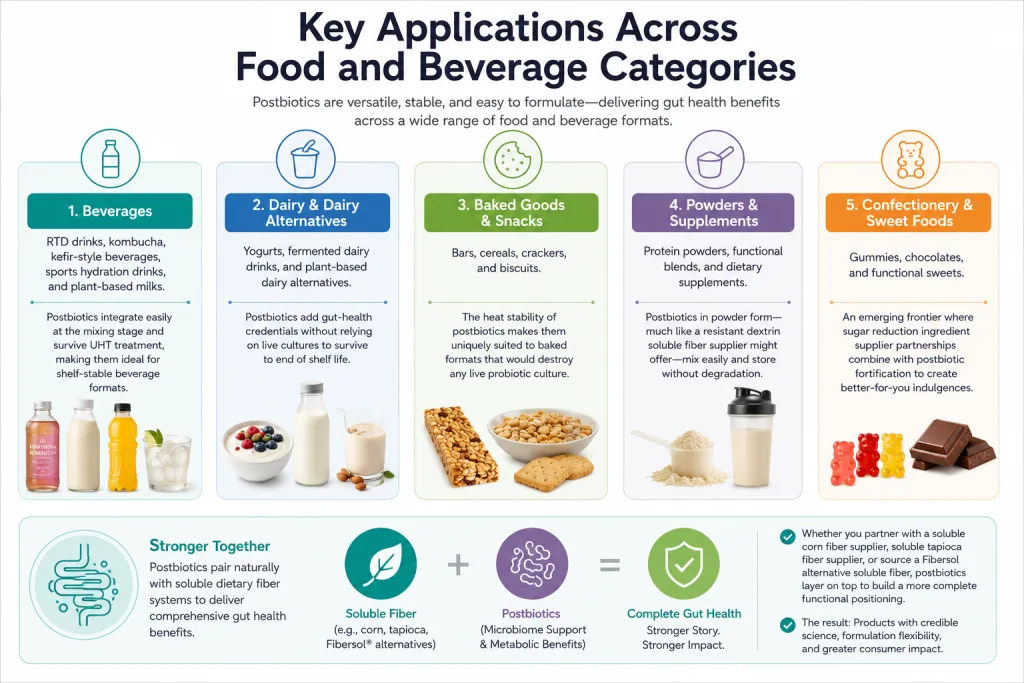
Key Applications Across Food and Beverage Categories
The versatility of postbiotics as a formulation ingredient is one of their most compelling qualities. Unlike many functional ingredients that work well in only one or two food matrices, postbiotics have demonstrated compatibility across a remarkably wide range of product types. Here’s where they’re making the most meaningful impact.
- Beverages: RTD drinks, kombucha, kefir-style beverages, sports hydration drinks, and plant-based milks. Postbiotics integrate easily at the mixing stage and survive UHT treatment, making them ideal for shelf-stable beverage formats.
- Dairy and dairy alternatives: Yogurts, fermented dairy drinks, and plant-based dairy alternatives. Postbiotics add gut-health credentials without relying on live cultures to survive to end of shelf life.
- Baked goods and snacks: Bars, cereals, crackers, and biscuits. The heat stability of postbiotics makes them uniquely suited to baked formats that would destroy any live probiotic culture.
- Powders and supplements: Protein powders, functional blends, and dietary supplements. Postbiotics in powder form — much like a resistant dextrin soluble fiber supplier might offer — mix easily and store without degradation.
- Confectionery and sweet foods: Gummies, chocolates, and functional sweets. An emerging frontier where sugar reduction ingredient supplier partnerships are combining with postbiotic fortification to create genuinely better-for-you indulgences.
Across all these categories, postbiotics pair naturally with soluble dietary fiber systems. Fiber-enriched products already carry a strong gut-health narrative; adding postbiotics deepens that story with direct evidence of microbiome support. Whether a formulator is working with a soluble corn fiber supplier, a soluble tapioca fiber supplier, or sourcing a Fibersol alternative soluble fiber for a specific application, postbiotics can be layered on top to build a more complete functional positioning.
The Synergy Between Postbiotics and Prebiotic Soluble Fibers
Here’s something that doesn’t get talked about enough: postbiotics and prebiotic fibers are not competing strategies — they’re complementary ones. Prebiotics, such as resistant dextrin and other soluble dietary fiber ingredients, feed the beneficial bacteria in the gut. When those bacteria ferment prebiotic fiber, they produce postbiotic compounds — including the short-chain fatty acids that have been so extensively studied for their role in gut barrier integrity and immune modulation.
What this means practically is that a product formulated with both a high-quality soluble fiber and a postbiotic ingredient can tell a more complete gut-health story than either ingredient can alone. The fiber provides the substrate; the postbiotic delivers the endpoint benefit directly. For manufacturers sourcing a Nutriose FM alternative or comparing Nutriose vs resistant dextrin options, it’s worth considering how those fiber systems integrate with a broader functional food architecture that includes postbiotics.
Resistant dextrin — a type of soluble dietary fiber derived from corn or tapioca starch — is particularly well-suited to this dual strategy. As a prebiotic fiber that reaches the colon largely intact, it provides fuel for gut bacteria to produce exactly the kinds of SCFAs and other metabolites that are classified as postbiotics. Formulators working with a resistant maltodextrin alternative supplier or looking for a Fiberfit soluble fiber solution are, in a sense, already laying the groundwork for endogenous postbiotic production — even if they haven’t framed it that way yet.
What to Look for When Sourcing Postbiotic and Fiber Ingredients
Not all functional ingredient suppliers are created equal, and in a category as science-led as postbiotics, the quality of your supplier matters enormously. Here are the key criteria that should guide your sourcing decisions.
- Clinical substantiation: Postbiotic ingredients should be backed by published human clinical trials, not just in-vitro or animal data. The health benefit claim must be demonstrated for the specific preparation being used.
- Batch-to-batch consistency: Fermentation-derived ingredients can vary between production batches. Look for a manufacturer with standardized production processes, validated QC systems, and HACCP or ISO certification.
- Certifications aligned with your target market: If you’re selling into European or North American markets, halal certification, non-GMO verification, and Kosher approval can all be meaningful differentiators. A clean label soluble fiber ingredient supplier should hold comparable certifications for any fiber systems in your formulation.
- Formulation support: The best ingredient partners offer more than raw material. Look for technical teams who can help you navigate incorporation protocols, claim substantiation, and regulatory considerations in your specific target markets.
- Supply chain reliability: For a soluble fiber supplier Indonesia-based or elsewhere in Asia, proximity to major manufacturing hubs can be an advantage — but only if it’s backed by a robust supply chain and proven export capabilities to your target regions.
For manufacturers developing products for the EU or North American markets, it’s also worth assessing whether a potential supplier has experience navigating the regulatory requirements in those regions, including familiarity with EFSA’s novel food framework and FDA GRAS processes.
Building a Gut-Health Formulation Strategy That Incorporates Postbiotics
The most successful functional food formulations don’t just throw a trending ingredient into an existing product and call it done. They start with a clear health positioning, choose ingredients that deliver on that positioning with evidence, and engineer the product to ensure those ingredients actually reach the consumer in an effective form.
For a gut-health formulation strategy that incorporates postbiotics, a useful framework looks something like this:
- Define your health claim: Are you targeting digestive comfort, immune support, gut barrier integrity, or metabolic health? Different postbiotic compounds have different evidence bases, so your ingredient selection should follow your claim.
- Select complementary fiber ingredients: Layer in a prebiotic fiber — such as resistant dextrin or another soluble dietary fiber — that supports the gut microbiome environment your postbiotic is designed to benefit. This is where fiber enrichment ingredient manufacturer relationships become strategically important.
- Engineer for stability: Confirm your postbiotic ingredient maintains its bioactivity through your specific processing conditions. This often means working directly with your ingredient supplier to run stability testing at your process temperatures and pH levels.
- Plan your label and regulatory pathway: Work with your supplier and a regulatory partner to identify how your postbiotic and fiber claims should be substantiated and communicated in each target market.
This integrated approach — postbiotics plus prebiotic fiber, engineered together from the start — is where the most compelling functional food products are being built right now. It’s a space where an experienced soluble fiber manufacturer with a strong formulation services offering has a real role to play.
Ready to Build Your Next Functional Product? Start With the Right Fiber Foundation
The gut-health ingredient space is moving quickly, and the brands that will win are those that formulate with intention — combining emerging categories like postbiotics with proven, high-quality fiber systems that support the whole microbiome picture.
Satoria Nutrisentials offers Resistant Dextrin (available through the Fiberfit® platform) — a soluble prebiotic dietary fiber derived from corn or tapioca starch that acts as an ideal foundation for functional food and beverage formulations. It’s heat-stable, highly soluble, and compatible with a wide range of processing conditions, making it a natural partner for any gut-health formulation strategy that includes postbiotics. The full product range, from natural sweeteners to plant-based proteins, is designed for food manufacturers that need world-class ingredients with certified supply chain transparency — including Halal, Non-GMO, FSSC 22000, and HACCP credentials.
Whether you’re developing a new RTD gut-health beverage, reformulating a protein bar, or exploring fiber enrichment for the first time, the Satoria team can help you identify the right ingredient combination for your specific application and target market. Connect with the team today to discuss your formulation needs and request a sample.
References
- Salminen, S., Collado, M. C., Endo, A., Hill, C., Lebeer, S., Quigley, E. M. M., Sanders, M. E., Shamir, R., Swann, J. R., Szajewska, H., & Vinderola, G. (2021). The International Scientific Association of Probiotics and Prebiotics (ISAPP) consensus statement on the definition and scope of postbiotics. Nature Reviews Gastroenterology & Hepatology, 18(9), 649–666. https://www.ncbi.nlm.nih.gov/pmc/articles/PMC8387231/
- Islam, F., Azmat, F., Imran, A., Zippi, M., Hong, W., Tariq, F., Shehzadi, U., Fatima, A., Safdar, M., Ahmed, H., Ijaz, M., Zeeshan, F., Ali, R., Shah, M. A., & Suleria, H. A. R. (2024). Role of postbiotics in food and health: A comprehensive review. CyTA – Journal of Food, 22(1). https://doi.org/10.1080/19476337.2024.2386412
- Isaac-Bamgboye, D. C. (2024). Exploring the potential of postbiotics for food safety and human health improvement. Journal of Nutrition and Metabolism, 2024, Article 1868161. https://doi.org/10.1155/2024/1868161
- Mafe, A. N., Edo, G. I., Akpoghelie, P. O., et al. (2026). Postbiotics in functional foods: Microbial derivatives shaping health, immunity and next-generation nutrition. Food Frontiers. https://doi.org/10.1002/fft2.70205
- Frontiers in Food Science and Technology. (2025). Current research status and trends in the bioactivity of postbiotics. Frontiers in Food Science and Technology, 5. https://doi.org/10.3389/frfst.2025.1692683
- Global Market Insights. (2025). Postbiotic ingredients in functional foods market size & trends, 2026–2035. https://www.gminsights.com/industry-analysis/postbiotic-ingredients-in-functional-foods-market
- Springer Nature Link. (2026). Postbiotics in food, feed, and culture media: Mechanisms and applications of microbial metabolites in sustainable systems. Food Production, Processing and Nutrition. https://doi.org/10.1186/s43014-025-00356-7
- Food and Drink Technology. (2024, April 10). Postbiotics: Enrichment for the food & beverage industry. https://www.foodanddrinktechnology.com/feature/51883/postbiotics-enrichment-for-the-food-beverage-industry/
Featured News
Category
Get a Promo and Keep Updated