
Rice Protein Isolate for Non-Dairy Sports Recovery RTD Shakes: A Formulator’s Guide
Prebiotic Soda Manufacturing: An OEM Formulation Guide to Resistant Dextrin
July 28, 2026
Resistant Dextrin - Articles
Sugar-free soda is no longer enough to win shelf space. Consumers now expect their carbonated drinks to do something for them, and gut health has become the benefit that sells. Prebiotic soda has moved from a niche kombucha alternative into a mainstream category, and beverage brands are racing to formulate their own version before the window closes.
For manufacturers and emerging brands, the opportunity is real, but so is the formulation challenge. Turning a good idea into a shelf-stable, great-tasting, compliant product requires the right fiber ingredient and the right production partner. This guide walks through how resistant dextrin fits into prebiotic soda formulation, what a typical OEM development timeline looks like, and what to check before committing to a manufacturing partner.
Why Prebiotic Soda Is Becoming a Manufacturing Priority
The functional beverage category has outgrown its early-adopter phase. Industry forecasts put the global prebiotic soda market on a trajectory from roughly USD 280 million in 2025 to nearly USD 584 million by 2035, a compound annual growth rate above 7% (Future Market Insights, 2025). Growth is being driven by consumers who want the ritual of a soda without the sugar load, particularly younger demographics who already treat gut health as a daily wellness metric rather than an occasional concern.
This shift matters for manufacturers because it changes what “innovation” means in the soda aisle. A decade ago, reformulation was mostly about removing sugar. Today, brands are expected to add something back: fiber, prebiotics, or both, while keeping the clean carbonated mouthfeel consumers associate with soda. Dairy-based prebiotic formats currently lead global revenue share, but conventional carbonated and RTD formats are catching up quickly as ingredient technology improves (Persistence Market Research, 2026).
For OEM and private-label manufacturers, this creates a clear opening. Brands that lack in-house food science capability still want to enter this category, and they need a partner who can translate a fiber-enrichment concept into a stable, compliant, production-ready formula. That is where ingredient selection becomes the first and most important decision in the entire development process.
What Resistant Dextrin Brings to Soda Formulation
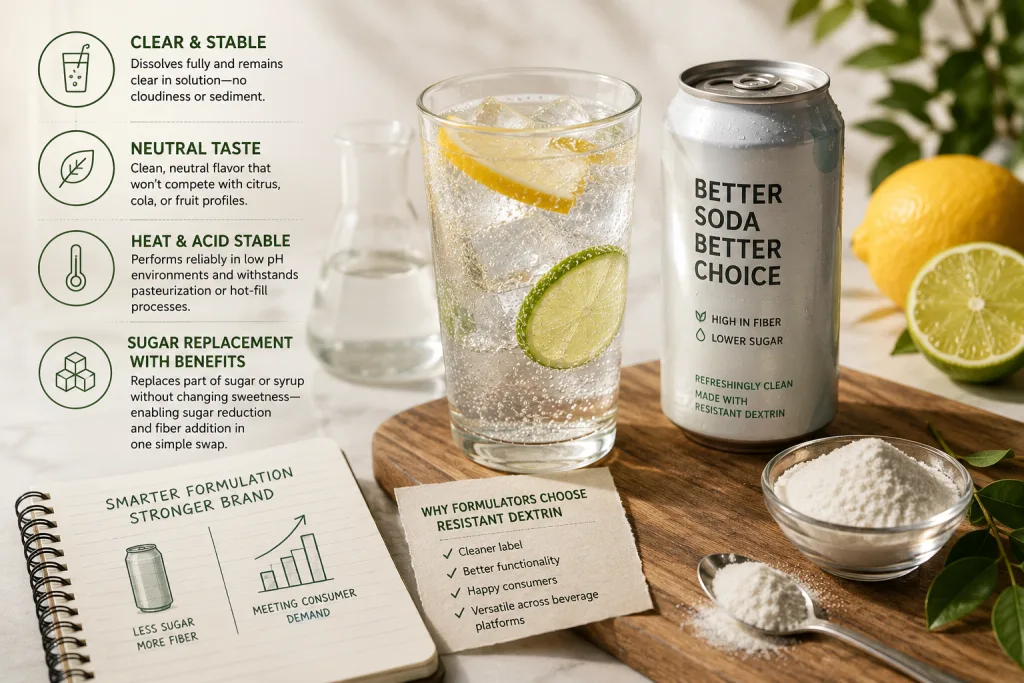
Not every fiber source works in a carbonated system. Inulin and chicory root fiber, both common in early prebiotic soda launches, can bring viscosity, cloudiness, or a mildly sweet aftertaste that fights against a clean soda profile. Resistant dextrin was developed specifically to avoid these formulation headaches, which is a large part of why it has become a go-to ingredient for beverage developers working across juices, RTD teas, and functional shakes (Nexus Ingredient, 2025).
Three properties make it particularly well suited to soda applications. First, it dissolves fully and remains clear in solution, so it will not cloud a carbonated beverage or leave sediment. Second, it carries a neutral taste profile, meaning it does not compete with citrus, cola, or fruit flavor systems the way some fiber sources can. Third, it is heat- and acid-stable, which matters directly for carbonated drinks, since most sodas sit at a low pH and may pass through pasteurization or hot-fill steps during production (Bio-Starch, 2026).
There is also a formulation bonus: resistant dextrin can replace part of the sugar or syrup load in a formula without altering sweetness perception, which allows brands to pursue a sugar-reduction claim and a fiber-addition claim from a single ingredient swap. For manufacturers already working on reduced-sugar reformulations, this makes resistant dextrin a natural next step rather than an entirely new formulation exercise.
Setting the Right Fiber Dosage for a Prebiotic Soda
Dosage is where many first-time formulators either underdeliver on the fiber claim or overshoot into digestive discomfort territory. Regulatory filings for resistant dextrin generally support intended use levels between 1.2 and 10 grams per serving across beverage categories, with liquid non-dairy beverages explicitly included in that range (U.S. Food and Drug Administration, n.d.). Within that range, most beverage developers target a few grams per serving, since even a modest inclusion level is enough to support a “good source of fiber” or “excellent source of fiber” label claim, depending on the total per-serving amount and local labeling rules.
Going higher is possible, but it comes with trade-offs. Because resistant dextrin is fermented in the colon like other soluble fibers, doses that climb toward the upper end of typical use levels can increase the likelihood of bloating or gas in sensitive consumers, particularly if a person is not used to a high-fiber diet (VitaLibrary, 2025). This is less a safety concern than a consumer-experience one: a first-time buyer who feels uncomfortable after one can is unlikely to become a repeat customer, regardless of how strong the fiber claim was on pack.
The practical approach most formulators land on is to start conservatively, in the 3 to 5 gram per serving range, validate consumer tolerance through sensory and consumer testing, and scale up only if the brand’s fiber-claim strategy requires it. This also leaves room to combine resistant dextrin with a second prebiotic fiber later in the product’s lifecycle, without needing to rebuild the base formulation from scratch.
The OEM Formulation Process, Step by Step
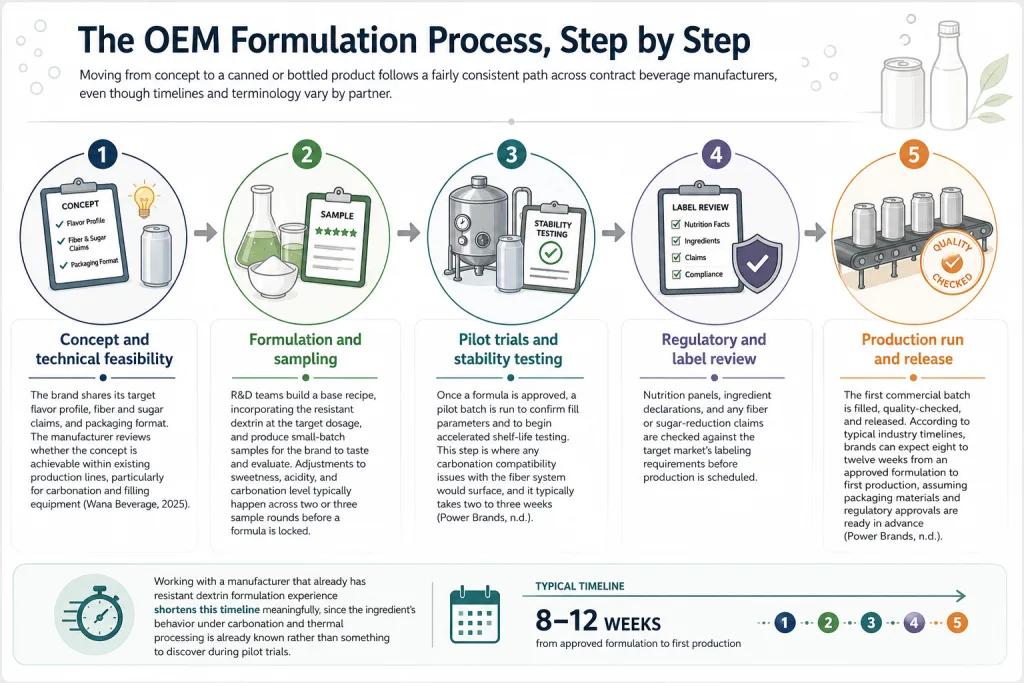
Moving from concept to a canned or bottled product follows a fairly consistent path across contract beverage manufacturers, even though timelines and terminology vary by partner.
Concept and technical feasibility. The brand shares its target flavor profile, fiber and sugar claims, and packaging format. The manufacturer reviews whether the concept is achievable within existing production lines, particularly for carbonation and filling equipment (Wana Beverage, 2025).
Formulation and sampling. R&D teams build a base recipe, incorporating the resistant dextrin at the target dosage, and produce small-batch samples for the brand to taste and evaluate. Adjustments to sweetness, acidity, and carbonation level typically happen across two or three sample rounds before a formula is locked.
Pilot trials and stability testing. Once a formula is approved, a pilot batch is run to confirm fill parameters and to begin accelerated shelf-life testing. This step is where any carbonation compatibility issues with the fiber system would surface, and it typically takes two to three weeks (Power Brands, n.d.).
Regulatory and label review. Nutrition panels, ingredient declarations, and any fiber or sugar-reduction claims are checked against the target market’s labeling requirements before production is scheduled.
Production run and release. The first commercial batch is filled, quality-checked, and released. According to typical industry timelines, brands can expect eight to twelve weeks from an approved formulation to first production, assuming packaging materials and regulatory approvals are ready in advance (Power Brands, n.d.).
Working with a manufacturer that already has resistant dextrin formulation experience shortens this timeline meaningfully, since the ingredient’s behavior under carbonation and thermal processing is already known rather than something to discover during pilot trials.
Formulation Considerations for Carbonated Systems
Carbonated beverages present a narrower formulation window than still drinks, and a few technical points are worth flagging early in development. Carbonation itself does not typically interact negatively with resistant dextrin, since the ingredient’s solubility and pH stability hold up under the acidic conditions most sodas require for flavor balance and microbial control. That said, formulators should still confirm compatibility during pilot trials rather than assuming it, since flavor systems, preservatives, and other functional additives can interact in ways a single-ingredient data sheet will not predict.
Process conditions matter too. Sodas that go through hot-fill or tunnel pasteurization need an ingredient that holds up to heat without degrading or developing off-notes, which is one of resistant dextrin’s core advantages over some alternative fibers (Bio-Starch, 2026). Cold-fill and aseptic lines carry less thermal risk but place more emphasis on microbial stability testing during the shelf-life window.
Finally, mouthfeel deserves explicit testing rather than assumption. Resistant dextrin is prized for adding negligible viscosity, but at the higher end of typical use levels, sensory panels should still confirm that carbonation “bite” and overall drink texture remain unchanged. Small formulation adjustments, such as fine-tuning carbonation volumes or acidulant levels, are far easier to make during pilot trials than after a commercial run is already scheduled.
Compliance and Label Claims for Fiber-Enriched Sodas
Fiber claims only work commercially if they hold up on the label. In the United States, the FDA’s 2016 update to the dietary fiber definition means that only fibers with demonstrated physiological benefit can be counted toward a product’s declared fiber content, and resistant maltodextrin has been recognized as meeting that definition since 2018 (Nexus Ingredient, 2025). This is a meaningful point for brands sourcing fiber ingredients, since not every fiber source on the market carries the same regulatory standing.
Separately, resistant dextrin has an established safety and GRAS history for use in conventional foods and beverages, with scientific assessments supporting daily intakes as high as 30 grams per day under typical consumption patterns (Satoria Nutrisentials, 2026). That said, a per-serving dosage decision should still be based on the target claim, sensory testing, and the applicable serving size for the beverage category, not on the upper safety limit.
Brands manufacturing for multiple markets should also confirm labeling requirements locally, since fiber definitions, permitted claims, and rounding rules can differ by region even when the underlying ingredient is approved in all of them. An experienced OEM partner will typically flag these differences during the regulatory review stage of development, before a label is finalized and packaging is committed.
Choosing an OEM Partner for Prebiotic Soda Production
Not every co-packer is set up to handle a fiber-enriched carbonated product well. A few criteria are worth checking before signing on with a manufacturing partner.
Look for demonstrated experience with functional or fortified beverages specifically, not just general soda co-packing, since fiber inclusion changes formulation behavior in ways a standard soda recipe does not account for. Ask whether the facility offers both hot-fill and cold-fill or aseptic capabilities, since the right process depends on the final formula and preservation strategy. Confirm what regulatory and label-review support is included, particularly if the product will launch in more than one market. Finally, request sample batches early, since tasting the actual formulation under production conditions reveals issues that a technical data sheet cannot.
A manufacturing partner with existing resistant dextrin formulation experience, rather than one encountering the ingredient for the first time, generally moves through pilot trials faster and with fewer surprises at the production stage.
Bringing a Fiber-Enriched Soda to Market
Prebiotic soda is no longer a passing trend, and the manufacturers who move early with a well-formulated product stand to capture disproportionate share as the category matures. Resistant dextrin gives formulators a practical way to add a credible fiber claim without compromising the clean, familiar drinking experience consumers expect from a soda. The ingredient decision is only the starting point, though. The formulation, dosage, and manufacturing partner chosen around it determine whether the finished product actually performs on shelf and earns repeat purchases.
If your team is evaluating fiber ingredients for a new or reformulated beverage line, Satoria Nutrisentials’ technical team can walk through resistant dextrin’s application data and formulation support for carbonated systems.
References
Bio-Starch. (2026, February 16). Organic resistant dextrin: The ideal ingredient for sugar-reduced and high-fiber beverages. https://www.bio-starch.com/news/organic-resistant-dextrin-the-ideal-ingredient-for-sugar-reduced-and-high-fiber-beverages/
Future Market Insights. (2025, April 30). Prebiotic soda market size, trends & forecast to 2035. https://www.futuremarketinsights.com/reports/prebiotic-soda-market
Nexus Ingredient. (2025, September 18). FiberWorks® resistant dextrin: A soluble fiber solution for health and formulation. https://nexusingredient.com/fiberworks-resistant-dextrin-a-soluble-fiber-solution-for-health-and-formulation/
Persistence Market Research. (2026). Prebiotic soda market value & forecast 2026 to 2033. https://www.persistencemarketresearch.com/market-research/prebiotic-soda-market.asp
Power Brands. (n.d.). Beverage co-packers (alcoholic & non-alcoholic): Contract manufacturing. https://www.powerbrands.us/beverage-co-packer
Satoria Nutrisentials. (2026, February 12). FDA resistant dextrin GRAS: Regulatory clarity for food and beverage manufacturers. https://satorianutrisentials.com/article/fda-resistant-dextrin-gras-regulatory-clarity-for-food-and-beverage-manufacturers/
U.S. Food and Drug Administration. (n.d.). AGG’s resistant dextrin: Determination of GRAS status https://www.fda.gov/media/161882/download
VitaLibrary. (2025, December 12). Resistant dextrin prebiotic fiber: Uses, dosage, and side effects for digestive and metabolic health. https://vitalibrary.com/resistant-dextrin-benefits-guide/
Wana Beverage. (2025, September 19). Modern beverage manufacturing: Inside drink production. https://wanabeverage.com/how-beverages-are-made-inside-the-modern-beverage-manufacturing-process/
Featured News
Category
Get a Promo and Keep Updated