
Rice Protein Isolate for Non-Dairy Sports Recovery RTD Shakes: A Formulator’s Guide
Why Saudi Arabia and the GCC Are the Next Big Opportunity for Halal Food Ingredient Suppliers
June 19, 2026
General - Articles
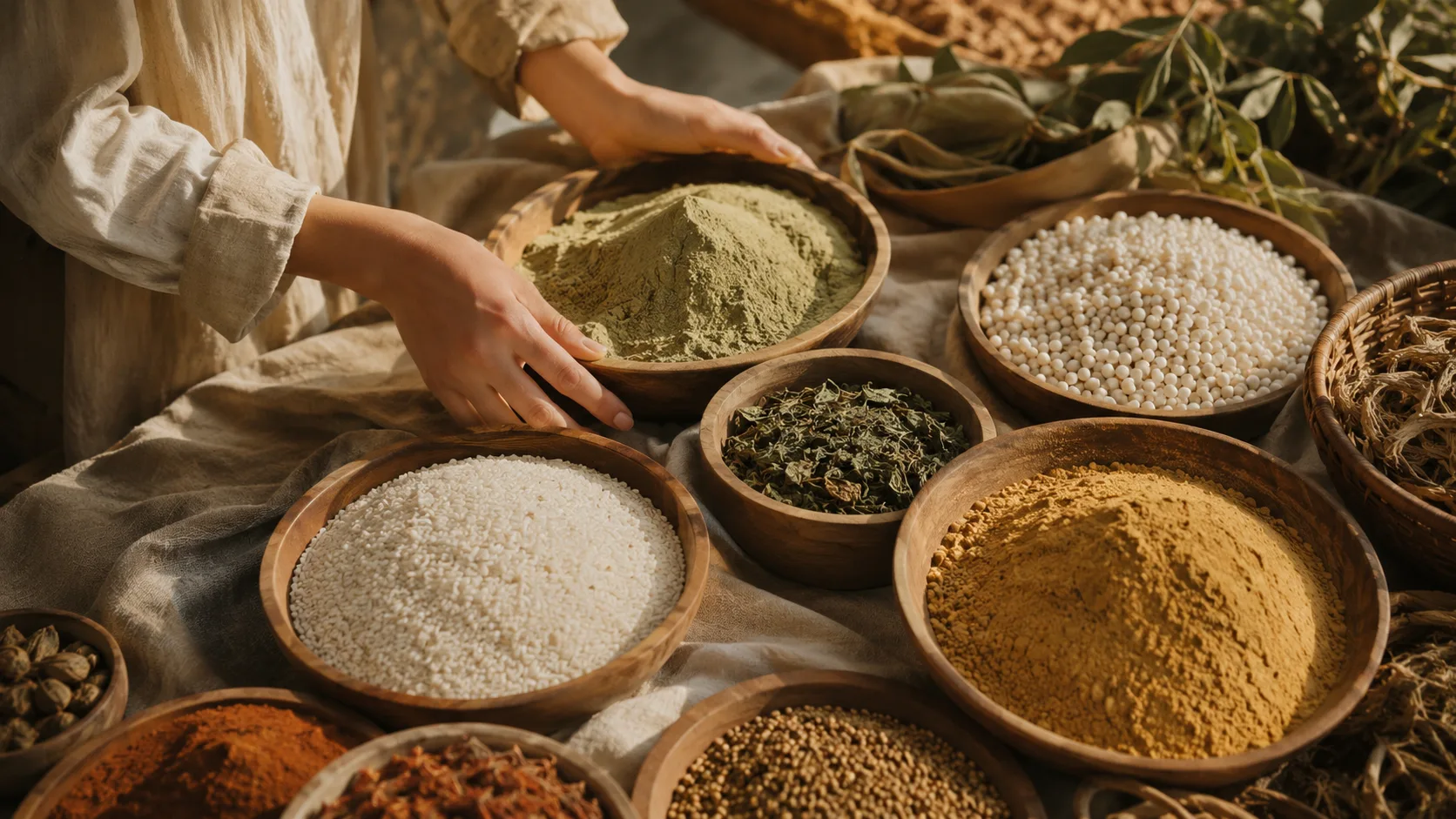
If you work in food manufacturing, you already know that halal certification is no longer just a religious requirement — it is a global quality benchmark. Nowhere is this more evident than in Saudi Arabia and the broader Gulf Cooperation Council (GCC) region, where the demand for certified, traceable, and health-forward ingredients has never been stronger. For any serious halal food ingredient supplier, this market deserves your full attention.
The numbers speak for themselves. The GCC halal food market reached USD 67.3 billion in 2025 and is on track to approach USD 89 billion by 2034. Saudi Arabia alone accounts for a significant share, with its halal food industry valued at USD 46.22 billion in 2025, growing at a compound annual growth rate of around 6.48% through 2030. That kind of trajectory does not happen by accident — it is the result of deeply rooted consumer demand, strong government infrastructure, and Vision 2030 pushing the Kingdom toward becoming a global halal hub.
So what does this mean for food manufacturers, brand developers, and procurement teams? It means the sourcing decisions you make today — which ingredients you use, who supplies them, and how they are certified — will determine whether you can access one of the world’s most lucrative food markets. This guide breaks down what you need to know.
Understanding the GCC Halal Market: More Than Just a Religious Standard
It is a common misconception that halal certification is purely about religious compliance. In the GCC — and especially in Saudi Arabia — it is also about food safety, traceability, and consumer trust. The Saudi Food and Drug Authority (SFDA) enforces some of the strictest halal import regulations in the world, requiring that all food products containing animal-derived ingredients, fats, gelatin, collagen, or enzymes of animal origin carry a valid halal certificate from an SFDA-approved certifying body before clearing customs.
For plant-based and functional ingredients — think pea protein, rice protein isolate, resistant dextrin, and natural sweeteners derived from tapioca or rice — the regulatory picture is generally more straightforward. These ingredients are inherently plant-sourced and carry no animal-derived components, which simplifies the halal compliance pathway considerably. That said, working with an SFDA approved halal ingredient supplier that already holds the right certifications eliminates risk at every step of your supply chain.
The Gulf Standardization Organization’s GSO 2055-2 standard governs halal food across all six GCC member states — Saudi Arabia, UAE, Qatar, Kuwait, Bahrain, and Oman. Compliance with this standard is not just good practice; it is effectively a prerequisite for shelf space in the region’s retail and foodservice channels. Importers who arrive without compliant documentation face rejection, delays, and costly re-certification — all of which can be avoided by partnering with a certified halal ingredient supplier from the outset.
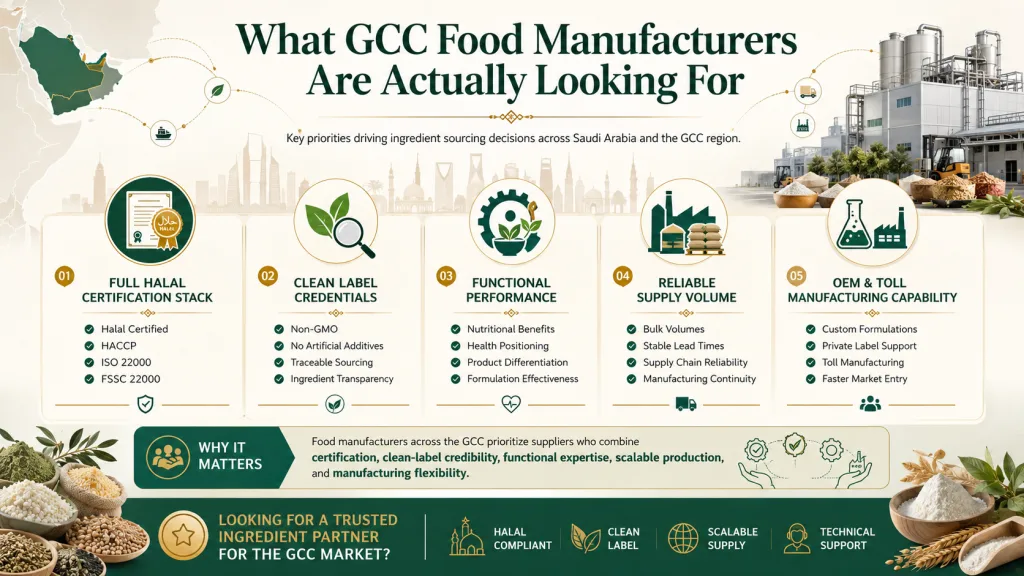
What GCC Food Manufacturers Are Actually Looking For
The region’s food manufacturers are not simply seeking the cheapest available ingredient. They are looking for suppliers who understand the market’s complexity, can deliver at scale, and bring genuine formulation expertise. Here is what procurement teams in Saudi Arabia and across the GCC are consistently prioritising:
- Full halal certification stack — including HACCP, ISO 22000, and FSSC 22000 alongside halal credentials
- Clean label credentials — Non-GMO, no artificial additives, transparent ingredient sourcing
- Functional performance — ingredients that deliver measurable health or nutritional benefits in finished products
- Reliable supply volume — bulk availability for industrial-scale food and beverage production
- OEM and toll manufacturing capability — for brands that want custom formulations without building their own production infrastructure
The clean label trend is particularly relevant. GCC consumers — especially in Saudi Arabia, where a young, health-conscious population is driving purchasing decisions — are increasingly reading ingredient labels. Concepts like prebiotic fibers, plant proteins, and natural sweeteners resonate strongly with this demographic. A halal clean label ingredient supplier that can deliver on all three fronts holds a significant competitive advantage.
It is also worth noting that the GCC is not an isolated market. Many regional manufacturers export to broader MENA markets — Egypt, Jordan, Iraq, and Pakistan among them — which means that halal compliance achieved for Saudi Arabia often opens doors across a much wider geography.
The Role of Functional Ingredients in the GCC’s Evolving Food Industry
Fiber and Digestive Health
Dietary fiber consumption remains critically below recommended levels across much of the world, and the GCC is no exception. As awareness of gut health grows, food manufacturers in the region are actively seeking halal prebiotic fiber ingredients for B2B incorporation into beverages, dairy alternatives, bakery products, and nutrition bars. Resistant dextrin — a soluble, prebiotic dietary fiber derived from plant starch — has emerged as a particularly versatile ingredient in this space.
Research published in peer-reviewed journals has demonstrated that resistant dextrin supports blood glucose management, promotes satiety, and modulates gut microbiota composition in beneficial ways. Its neutral taste profile and excellent solubility make it easy to incorporate into a wide range of product formats without affecting texture or flavour — a quality that food developers in the GCC’s fast-growing functional food sector find invaluable.
Plant Proteins for a Growing Market
Protein fortification is another high-growth category in the GCC. Whether the end product is a sports nutrition supplement, a high-protein dairy alternative, or an enriched snack for the region’s increasingly fitness-conscious consumers, manufacturers need a reliable halal plant protein ingredient supplier they can count on. Pea protein isolate and rice protein isolate are leading candidates here, valued for their amino acid profiles, digestibility, and fully plant-based origin — meaning they sit squarely within halal compliance requirements without any additional scrutiny.
Scientific reviews have confirmed that pea protein supports gut microbiome health, contributes to satiety, and offers cardiometabolic benefits comparable to animal-derived protein sources. For a halal nutraceutical ingredient manufacturer serving the GCC, this is meaningful: it means products built on these ingredients carry a credible health story that supports both regulatory compliance and marketing claims.
Natural Sweeteners
The GCC’s food industry is under real pressure to reduce sugar content. Consumer awareness of metabolic health, diabetes risk, and obesity — all of which are prevalent health challenges across Saudi Arabia and neighbouring countries — is driving demand for functional, natural sugar alternatives. Ingredients like tapioca syrup, rice syrup, and low-GI sugar alternatives that maintain sweetness without the metabolic spike of refined sugar are in genuine demand from manufacturers seeking halal certified food ingredient supplier solutions that also support clean-label positioning.
Why Sourcing Locally or Regionally Certified Ingredients Matters
For manufacturers supplying the GCC, the country of origin and the certification chain of your ingredients both matter. Saudi Arabia’s SFDA requires full traceability from raw material to finished product. This means your halal food ingredient supplier for the Saudi Arabia market must be able to provide documentation at every stage — not just a certificate on the final product, but evidence that the supply chain itself meets halal standards.
This is where working with a supplier that has both manufacturing-level certification (ISO 22000, FSSC 22000, HACCP, GMP) and product-level halal certification makes a significant practical difference. It simplifies your audit trail, speeds up SFDA registration, and reduces the risk of rejected shipments. Critically, it also protects your brand — because halal non-compliance in Saudi Arabia is not a minor paperwork issue. It can result in product recalls, import bans, and serious reputational damage.
At the same time, manufacturers targeting the US, Canada, or European markets alongside the GCC will benefit from partnering with suppliers who hold multiple overlapping certifications — FDA registration, USDA Organic, Non-GMO, Kosher, and halal — all from a single source. This simplifies procurement, reduces vendor management complexity, and makes it far easier to develop product lines that can move between markets without reformulation.
OEM and Toll Manufacturing: A Strategic Advantage for GCC Market Entry
Not every brand entering the GCC market has the production infrastructure to manufacture at scale. This is where halal OEM food manufacturing and halal toll manufacturing food ingredients services become genuinely strategic. Rather than investing in proprietary production facilities, brands can partner with a certified manufacturer to produce custom ingredient blends, finished formulations, or private-label products that meet GCC regulatory requirements.
This model is particularly attractive for international brands — whether from the US, Canada, or Europe — looking to enter Saudi Arabia or the broader GCC without establishing a local manufacturing presence. The OEM partner handles production, certification, and quality assurance. The brand handles distribution, marketing, and commercialisation. It is an efficient route to market that significantly reduces time, capital outlay, and regulatory risk.
For halal ingredient manufacturer United States or halal food ingredient supplier Europe operations looking to serve GCC buyers, offering OEM and toll manufacturing capability is often the differentiator that closes the deal. GCC importers are experienced buyers — they know exactly what they need, and they want a supplier who can deliver it with minimal friction.
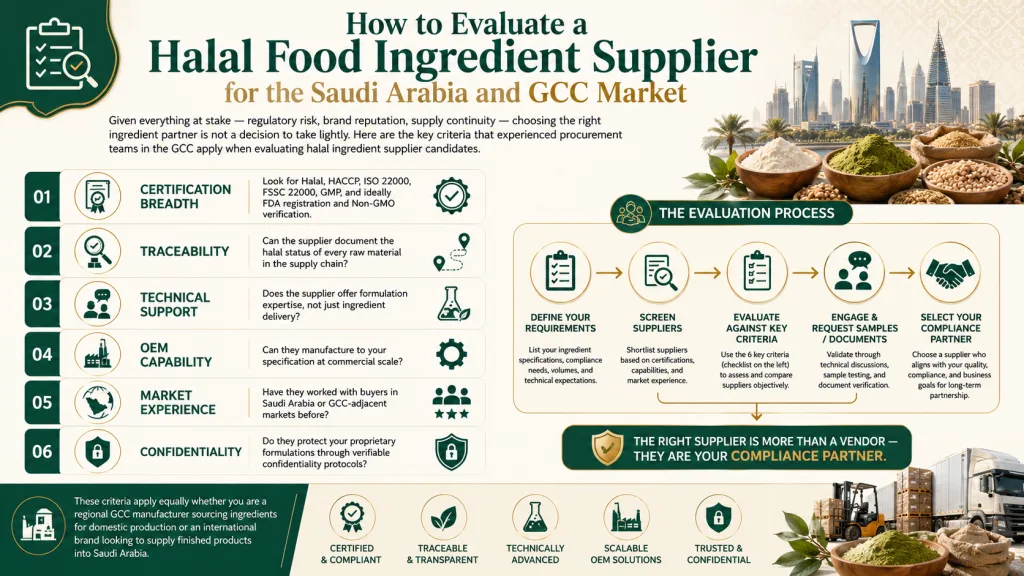
How to Evaluate a Halal Food Ingredient Supplier for the Saudi Arabia and GCC Market
Given everything at stake — regulatory risk, brand reputation, supply continuity — choosing the right ingredient partner is not a decision to take lightly. Here are the key criteria that experienced procurement teams in the GCC apply when evaluating a halal ingredient supplier GCC market candidates:
- Certification breadth: Look for Halal, HACCP, ISO 22000, FSSC 22000, GMP, and ideally FDA registration and Non-GMO verification
- Traceability: Can the supplier document the halal status of every raw material in the supply chain?
- Technical support: Does the supplier offer formulation expertise, not just ingredient delivery?
- OEM capability: Can they manufacture to your specification at commercial scale?
- Market experience: Have they worked with buyers in Saudi Arabia or GCC-adjacent markets before?
- Confidentiality: Do they protect your proprietary formulations through verifiable confidentiality protocols?
These criteria apply equally whether you are a regional GCC manufacturer sourcing ingredients for domestic production or an international brand looking to supply finished products into Saudi Arabia. The right supplier is not just a vendor — they are a compliance partner.
Satoria Nutrisentials: A World-Class Solution for GCC Halal Ingredient Sourcing
For F&B brands and manufacturers looking for a fully certified, technically capable, and export-ready halal food ingredient supplier for Saudi Arabia, GCC, and international markets, Satoria Nutrisentials offers a compelling solution. Headquartered in Indonesia and manufacturing to world-class standards, Satoria holds a comprehensive certification stack that includes Halal, HACCP, ISO 22000, FSSC 22000, ISO 14001, ISO 45001, FDA, BPOM, SNI, USDA Organic, Non-GMO, and Australian Kosher accreditation — meaning their products meet the stringent requirements of SFDA-regulated importers and are equally at home in the US, Canadian, and European markets.
Their industrial product portfolio maps directly to the GCC’s highest-demand ingredient categories. Resistant Dextrin serves the growing prebiotic fiber and digestive health segment. Pea Protein Isolate and Rice Protein Isolate address the plant protein fortification trend sweeping the region’s sports nutrition, dairy alternative, and functional food categories. Rice Maltodextrin, Pea Maltodextrin, Rice Syrup, and Tapioca Syrup round out a functional carbohydrate and natural sweetener range that gives food developers meaningful formulation flexibility. Each ingredient is available in bulk quantities designed for industrial-scale manufacturing — and the entire portfolio carries full halal certification.
Beyond ingredients, Satoria’s OEM and Toll Manufacturing service is specifically designed for brands that want bespoke product development — including spray-dried and biscuit product formats — without the capital investment of building their own facility. Their confidentiality-first approach means your proprietary formulation stays your competitive edge. If you are evaluating halal ingredient supplier GCC market options, Satoria is purpose-built for exactly this kind of partnership.
Ready to Build Your GCC Supply Chain on a Certified, World-Class Foundation?
The GCC halal food market is growing fast, and the manufacturers who will win in Saudi Arabia, UAE, Qatar, and beyond are the ones making smart sourcing decisions right now. Whether you are formulating a new product line, scaling an existing range, or entering the GCC market for the first time, your ingredient supplier is the foundation everything else is built on.
Satoria Nutrisentials provides innovative, healthy food ingredients tailored to your needs — backed by world-class certifications, genuine technical expertise, and a manufacturing infrastructure built for serious B2B partnerships. Explore the full product catalogue and discover how Satoria’s halal-certified ingredient range can unlock the GCC and Saudi Arabia market for your brand.
Visit satorianutrisentials.com/products to explore the full range and get in touch with the team today.
References
- IMARC Group. (2025). GCC Halal Food Market: Industry Trends, Share, Size, Growth, Opportunity and Forecast 2025–2033. Retrieved from https://www.imarcgroup.com/gcc-halal-food-market
- MarkNtel Advisors. (2025). Saudi Arabia Halal Food Market Size and Growth Forecast by 2030. Retrieved from https://www.marknteladvisors.com/research-library/halal-food-market-saudi-arabia.html
- Saudi Food and Drug Authority (SFDA). (2025). Executive Management of Food Import Control. Retrieved from https://www.sfda.gov.sa/en/imported-food
- ChemLinked. (2026). Saudi Arabia Food Regulation. Retrieved from https://food.chemlinked.com/foodpedia/saudi-arabia-food-regulation
- Dahl, W. J., Zeng, H., & Auger, J. (2022). Effect of resistant dextrin on intestinal gas homeostasis and microbiota. National Institutes of Health / PubMed Central. Retrieved from https://www.ncbi.nlm.nih.gov/pmc/articles/PMC9654059/
- Li, H., Prairie, N., Udenigwe, C. C., Adebiyi, A. P., Tappia, P. S., Aukema, H. M., Jones, P. J., & Aluko, R. E. (2022). Recent advances in the health benefits of pea protein (Pisum sativum): bioactive peptides and the interaction with the gut microbiome. ScienceDirect. Retrieved from https://www.sciencedirect.com/science/article/abs/pii/S2214799322001461
- Gorissen, S. H. M., Crombag, J. J. R., Senden, J. M. G., Waterval, W. A. H., Bierau, J., Verdijk, L. B., & van Loon, L. J. C. (2020). Exploring health-promoting attributes of plant proteins as a functional ingredient for the food sector: A systematic review of human interventional studies. PubMed Central. Retrieved from https://www.ncbi.nlm.nih.gov/pmc/articles/PMC7468935/
- Zhang, Q., Zhao, L., Chen, L., Tian, X., & Yang, F. (2020). Resistant dextrin improves high-fat-high-fructose diet induced insulin resistance. PubMed Central. Retrieved from https://www.ncbi.nlm.nih.gov/pmc/articles/PMC7227367/
- Gulf Standardization Organization (GSO). (2015). GSO 2055-1: General Requirements for Halal Food. Gulf Standardization Organization. Retrieved from https://saudifoodregistration.com/gso-2055-2-halal-certification
Featured News
Category
Get a Promo and Keep Updated