
Rice Protein Isolate for Non-Dairy Sports Recovery RTD Shakes: A Formulator’s Guide
Why Choosing a Halal Certified Food Ingredient Manufacturer Matters More Than Ever
May 11, 2026
General - Articles
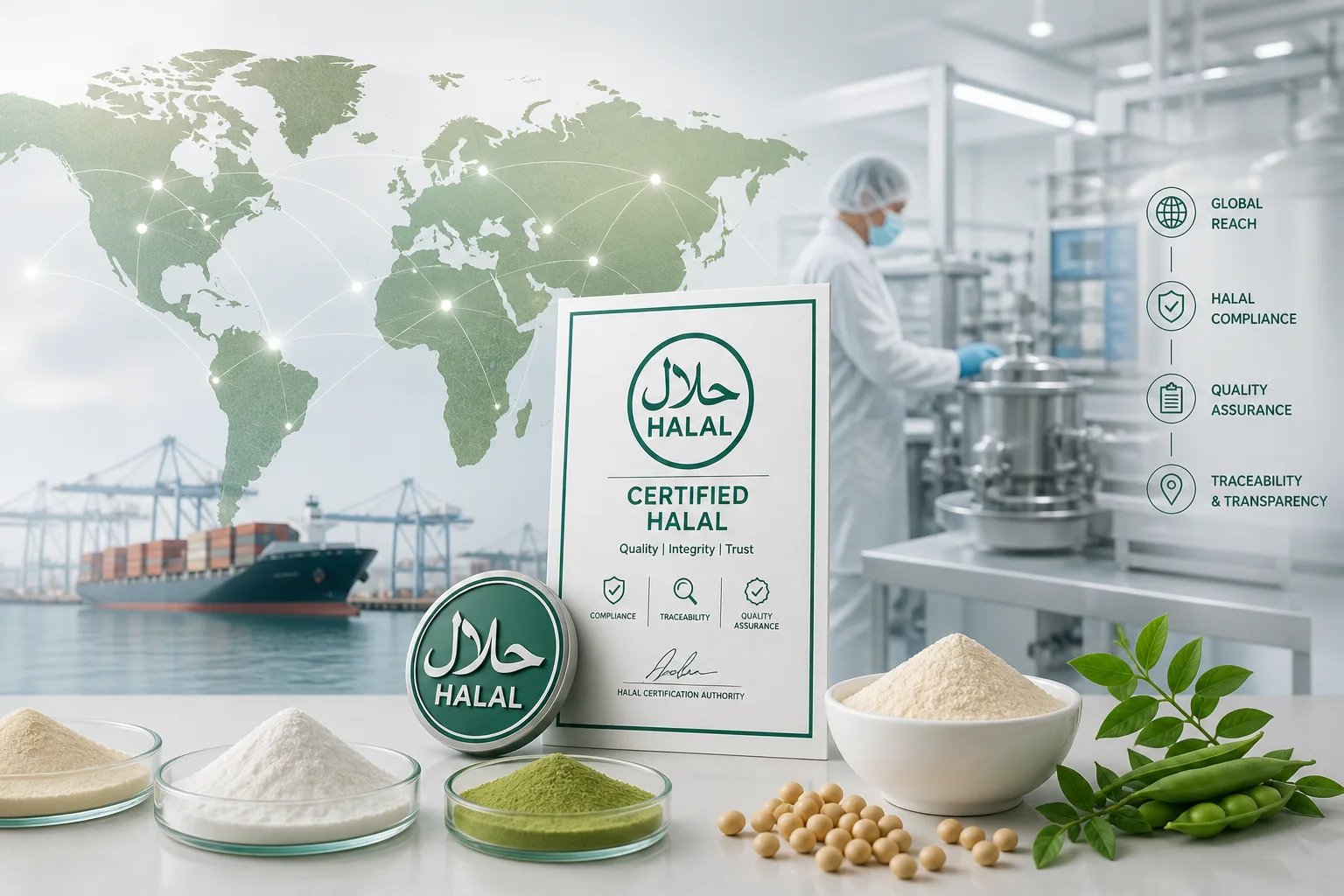
The global halal food market is no longer a niche. It is one of the fastest-growing segments in the food industry, driven by 1.8 billion Muslim consumers worldwide — and a growing number of non-Muslim buyers who associate halal certification with higher standards of quality, hygiene, and traceability. For brands and manufacturers, partnering with a halal certified food ingredient manufacturer has shifted from a nice-to-have to a genuine business imperative.
But what does halal certification actually mean for functional food ingredients? And how do you find a supplier who delivers on both the compliance promise and the formulation performance your products demand? This guide breaks it all down.
What Halal Certification Really Means for Food Ingredients
Halal is an Arabic word meaning ‘permissible.’ In the context of food manufacturing, it covers far more than simply avoiding pork or alcohol. Halal certification encompasses the entire supply chain — from raw material sourcing and production equipment to storage, handling, and transportation. Every point of potential contamination must be assessed and controlled.
For functional food ingredients specifically, this matters enormously. An ingredient like a plant-based protein or a natural sweetener may be derived from a permissible source, but if it was processed on shared equipment with non-halal materials, the certification is void. A rigorous halal certified food ingredient manufacturer maintains separate production lines or conducts thorough cleaning validation between production runs.
Third-party halal certification bodies — such as the Indonesian Ulema Council (MUI), JAKIM in Malaysia, or IFANCA — audit manufacturers regularly. They verify ingredient sourcing, processing protocols, sanitation procedures, and staff training. For buyers, this audit trail provides a level of transparency that goes well beyond a supplier’s word alone.
The Growing Demand for Halal Functional Food Ingredients
Why is demand surging right now? Several converging trends are reshaping the market. The global halal food and beverage market was valued at over USD 1.9 trillion in 2023 and is projected to grow significantly through the decade. That growth is not confined to Muslim-majority regions — it is expanding into Europe, North America, and East Asia, where halal labelling increasingly signals clean-label, ethically produced food.
Simultaneously, consumers everywhere are becoming more sophisticated about functional food ingredients. They want products that do more than just taste good — ingredients that support gut health, manage blood sugar, boost protein intake, or reduce sugar content. When you combine these two trends, the opportunity for a halal certified manufacturer of functional ingredients becomes very clear.
Food companies entering markets across Southeast Asia, the Middle East, or Muslim communities in Western countries face a simple reality: without halal certification on their ingredient stack, they cannot access those consumers at all. This makes the certification a market access tool, not just a compliance checkbox.
Key Functional Food Ingredients and Their Halal Considerations
Not all functional food ingredients carry the same halal risk profile. Understanding the specific considerations for each category helps procurement teams ask better questions and make smarter sourcing decisions.
Dietary Fibres and Digestive Health Ingredients
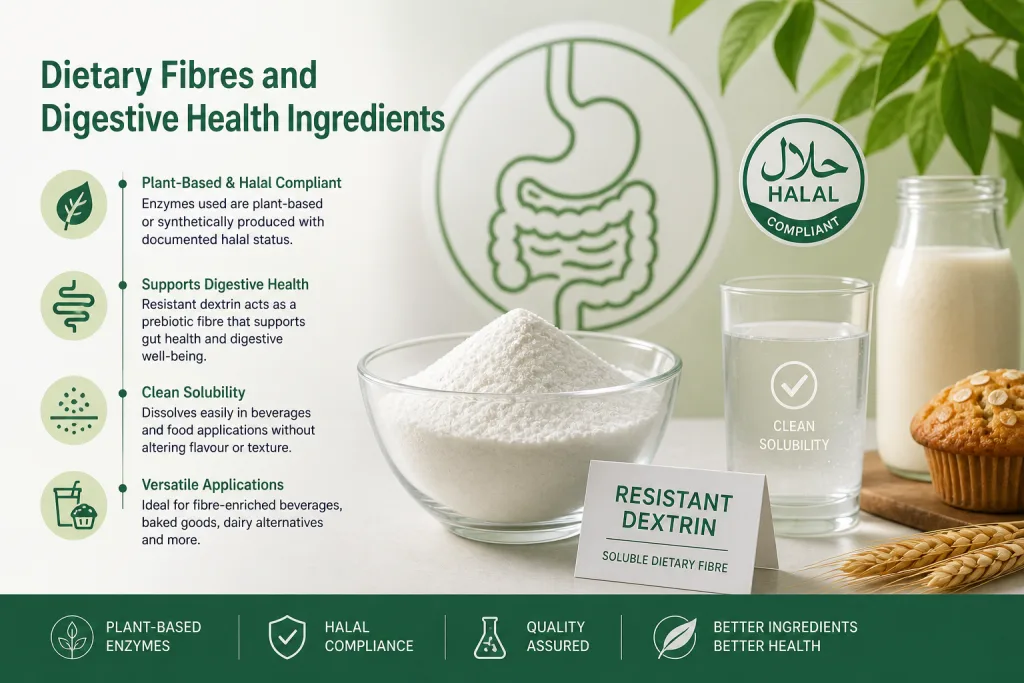
Soluble dietary fibres like resistant dextrin are produced through the enzymatic or chemical modification of starch. The key halal concern here lies in the enzymes used during processing — some commercial enzymes are derived from animal sources or fermented using non-halal substrates. A compliant manufacturer will use only plant-based or synthetically produced enzymes with documented halal status. Resistant dextrin itself is a compelling ingredient for fibre-enriched beverages, baked goods, and dairy alternatives precisely because it dissolves cleanly and does not alter flavour or texture.
Plant-Based Proteins
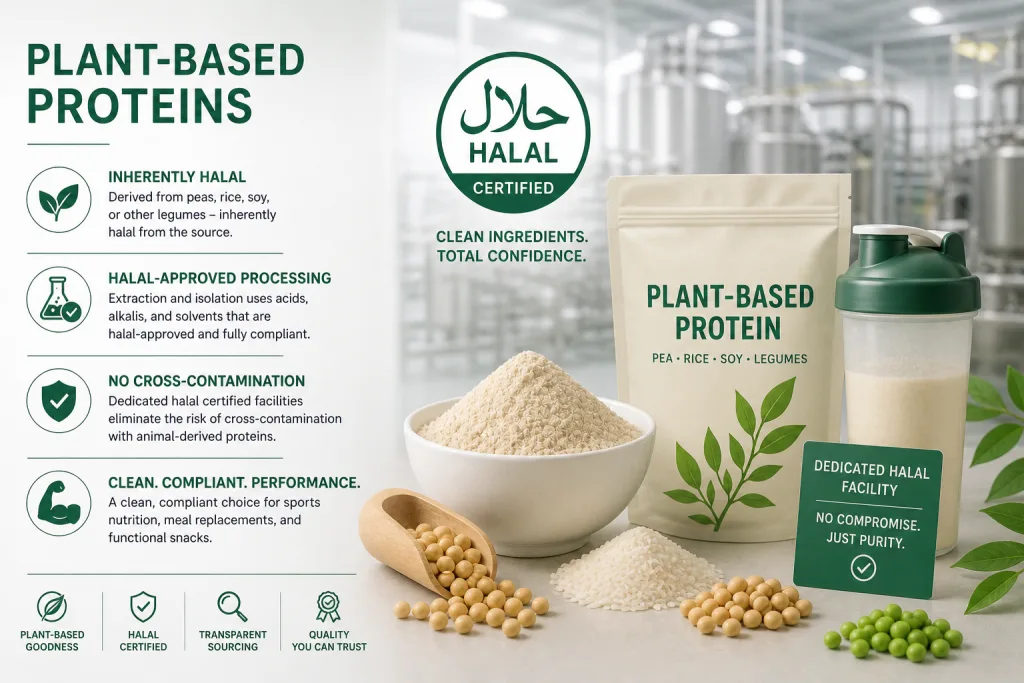
Plant-based protein — derived from peas, rice, soy, or other legumes — is inherently halal from a source perspective. However, the extraction and isolation process often involves acids, alkalis, and solvents that must themselves be halal-approved. Cross-contamination with animal-derived proteins during shared processing is another concern. A dedicated halal certified facility eliminates this risk, making plant-based protein a clean, compliant choice for sports nutrition, meal replacements, and functional snacks.
Natural Sweeteners
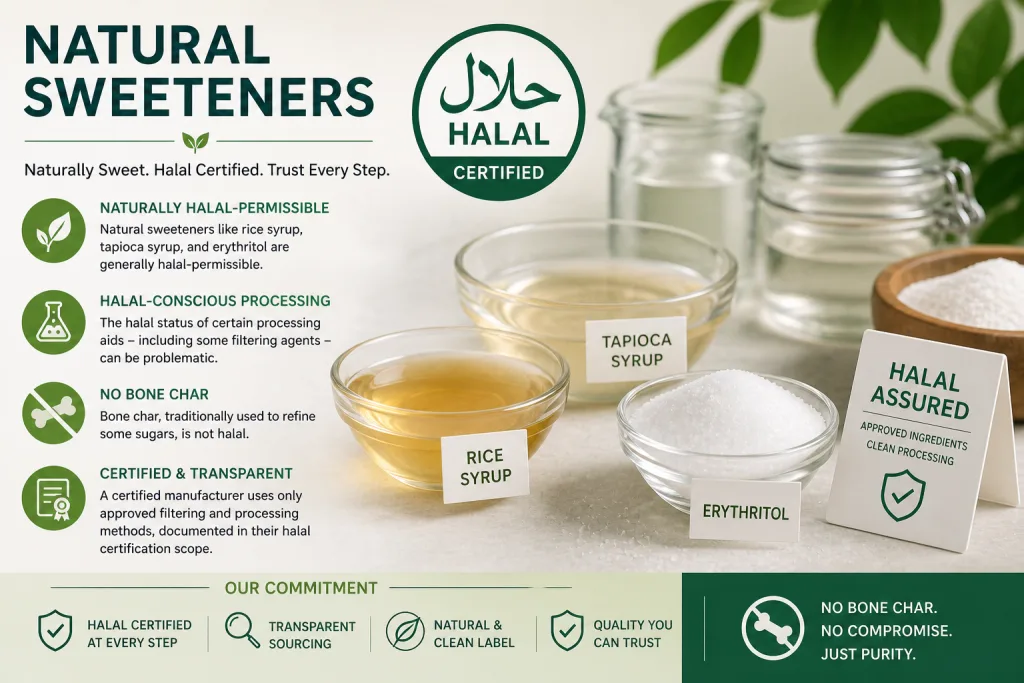
Natural sweeteners like rice syrup, tapioca syrup, and erythritol are generally halal-permissible, but the halal status of certain processing aids — including some filtering agents — can be problematic. Bone char, traditionally used to refine some sugars, is not halal. A certified manufacturer uses only approved filtering and processing methods, documented in their halal certification scope.
What to Look for in a Halal Certified Food Ingredient Supplier
Choosing the right food ingredient supplier in Southeast Asia — or anywhere — goes beyond checking whether they hold a current halal certificate. Here are the most important criteria to evaluate:
- Recognised halal certification body: Ensure the certifying body is accepted in your target markets. MUI (Indonesia) and JAKIM (Malaysia) certificates are widely recognised globally.
- Scope of certification: Verify the certificate covers the specific ingredients you intend to buy, not just the facility generally.
- Complementary food safety certifications: Look for ISO 22000, FSSC 22000, and HACCP alongside halal — these confirm the manufacturer operates robust safety management systems.
- Transparency in raw material sourcing: A trustworthy supplier will openly share their ingredient origin documentation and supplier audit records.
- OEM and toll manufacturing capability: If you need custom formulations, choose a partner who offers both OEM food manufacturing and toll manufacturing services, ideally with in-house R&D support.
- Non-GMO and other certifications: Additional certifications like Non-GMO, USDA Organic, and Kosher broaden your market reach and signal premium quality.
The Advantage of Southeast Asia as a Sourcing Hub
When it comes to private label food ingredient sourcing, Asia — and Southeast Asia in particular — offers a compelling combination of ingredient diversity, manufacturing sophistication, and cost efficiency. The region is the world’s largest producer of tapioca, rice, peas, and other plant crops that serve as the raw material basis for many key functional food ingredients.
Indonesia alone has one of the most rigorous national halal certification frameworks in the world, administered by BPJPH and backed by MUI fatwa guidelines. Manufacturers based in Indonesia are therefore well-positioned to supply to Muslim-majority markets in the Middle East, South and Southeast Asia, as well as Western markets with significant Muslim populations.
For brands exploring custom food formulation and looking to differentiate their product range, a Southeast Asian manufacturer with halal certification, GMP compliance, and in-house formulation expertise can dramatically reduce time-to-market while keeping ingredient costs competitive.
OEM and Toll Manufacturing: How Halal Certification Fits In
Many brands today do not manufacture their own ingredients — they work with OEM food manufacturing partners or toll manufacturing facilities to bring their formulations to life. In this model, the halal integrity of the manufacturing partner becomes the halal integrity of your product. There is no middle ground.
A reputable OEM partner working under halal certification will maintain strict production scheduling to prevent cross-contamination, use only halal-approved inputs across all formulations, and provide you with the documentation needed to apply for halal certification on your finished product. This is particularly valuable for brands building a halal product line from scratch, who need to move quickly without building their own certified manufacturing infrastructure.
Toll manufacturing adds another layer of flexibility. If your brand has a proprietary formula, a toll manufacturer processes it using their certified facilities and equipment — meaning your formula remains confidential while the certification compliance is fully managed on your behalf. For startups and established brands alike, this significantly reduces capital investment and compliance burden.
How Satoria Nutrisentials Delivers on Halal Certification
Satoria Nutrisentials, based in Pasuruan, East Java, Indonesia, operates as a fully integrated halal certified food ingredient manufacturer. Their 14-hectare facility holds halal certification alongside FSSC 22000, ISO 22000, HACCP, GMP, Non-GMO, Kosher, USDA Organic, BPOM, and FDA certifications — a combination that covers virtually every major market standard globally.
Their industrial ingredient range is built around the most in-demand functional food categories. Resistant dextrin — their hero product — is a prebiotic soluble fibre used in digestive health products, beverages, and reduced-sugar formulations. It is produced using halal-compliant processing and is available in bulk quantities for large-scale food manufacturing. Their plant-based protein portfolio includes rice protein isolate and pea protein, both derived from non-animal, halal-permissible sources and processed in their certified facility.
On the natural sweeteners side, Satoria offers rice syrup, tapioca syrup, and their SweetSentials sugar alternative — all formulated as clean-label, halal-compliant options for brands reducing refined sugar in their products. And for brands who need a manufacturing partner rather than just an ingredient supplier, their OEM and toll manufacturing services for biscuits and spray-dried products provide end-to-end halal-compliant production with full confidentiality guaranteed.
Ready to Build a Halal-Compliant Product Range? Let’s Talk.
Whether you are formulating a new functional food product from scratch, seeking a reliable food ingredient supplier in Southeast Asia, or looking for a trusted OEM manufacturing partner who takes halal compliance as seriously as you do — the right first step is finding a manufacturer who can genuinely deliver on every dimension.
Satoria Nutrisentials offers exactly that: world-class certified functional food ingredients, custom formulation support, and flexible OEM and toll manufacturing services, all under a rigorous halal-certified framework. From resistant dextrin and plant-based protein to natural sweeteners and specialty starches, their product range gives your brand the foundation it needs to compete in today’s health-conscious, halal-aware market.
Explore Satoria Nutrisentials’ full product range and OEM services, and take the first step towards a fully halal-compliant, market-ready formulation today.
References
- Bonne, K., & Verbeke, W. (2008). Muslim consumer trust in halal meat status and control in Belgium. Meat Science, 79(1), 113–123. https://doi.org/10.1016/j.meatsci.2007.08.007
- Talib, M. S. A., Hamid, A. B. A., & Zulfakar, M. H. (2015). Halal supply chain critical success factors: a literature review. Journal of Islamic Marketing, 6(1), 44–71. https://doi.org/10.1108/JIMA-07-2013-0049
- Geng, S., Zhu, W., Xie, F., Li, T., Wu, J., & Zhu, Z. (2016). Medium-chain fatty acid salts improve gut environment and modulate gut health markers in growing pigs. Nutrients, 8(9), 530. https://doi.org/10.3390/nu8090530
- Sajilata, M. G., Singhal, R. S., & Kulkarni, P. R. (2006). Resistant starch — a review. Comprehensive Reviews in Food Science and Food Safety, 5(1), 1–17. https://doi.org/10.1111/j.1541-4337.2006.tb00076.x
- Boye, J., Zare, F., & Pletch, A. (2010). Pulse proteins: processing, characterization, functional properties and applications in food and feed. Food Research International, 43(2), 414–431. https://doi.org/10.1016/j.foodres.2009.09.003
- World Health Organization (2023). Food safety: Halal food production and global standards. WHO Technical Report Series. https://www.who.int/news-room/fact-sheets/detail/food-safety
- State of the Global Islamic Economy Report (2023). Halal food market: Global trends and projections 2023–2028. DinarStandard / Salaam Gateway. https://www.salaamgateway.com/reports/state-of-the-global-islamic-economy-report-2023
- Verbeke, W., Rutsaert, P., Bonne, K., & Vermeir, I. (2013). Credence quality coordination and consumers’ willingness-to-pay for certified halal labelled meat. Meat Science, 95(4), 790–797. https://doi.org/10.1016/j.meatsci.2013.04.042
Featured News
Category
Get a Promo and Keep Updated