
Rice Protein Isolate for Non-Dairy Sports Recovery RTD Shakes: A Formulator’s Guide
The Smart Buyer’s Guide to Finding a Fibersol Alternative Resistant Dextrin Supplier
June 8, 2026
Resistant Dextrin - Articles
If your formulation team has been relying on Fibersol-2 as your go-to soluble fiber ingredient, you’re in good company. It’s one of the most studied digestion resistant maltodextrin alternatives on the market, with decades of research behind it. But here’s a question worth asking: is Fibersol-2 actually the only credible option — or has the market quietly matured to the point where equally effective, better-positioned alternatives now exist?
The answer, increasingly, is the latter. A growing number of food and beverage manufacturers are exploring what it means to source resistant dextrin in bulk from a reliable, certified supplier — one that can deliver the same functional performance, with cleaner credentials, more flexible supply chain options, and a price point that makes sense at scale. This guide walks you through what to look for, how to compare your options, and why the sourcing decision matters more than most people realize.
What Is Resistant Dextrin and Why Does It Matter?
Resistant dextrin is a soluble dietary fiber derived from starch — typically corn or tapioca — through a process of controlled heat and enzymatic treatment. The result is a short-chain glucose polymer that resists digestion in the small intestine and travels largely intact to the colon, where it acts as a prebiotic, fueling beneficial gut bacteria and producing short-chain fatty acids (SCFAs).
From a formulation standpoint, what makes resistant dextrin so attractive is its processing neutrality. It’s colorless, nearly tasteless, and stable across a wide pH range (roughly 2–8) and temperatures up to 150–200°C. It dissolves cleanly in both wet and dry applications — beverages, baked goods, dairy products, confectionery, and more — without altering texture or appearance. For brands building fiber-enriched products, that kind of versatility is genuinely rare.
Functionally, the health benefits are well-supported. Peer-reviewed studies have linked resistant dextrin supplementation to improved glycemic response, reduced cholesterol, better satiety, and meaningful shifts in gut microbiota composition. It’s FDA GRAS-recognized and widely approved across global regulatory frameworks, which matters enormously for manufacturers selling into multiple markets.
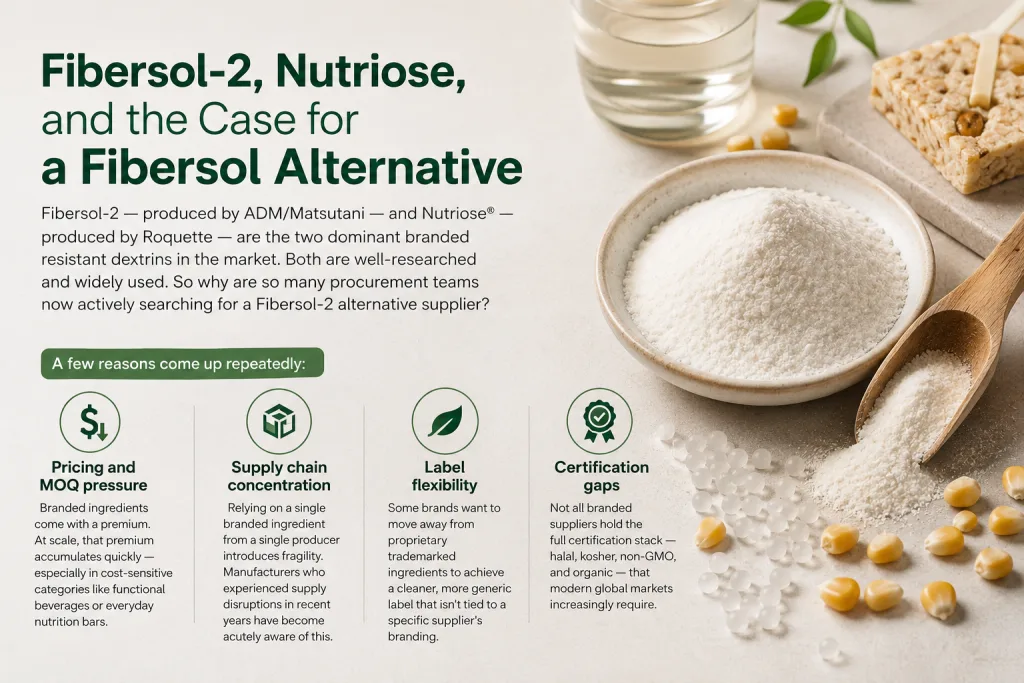
Fibersol-2, Nutriose, and the Case for a Fibersol Alternative
Fibersol-2 — produced by ADM/Matsutani — and Nutriose® — produced by Roquette — are the two dominant branded resistant dextrins in the market. Both are well-researched and widely used. So why are so many procurement teams now actively searching for a Fibersol-2 alternative supplier?
A few reasons come up repeatedly:
- Pricing and MOQ pressure: Branded ingredients come with a premium. At scale, that premium accumulates quickly — especially in cost-sensitive categories like functional beverages or everyday nutrition bars.
- Supply chain concentration: Relying on a single branded ingredient from a single producer introduces fragility. Manufacturers who experienced supply disruptions in recent years have become acutely aware of this.
- Label flexibility: Some brands want to move away from proprietary trademarked ingredients to achieve a cleaner, more generic label that isn’t tied to a specific supplier’s branding.
- Certification gaps: Not all branded suppliers hold the full certification stack — halal, kosher, non-GMO, and organic — that modern global markets increasingly require.
A quality resistant dextrin B2B supplier can often match the functional performance of branded products while addressing all of these concerns. The key is knowing what to verify before you sign a supply agreement.
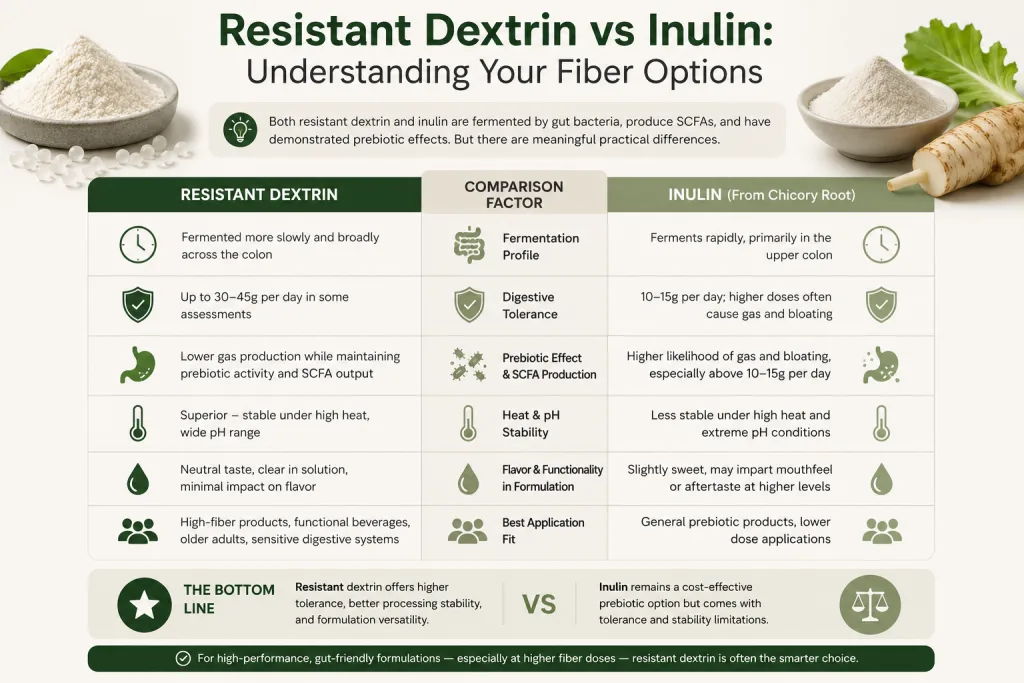
Resistant Dextrin vs Inulin: Understanding Your Fiber Options
Before committing to any soluble fiber ingredient, it’s worth understanding how resistant dextrin compares to other commonly used options — particularly inulin, which remains one of the most popular prebiotic fibers in functional food formulation.
Both resistant dextrin and inulin are fermented by gut bacteria, produce SCFAs, and have demonstrated prebiotic effects. But there are meaningful practical differences.
Inulin, derived primarily from chicory root, ferments rapidly and can cause significant gas and bloating — particularly at doses above 10–15g per day. Research published in Nutrients found that substituting a portion of inulin with resistant dextrin in a combination formula reduced gas production while maintaining comparable prebiotic activity and SCFA output, making it a more gut-friendly approach, especially for older consumers.
Resistant dextrin, by contrast, is fermented more slowly and broadly across the colon. Studies suggest its digestive tolerance range is substantially higher — up to 30–45g per day in some assessments — compared to inulin’s more limited ceiling. For manufacturers building high-fiber products or products targeting sensitive digestive systems, that difference is formulation-defining. Add in resistant dextrin’s superior heat stability, pH tolerance, and flavor neutrality, and it becomes a strong all-rounder in contexts where inulin’s limitations create formulation headaches.
What Certifications Should a Resistant Dextrin Supplier Hold?
This is where many sourcing decisions either gain confidence or fall apart. The certifications your supplier holds aren’t just paperwork — they’re your entry ticket to different markets, and they’re increasingly part of the story you tell consumers.
Here’s what a credible resistant dextrin manufacturer should be able to demonstrate:
Halal and Kosher Certification
For brands selling into Muslim-majority markets across Southeast Asia, the Middle East, and parts of Africa — or into Jewish community markets in North America and Europe — resistant dextrin halal certified and kosher certified status is non-negotiable. These certifications require third-party audits of ingredients, processing aids, facility protocols, and cross-contamination prevention.
Non-GMO Verification
Consumer preference for non-GMO ingredients continues to grow globally. A resistant dextrin non-GMO supplier should be able to provide documentation of non-GMO source starch and production traceability. This matters particularly for brands positioning products in the natural, organic, or clean label space.
Food Safety Standards
Look for FSSC 22000, ISO 22000, HACCP, and GMP compliance at minimum. These frameworks govern everything from raw material handling to finished product testing, and they signal that the manufacturer treats food safety as a system rather than an afterthought.
Regulatory Approvals
BPOM (for Indonesian market), US FDA GRAS status, and alignment with EU food law are the foundational regulatory markers. A clean label dietary fiber supplier operating across multiple geographies should hold or be able to support registrations in your target market.
What to Look for in a Resistant Dextrin B2B Supplier
Beyond certifications, the sourcing relationship itself matters. Finding a reliable resistant dextrin supplier — especially one capable of OEM and bulk supply — involves evaluating a few additional dimensions.
Manufacturing capacity and consistency: Can the supplier reliably fulfill large orders without batch-to-batch variability? Consistent fiber content, moisture levels, and particle size are critical for maintaining product performance at scale. Look for suppliers who manufacture in dedicated facilities with documented quality control protocols.
Packaging flexibility: A good resistant dextrin bulk supplier should offer multiple packaging formats — powder in paper bags (typically 25kg), liquid in IBC tanks, and potentially retail-ready packaging if you’re developing a consumer-facing product. This flexibility supports both industrial manufacturing and direct-to-consumer formulation pathways.
OEM and toll manufacturing capability: If you need finished product manufacturing — not just raw ingredient supply — a resistant dextrin OEM manufacturer who can handle formulation, processing, and packaging under your brand is a significant value-add. This is particularly relevant for brands entering new markets without existing manufacturing infrastructure.
Geographic positioning: A resistant dextrin Indonesia supplier offers meaningful advantages for brands sourcing into Asian markets. Indonesia’s position as a major agricultural processing hub, combined with lower logistics costs to regional markets across Southeast Asia, Australia, and parts of the Middle East, can translate to real competitive advantages in your supply chain economics.
Fiberfit Resistant Dextrin: A Production-Ready Solution
For brands that have been searching for a credible, commercially available Fibersol alternative with a solid certification stack, Fiberfit resistant dextrin — produced by Satoria Nutrisentials — is worth examining closely.
Satoria Nutrisentials operates out of a 14-hectare integrated manufacturing facility in Pasuruan, East Java, Indonesia. Their resistant dextrin is derived from corn or tapioca starch and is manufactured to meet the requirements of a comprehensive certification portfolio: Halal (MUI), Kosher (Australian Kosher), Non-GMO, FSSC 22000, ISO 22000, HACCP, GMP, USDA Organic, BPOM, and US FDA.
From a functional standpoint, Fiberfit resistant dextrin delivers what you’d expect from a quality digestion resistant maltodextrin alternative: high solubility, colorless and tasteless profile, pH stability across a 2–7 range, and heat resistance up to 200°C. It’s positioned as having approximately twice the digestive tolerance of inulin — a meaningful advantage for high-fiber formulations targeting a broad consumer base. Applications span beverages, dairy, baked goods, nutritional foods, confectionery, soups, cereals, condiments, and more.
For industrial buyers, Fiberfit is available in 25kg powder bags and 1,400kg IBC liquid tanks — appropriate for large-scale manufacturing. A retail-ready 280g powder format is also available, which opens the door for brands exploring direct-to-consumer fiber supplement positioning.
Satoria also offers OEM and toll manufacturing services, which means they can support brands that need finished product development — not just ingredient supply — under strict confidentiality protocols. That end-to-end capability is relatively rare among resistant dextrin suppliers in the region, and it positions Satoria as a potential single-partner solution for brands building or scaling fiber-enriched product lines.
How to Evaluate and Switch Suppliers Without Disrupting Your Formulation
One of the hesitations manufacturers cite when considering a move away from Fibersol-2 or a Nutriose alternative is the risk of formulation disruption. It’s a legitimate concern. But with the right supplier vetting process, the transition is typically lower-risk than it appears.
Start with a technical data sheet comparison. Key parameters to align include total dietary fiber content (%), moisture content, pH range, heat stability thresholds, solubility, and particle size distribution for powder formats. Most quality soluble fiber ingredient manufacturers will provide COAs (Certificates of Analysis) and technical specifications on request.
Request samples for in-house formulation trials before committing to a full supply agreement. Test your existing recipe with the alternative ingredient at equivalent inclusion rates and compare performance across your critical quality parameters — dissolution, viscosity, taste profile, and finished product stability.
Finally, validate regulatory documentation for your target markets before launch. A supplier who can’t produce up-to-date halal certificates, non-GMO declarations, or food safety audit reports is a supply chain risk waiting to materialize.
The transition from a branded ingredient to a quality generic equivalent isn’t always seamless, but it’s also not as complex as ingredient originators might suggest. The functional science is well-established. What varies is the supplier’s execution — and that’s exactly what your vetting process should focus on.
Unlock Your Formulation’s Potential with a World-Class Fiber Partner
If you’re actively sourcing a Fibersol alternative, evaluating resistant dextrin suppliers, or simply trying to future-proof your fiber ingredient supply chain, the logical next step is a conversation with a manufacturer who can back up their claims with documentation, samples, and production capacity.
Satoria Nutrisentials offers exactly that — world-class integrated manufacturing solutions built around innovative, healthy food ingredients. Whether you need resistant dextrin in bulk for large-scale production, OEM toll manufacturing for a finished fiber product, or technical support in adapting your formulation, their team is equipped to help you move from evaluation to production without losing momentum.
Explore Satoria Nutrisentials’ full range of industrial and commercial products — including Fiberfit® Resistant Dextrin — and reach out to consult your specific formulation or sourcing needs.
References
- Hu, F., Niu, Y., Xu, X., Hu, Q., Su, Q., & Zhang, H. (2020). Resistant dextrin improves high-fat-high-fructose diet induced insulin resistance. Nutrition & Metabolism, 17, 42. https://www.ncbi.nlm.nih.gov/pmc/articles/PMC7227367/
- Baxter, N. T., Schmidt, A. W., Venkataraman, A., Kim, K. S., Waldron, C., & Martens, E. C. (2015). Transmissible microbial and metabolomic remodeling by soluble dietary fiber improves metabolic homeostasis. Cell Host & Microbe, 17(5), 674–686. https://www.ncbi.nlm.nih.gov/pmc/articles/PMC4455235/
- Deehan, E. C., Yang, C., Perez-Muñoz, M. E., Nguyen, N. K., Cheng, C. C., Triador, L., Walter, J. (2022). Effect of resistant dextrin on intestinal gas homeostasis and microbiota. Gastroenterology. https://www.ncbi.nlm.nih.gov/pmc/articles/PMC9654059/
- Nowak, A., Paliwoda, A., & Blasiak, J. (2021). Efficiency of resistant starch and dextrins as prebiotics: A review of the existing evidence and clinical trials. Nutrients, 13(11), 3808. https://pmc.ncbi.nlm.nih.gov/articles/PMC8621223/
- Kato, M., Tominaga, Y., Hayashi, H., Mori, Y., & Sasaki, H. (2024). Combination of inulin and resistant dextrin has superior prebiotic effects and reduces gas production during in vitro fermentation of fecal samples from older people. Nutrients, 17(1). https://www.ncbi.nlm.nih.gov/pmc/articles/PMC11678394/
- Li, F., Guan, R., & Chen, Z. (2023). Characterization, health benefits, and food applications of enzymatic digestion-resistant dextrin: A review. International Journal of Biological Macromolecules. https://www.sciencedirect.com/science/article/abs/pii/S0141813023038679
- Noack, J., Timm, D., Hospattankar, A., & Slavin, J. (2026). Fiber mixtures containing chicory inulin, wheat dextrin, and cellulose, or tapioca dextrin alone, beneficially modulate microbial metabolic activity and composition in short-term colonic simulations. Frontiers in Nutrition, 12. https://www.frontiersin.org/journals/nutrition/articles/10.3389/fnut.2026.1749272/full
- Matsutani Chemical Industry Co., Ltd. (2016). Scientific evidence to support the labeling of Fibersol as a source of dietary fiber. FDA Docket FDA-2016-N-3389. https://downloads.regulations.gov/FDA-2016-N-3389-0427/attachment_6.pdf
Featured News
Category
Get a Promo and Keep Updated