
Rice Protein Isolate for Non-Dairy Sports Recovery RTD Shakes: A Formulator’s Guide
Food Ingredient Manufacturer USA FDA Import Guide: What Every F&B Buyer Needs to Know
June 18, 2026
General - Articles
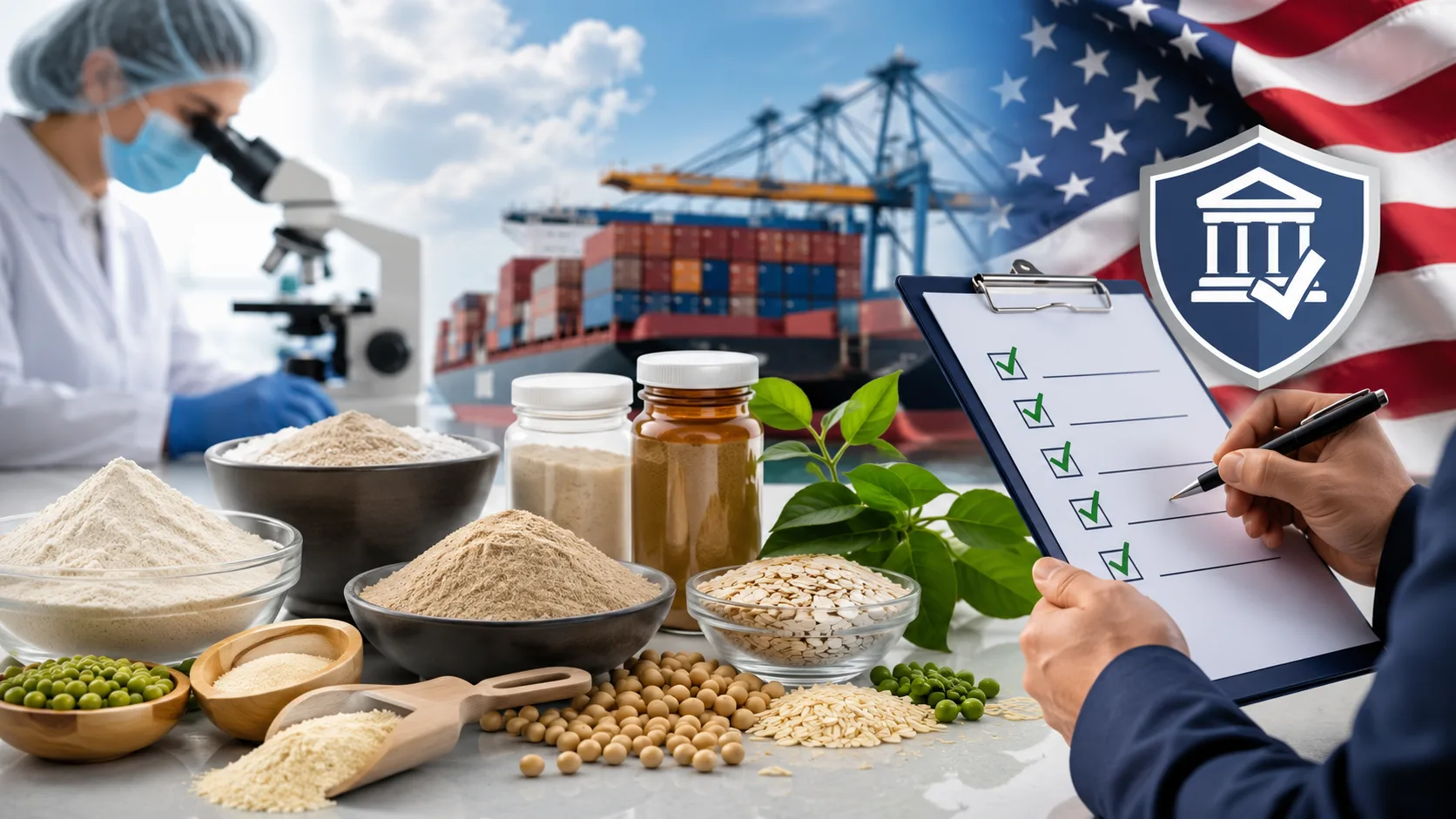
Breaking into the U.S. food and beverage market is one of the most exciting opportunities available to food ingredient manufacturers today. But it comes with a rigorous compliance landscape that trips up even experienced players. The U.S. Food and Drug Administration (FDA) enforces some of the world’s most detailed food safety standards — and for good reason.
So, how do you navigate food ingredient import compliance in the USA without losing momentum? This guide breaks it down step by step — from facility registration and GRAS certification to prior notice and supplier verification. Whether you’re a procurement manager evaluating new suppliers or a manufacturer preparing to enter the U.S. market, consider this your practical starting point.
Why U.S. FDA Compliance Matters for Food Ingredient Suppliers
The U.S. is one of the largest and most lucrative food markets in the world. But access isn’t automatic. Any food ingredient — from soluble fiber to plant-based protein — that enters U.S. commerce must meet the standards set out in the Federal Food, Drug, and Cosmetic Act (FD&C Act). Fail to comply, and your shipment could be detained at port of entry, or worse, refused entirely.
For a functional food ingredient supplier targeting the USA, compliance isn’t just a legal checkbox. It’s a competitive signal. U.S. food and beverage manufacturers — your customers — are legally responsible for verifying their supply chain. When you arrive with documentation in order, certifications aligned, and a facility registration on file, you make their job easier. That builds trust and long-term commercial relationships.
Beyond avoiding penalties, proactive compliance also prepares you for the European market. Increasingly, suppliers pursuing FDA and EFSA compliant food ingredient status find that dual compliance opens doors across both continents simultaneously — a powerful positioning advantage.
Step 1: FDA Food Facility Registration for Foreign Manufacturers
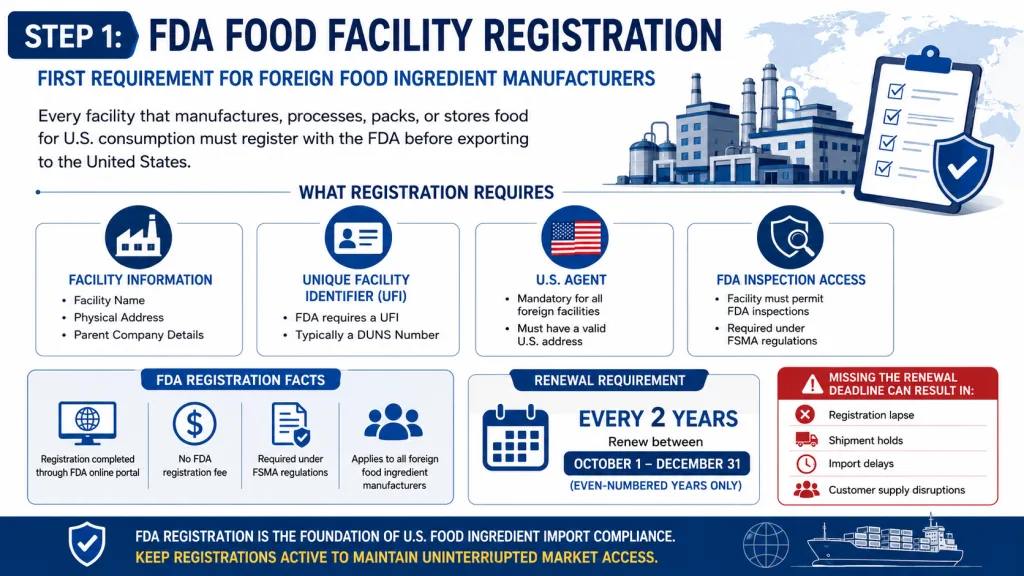
The very first step for any foreign manufacturer exporting food ingredients to the United States is registering with the FDA. Under the FD&C Act as amended by the Food Safety Modernization Act (FSMA), every facility involved in manufacturing, processing, packing, or holding food for U.S. consumption must be registered — regardless of whether it’s based in the U.S. or overseas.
What FDA food facility registration requires
The registration process requires submitting key details about your operation, including:
- Facility name, address, and parent company details
- A unique facility identifier (UFI) — typically a DUNS number
- Appointment of a U.S. Agent with a local U.S. address (required for all foreign facilities)
- An assurance that FDA will be permitted to inspect the facility
Registration is free of charge and is conducted through the FDA’s online portal. Critically, it must be renewed every two years — in even-numbered years between October 1 and December 31. Missing the renewal window means your registration lapses, which can trigger shipment holds and disrupt customer relationships at the worst possible time.
Foreign manufacturers should treat FDA facility registration not as a one-time task but as an ongoing compliance commitment — one that U.S. buyers will actively verify when qualifying new ingredient suppliers.
Step 2: Understanding FDA GRAS Certification for Food Ingredients
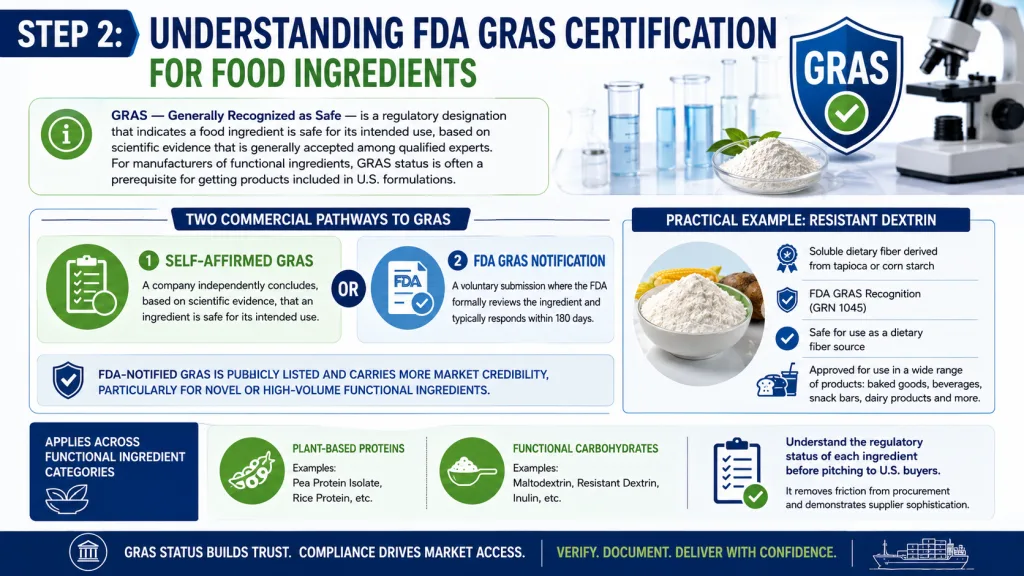
GRAS — Generally Recognized as Safe — is one of the most important regulatory designations in the U.S. food system. It signals that a food ingredient is safe for its intended use, based on scientific evidence that is generally accepted among qualified experts. For manufacturers of functional ingredients, GRAS status is often a prerequisite for getting their products included in U.S. formulations.
There are two commercial pathways to GRAS: Self-Affirmed GRAS, where a company independently concludes based on scientific evidence that an ingredient is safe, and FDA GRAS Notification, a voluntary submission where the FDA formally reviews the ingredient and typically responds within 180 days. FDA-notified GRAS is publicly listed and carries more market credibility, particularly for novel or high-volume functional ingredients.
Take resistant dextrin as a practical example. This soluble dietary fiber — derived from tapioca or corn starch — has received FDA GRAS recognition (GRN 1045), confirming it is safe for use as a dietary fiber source in categories ranging from baked goods and beverages to snack bars and dairy products. For food manufacturers formulating fiber-enriched products for the U.S. market, this GRAS status is a meaningful green light.
The same principle applies across functional ingredient categories. Whether you’re working with plant-based proteins like pea protein isolate or rice protein, or functional carbohydrates like maltodextrin, understanding the regulatory status of each ingredient before you pitch to U.S. buyers is essential. It removes friction from the procurement process and demonstrates supplier sophistication.
Step 3: FSMA and the Foreign Supplier Verification Program (FSVP)
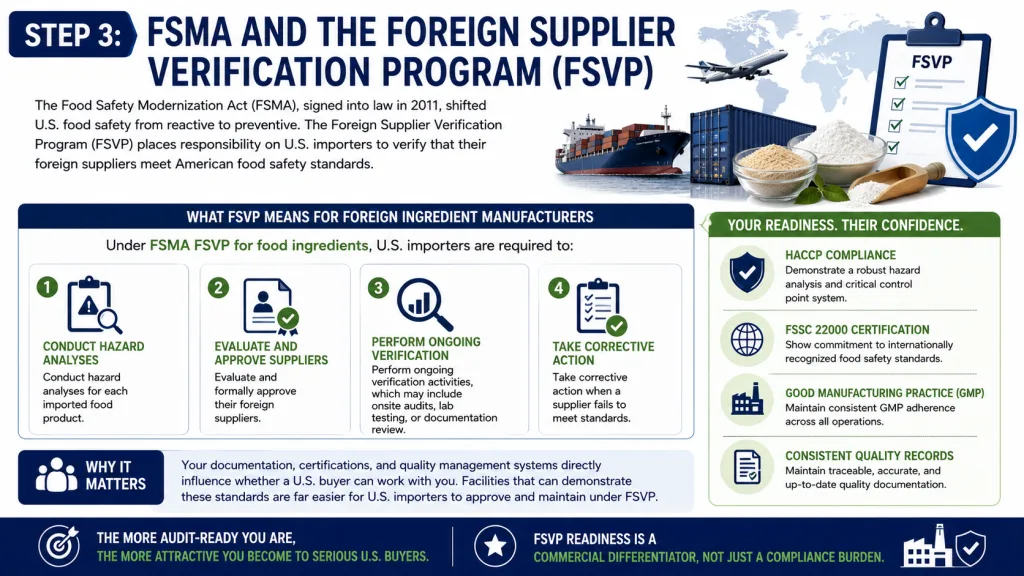
The Food Safety Modernization Act (FSMA), signed into law in 2011, fundamentally shifted U.S. food safety philosophy from reactive to preventive. One of its most impactful provisions for global ingredient trade is the Foreign Supplier Verification Program (FSVP) — a rule that places explicit responsibility on U.S. importers to verify that their foreign suppliers meet American food safety standards.
What FSVP means for foreign ingredient manufacturers
Under FSMA FSVP for food ingredients, U.S. importers are required to:
- Conduct hazard analyses for each imported food product
- Evaluate and formally approve their foreign suppliers
- Perform ongoing verification activities, which may include onsite audits, lab testing, or documentation review
- Take corrective action when a supplier fails to meet standards
This means that as a foreign supplier, your documentation, certifications, and quality management systems directly influence whether a U.S. buyer can work with you at all. Facilities that can demonstrate HACCP compliance, FSSC 22000 certification, Good Manufacturing Practice (GMP) adherence, and consistent quality records are far easier for U.S. importers to approve and maintain under FSVP.
The more audit-ready you are as a supplier, the more attractive you become to serious U.S. buyers. Think of FSVP readiness as a commercial differentiator, not just a compliance burden.
Step 4: Filing FDA Prior Notice for Food Ingredient Shipments
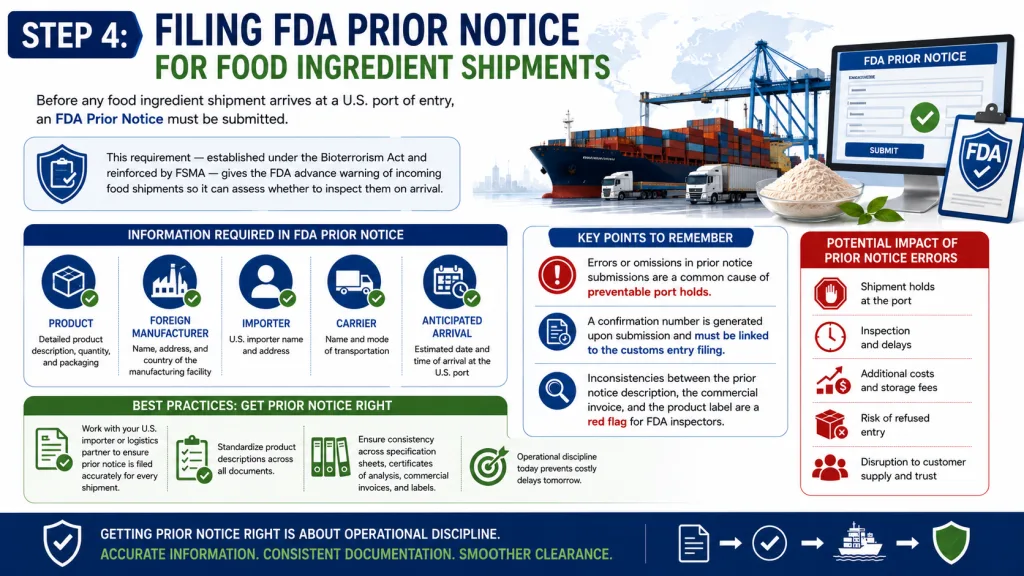
Before any food ingredient shipment arrives at a U.S. port of entry, an FDA Prior Notice must be submitted. This requirement — established under the Bioterrorism Act and reinforced by FSMA — gives the FDA advance warning of incoming food shipments so it can assess whether to inspect them on arrival.
The FDA prior notice for a food ingredient shipment must include detailed information about the product, the foreign manufacturer, the importer, the carrier, and the anticipated arrival time. Errors or omissions in prior notice submissions are a common cause of preventable port holds. A confirmation number is generated upon submission and must be linked to the customs entry filing.
For food ingredient manufacturers, the practical implication is this: make sure your U.S. importer or logistics partner is handling prior notice correctly on every shipment. Inconsistencies between the prior notice description, the commercial invoice, and the product label are a red flag for FDA inspectors and can result in costly delays.
Getting prior notice right is ultimately about operational discipline. Standardize your product descriptions across all documentation — specification sheets, certificates of analysis, commercial invoices — so they match consistently on every shipment.
Beyond FDA: Certifications That Strengthen Your U.S. Market Position
FDA compliance is the baseline. But in a competitive ingredients market, certifications beyond the regulatory minimum can meaningfully differentiate a supplier. For U.S. buyers formulating for health-conscious, specialty, or multicultural consumer segments, additional credentials add commercial value — and sometimes serve as hard requirements.
Key certifications U.S. buyers look for
- Halal certification: The U.S. halal food market is substantial and growing. A halal certified functional food ingredient supplier has immediate access to manufacturers producing for Muslim consumers — a segment that conventional suppliers without certification simply cannot serve.
- Kosher certification: Many U.S. food manufacturers look for Kosher-certified ingredients as a proxy for quality and process integrity, even outside specifically Kosher product lines.
- ISO 22000 / FSSC 22000: These internationally recognized food safety management certifications signal a systematic, audit-ready approach to quality — exactly what U.S. importers need to satisfy FSVP obligations.
- Non-GMO and organic: Consumer-driven label claims increasingly push manufacturers to source certified non-GMO or organic ingredients, particularly in premium product categories.
For suppliers aiming at both the U.S. and European markets simultaneously, building toward FDA and EFSA compliant food ingredient status provides a strong foundation. While the two regulatory systems differ in specifics, the commitment to safety documentation, traceability, and transparent manufacturing processes is common to both.
How to Import Food Ingredients into the United States: A Practical Checklist
Pulling it all together, here’s a consolidated checklist for manufacturers and their U.S. buyers preparing for the import process:
- Register the manufacturing facility with FDA — obtain a DUNS number, appoint a U.S. Agent, and renew every two years
- Confirm GRAS or food additive status for each ingredient intended for U.S. formulation
- Prepare FSVP-ready documentation — HACCP plans, GMP records, certificates of analysis, and audit reports
- Ensure accurate FDA Prior Notice submissions — product descriptions must match labels and invoices exactly
- Review labeling requirements — ingredient declarations, allergen labeling (FALCPA), and Nutrition Facts panels must meet FDA standards
- Consider additional certifications — Halal, Kosher, non-GMO, or organic credentials depending on your target markets and customer requirements
- Work with a qualified U.S. regulatory consultant or customs broker — especially for novel or specialty functional ingredients
This checklist applies whether you’re exporting resistant dextrin for fiber enrichment, rice protein for plant-based nutrition formulas, pea maltodextrin for sports nutrition, or natural sweeteners like rice syrup or tapioca syrup. Each category carries the same core compliance requirements, though specific rules may vary by ingredient classification.
Ready to Source FDA-Compliant Functional Ingredients from a World-Class Manufacturer?
Navigating FDA import compliance is genuinely complex — but the right ingredient supplier makes it significantly easier. When a supplier arrives with facility registration in place, GRAS-reviewed ingredients, FSSC 22000 certification, Halal and Kosher credentials, and audit-ready quality documentation, they’re not just selling an ingredient. They’re removing compliance friction from your supply chain.
Satoria Nutrisentials is a world-class integrated food manufacturing solutions provider supplying innovative functional ingredients — including resistant dextrin, pea and rice proteins, natural sweeteners, and functional starches — to F&B manufacturers across the U.S., Canada, and Europe. Every product is manufactured under HACCP, ISO 22000, FSSC 22000, GMP, Halal, and Kosher standards, with full traceability and documentation designed to support your import compliance needs.
Explore Satoria Nutrisentials’ full range of industrial and commercial food ingredients — and get in touch with our team to discuss specifications, documentation, and how we can support your U.S. market formulation goals.
References
- U.S. Food and Drug Administration. (2024). Registration of food facilities and other submissions. https://www.fda.gov/food/guidance-regulation-food-and-dietary-supplements/registration-food-facilities-and-other-submissions
- U.S. Food and Drug Administration. (2023). FSMA final rule on foreign supplier verification programs (FSVP) for importers of food for humans and animals. https://www.fda.gov/food/food-safety-modernization-act-fsma/fsma-final-rule-foreign-supplier-verification-programs-fsvp-importers-food-humans-and-animals
- U.S. Food and Drug Administration. (2022). Importing food products into the United States. https://www.fda.gov/food/food-imports-exports/importing-food-products-united-states
- U.S. Food and Drug Administration. (2023). GRAS notice No. GRN 001045: Resistant dextrin from tapioca. https://www.fda.gov/media/167305/download
- U.S. Food and Drug Administration. (2023). Frequently asked questions on FSMA. https://www.fda.gov/food/food-safety-modernization-act-fsma/frequently-asked-questions-fsma
- Elchemy. (2025). Navigating FDA requirements for food: Tips for U.S. producers and importers. https://elchemy.com/blogs/food-nutrition/navigating-fda-requirements-for-food-tips-for-u-s-producers-and-importers
- Food Dive. (2023, March 23). Tapioca starch sweetener gets GRAS status from the FDA. https://www.fooddive.com/news/fibersmart-sweetener-gras-tapioca-starch/645750/
- Freyr Solutions. (2024). FDA food registration: US requirements & compliance. https://www.freyrsolutions.com/food-supplements/us-fda-food-registration
Featured News
Category
Get a Promo and Keep Updated