
Oat Fiber vs Resistant Dextrin: Which Soluble Fiber Ingredient Is Right for Your Formulation?
Pea Protein and Resistant Dextrin in Meat Analog Formulation: A Manufacturer’s Guide
July 30, 2026
Protein & Nutritional Enhancers - Articles
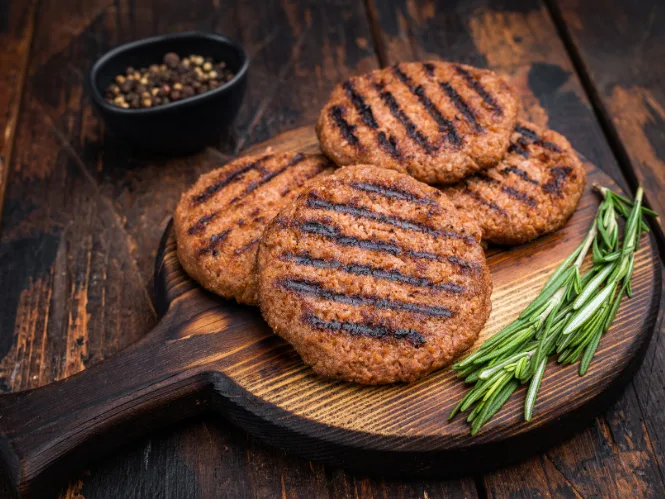
Plant-based meat developers have spent the last several years chasing one moving target: a product that holds together like meat, chews like meat, and still reads as a clean, functional label. Pea protein isolate has become the default backbone for that texture, but on its own it can leave gaps in moisture retention, yield, and mouthfeel that are difficult to close through protein alone. Resistant dextrin, more commonly associated with fiber-fortified beverages and dairy, is increasingly finding a second role in these formulations as a fat replacer and structure-stabilizing fiber. This guide walks through how the two ingredients function individually, where they support each other in a meat analog matrix, and what formulators should evaluate before scaling a blend into production.
The Formulation Challenge Behind Plant-Based Meat
Meat analogs are judged against a very specific benchmark: the fibrous, juicy bite of animal muscle tissue. Reaching that benchmark with plant ingredients means solving three problems at once — building a fibrous protein network, retaining enough moisture and fat to avoid a dry or crumbly bite, and keeping the finished product’s ingredient list simple enough for a clean label claim. Missing any one of these usually shows up immediately in consumer feedback, whether as a rubbery chew, a dry finish, or a formulation that reads as overly processed on pack.
Wheat gluten and soy protein were the first widely used solutions for structure, largely because of their strong viscoelastic and gelling behavior during extrusion. Both carry drawbacks for the growing share of consumers avoiding gluten or soy, which has pushed formulators toward pea protein as a hypoallergenic, non-GMO alternative that still performs under high-moisture extrusion conditions (Bakhsh et al., 2021, as cited in Iqbal et al., 2022). Legumes more broadly have drawn formulation interest for the same reason: pulse-derived proteins tend to carry a more favorable allergen profile than the soy- and wheat-based ingredients they are increasingly replacing.
Protein choice, however, is only half the formulation. Fat and moisture management largely determine whether a finished patty, nugget, or sausage analog reads as “dry” or “juicy” on the palate, which is where fiber ingredients like resistant dextrin increasingly enter the conversation. A formulation that nails texture but loses moisture during cooking will still underperform in consumer testing, which is why formulators increasingly treat protein and fiber selection as a single, connected decision rather than two separate ingredient categories.
Pea Protein Isolate as the Structural Backbone
Pea protein isolate typically supplies 80–90% protein content and is favored in high-moisture extrusion because of how it behaves under heat and shear. During extrusion cooking, the protein denatures and realigns into layered, fibrous strands that mimic the muscle fiber structure of animal meat (Sun et al., 2024).
Solubility, Gelation, and Water Holding
Not all commercial pea protein isolates perform the same way. Differences in extraction method and growing conditions affect protein solubility, gelation strength, and water-holding capacity, which in turn influence how well a given isolate texturizes and how much moisture the finished product retains after cooking (Sun et al., 2024). Isolates with higher solubility and stronger gel-forming behavior generally produce a more cohesive, less crumbly fiber structure.
Matching Isolate Type to Extrusion Process
Formulators working with high-moisture extrusion should treat isolate selection as a process variable, not just a nutrition input. Comparative testing across isolate and concentrate forms shows that structural anisotropy — how directional the fiber alignment becomes — varies by protein type and processing conditions, which directly affects the finished product’s bite and chew (ScienceDirect, 2025). Running small-batch trials across two or three isolate sources before committing to a supplier is standard practice for this reason.
Inclusion levels also matter beyond a simple protein-content target. Research comparing pea protein isolate inclusion across a 30–60% range found that both the amount and the specific isolate type shaped final product texture, underscoring that a formulation tuned for one supplier’s isolate may need rebalancing if the source changes (Sun et al., 2024). For manufacturers producing burger patties, nuggets, and sausage-style analogs from the same base formulation, this means texture targets should be validated separately for each finished format rather than assumed to transfer directly.
Where Resistant Dextrin Adds Value Beyond Fiber Claims
Resistant dextrin is best known on pack as a soluble fiber and prebiotic ingredient, but its functional profile — high solubility, low viscosity, strong water-binding, and thermal stability — makes it useful as a processing aid inside a meat analog matrix, not just a nutrition-panel addition (Wu et al., 2024).
In conventional meat products, water-soluble resistant dextrin is already used as a fat replacer to help formulators reduce fat and calorie content while maintaining yield and mouthfeel. The same water- and fat-binding behavior is relevant to plant-based analogs, where moisture loss during cooking is one of the more common consumer complaints. Because resistant dextrin dissolves cleanly and carries a neutral taste profile, it can be incorporated without introducing the chalkiness or off-notes that heavier fibers sometimes contribute.
For manufacturers already using resistant dextrin in fiber-fortified products, extending it into a meat analog line is a relatively low-risk formulation move — the ingredient’s regulatory status, solubility behavior, and clean-label positioning carry over directly.
Formulating Pea Protein and Resistant Dextrin Together
The two ingredients address different parts of the same problem. Pea protein isolate builds the fibrous network that gives a meat analog its bite; resistant dextrin manages the water and fat phase that determines juiciness and shelf stability. Used together, the pairing lets formulators lean on pea protein for structure while using resistant dextrin to fine-tune moisture retention rather than over-relying on added oils or gums.
A practical starting point is to treat resistant dextrin as a partial fat or filler replacement rather than a primary structural ingredient. Because it holds water without adding significant viscosity, small-scale inclusion levels can improve yield and perceived juiciness without disrupting the fibrous texture built by the protein matrix during extrusion (Wu et al., 2024). As with any reformulation, inclusion levels should be validated through bench trials, since interactions between fiber, protein, and any added fat sources are formulation-specific.
This combination also supports a cleaner overall label. Both ingredients can typically be sourced as non-GMO and allergen-friendly, which allows formulators to address texture, moisture, and fiber fortification within a shorter, more recognizable ingredient list.
Common Formulation Pitfalls to Avoid
Beany or grassy off-notes remain one of the most persistent challenges with pea protein, particularly at higher inclusion levels. Processing techniques such as fermentation and enzymatic treatment have been shown to reduce these flavor compounds, and formulators sourcing pea protein for meat analogs should ask suppliers directly about the flavor-masking or processing steps applied before the isolate reaches them.
Batch-to-batch variability in pea protein functionality is another recurring issue. Because solubility and gelation strength differ across suppliers and even across production lots from the same supplier, formulators should request functionality data — not just protein content — before qualifying a new source (Sun et al., 2024).
On the fiber side, the main pitfall is treating resistant dextrin as a drop-in fat replacement without adjusting for its water-binding behavior. Overinclusion can shift the moisture balance enough to soften the fibrous structure built by the protein, so trial batches at multiple inclusion levels are worth the time before scaling to full production runs.
It is also worth budgeting time for shelf-life validation rather than relying solely on day-one sensory results. Moisture migration, texture softening, and flavor drift can all shift over a product’s intended shelf life, and a formulation that performs well immediately after production is not automatically stable weeks later. Building accelerated or real-time shelf-life testing into the development timeline early avoids reformulation surprises after a product has already gone to market.
Application Across Meat Analog Formats
The pea protein and resistant dextrin pairing behaves differently depending on the finished product format, which is worth accounting for early in development rather than after a formulation is locked. High-moisture extruded products, such as fibrous chicken or steak-style analogs, rely most heavily on pea protein’s gelation and fiber-forming behavior, with resistant dextrin playing a supporting role in moisture retention through the cooling die and packaging stages.
Ground and formed formats — patties, nuggets, and sausage-style analogs — tend to have more flexibility for fiber inclusion, since these products are not built entirely around directional fiber alignment. In these formats, resistant dextrin’s water- and fat-binding behavior can play a larger role in yield and juiciness, since the surrounding matrix does not depend as heavily on a single extrusion step to build texture.
Emulsified and comminuted analogs, similar in structure to plant-based deli meats or spreads, generally tolerate the highest fiber inclusion levels, since texture in these products is driven more by emulsification and binding than by fibrous protein alignment. Testing inclusion levels separately for each format is the most reliable way to find the right balance between structure, moisture, and cost.
Label and Regulatory Considerations for Formulators
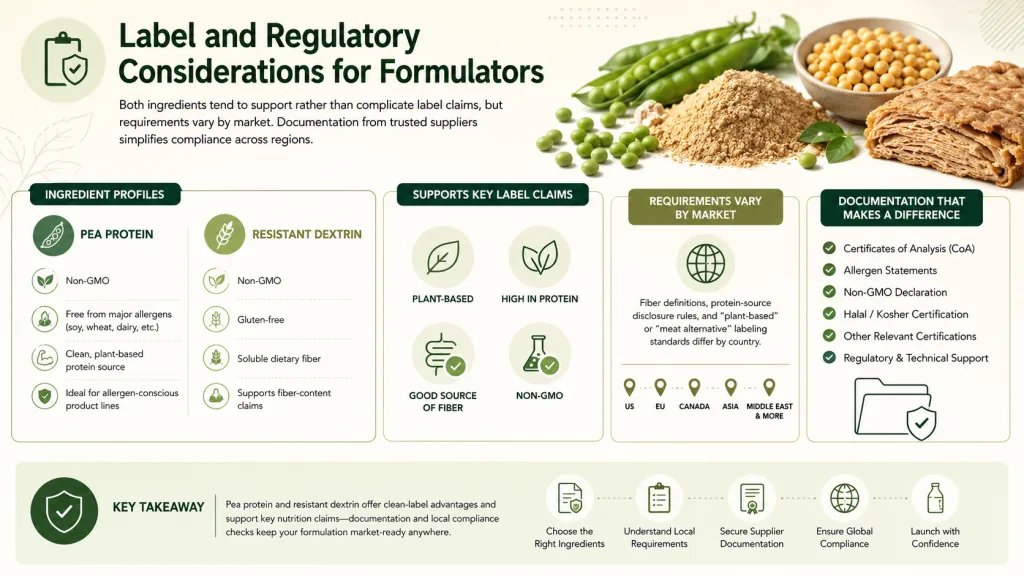
Both ingredients tend to support rather than complicate label claims. Pea protein is broadly recognized as non-GMO and free of the major allergens associated with soy and wheat, which is one of the reasons it has become the default protein source for allergen-conscious plant-based meat lines. Resistant dextrin carries a similar profile: it is typically non-GMO, gluten-free, and classified as a soluble dietary fiber, allowing it to contribute toward fiber-content claims on the finished product.
Formulators exporting into multiple markets should still confirm labeling and claim requirements locally, since fiber definitions, protein-source disclosure rules, and “plant-based” or “meat alternative” labeling standards vary by country. Working with a supplier that can provide documentation — certificates of analysis, allergen statements, and relevant certifications such as Halal, Kosher, or non-GMO — simplifies this step considerably when a product is destined for several regions at once.
Choosing the Right Ingredient Partner
Because pea protein functionality varies so much by source, and because fiber ingredients like resistant dextrin need to integrate cleanly into an existing formulation, ingredient sourcing decisions carry real weight in meat analog development. Look for a supplier that can provide functional data alongside compositional specs, supports small-batch sampling for trial runs, and can scale supply consistently once a formulation is finalized.
A manufacturer that produces both the protein and the fiber component in-house also removes a layer of supply chain risk, since sourcing, quality control, and lot consistency are managed under a single system rather than coordinated across separate vendors.
Formulating a meat analog that holds up through extrusion, cooking, and shelf life is rarely solved by a single ingredient. Pea protein and resistant dextrin address different parts of that challenge, and testing how they interact in a specific formulation is usually the fastest way to find the right balance. Food scientists and product developers exploring this pairing are welcome to reach out to discuss functional data, sample availability, or formulation support.
References
- Bakhsh, A., Lee, S.-J., Lee, E.-Y., Hwang, Y.-H., & Joo, S.-T. (2021). Traditional plant-based meat alternatives, current, and future perspective: A review. Journal of Agriculture, Life and Environmental Sciences. (as cited in Iqbal et al., 2022)
- Sun, X., et al. (2024). Use of pea proteins in high-moisture meat analogs: Physicochemical properties of raw formulations and their texturization using extrusion. Foods, 13(8), 1195.
- Iqbal, A., et al. (2022). Plant-based meat analogs: A review with reference to formulation and gastrointestinal fate. Current Research in Food Science.
- ScienceDirect. (2025). Impact of the physico-chemical properties of commercial pea proteins concentrate and isolate on the quality of meat analogs. Food Hydrocolloids.
- ScienceDirect. (2025). Advancing meat analogues with pea proteins: A comprehensive and systematic review of applications, 3D-printing and digestive properties.
- Wu, Y., et al. (2024). An in-depth overview of the structural properties, health benefits, and applications of resistant dextrin. Journal of Food Processing and Preservation.
- Zahir, M., et al. (2026). Improving meat analogues with pea proteins: A comprehensive review of applications, allergenicity, and safety. Legume Science.
- Good Food Institute. (2022). Deep dive: Plant-based meat end product formulation and manufacturing.
Featured News
Category
Get a Promo and Keep Updated