
Pea & Rice Protein Blend Ratio Optimization for Complete Amino Acid Profile: A Formulator’s Guide
Pea & Rice Protein Blend Ratio Optimization for Complete Amino Acid Profile: A Formulator’s Guide
October 28, 2026
Protein & Nutritional Enhancers - Articles
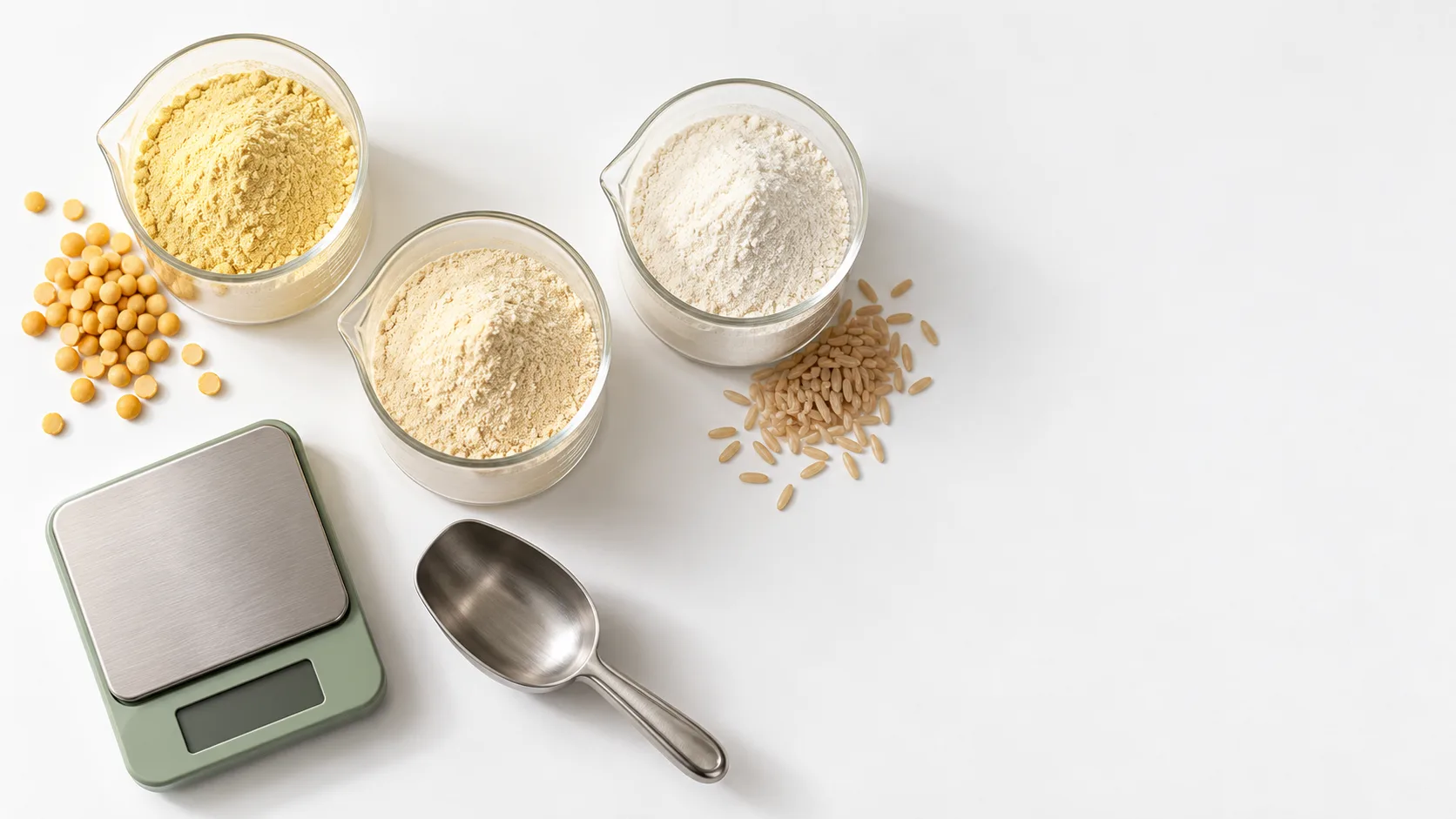
Walk down any sports nutrition aisle and you’ll see the same pairing again and again: pea and rice. It isn’t a marketing coincidence. A well-built pea and rice protein blend can deliver an amino acid profile that neither ingredient manages on its own, which is why it has become the backbone of so many dairy-free shakes, bars and RTD drinks.
But here’s the question formulators keep asking: what ratio actually works best? The “standard” answer you’ll hear is 70:30, yet the published science points somewhere slightly different. In this guide, we’ll unpack the amino acid logic behind complementary plant proteins, show how protein quality scores like PDCAAS and DIAAS change with the blend ratio, and share a practical workflow for finding the right ratio for your own product.
Why Combine Pea and Rice Protein? The Science of Complementary Plant Proteins
Every protein is built from amino acids, nine of which are “essential” because our bodies can’t make them. A protein’s nutritional value depends less on how many grams it contains and more on whether it supplies all nine in the proportions humans need (WHO, FAO, & UNU, 2007). The amino acid in shortest supply relative to need is called the “limiting” amino acid, and it caps how well the whole protein can be used.
Pea and rice happen to be limited in opposite places. That’s what makes them complementary plant proteins: each one fills the other’s gap. Research comparing commercial plant protein isolates found large differences in essential amino acid content between sources, and concluded that combining plant isolates can produce a profile that closely reflects animal-based proteins (Gorissen et al., 2018).
So when people ask, “Is pea protein and rice protein a complete protein?”, the honest answer has two layers:
- Each one contains all nine essential amino acids, but not in ideal proportions.
- Blended at the right ratio, they form a complete plant-based protein blend that covers adult requirements far more evenly.
Think of it like a two-person relay team. Neither runner is built for the whole race, but together they cover the distance comfortably. The plant protein blend amino acid profile is the real product here, not either ingredient alone.
Limiting Amino Acids: Where Pea and Rice Each Fall Short
Before you can optimize a ratio, you need to know exactly what you’re correcting for. The pea protein lysine, rice protein methionine story is the heart of this pairing.
Limiting Amino Acids in Pea Protein
Pea protein is rich in lysine, an amino acid that cereals typically lack. Its weak spot is the sulfur amino acids, methionine and cysteine. When pea protein is scored on its own, these sulfur amino acids are what hold its DIAAS back (Herreman et al., 2020).
So what amino acids are missing in pea protein? Strictly speaking, none are absent. Methionine and cysteine are simply present at levels below what an ideal reference pattern calls for, which is exactly why pea benefits from a partner rather than a replacement.
Limiting Amino Acids in Rice Protein
Rice protein flips the picture. As a cereal protein, it is comparatively low in lysine but carries more methionine and cysteine than pea. Rice protein isolates are also respectable sources of leucine; one widely cited trial used a rice isolate containing about 8% leucine (Joy et al., 2013).
Put the two side by side and the logic becomes obvious:
- Pea brings the lysine that rice lacks.
- Rice brings the sulfur amino acids that pea lacks.
- Both contribute branched-chain amino acids, including leucine.
Pea Rice Protein PDCAAS / DIAAS: Measuring What Really Counts
To compare blends objectively, you need a scoring system. For decades, the standard was PDCAAS (Protein Digestibility Corrected Amino Acid Score). In 2013, an FAO expert consultation recommended a newer method, DIAAS (Digestible Indispensable Amino Acid Score), because it measures the digestibility of each amino acid at the end of the small intestine rather than relying on whole-protein faecal digestibility (FAO, 2013).
Why does that matter for blends? PDCAAS is capped at 1.0 and can flatter mixtures. DIAAS is uncapped, amino-acid-specific and better at revealing which amino acid is truly limiting at each ratio. The FAO also proposed DIAAS bands: below 75 makes no quality claim, 75 to 99 indicates high-quality protein, and 100 or above indicates excellent quality.
How Do You Calculate DIAAS for a Protein Blend?
The method is more approachable than it sounds:
- List the content of each indispensable amino acid (mg per g protein) in each ingredient.
- Multiply each value by that amino acid’s standardized ileal digestibility.
- Combine the ingredients in proportion to how much protein each contributes to the blend.
- Divide each blended digestible amino acid value by the reference pattern for your target age group.
- The lowest ratio, multiplied by 100, is the blend’s DIAAS.
Because the limiting amino acid shifts as you change the ratio, plotting DIAAS across a range of blends shows you exactly where the “sweet spot” sits.
What Is the Best Ratio of Pea to Rice Protein?
This is where things get interesting, because the most commonly quoted answer and the best-documented answer don’t quite match.
Where the 70:30 Pea Rice Protein Blend Comes From
The 70:30 pea rice protein blend is widespread across supplement labels and supplier materials. It’s a sensible industry convention: pea dominates for lysine, rice tops up the sulfur amino acids, and taste and texture tend to work well. However, we were unable to trace it to a specific peer-reviewed study that establishes 70:30 as optimal. It’s best treated as a reliable starting point, not a scientific constant.
What DIAAS Modelling Suggests
A comprehensive DIAAS review modelled pea and rice mixtures using averaged amino acid and digestibility data from the literature. It found that the blend score peaked at a DIAAS of 84 when rice protein made up about 41% of the mixture, roughly a 60:40 pea-to-rice ratio (Herreman et al., 2020). Individually, both pea and rice fell below 75 in that review, so the blend crosses into the “high-quality” band where neither ingredient could alone.
In practice, the best ratio of pea to rice protein usually falls somewhere between 60:40 and 70:30. The exact point depends on your specific ingredients’ amino acid profiles, their digestibility and what your product needs to achieve.
Beyond the Score: Leucine, Whey and Sports Nutrition
A high DIAAS is necessary, but it isn’t the whole story, especially for products aimed at active consumers.
Leucine Content in Pea Rice Protein Blend
Leucine acts as a key trigger for muscle protein synthesis. The International Society of Sports Nutrition recommends 20 to 40 g of protein per serving, with each dose providing roughly 700 to 3,000 mg of leucine (Jäger et al., 2017). If both proteins sit around 8% leucine, a 30 g serving of blend protein supplies roughly 2.4 g, comfortably within that range.
Pea Rice Protein Blend vs Whey Protein Amino Acids
Does pea and rice protein compare to whey? On paper, whey still leads. It contains more essential amino acids by weight (Gorissen et al., 2018), and linear-programming work found plant blends could reach about 92% similarity to whey’s amino acid profile, with leucine and lysine as the hardest gaps to close (Dimina et al., 2022).
Real-world outcomes are encouraging, though. In a 12-week trial, pea protein produced muscle thickness gains with no significant difference from whey (Babault et al., 2015). An eight-week study likewise found no differences between rice and whey protein isolates in body composition or performance (Joy et al., 2013). For a pea rice protein blend for sports nutrition, adequate dose matters as much as source.
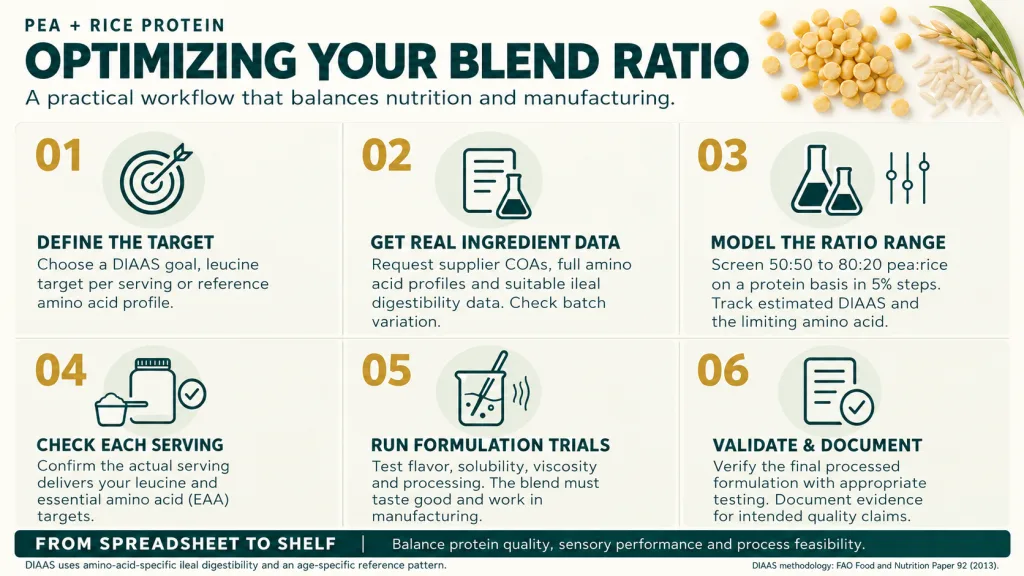
A Practical Workflow for Optimizing Your Blend Ratio
Here’s a step-by-step approach that balances nutrition with real manufacturing constraints:
- Define the nutritional target. Decide whether you’re aiming for a DIAAS-based quality claim, a leucine threshold per serving, or a “whey-like” profile.
- Get real ingredient data. Request certificates of analysis with full amino acid profiles. Values vary between suppliers and production batches.
- Model the ratio range. Calculate DIAAS at 5% steps from 50:50 to 80:20 and identify where the limiting amino acid switches from sulfur amino acids to lysine.
- Check leucine and EAA per serving. Confirm your serving size actually delivers your target.
- Run sensory and functional trials. Pea and rice behave differently in solubility, viscosity and flavor. A nutritionally ideal ratio still has to taste good and process well.
- Validate and document. Use analytical testing to support any quality claim on the final formulation.
This is how optimizing plant protein blends for DIAAS score moves from a spreadsheet to a shelf-ready product.
Sourcing Ingredients for a Complete Plant-Based Protein Blend
Your ratio is only as good as the ingredients behind it. Consistent amino acid profiles, clean processing and the right certifications all affect whether a blend performs the way your model predicts.
For brands building a plant protein blend for food manufacturers or consumers, a few qualities make a real difference:
- Consistency. Stable composition from batch to batch keeps your optimized ratio valid over time.
- Allergen positioning. Pea and rice are allergen-free protein ingredients in the sense that they avoid dairy, soy and gluten, which opens doors to sensitive consumer groups.
- Certifications. Non-GMO, halal and kosher credentials help products travel across markets.
- Format flexibility. Pea and rice protein for RTD shakes, bars and baked goods each need slightly different functional properties.
This is where Satoria Nutrisentials fits naturally into the picture. Satoria produces both Pea Protein & Pea Protein Isolate, a non-GMO, hypoallergenic yellow pea protein, and Rice Protein Isolate, with protein content exceeding 80% and a neutral flavor profile. Having both halves of the blend from one bulk plant protein ingredients partner makes amino acid data easier to align. For brands that would rather not build in-house, Satoria’s OEM & Toll Manufacturing service supports OEM plant-based protein powder development.
Frequently Asked Questions
Is pea and rice protein a complete protein?
Yes, when blended well. Each contains all nine essential amino acids, but pea is low in methionine and rice is low in lysine. Combined at the right ratio, they deliver a far more balanced profile.
Why combine pea and rice protein?
Because their limiting amino acids are opposites. Pea supplies lysine, rice supplies sulfur amino acids, and the blend scores higher on DIAAS than either protein alone.
What is the best ratio of pea to rice protein?
Most blends fall between 60:40 and 70:30. DIAAS modelling found a peak near 60:40, while 70:30 is the common industry convention.
Does pea and rice protein compare to whey?
Whey has a higher essential amino acid and leucine content. Still, clinical trials show pea and rice proteins producing results comparable to whey when doses are adequate.
What amino acids are missing in pea protein?
None are completely missing. Methionine and cysteine are simply its limiting amino acids, which is why pairing pea with rice protein works so well.
How do you calculate DIAAS for a protein blend?
Weight each ingredient’s digestible indispensable amino acids by its share of blend protein, divide by the reference pattern, and take the lowest ratio multiplied by 100.
Unleash the Full Potential of Your Plant Protein Formulation
Getting the ratio right is what turns two good plant proteins into one complete, high-quality blend. Whether you’re developing an RTD shake, a protein bar or a clean-label powder, the principles are the same: know your limiting amino acids, model your DIAAS, check your leucine and test what consumers will actually taste.
The good news? You don’t have to solve it alone. The most successful plant protein launches usually come from close collaboration between brand, formulator and ingredient partner, with real amino acid data shared early and ratio trials run before the label is locked. That kind of partnership turns a promising concept into a product people reach for again and again.
If you’re ready to put this into practice, start by requesting full amino acid specifications for both proteins, then model your ratio range. Explore Satoria Nutrisentials’ Pea Protein & Pea Protein Isolate and Rice Protein Isolate, or consult with the Satoria team about the right ingredients for your formulation goals.
References
- Babault, N., Païzis, C., Deley, G., Guérin-Deremaux, L., Saniez, M.-H., Lefranc-Millot, C., & Allaert, F. A. (2015). Pea proteins oral supplementation promotes muscle thickness gains during resistance training: A double-blind, randomized, placebo-controlled clinical trial vs. whey protein. Journal of the International Society of Sports Nutrition, 12(1), 3. https://doi.org/10.1186/s12970-014-0064-5
- Dimina, L., Rémond, D., Huneau, J.-F., & Mariotti, F. (2022). Combining plant proteins to achieve amino acid profiles adapted to various nutritional objectives—An exploratory analysis using linear programming. Frontiers in Nutrition, 8, 809685. https://doi.org/10.3389/fnut.2021.809685
- Food and Agriculture Organization of the United Nations. (2013). Dietary protein quality evaluation in human nutrition: Report of an FAO expert consultation (FAO Food and Nutrition Paper No. 92). FAO. https://openknowledge.fao.org/items/c1db9994-e6f7-4e6d-8fbf-f3d528f3f216
- Gorissen, S. H. M., Crombag, J. J. R., Senden, J. M. G., Waterval, W. A. H., Bierau, J., Verdijk, L. B., & van Loon, L. J. C. (2018). Protein content and amino acid composition of commercially available plant-based protein isolates. Amino Acids, 50(12), 1685–1695. https://doi.org/10.1007/s00726-018-2640-5
- Herreman, L., Nommensen, P., Pennings, B., & Laus, M. C. (2020). Comprehensive overview of the quality of plant- and animal-sourced proteins based on the digestible indispensable amino acid score. Food Science & Nutrition, 8(10), 5379–5391. https://doi.org/10.1002/fsn3.1809
- Jäger, R., Kerksick, C. M., Campbell, B. I., Cribb, P. J., Wells, S. D., Skwiat, T. M., Purpura, M., Ziegenfuss, T. N., Ferrando, A. A., Arent, S. M., Smith-Ryan, A. E., Stout, J. R., Arciero, P. J., Ormsbee, M. J., Taylor, L. W., Wilborn, C. D., Kalman, D. S., Kreider, R. B., Willoughby, D. S., … Antonio, J. (2017). International Society of Sports Nutrition position stand: Protein and exercise. Journal of the International Society of Sports Nutrition, 14, 20. https://doi.org/10.1186/s12970-017-0177-8
- Joy, J. M., Lowery, R. P., Wilson, J. M., Purpura, M., De Souza, E. O., Wilson, S. M. C., Kalman, D. S., Dudeck, J. E., & Jäger, R. (2013). The effects of 8 weeks of whey or rice protein supplementation on body composition and exercise performance. Nutrition Journal, 12, 86. https://doi.org/10.1186/1475-2891-12-86
- World Health Organization, Food and Agriculture Organization of the United Nations, & United Nations University. (2007). Protein and amino acid requirements in human nutrition: Report of a joint WHO/FAO/UNU expert consultation (WHO Technical Report Series No. 935). World Health Organization. https://iris.who.int/handle/10665/43411
Featured News
Category
Get a Promo and Keep Updated