
Plant-Based Egg Replacer Ingredients: A Formulator’s Guide to Functional, Bulk-Ready Alternatives
Plant-Based Egg Replacer Ingredients: A Formulator’s Guide to Functional, Bulk-Ready Alternatives
September 10, 2026
General - Articles

Ask any product developer what’s hardest to replace in a formulation, and eggs usually top the list. They bind, they foam, they emulsify, and they set — often all in the same product. Finding the right plant-based egg replacer ingredients starts with understanding which specific job you’re asking an ingredient to do, then matching it to a raw material that can actually perform it at scale.
Why Egg Replacement Has Become a Formulation Priority
Between 2022 and 2025, recurring waves of highly pathogenic avian influenza forced U.S. producers to cull tens of millions of laying hens, and wholesale egg prices swung from historic highs to multi-year lows within about eighteen months as flocks recovered (U.S. Department of Agriculture, 2025). That kind of volatility gets a formulator’s attention fast — even once supply stabilizes, few manufacturers want a core recipe held hostage to a single, disease-prone commodity again.
Avian flu egg supply alternative ingredients research is just one pressure point. Egg allergy remains one of the most common pediatric food allergies, complicating shelf placement and cross-contact risk for brands selling into schools, hospitals, or export markets with strict allergen labeling (Mathew & Pfleghaar, 2023). Add rising vegan and flexitarian demand, and egg replacement stops being a niche request and becomes a standing line on most reformulation briefs.
Sustainable egg alternative ingredients are one of the clearer egg replacer market trends 2026 has brought into focus, running alongside a related but separate conversation: precision fermentation vs plant-based egg replacer approaches, which use engineered microbes to brew egg proteins rather than extract them from crops. Both paths are gaining ground, but plant-based ingredients remain the faster, lower-cost route to market for most manufacturers today.
The good news is that today’s plant-based egg replacer ingredients rarely require reinventing a recipe from scratch. Most briefs call for matching one or two specific functions — binding, foaming, emulsifying, or moisture retention — with an ingredient engineered for that job, then blending in a fiber or starch to round out mouthfeel. That’s a formulation puzzle, not a compromise.
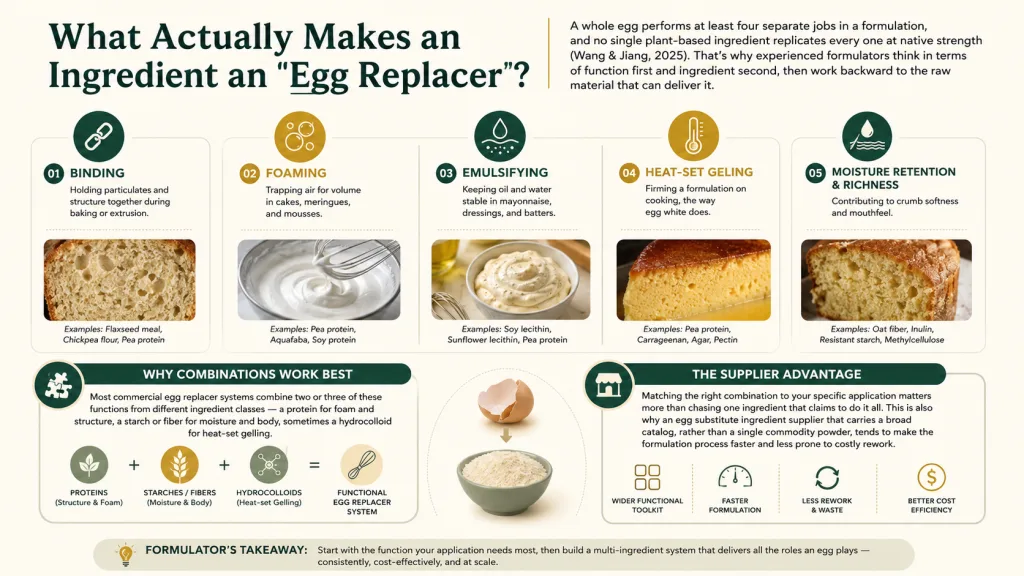
What Actually Makes an Ingredient an “Egg Replacer”?
A whole egg performs at least four separate jobs in a formulation, and no single plant-based ingredient replicates every one at native strength (Wang & Jiang, 2025). That’s why experienced formulators think in terms of function first and ingredient second, then work backward to the raw material that can deliver it.
- Binding: holding particulates and structure together during baking or extrusion
- Foaming: trapping air for volume in cakes, meringues, and mousses
- Emulsifying: keeping oil and water stable in mayonnaise, dressings, and batters
- Heat-set gelling: firming a formulation on cooking, the way egg white does
- Moisture retention and richness: contributing to crumb softness and mouthfeel
Most commercial egg replacer systems combine two or three of these functions from different ingredient classes — a protein for foam and structure, a starch or fiber for moisture and body, sometimes a hydrocolloid for heat-set gelling. Matching the right combination to your specific application matters more than chasing one ingredient that claims to do it all. This is also why an egg substitute ingredient supplier that carries a broad catalog, rather than a single commodity powder, tends to make the formulation process faster and less prone to costly rework.
Protein-Based Egg Replacers: Pea and Rice Protein Isolate
Pea protein isolate is one of the most widely used plant-based egg replacer ingredients in commercial bakery and meat-analog production, prized for solid water- and oil-holding capacity, dependable emulsification, and reliable gelation once heated (Shanthakumar et al., 2022). It carries a milder flavor than soy, performs well in neutral or savory applications, and is broadly accepted as non-GMO and allergen-friendly relative to egg and dairy.
Rice protein brings a different strength to the table: it’s one of the least allergenic plant proteins available, which makes rice protein egg substitute formulations attractive for hypoallergenic product lines, clinical nutrition, and export markets with strict allergen labeling. It contributes less raw foaming power than pea protein on its own, so many formulators blend the two to balance structure with a cleaner amino acid profile.
In practice, pea protein isolate tends to lead in applications needing strong binding and emulsification — plant-based mayonnaise, meat analogs, and protein-fortified baked goods — while rice protein plays a supporting role where allergen sensitivity matters more than raw functional strength. Neither ingredient is a like-for-like swap on its own; both typically need a starch or fiber alongside them to fully replicate an egg’s moisture and mouthfeel contribution. Satoria Nutrisentials manufactures both Pea Protein Isolate and Rice Protein Isolate to food-grade specification, sized for exactly this kind of blended B2B system.
Starch and Fiber Systems: Modified Starch and Resistant Dextrin
Modified starches step in where an egg would normally trap moisture and add body — think cake crumb, custard set, or the silky mouthfeel of a sauce. Chemically or physically modified starches (oxidized, cross-linked, pregelatinized) can be tuned for cold-water swelling, freeze-thaw stability, or heat-set thickening, which makes modified starch egg replacement systems especially useful in bakery mixes and dairy-free desserts that still need a familiar bite.
Resistant dextrin plays a less obvious but increasingly valuable role. It’s best known as a soluble prebiotic fiber, but its low viscosity, mild sweetness suppression, and moisture-binding behavior also make it useful in resistant dextrin egg replacer applications where formulators want to add fiber or trim sugar without disrupting texture — a genuine two-for-one in products already being reformulated for label appeal.
Pairing a functional starch with resistant dextrin is a common move in bulk egg replacer ingredient systems: the starch handles structure and moisture, while the fiber quietly improves the nutrition panel. Neither ingredient carries an allergen flag, both are easy to declare on a clean label, and both scale predictably from a lab trial to a full production run. Satoria’s Rice Maltodextrin, Pea Maltodextrin, and Resistant Dextrin are manufactured for exactly this kind of dual-purpose formulation work, available in the bulk volumes B2B manufacturers need.
Hydrocolloids and Specialty Ingredients: Methylcellulose, Algal Flour, and Soy Protein Isolate
Methylcellulose is the ingredient most responsible for the “sizzle” in plant-based burger patties — it gels on heating rather than cooling, the reverse of gelatin, which lets it firm up a formulation exactly when other binders are melting (Nath et al., 2022). That reverse thermal gelation makes methylcellulose egg substitute systems particularly effective in meat analogs and any product cooked from a batter or slurry into a set shape.
Broader hydrocolloid egg replacement systems combine gums like xanthan or guar with starches and proteins to fine-tune viscosity, foam stability, and shelf life — useful wherever a single ingredient can’t hit every target on its own. Algal flour, derived from microalgae such as Chlorella or Spirulina, is a newer entrant that brings strong emulsifying and gelling properties along with a naturally rich color, making algal flour egg alternative blends interesting for bakery and dairy-alternative applications (Prates, 2025).
Soy protein isolate egg replacer systems remain among the most cost-effective, high-functionality options on the market, contributing solid foaming and emulsification for products like egg-free cakes and dressings, though a stronger flavor and allergen status rule it out for some brands (Topaloğlu Günan & Yolci Ömeroğlu, 2025). Choosing among these specialty ingredients usually comes down to allergen profile, target texture, and whether the finished product needs a genuinely neutral flavor.

Matching the Ingredient to the Application
No two applications ask the same thing of an egg replacer, which is why the strongest formulations start from the finished product and work backward. A quick map of common categories:
- Baking (cakes, muffins, cookies): pea or rice protein for structure, modified starch or resistant dextrin for moisture — the combination most vegan egg replacer for bakery OEM programs rely on.
- Mayonnaise and dressings: protein isolates chosen for their egg substitute for emulsification performance, paired with a starch to stabilize viscosity — the backbone of most egg replacer for mayonnaise formulation projects.
- Meat analogs: methylcellulose for heat-set binding alongside pea protein for structure, a pairing that shows up throughout egg replacer for meat analog production.
- Foams and meringues: protein isolates selected specifically for whipping strength, since foaming agent egg replacer performance varies significantly between protein sources.
The common thread is that egg-free binding agent food industry solutions rarely rely on one ingredient alone. Blending a protein with a starch, fiber, or hydrocolloid gets closer to the multi-functional performance of a real egg than any single raw material can deliver by itself — which is exactly why suppliers with a broad functional-ingredient portfolio tend to be easier to formulate around, especially when a project needs to move quickly from bench trial to production batch.
Clean Label, Allergen-Free, and Certification Considerations
For many buyers, functionality is only half the brief. A clean label egg replacer needs to read simply on the ingredient panel — pea protein, resistant dextrin — rather than a string of unfamiliar additive codes, which is part of why plant proteins and starches have gained ground over some synthetic stabilizers in recent reformulations.
Egg allergen-free food formulation carries its own documentation burden: buyers sourcing for retail or foodservice increasingly ask for allergen statements, manufacturing-line segregation records, and non-GMO declarations up front, not after a purchase order is signed. Any non-GMO egg substitute supplier worth evaluating should have these documents ready before formulation work even starts. Halal egg replacer ingredients and kosher-certified options are now standard requests for brands selling into the Middle East, Southeast Asia, and observant consumer markets in the West.
Certification isn’t a checkbox exercise — egg replacer ingredient certification, whether halal, kosher, non-GMO, or FSSC 22000, should be verifiable through documentation the supplier can produce on request, not just a logo on a spec sheet. Ask early, before formulation work is finished, since swapping a supplier mid-project over a missing certificate is far more expensive, and far more disruptive to a launch timeline, than confirming it upfront.
Sourcing Egg Replacer Ingredients: What B2B Buyers Should Look For
Sourcing bulk egg replacer ingredients is a different exercise from buying a retail substitute off a shelf. B2B buyers need consistent particle size and functionality batch to batch, documented specifications, and a supplier who can scale from a pilot run to a container load without changing the formula’s behavior mid-production.
Southeast Asia has become a meaningful sourcing region for functional food ingredients, with an egg replacer ingredient supplier Indonesia base offering competitive raw material costs, proximity to key agricultural inputs like rice and cassava, and manufacturing capacity built specifically for export. Working with an egg replacer OEM manufacturer Asia partner can also shorten lead times for brands already sourcing other ingredients from the region, since fewer suppliers usually means fewer points of failure in a supply chain.
Beyond raw ingredient supply, many manufacturers now want a private label egg replacer ingredients partner who can formulate a blended system to spec, not just sell a single commodity powder. An egg replacer bulk wholesale supplier with in-house R&D and toll manufacturing capability can shortcut months of internal formulation work — often the real value in choosing the right egg replacer manufacturer B2B relationship from the start, rather than treating ingredient sourcing as an afterthought once a recipe is already finished.
Build Your Next Egg-Free Formulation with Satoria Nutrisentials
Replacing eggs well is rarely about finding one perfect ingredient — it’s about pairing the right protein, starch, and fiber for the job in front of you. Satoria Nutrisentials manufactures the building blocks formulators reach for most often: Pea Protein Isolate and Rice Protein Isolate for structure and binding, Rice Maltodextrin and Pea Maltodextrin for moisture and body, and Resistant Dextrin for fiber-forward reformulations.
Every ingredient is produced under HACCP, ISO, Halal, and Non-GMO certification, with confidentiality maintained around your specific formulation — in line with Satoria’s commitment to keeping your unique recipe your own. Whether you need bulk supply for an established recipe or OEM support to develop an egg-free product from scratch, Satoria’s team can work with you from a pilot batch through to full-scale, export-ready production.
If you’re formulating an egg-free line and want to talk through which combination of ingredients fits your application, get in touch with Satoria Nutrisentials to request samples or discuss a custom blend built around your production volume and target launch timeline.
References
- Mathew, P., & Pfleghaar, J. L. (2023, July 4). Egg allergy. In StatPearls. StatPearls Publishing. https://www.ncbi.nlm.nih.gov/books/NBK538192/
- Nath, P. C., Debnath, S., Sridhar, K., Inbaraj, B. S., Nayak, P. K., & Sharma, M. (2022). A comprehensive review of food hydrogels: Principles, formation mechanisms, microstructure, and its applications. Gels, 9(1), 1. https://doi.org/10.3390/gels9010001
- Prates, J. A. M. (2025). Unlocking the functional and nutritional potential of microalgae proteins in food systems: A narrative review. Foods, 14(9), 1524. https://doi.org/10.3390/foods14091524
- Shanthakumar, P., Klepacka, J., Bains, A., Chawla, P., Dhull, S. B., & Najda, A. (2022). The current situation of pea protein and its application in the food industry. Molecules, 27(16), 5354. https://doi.org/10.3390/molecules27165354
- Topaloğlu Günan, K., & Yolci Ömeroğlu, P. (2025). Evaluation of plant-based egg substitutes in vegan muffins: Functional, structural, and nutritional characterization. Foods, 14(17), 3012. https://doi.org/10.3390/foods14173012
- U.S. Department of Agriculture. (2025, June 26). Secretary Rollins provides update on bird flu strategy, egg prices continue to fall. https://www.usda.gov/about-usda/news/press-releases/2025/06/26/secretary-rollins-provides-update-bird-flu-strategy-egg-prices-continue-fall
- Wang, L., & Jiang, J. (2025). Unlocking the potential of plant-based egg analogs: Mechanisms, challenges, and strategies for diverse food systems. Comprehensive Reviews in Food Science and Food Safety, 24(5), e70287. https://doi.org/10.1111/1541-4337.70287
Featured News
Category
Get a Promo and Keep Updated