
High-Protein Pasta Formulation: A B2B Guide to Ingredient Selection and Functional Performance
High-Protein Pasta Formulation: A B2B Guide to Ingredient Selection and Functional Performance
September 14, 2026
Protein & Nutritional Enhancers - Articles
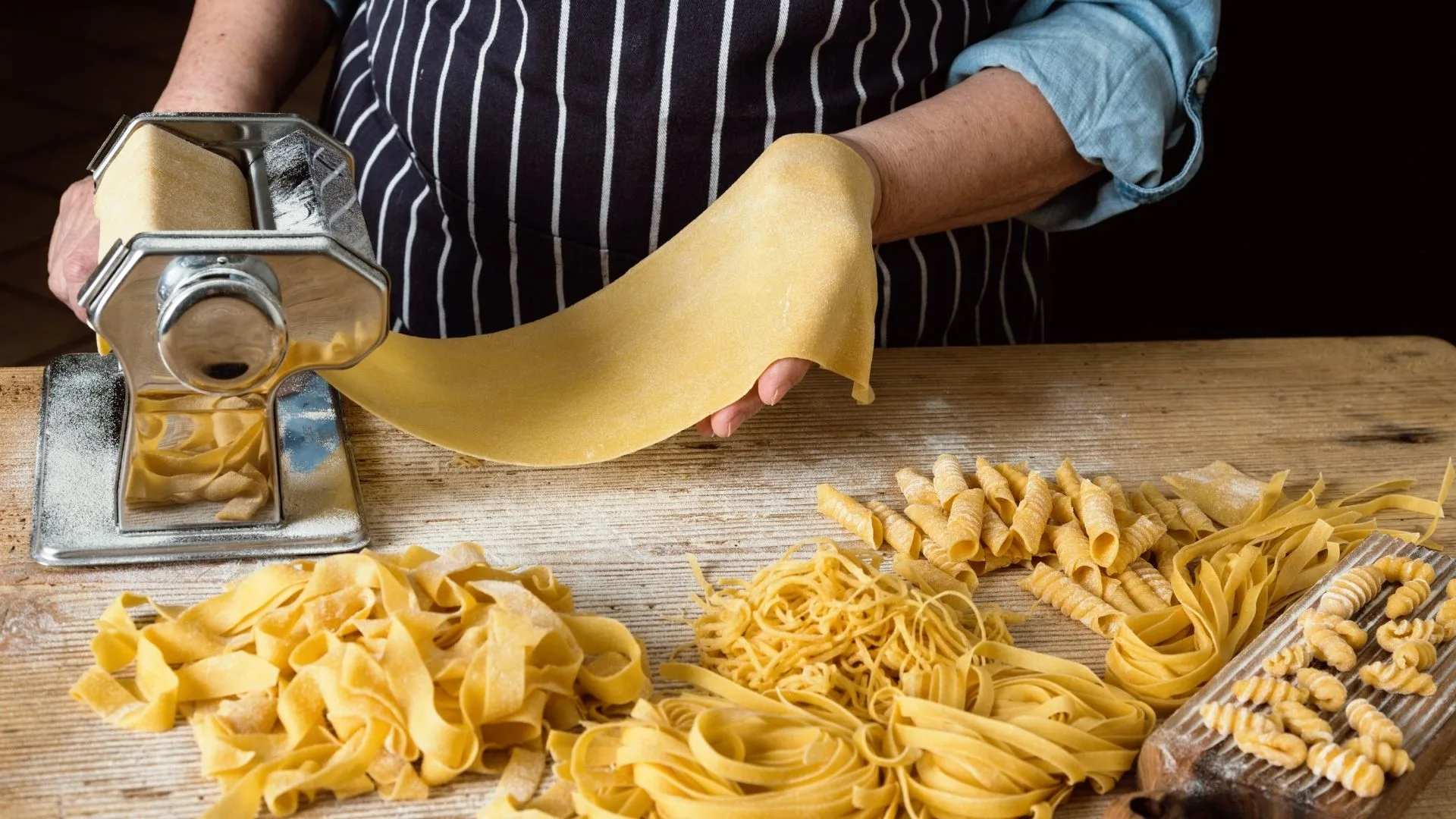
High-protein pasta has moved from a niche sports-nutrition item to a mainstream growth category, and that shift is putting new pressure on product development teams. Brand owners and co-packers are being asked to hit a “high protein” or “source of protein” label claim without sacrificing bite, cooking behavior, or shelf appeal — and the ingredient choices behind that claim determine whether the finished product succeeds or ends up reformulated. This guide walks through the protein sources, functional ingredients, and formulation trade-offs that food manufacturers and R&D teams evaluate when developing high-protein pasta, along with the regulatory groundwork that shapes label claims across major markets.
Why High-Protein Pasta Is Reshaping the Functional Food Category
Protein fortification has become one of the clearest growth levers in the global pasta category. Industry forecasts put the broader pasta market on a path from roughly USD 70–80 billion today toward USD 100–120 billion by the early 2030s, with functional and fortified formats cited repeatedly as a primary growth driver rather than a side trend (Fortune Business Insights, 2026; The Business Research Company, 2026). The high-protein noodle and pasta segment specifically is expanding even faster: one forecast places the high-protein noodles market at close to USD 3.8 billion in 2026, growing at roughly 9% annually toward 2036 (Future Market Insights, 2026).
Consumer research helps explain why. Surveys cited in recent market analysis found that a large majority of U.S. consumers say they are actively trying to increase protein intake, but remain uncertain about how much they actually need — which shifts purchase decisions toward familiar formats with a clear, front-of-pack protein number rather than unfamiliar supplement formats (Future Market Insights, 2026). Established pasta brands have already demonstrated the commercial upside: one major branded pasta line reported double-digit global growth tied directly to a protein-forward product range launch (Fortune Business Insights, 2026). For ingredient manufacturers and formulators, this creates sustained demand for protein sources and functional ingredients that can deliver a defensible protein claim while keeping cooking loss, texture, and taste within the range consumers expect from pasta.
Core Protein Sources for Pasta Fortification
Formulators generally draw from four protein categories, often blending two or more to balance amino acid profile, functionality, and cost.
Pea Protein Isolate
Pea protein isolate is the most widely used plant protein in high-protein pasta because of its neutral flavor, allergen-friendly profile, and strong water-binding and gelation properties. Studies on hybrid formulations have achieved protein content in the range of 36–40 g per 100 g using pea protein isolate as the primary fortifying ingredient, in some cases combined with a small percentage of dried spinach powder for color and micronutrient contribution (ScienceDirect, 2026). Because pea protein contains no gluten or common allergens, it is frequently positioned for allergen-free and clean-label formulations aimed at sports nutrition and general wellness buyers.
Rice Protein
Rice protein is typically paired with pea protein to round out the amino acid profile, since the two sources have complementary limiting amino acids. It also contributes a cleaner, less “beany” flavor note than pea protein alone, which can matter for sensory acceptance in retail formats.
Soy Protein, Whey Protein, and Egg White
Soy protein isolate and whey protein isolate remain common in formulations targeting sports nutrition, where a higher total protein percentage and complete amino acid profile are priorities. A D-optimal mixture design study found that a blend of roughly 24% pea protein isolate, 18% oat flour, 5% soy protein isolate, 5% whey protein isolate, and 2% vital wheat gluten nearly tripled protein content relative to a standard semolina control, while increasing hardness and cooking time in a measurable, formulation-dependent way (PMC, 2026). Egg white and dairy-derived proteins remain relevant for markets without dietary restrictions, though they narrow the addressable buyer base for vegan and allergen-free positioning.
Hybrid Legume-Cereal Blends
A growing body of research favors hybrid blends — combining legumes such as faba bean, lupin, or chickpea with pseudocereals like buckwheat — over single-source high-protein pasta. These blends are reported to maintain cooking loss, firmness, and stickiness closer to standard wheat pasta while improving protein efficiency and reducing antinutritional factors compared with single-protein formulations (ScienceDirect, 2026). For manufacturers, this supports a portfolio strategy: a hybrid blend can serve as a mid-tier product between conventional pasta and a maximum-protein sports nutrition SKU.
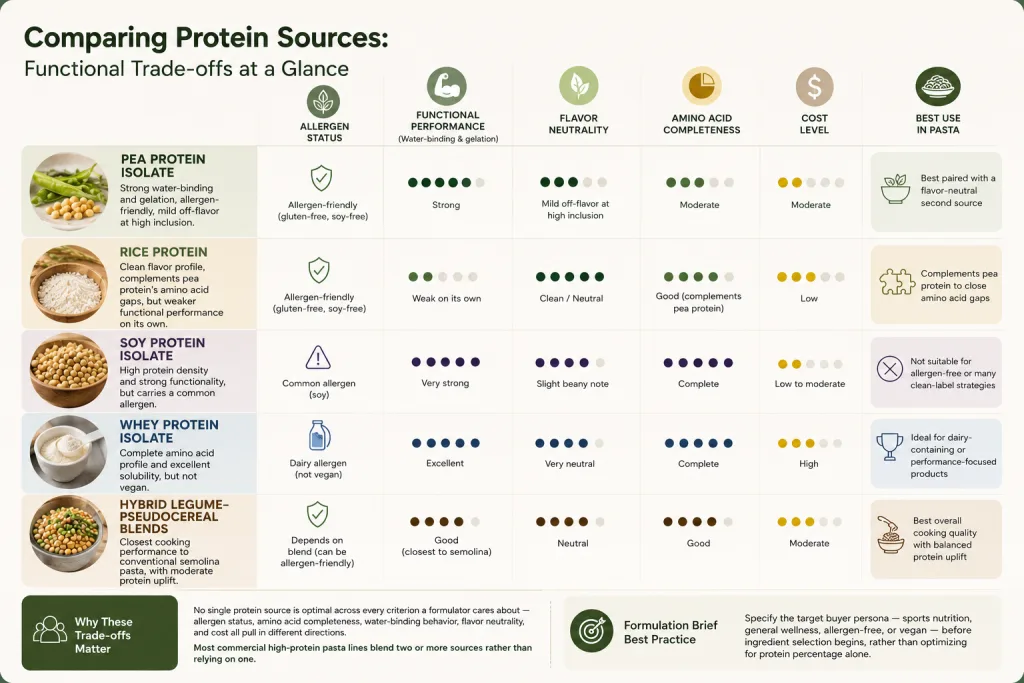
Comparing Protein Sources: Functional Trade-offs at a Glance
No single protein source is optimal across every criterion a formulator cares about — allergen status, amino acid completeness, water-binding behavior, flavor neutrality, and cost all pull in different directions, which is why most commercial high-protein pasta lines blend two or more sources rather than relying on one.
- Pea protein isolate: strong water-binding and gelation, allergen-friendly, mild off-flavor at high inclusion — best paired with a flavor-neutral second source.
- Rice protein: clean flavor profile, complements pea protein’s amino acid gaps, but weaker functional (binding) performance on its own.
- Soy protein isolate: high protein density and strong functionality, but carries a common allergen and is excluded from many allergen-free and some clean-label positioning strategies.
- Whey protein isolate: complete amino acid profile and excellent solubility, but not vegan and not suitable for dairy-restricted markets.
- Hybrid legume-pseudocereal blends: closest cooking performance to conventional semolina pasta, with a more moderate protein uplift than single-source high-inclusion formulations.
This trade-off structure is also why a formulation brief should specify the target buyer persona — sports nutrition, general wellness, allergen-free, or vegan — before ingredient selection begins, rather than optimizing for protein percentage alone.
Formulation Challenges: Balancing Protein Content with Texture and Cooking Quality
Cooking Loss and Structural Integrity
Replacing semolina with protein isolates disrupts the gluten network that normally holds pasta together during boiling. Research consistently shows that as protein-fortifying ingredient levels rise, cooking loss, hardness, and optimal cooking time all shift — sometimes favorably, sometimes not — depending on the specific protein source and inclusion rate (PMC, 2026). Formulators typically run cooking-loss and texture-profile analysis at each inclusion level rather than assuming a linear relationship between protein percentage and product quality.
Gluten Network Disruption and Structuring Agents
Because many high-protein ingredients dilute or replace gluten-forming proteins, structuring agents are often needed to preserve bite and prevent breakage during cooking. Commercial high-protein pasta formulations frequently list guar gum, sodium alginate, or similar hydrocolloids for this purpose, alongside inulin or resistant dextrin for a secondary fiber claim (MDPI, 2026).
Sensory Acceptance
Protein fortification changes color, mouthfeel, and sometimes introduces off-notes, particularly with legume proteins. Formulation studies have found that small additions of vegetable powders (such as carrot) or flavor-masking approaches can meaningfully improve sensory scores without diluting the protein claim (ResearchGate, 2026). This is typically the last optimization step once protein content and cooking performance targets are met.
Functional Ingredients That Support High-Protein Claims
Resistant Dextrin for Fiber-Protein Synergy
Pairing a high-protein claim with a fiber claim is an increasingly common positioning strategy, since the two nutrition messages reinforce each other for satiety-focused and digestive-health-focused buyers. Resistant dextrin is well suited to this role in pasta systems: it is low-viscosity, heat- and acid-stable through extrusion and drying, and does not significantly affect dough handling — making it a practical fiber-fortification ingredient to pair with pea or rice protein in a dual-claim formulation.
Konjac Flour for Texture Modification
Konjac flour is used in high-protein and low-carbohydrate pasta systems for its strong water-binding and gel-forming capacity, which helps offset the textural deficits introduced by high protein-isolate inclusion. It is a common component in commercial high-protein, low-carb pasta lines already on the market (Hethstia, 2026).
Stabilizers and Structuring Agents
Beyond gums and hydrocolloids, formulators evaluate emulsifiers and vital wheat gluten (where an allergen-free claim is not required) to restore some of the viscoelastic network lost to protein substitution. Ingredient selection here is highly formulation-specific and typically finalized only after cooking-loss and texture testing.
Regulatory Considerations for “High Protein” and “Source of Protein” Claims
Label claims are jurisdiction-specific and should be confirmed against current local regulation before finalizing a formulation, but the general framework is consistent across major markets: a “source of protein” claim typically requires that protein contributes a defined minimum share of a product’s energy value, while a “high protein” claim requires roughly double that share (PMC, 2026). In practice, this means the finished, cooked product — not just the dry formulation — needs to be tested to confirm the claim holds after water absorption during cooking. Manufacturers targeting halal or kosher certification, or export markets such as the GCC, EU, UK, or Australia, should also confirm that any animal-derived protein source (whey, egg white) and its certification status align with the target market before scaling production.
Certification and documentation planning should start alongside formulation, not after: allergen statements, halal/kosher status, and country-specific nutrient reference values all affect which protein blend is viable for a given export market, and reworking these after pilot-scale production is significantly more costly than confirming them at the brief stage.
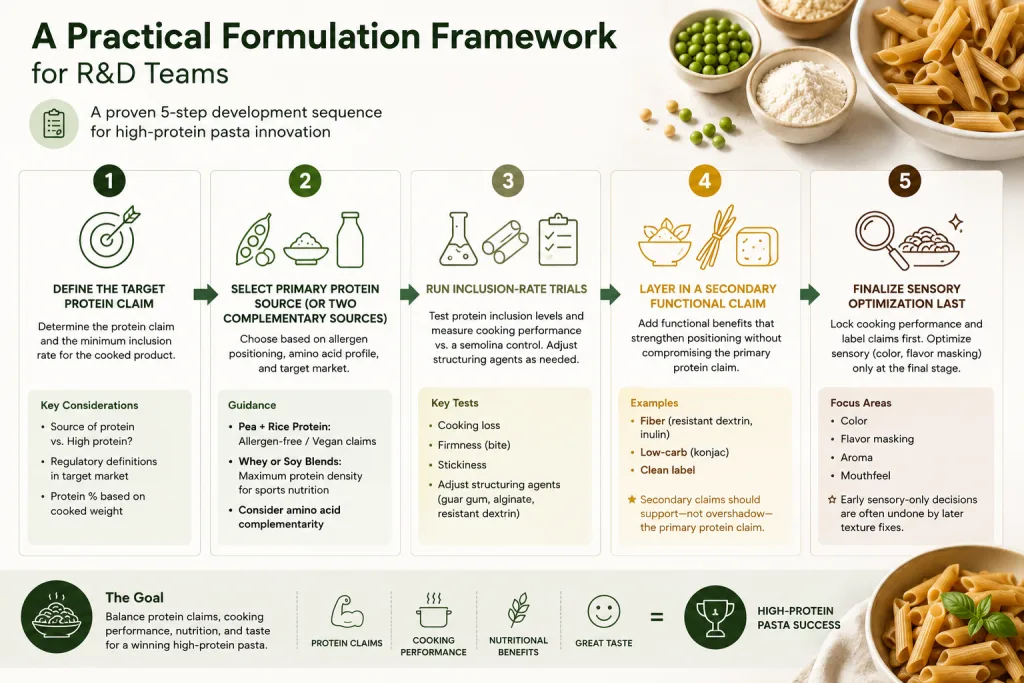
A Practical Formulation Framework for R&D Teams
Across the formulation studies reviewed here, a consistent development sequence emerges:
- Define the target protein claim (source of protein vs. high protein) and the corresponding minimum inclusion rate for the cooked product.
- Select a primary protein source (or two complementary sources) based on allergen positioning, amino acid profile, and target market — pea and rice protein for allergen-free/vegan claims; whey or soy blends for maximum protein density in sports nutrition.
- Run inclusion-rate trials measuring cooking loss, firmness, and stickiness against a semolina control, adjusting structuring agents (guar gum, alginate, resistant dextrin) as needed.
- Layer in a secondary functional claim where it strengthens positioning — fiber (resistant dextrin, inulin), low-carb (konjac), or clean label — without compromising the primary protein claim.
- Finalize sensory optimization (color, flavor masking) only after cooking performance and label claims are locked, since early sensory-only decisions are often undone by later texture fixes.
Market Opportunity for Ingredient Manufacturers and Co-Packers
The commercial case for investing in high-protein pasta formulation is strongest where three trends intersect: sustained global protein-forward demand, expansion of functional and fortified pasta as a distinct market segment growing faster than pasta overall, and Asia-Pacific’s position as the fastest-growing regional market for pasta broadly (The Business Research Company, 2026). For ingredient suppliers and contract manufacturers serving halal-certified or export-focused brand owners, formulation expertise that pairs a protein claim with a fiber, low-carb, or clean-label secondary claim offers a differentiated position rather than competing purely on protein percentage or price.
Formulation Support and Next Steps
Developing a high-protein pasta formulation that holds up through extrusion, drying, and cooking — while clearing the label claim threshold in your target market — typically requires several rounds of inclusion-rate and structuring-agent trials. Manufacturers evaluating pea protein, rice protein, resistant dextrin, or konjac-based systems for a new pasta line are welcome to reach out to discuss formulation data, functional ingredient specifications, or sample requests.
References
- Fortune Business Insights. (2026). Pasta market size, share, industry trends, forecast, 2034. https://www.fortunebusinessinsights.com/pasta-market-102284
- Future Market Insights. (2026). Global high-protein noodles market — Analysis of key trends, regional growth, top players, and a 10-year forecast from 2026 to 2036. https://www.futuremarketinsights.com/reports/high-protein-noodles-market
- Hethstia. (2026). Pea protein pasta, gluten free pea pasta. https://hethstia.com/dry-konjac-series/high-protein-pasta/pea-protein-pasta/
- MDPI. (2026). Nutritional and technological quality of high protein pasta. Foods. https://www.mdpi.com/2304-8158/10/3/589
- PMC — National Center for Biotechnology Information. (2026). Optimization of athletic pasta formulation by D-optimal mixture design. https://pmc.ncbi.nlm.nih.gov/articles/PMC7455935/
- ResearchGate. (2026). Nutritional and technological quality of high protein pasta [PDF]. https://www.researchgate.net/publication/350009910_Nutritional_and_Technological_Quality_of_High_Protein_Pasta
- ScienceDirect. (2026). Protein pasta: Formulation, processing strategies and market positioning. https://www.sciencedirect.com/science/article/pii/S3117383726000019
- The Business Research Company. (2026). Pasta market size, share and growth report 2026–2030. https://www.thebusinessresearchcompany.com/report/pasta-market-report
Featured News
Category
Get a Promo and Keep Updated