
High-Fiber, Low-Carb Tortilla & Flatbread Formulation: A Manufacturer’s Guide to Better Wraps
High-Fiber, Low-Carb Tortilla & Flatbread Formulation: A Manufacturer’s Guide to Better Wraps
September 24, 2026
General - Articles
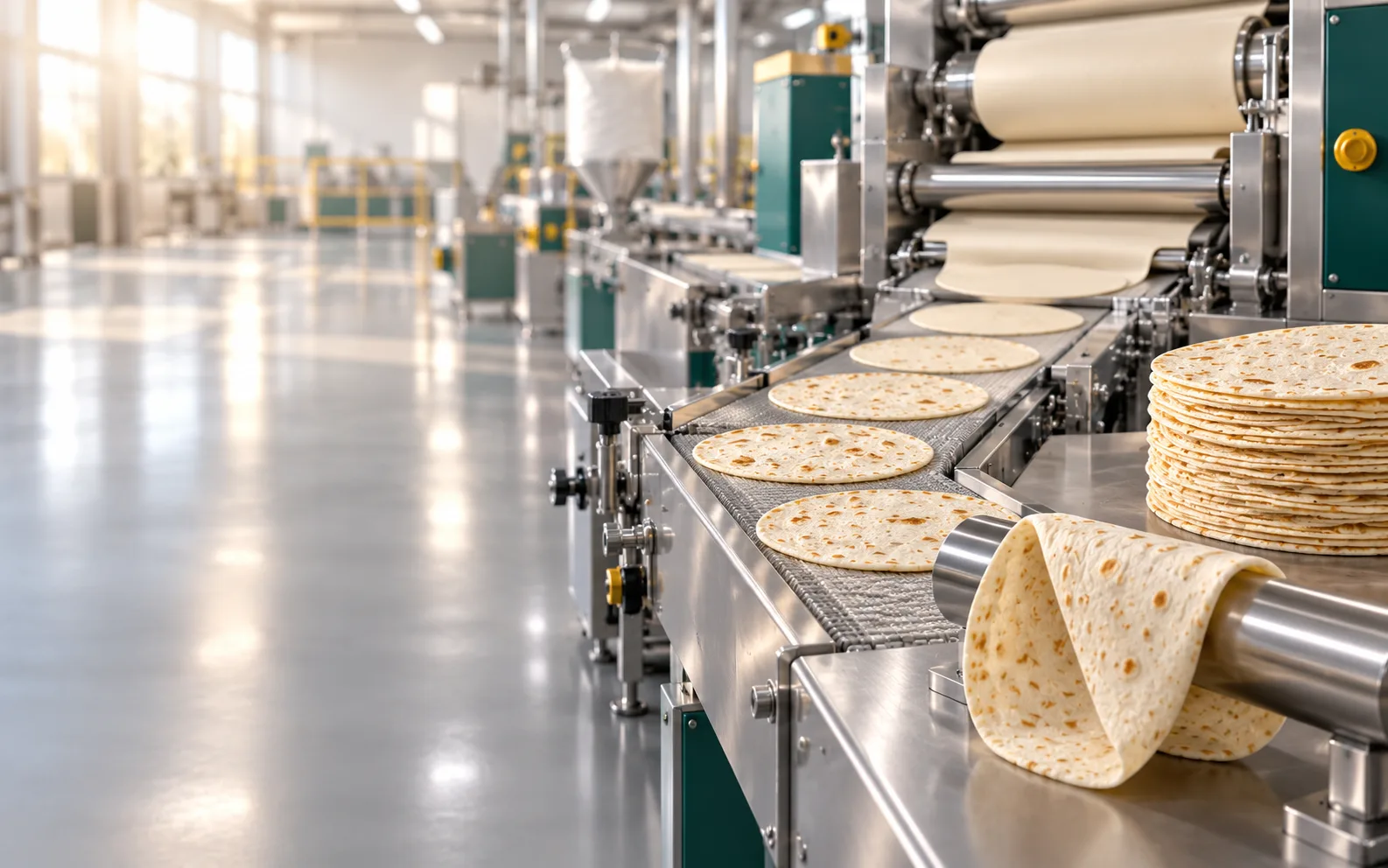
Tortillas and flatbreads sit at an odd crossroads in packaged bakery: they are a carbohydrate-heavy staple, yet shoppers increasingly want them to fit low-carb, high-fiber, and keto-friendly diets. For formulators, that is a genuine engineering problem, not just a marketing angle. Reducing available carbohydrate while boosting fiber content means rethinking flour ratios, hydration, and dough machinability, often without losing the pliability that makes a tortilla worth rolling in the first place.
This guide walks through the practical side of high-fiber low-carb tortilla and flatbread formulation: which fiber and protein ingredients perform well in a rolled dough system, how high fiber and low carb claims are actually regulated, and what B2B manufacturers should look for when sourcing functional ingredients at scale.
Why Low-Carb, High-Fiber Flatbreads Are Reshaping the Bakery Aisle
The low-carb bakery trend heading into 2026 is not a fad confined to keto influencers, it is showing up in mainstream grocery planograms, foodservice menus, and private label roadmaps. Consumers who once avoided bread altogether are now choosing reformulated tortillas, wraps, and flatbreads that let them keep the format they like while cutting net carbs. That shift has turned fiber-fortified flatbread into one of the faster-growing subcategories within packaged bakery, driven partly by consumers seeking lower-carb, higher-satiety staples, and partly by longstanding low-carb and diabetic-friendly diet trends.
For manufacturers, this creates real commercial opportunity, but only if the product performs. Early low-carb tortillas earned a reputation for being dense, gummy, or prone to cracking, problems rooted in formulation, not category. Today’s better options rely on functional fiber and protein ingredients that replace displaced starch without sacrificing rollability, which is exactly what B2B ingredient buyers and private label brands need to get right before scaling production.
What “High Fiber” and “Low Carb” Actually Mean on a Label
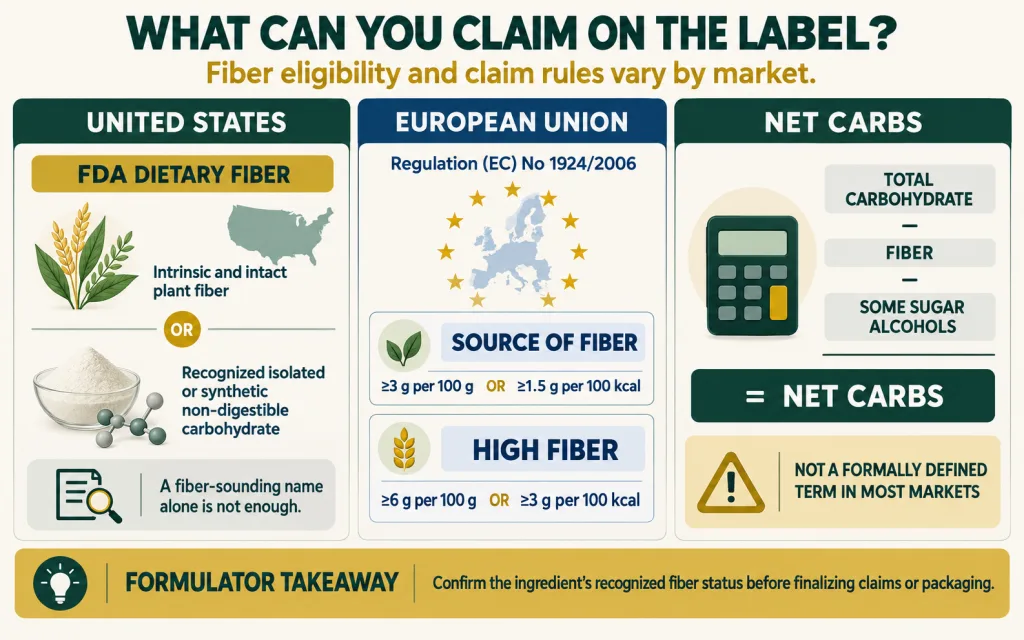
Before any dough is mixed, formulators need clarity on what regulators actually allow them to claim. In the United States, dietary fiber for label purposes must meet the FDA’s definition: either fiber that is intrinsic and intact in plants, or an isolated or synthetic non-digestible carbohydrate that FDA has determined has a beneficial physiological effect, such as improved blood glucose control or increased stool bulk. Not every fiber-sounding ingredient automatically qualifies, so an ingredient’s regulatory status matters as much as its functional performance.
In the EU, a high fiber or source of fiber claim carries its own thresholds under Regulation (EC) No 1924/2006. A source of fiber claim requires at least 3 grams of fiber per 100 grams of product, or 1.5 grams per 100 kcal, while a high fiber claim requires at least 6 grams per 100 grams, or 3 grams per 100 kcal. Net carb labeling is not a formally regulated term in most markets, so brands calculate it by subtracting fiber, and sometimes sugar alcohols, from total carbohydrate. That means an ingredient’s fiber declaration status directly affects the net carb number printed on pack, which is why sourcing a fiber already recognized under the relevant framework saves formulators from a late-stage labeling surprise.
The Formulation Challenge: Replacing Carbs Without Losing Texture
Cutting available carbohydrate in a tortilla or flatbread almost always means removing some of the wheat or corn flour that normally provides starch, structure, and gluten development. That is where most low-carb reformulations run into trouble. Pull out too much flour without a functional replacement, and dough machinability suffers, the sheet tears on the line, resists rolling, or dries out and cracks during storage.
Fiber ingredients used for carb replacement need to bring several things to the dough system at once:
- Appropriate water absorption, so hydration levels do not need a full re-engineering
- Enough plasticity to support sheeting and pressing
- Stability through baking or griddling without breaking down the finished product’s bite
Fiber ingredient water absorption is one of the trickier variables, a fiber that absorbs too aggressively can starve the gluten network of moisture, while one that absorbs too little leaves the dough slack and hard to handle. Shelf life adds another layer, since tortillas need to stay pliable for weeks without becoming stale or brittle.
Getting texture and shelf life right in a fiber fortified bakery product typically takes a few small-batch trials adjusting inclusion rate, hydration, and resting time, which is exactly where working with a supplier who understands bakery applications, rather than just supplying a spec sheet, saves development time.

Choosing the Right Fiber Ingredient for Tortillas and Flatbreads
Not all fibers behave the same way in a rolled dough. The right choice depends on whether you are prioritizing net carb reduction, dough machinability, or a specific texture profile, and often it is a blend of two or three ingredients working together rather than a single fiber doing all the work.
Resistant Dextrin for Net Carb Reduction
Resistant dextrin is one of the most widely used soluble fibers for tortilla applications because it is nearly neutral in taste, dissolves cleanly, and does not add unwanted viscosity to the dough. Since it is classified as a non-digestible carbohydrate, its grams typically count toward dietary fiber rather than net carbs, making it a practical tool for low-carb bakery formulations, and it tends to be gentler on the gut than some other high-dose soluble fibers at comparable inclusion rates.
Oat Fiber vs Resistant Dextrin in Bakery Systems
Oat fiber is a common alternative, valued for its water-holding capacity and insoluble structure, which can help bulk up dough without contributing digestible carbohydrate. The comparison with resistant dextrin usually comes down to texture: oat fiber can add a slightly grainy mouthfeel and stiffen dough at higher inclusion levels, while resistant dextrin stays smoother and more neutral, making it easier to dial in without compromising rollability.
Resistant Starch for Flatbread Structure
Resistant starch, including modified starches designed for fiber fortification, is worth testing in flatbread formulation work as well. It behaves more like conventional starch during mixing and sheeting, which can make it easier to integrate into an existing production line without a full process redesign, while still contributing to the fiber count and reducing digestible starch content.
Building Protein and Functional Carbohydrate Synergy
Fiber alone rarely solves the whole formulation puzzle. Protein ingredients play a supporting role in structure, nutrition, and mouthfeel, and pairing them thoughtfully with a fiber source tends to produce a better finished tortilla than fiber substitution alone.
Pea and Rice Protein for Structure and Nutrition
Pea protein and rice protein fortification both add a nutritional boost while contributing to dough elasticity, which partially offsets the structural role that reduced flour would otherwise play. Rice protein isolate brings a clean flavor profile and hypoallergenic positioning for allergen-conscious lines, while pea protein offers strong water-binding and a cost-efficient inclusion rate at scale.
Konjac for Chew and Moisture Retention
Konjac-based ingredients are worth testing where tortilla texture and chew are a priority. Their glucomannan content forms a gel structure that supports moisture retention, which is particularly useful in flatbread formats that need to stay pliable through refrigerated or ambient distribution without drying out or turning brittle over shelf life.
Formulating for Keto, Gluten-Free, and Clean-Label Markets
Keto tortilla formulation adds another constraint layer, since net carbs typically need to stay in the low single digits per serving. That usually means combining a soluble fiber like resistant dextrin with a low-glycemic protein rather than relying on fiber alone. Almond, coconut, or cassava-based systems are common bases, but the fiber and protein ingredients discussed above can improve texture regardless of the base flour chosen.
Gluten-free low-carb flatbread formulation brings its own challenge, since removing gluten removes the primary structural network that makes a tortilla foldable. Here, fiber and protein blends need to do double duty, providing both the fiber declaration and enough binding to prevent the dough from tearing during sheeting or the finished product from cracking on the fold test.
Clean label positioning is increasingly a market expectation rather than a premium differentiator. Ingredients derived through recognizable processes, rather than heavily modified starches, tend to read better on an ingredient panel to health-conscious shoppers, which is part of why naturally derived fibers and plant proteins have gained ground over synthetic gums in reformulation projects.
Sourcing Considerations for B2B Manufacturers and Private Label Brands
Once the formulation direction is set, sourcing becomes the next bottleneck. A bulk dietary fiber ingredient supplier needs to deliver consistent particle size, moisture content, and fiber percentage batch to batch, since variability here shows up downstream as inconsistent dough hydration and unpredictable bake results, a costly problem to trace back after the fact.
For B2B procurement, a current Certificate of Analysis should be standard practice before confirming any order. Reviewing the following gives formulators the data needed to adjust the recipe with confidence rather than guesswork:
- Total dietary fiber content, on a dry-weight basis
- Moisture content
- Ash content
- pH
A supplier that provides this documentation proactively, rather than only on request, is generally a good signal of manufacturing consistency. Private label low-carb tortilla programs and OEM flatbread formulation projects both benefit from working with an ingredient manufacturer who can support technical trials, not just ship raw material, adjusting inclusion rates, running pilot batches, and troubleshooting texture issues to shorten development timelines.
Halal and Global Market Considerations for Fiber-Fortified Flatbreads
Tortillas and flatbreads travel across a wide range of markets and dietary requirements, which makes certification status a practical sourcing filter, not an afterthought. A halal-certified fiber ingredient supplier matters for brands targeting the Middle East, Southeast Asia, and other halal-conscious markets, while kosher certification opens additional distribution channels in North America and Europe.
Functional bakery ingredient trends across Asia are also worth watching, as manufacturers in the region increasingly formulate fiber-fortified staples, rice-based flatbreads, functional wraps, and reduced-carb breads, for both domestic and export markets. Sourcing from a fiber ingredient manufacturer based in Indonesia or elsewhere in Southeast Asia can offer logistical and cost advantages for brands scaling across the region, provided the supplier holds the food safety and quality certifications global buyers expect, including HACCP, ISO, FSSC, and halal accreditation.
Partner With Satoria Nutrisentials to Formulate Your Next High-Fiber Flatbread
Reformulating a tortilla or flatbread for a high-fiber, low-carb positioning takes more than swapping one ingredient for another, it takes a fiber and protein toolkit built for real dough systems, backed by a supplier who understands bakery applications from mixing to shelf life. Satoria Nutrisentials’ Resistant Dextrin was developed specifically to support fiber enrichment across F&B categories, offering a neutral-tasting, non-viscous soluble fiber that fits naturally into rolled dough formulations without compromising texture. Paired with Satoria’s Rice Protein Isolate and Pea Protein for structural and nutritional support, it gives formulators a practical starting point for keto, gluten-free, or general better-for-you flatbread lines.
Every Satoria ingredient is backed by HACCP, ISO, FSSC 22000, and Halal certification, with bulk and OEM toll manufacturing options for brands scaling from pilot batch to full production, and your formula stays confidential throughout. If you are developing a high-fiber, low-carb tortilla or flatbread and want formulation support from a team that has done this work before, reach out to Satoria Nutrisentials to request a sample and start a technical conversation about your project.
References
- European Parliament and Council of the European Union. (2006). Regulation (EC) No 1924/2006 on nutrition and health claims made on foods. https://eur-lex.europa.eu/legal-content/EN/TXT/HTML/?uri=CELEX:32006R1924
- U.S. Food and Drug Administration. (2024). Questions and answers on dietary fiber. https://www.fda.gov/food/nutrition-food-labeling-and-critical-foods/questions-and-answers-dietary-fiber
- National Center for Biotechnology Information. (2025). The role of dietary fiber in health promotion and disease prevention: A practical guide for clinicians. In StatPearls. https://www.ncbi.nlm.nih.gov/books/NBK559033/
- Frontiers in Nutrition. (2021). Comparative effect of 22 dietary sources of fiber on gut microbiota of healthy humans in vitro. https://www.frontiersin.org/journals/nutrition/articles/10.3389/fnut.2021.700571/full
- Nutrients. (2022). Effect of resistant dextrin on intestinal gas homeostasis and microbiota. https://doi.org/10.3390/nu14214611
- Nutrition Journal. (2026). Effects of resistant dextrin on glycemic traits: A systematic review and meta-analysis of randomized controlled trials. https://link.springer.com/article/10.1186/s12937-026-01292-z
- British Journal of Nutrition. (2015). Resistant dextrin, as a prebiotic, improves insulin resistance and inflammation in women with type 2 diabetes: A randomised controlled clinical trial. https://www.cambridge.org/core/journals/british-journal-of-nutrition/article/resistant-dextrin-as-a-prebiotic-improves-insulin-resistance-and-inflammation-in-women-with-type-2-diabetes-a-randomised-controlled-clinical-trial/F4EA168D73C2C15220AAF3D69818C853
- PubMed Central. (2020). Attenuation of glycaemic and insulin responses following tapioca resistant maltodextrin consumption in healthy subjects: A randomised cross-over controlled trial. https://pmc.ncbi.nlm.nih.gov/articles/PMC7372190/
Featured News
Category
Get a Promo and Keep Updated