
Konjac Glucomannan for Weight Management: A B2B Formulator’s Guide to Sourcing, Science, and Applications
Konjac Glucomannan for Weight Management: A B2B Formulator’s Guide to Sourcing, Science, and Applications
September 18, 2026
Functional Rice - Articles
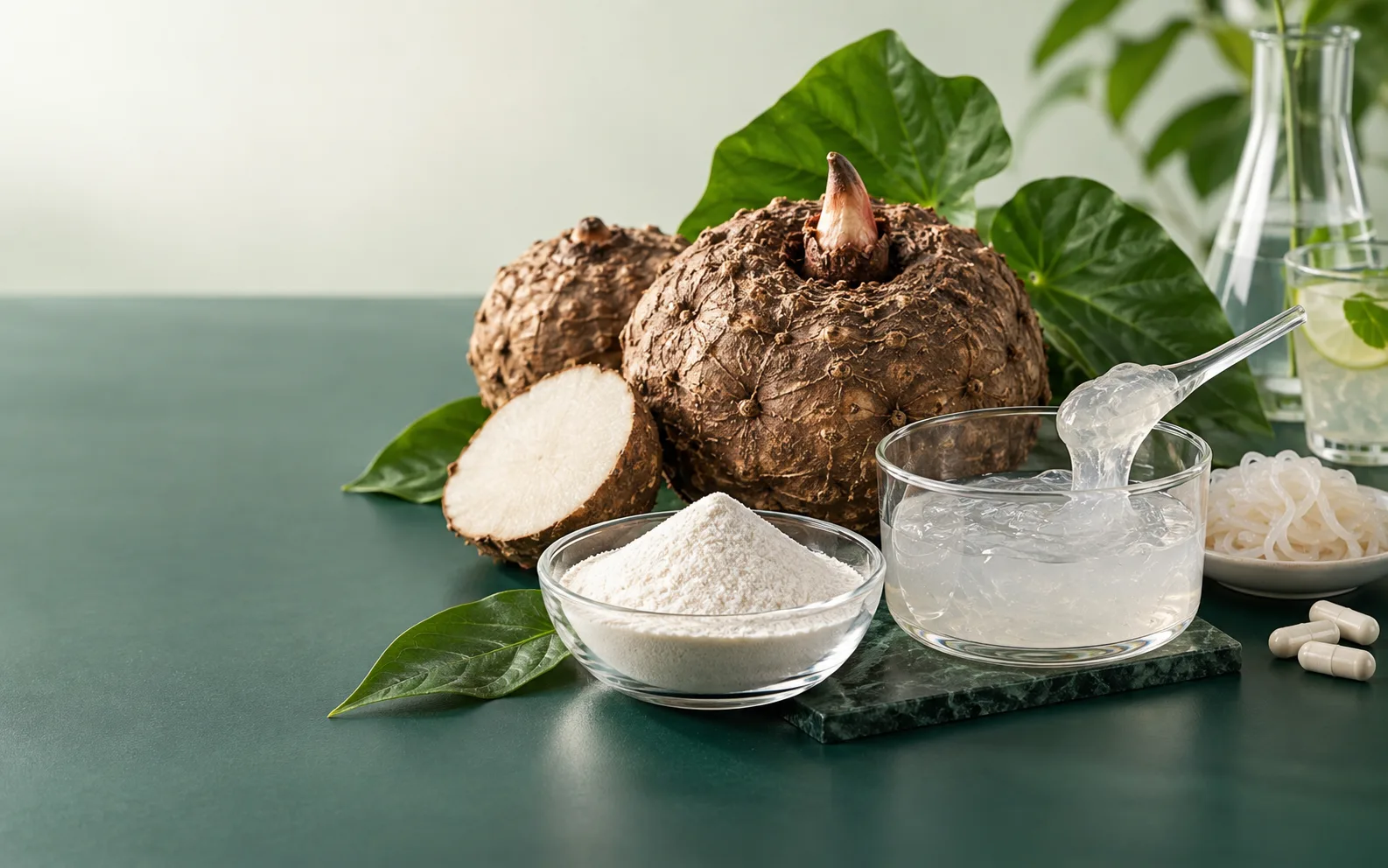
Weight management is one of the most heavily formulated categories in food, beverage, and supplement development, and konjac glucomannan keeps landing at the center of it. If you’re sourcing an ingredient for a new SKU or reformulating an existing one, you’ve probably run into it already: viscous, satiating, backed by an actual regulatory health claim, and flexible enough to work across capsules, powders, noodles, and functional beverages. But turning “glucomannan for weight management” from a marketing headline into a manufacturable, compliant, and genuinely effective product takes more than enthusiasm — it takes the right spec sheet, the right documentation, and an honest read of the clinical evidence. Here’s what B2B buyers and formulators actually need to know before they source it.
What Is Konjac Glucomannan, and Why Does It Work?
Konjac glucomannan is a soluble dietary fiber extracted from the tuber of Amorphophallus konjac, a plant that has been cultivated and consumed across Asia for centuries, traditionally processed into flour and, more recently, purified into a high-glucomannan powder for food and supplement use. What makes it unusual among dietary fibers is its water-holding capacity: it can absorb up to 50 times its own weight in water, forming a thick, viscous gel almost as soon as it makes contact with liquid.
That gel is the whole mechanical story behind its weight-management reputation. Once ingested, it increases gastric volume, activates stretch receptors in the stomach wall, and slows gastric emptying, which extends the feeling of fullness after a meal (Devaraj et al., 2019). It’s also fermented by gut bacteria rather than digested outright in the small intestine, which is part of why glucomannan interacts with cholesterol absorption, blood glucose response, and bowel regularity, not just appetite. For formulators, that multi-pathway profile is exactly what makes it interesting beyond a single weight-loss claim.
The Evidence for Weight Management: What the Research Actually Shows

The Regulatory Health Claim
In 2010, the European Food Safety Authority approved a health claim allowing that “glucomannan contributes to weight loss in the context of an energy-restricted diet,” at a dose of 3 grams per day, taken with water shortly before meals (EFSA Panel on Dietetic Products, Nutrition and Allergies, 2010). That approval is a meaningful regulatory milestone — very few dietary fibers have cleared this particular bar in the EU, and it’s the reason konjac glucomannan shows up so often in weight-management formulations sold across Europe.

Where the Evidence Gets More Nuanced
The broader clinical picture is genuinely mixed, and B2B buyers deserve the honest version rather than the marketing version. A 2008 meta-analysis of randomized trials found glucomannan produced meaningful reductions in total cholesterol and LDL cholesterol, along with a smaller but statistically significant effect on body weight (Sood et al., 2008). Later reviews were less conclusive on weight specifically: a 2014 meta-analysis found no statistically significant weight-loss effect once methodologically weaker trials were excluded (Onakpoya et al., 2014), while a 2015 systematic review found effects that varied considerably by study duration, dose, and population (Zalewski et al., 2015).
For formulators and marketing teams alike, that translates into a simple, defensible takeaway: glucomannan’s satiety and lipid-modulating effects are well-supported across the literature, but weight-loss claims perform best — and hold up best under regulatory scrutiny — when they stay tied to the approved context of an energy-restricted diet, rather than standing alone as a stand-in for calorie control.
Purity, Viscosity, and Mesh Size: What to Specify When Sourcing
Not all konjac glucomannan is interchangeable, and the spec sheet matters considerably more than the marketing copy attached to it.
Purity Percentage
Food-grade material typically ranges from 80–85% glucomannan content, while nutraceutical and supplement-grade material is more commonly specified at 90–95% purity. Higher purity generally correlates with stronger gelling performance and a cleaner label declaration, but it also affects landed cost, so the right purity percentage is really a function of the finished product category and price point rather than a universal “best” spec.
Viscosity and Mesh Size
High viscosity konjac glucomannan, often quoted in the 15,000–40,000+ mPa·s range, is what drives strong gelling and satiety performance in beverages, gels, and noodle-style products. Mesh size and particle size specification affect how quickly the powder hydrates and how well it compresses, so a formulator confirming mesh size for tablet formulation should treat that as a separate specification conversation from the mesh grade used in food or beverage applications.
Documentation to Request
Any serious supplier should be able to provide a Certificate of Analysis (CoA) for every batch, confirming purity, viscosity, particle size distribution, heavy metals, and microbiological testing. If a konjac glucomannan supplier can’t produce a CoA on request, or hedges on organic or non-GMO documentation, that’s a sourcing red flag worth taking seriously rather than a minor administrative gap.
Dosing, Hydration, and Safety Considerations Every Formulator Should Plan For
Because glucomannan’s entire functional value comes from rapid, high-capacity water absorption, dosing and hydration instructions aren’t a minor labeling detail — they’re a genuine safety consideration. Case reports have documented esophageal obstruction when concentrated glucomannan tablets were swallowed with insufficient liquid, allowing the gel to form before it cleared the esophagus (Vanderbeek et al., 2007).
In practice, this means capsule and tablet formats need clear “take with a full glass of water” labeling, and formulators should think carefully about tablet size, coating, and disintegration behavior rather than maximizing dose density alone. For powders and beverage formats, hydration timing during manufacturing also needs testing, since a batch that hydrates too quickly in-process can thicken before it’s packaged, causing line issues long before the product reaches a consumer.
None of this rules glucomannan out as a weight-management ingredient — it simply means dosing format deserves as much formulation attention as the ingredient’s headline satiety benefit. Suppliers who can share application-specific dosing guidance, rather than a single generic recommendation, tend to be the more experienced partners for this particular fiber.
Formulation Applications Across Product Categories
Glucomannan’s viscosity is an asset in some formats and a genuine formulation challenge in others, so it helps to know where it tends to fit most naturally:
- Appetite suppressant capsules and tablets — the most direct application of the EFSA-style dosing model, typically delivered around 1 gram per dose, three times daily.
- Meal replacement powders and weight loss shakes — added primarily for satiety, though hydration timing needs careful testing to avoid excessive thickening during mixing or shelf storage.
- Functional food and beverage products — used at lower inclusion rates as a satiety- and texture-modifying soluble fiber alongside other functional ingredients.
- Low-carb and keto noodle or “zero-calorie” formats — glucomannan’s rapid gelling behavior is what makes shirataki-style noodles and similar products possible in the first place.
- Fat replacement and texturizing applications — its viscosity can partially stand in for fat in some reduced-calorie bakery, dessert, and sauce formats.
Each of these calls for a distinct viscosity and particle size profile, which is why formulation trials with a supplier’s actual production-grade material matter as much as the ingredient spec sheet on paper.
Certifications and Compliance: What Serious Buyers Verify
For B2B procurement teams, the ingredient’s functional profile is only half of the qualification process — compliance documentation is the other half, and increasingly the deciding factor. Buyers evaluating a glucomannan food grade supplier should confirm GMP-certified manufacturing at minimum, and ideally sourcing from an FDA-registered facility if the finished product is destined for the US market.
Beyond that baseline, certifications like halal, kosher, organic, and non-GMO status increasingly determine which markets a formulation can enter at all. A halal certified konjac glucomannan source opens GCC and other Muslim-majority markets without a separate certification cycle, while EFSA-aligned documentation matters specifically for any brand planning to use the EU weight-loss health claim on-pack. None of these certifications are optional extras anymore for a competitive B2B ingredient program — they’re baseline expectations from retail buyers and distribution partners alike.
It’s also worth asking how a supplier’s certifications are maintained over time, not just at the point of first approval. Audit frequency, traceability from raw material to finished lot, and willingness to share certificate renewals proactively are all reasonable things to request before signing a long-term supply agreement.
Vetting a Konjac Glucomannan Supplier or Manufacturer
Sourcing decisions usually come down to more than price per kilogram, and a few direct questions tend to separate a good long-term partner from a purely transactional vendor. Does the supplier offer OEM or private label capability, or only bulk raw material with no formulation support? Can they support custom glucomannan formulation work — adjusting viscosity, particle size, or blending with complementary fibers — rather than shipping a single fixed spec regardless of application?
Minimum order quantity matters too, and so does how sensibly it scales from pilot batches to full production runs as a product moves from concept to shelf. A wholesale distributor with deep inventory can be useful for an established SKU with stable demand, but a manufacturer with in-house formulation and technical support is usually the stronger partner for anything still in active development, since specification adjustments and troubleshooting happen faster with a team that actually processes the material.
Konjac Glucomannan vs Other Satiety Fibers
Glucomannan isn’t the only satiety-driving fiber on the market, and it’s worth understanding where it sits relative to alternatives like psyllium husk before locking in a formulation direction. Psyllium tends to be less viscous and gels more gradually in the gut, which some formulators prefer for beverage mouthfeel and easier processing, while glucomannan’s rapid, high-viscosity gel is what makes it particularly effective in capsule, tablet, and noodle-style applications specifically.
Neither fiber is a strict upgrade over the other — the right natural appetite suppressant ingredient depends on the finished format, the target viscosity profile, processing conditions, and how the fiber needs to behave both in-process and in the gut. Some formulations even combine the two, using glucomannan for satiety performance and a secondary fiber for texture or cost balance.
Resistant dextrin is another fiber worth considering alongside glucomannan for weight-management formats, particularly where a lower-viscosity, more neutral-tasting fiber is needed alongside glucomannan’s gelling strength. The choice ultimately comes down to a formulation trial, not a spec sheet comparison alone.
Regional Market Considerations
A konjac glucomannan supplier serving the USA needs to navigate FDA dietary fiber labeling rules and substantiation standards, while a glucomannan ingredient supplier targeting Europe has to work within EFSA’s specific authorized wording for the weight-management claim — deviating from that language is a compliance risk, not a stylistic marketing choice. For the GCC and other halal markets, certification documentation typically needs to travel with the ingredient from origin through to the finished product, which is where working with a manufacturer that already holds halal, kosher, and other relevant certifications saves considerable time during market entry and retail listing.
Brands selling across several of these regions at once often find it simpler to standardize on a single supplier that already carries the full certification stack, rather than piecing together separate ingredient lots with different compliance gaps for each market. That’s a sourcing decision worth making early, before packaging and label copy are finalized for each region.
Where This Fits Into a Broader Fiber and Weight-Management Strategy
If you’re evaluating konjac-based ingredients for a weight-management line, it’s worth knowing that konjac itself is already part of Satoria Nutrisentials’ own product development. SatoRice, our functional konjac-based rice, was built around the same fiber-forward, satiety-supporting principle, combined with plant protein for a more complete nutritional profile that still cooks and eats like ordinary rice. For brands working on fiber-enriched formats more broadly, Fiberfit® offers a retail-ready, low-calorie fiber ingredient already positioned around weight management and gut health.
And for teams that need an actual formulation and production partner rather than just a raw material shipment, our OEM and toll manufacturing services support everything from small-batch development trials through to full-scale production. That combination — functional fiber expertise plus in-house manufacturing capability — is often what separates a workable weight-management concept from a product that’s actually ready to launch, particularly for brands entering the category for the first time.
Ready to Formulate Your Next Weight-Management Product?
Sourcing a satiety fiber is only the first step — getting the viscosity, dosing format, and compliance documentation right is what actually determines whether a product performs on shelf and holds up to regulatory scrutiny. If you’re exploring konjac-based ingredients or fiber-enriched formats for your next launch, our team can walk through formulation options, certifications, and sample specifications suited to your target market. Get in touch to consult your needs and explore how our functional ingredient portfolio can support your next weight-management product.
References
- Devaraj, R. D., Reddy, C. K., & Xu, B. (2019). Health-promoting effects of konjac glucomannan and its practical applications: A critical review. International Journal of Biological Macromolecules, 126, 273–281. https://pubmed.ncbi.nlm.nih.gov/30586587/
- EFSA Panel on Dietetic Products, Nutrition and Allergies. (2010). Scientific opinion on the substantiation of health claims related to konjac mannan (glucomannan) and reduction of body weight, pursuant to Article 13(1) of Regulation (EC) No 1924/2006. EFSA Journal, 8(10), 1798. https://doi.org/10.2903/j.efsa.2010.1798
- National Center for Biotechnology Information. (2023). Obesity supplements. StatPearls. https://www.ncbi.nlm.nih.gov/books/NBK576386/
- Onakpoya, I., Posadzki, P., & Ernst, E. (2014). The efficacy of glucomannan supplementation in overweight and obesity: A systematic review and meta-analysis of randomized clinical trials. Journal of the American College of Nutrition, 33(1), 70–78. https://doi.org/10.1080/07315724.2014.870013
- Sood, N., Baker, W. L., & Coleman, C. I. (2008). Effect of glucomannan on plasma lipid and glucose concentrations, body weight, and blood pressure: Systematic review and meta-analysis. American Journal of Clinical Nutrition, 88(4), 1167–1175. https://pubmed.ncbi.nlm.nih.gov/18842808/
- Vanderbeek, P. B., Fasano, C., O’Malley, G., & Hornstein, J. (2007). Esophageal obstruction from a hygroscopic pharmacobezoar containing glucomannan. Clinical Toxicology, 45(1), 80–82. https://pubmed.ncbi.nlm.nih.gov/17357389/
- Zalewski, B. M., Chmielewska, A., & Szajewska, H. (2015). The effect of glucomannan on body weight in overweight or obese children and adults: A systematic review of randomized controlled trials. Nutrition, 31(3), 437–442. https://pubmed.ncbi.nlm.nih.gov/25701331/
Featured News
Category
Get a Promo and Keep Updated