
Functional Still Water Formulation: A B2B Guide to Clean-Label Hydration Ingredients
Functional Still Water Formulation: A B2B Guide to Clean-Label Hydration Ingredients
September 29, 2026
General - Articles

Still water has always sold on simplicity — no color to explain, no ingredient list to defend, nothing between the shopper and a clear bottle. That is exactly what makes functional still water formulation such a technical puzzle for F&B manufacturers. Add fiber, protein, or postbiotics and shoppers still expect the drink to look, taste, and pour like the water it replaced. Get the formulation wrong and cloudiness, grit, or an off-note gives the whole category away. Get it right, and you have built one of the most versatile platforms in functional beverages.
Why Functional Still Water Formulation Is Reshaping the Hydration Aisle
Functional water has moved well past the vitamin-and-electrolyte era. Industry forecasts point to the category growing at a compound annual rate above 6% through the early 2030s, with manufacturers layering in botanicals, proteins, and fiber to meet demand for measurable health benefits rather than flavor alone. Personalized hydration is one of the defining beverage trends heading into 2026, as consumers look for drinks tailored to digestion, energy, or recovery rather than a single blanket formula.
This is where still, non-carbonated formats have an underappreciated advantage. Carbonation and heavy flavoring can mask a rough-tasting functional ingredient, but still water offers nowhere to hide — which is precisely why brands that master clean-label functional water formulation earn outsized trust. A product that stays clear, tastes neutral, and delivers real digestive wellness benefits reads as more credible than one dressed up with flavor to cover its ingredients. That credibility is becoming the actual point of differentiation in a crowded functional beverage set.
The Real Formulation Challenge: Staying Invisible While Adding Function
Ask any formulator how to formulate functional water and the answer starts with a constraint, not an ingredient: whatever you add has to disappear. Fiber sources that work beautifully in a smoothie or bar often turn cloudy, viscous, or faintly sweet the moment they are dropped into a transparent, low-sugar base. Protein fractions can introduce beany notes or sediment that a flavored beverage would mask but a still water formulation cannot.
That constraint is exactly why ingredient selection matters more here than almost anywhere else in F&B development. A functional water ingredient supplier needs to offer more than a functional claim — it needs data on solubility at use-level concentrations, sensory neutrality, and behavior across the pH and thermal range your production line actually runs. Ingredients that were engineered for opaque or heavily flavored formats frequently fail this test outright.
The manufacturers getting this right are treating still water as its own formulation category, not a diluted version of a functional soda or juice brief. That means testing fiber and protein sources specifically for clarity retention, running shelf-life trials under real retail lighting and temperature conditions, and building in enough of a functional dose to support a genuine claim without tipping the sensory profile.
Soluble Fiber for Still Water: Why Low-Viscosity Wins
Fiber is the ingredient category most likely to make or break a functional water formulation project, and viscosity is the variable that decides it. Many soluble fibers — inulin, certain gums, some fructooligosaccharides — thicken a solution noticeably once you reach a meaningful fiber dose, giving the drink a syrupy mouthfeel that instantly signals “additive” instead of “water.” Dietary fiber intake is already a documented public health gap, with most adults falling well short of recommended levels, so the opportunity to close that gap through beverages is real — but only if the fiber itself does not compromise the format (Quagliani & Felt-Gunderson, 2016).
Resistant Dextrin in Water Formulation
Resistant dextrin stands out here because its solution viscosity stays low even at functional inclusion levels, and it dissolves to a colorless, transparent solution rather than a cloudy suspension. It is also tasteless, which matters enormously in a format with no flavor system to lean on. Clinical work on resistant dextrin, marketed under names such as NUTRIOSE, has shown it modulates colonic bacteria favorably and is well tolerated across a range of daily intakes without gastrointestinal distress at appropriate doses (Lefranc-Millot et al., 2012).
Fiber Solubility in Cold Water Beverages
Cold-fill and ambient-fill lines add a second layer of difficulty, since some fibers that dissolve cleanly when heated during processing partially recrystallize or cloud once the product cools and sits on shelf. A soluble fiber for still water needs to demonstrate solubility and clarity retention specifically under cold and room-temperature conditions, not just at processing temperature, because that is the state the consumer actually sees at the point of purchase.
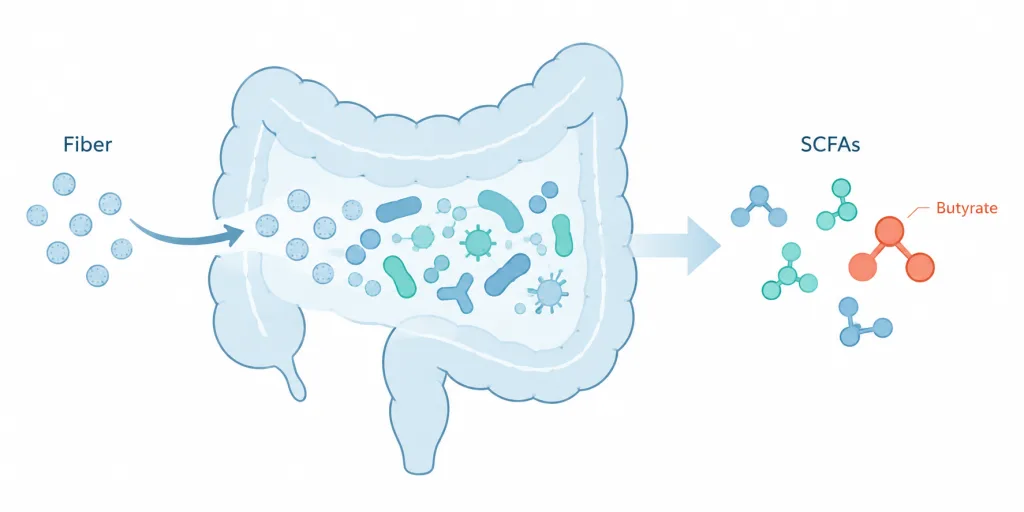
Prebiotic Fiber Water Formulation for Gut Health
A prebiotic fiber water formulation gives brands a way to speak to gut health water formulation claims without adding live cultures, which carry their own cold-chain and stability demands that most still water production and distribution networks are not built for. Prebiotic fibers are selectively fermented by beneficial gut bacteria, and resistant dextrin in particular has demonstrated the ability to shift short-chain fatty acid production toward butyrate — the preferred energy source for colon cells — while remaining gentle on digestive comfort at appropriate intake levels (Lefranc-Millot et al., 2012).
For a formulator, the appeal is practical as much as physiological. A well-chosen prebiotic fiber requires no refrigeration, no viable-organism testing, and no special handling through distribution, yet it still supports a genuine digestive wellness beverage ingredients claim on pack. That combination of functional credibility and manufacturing simplicity is a major reason fiber has become the leading ingredient category in the functional water conversation, ahead of more operationally demanding options like live probiotics.
Adding Protein Without Losing Clarity: Pea Protein Infused Water
Protein-fortified water is one of the fastest-growing subsegments in the category, but it is also one of the hardest to execute cleanly. Whey-based options carry allergen and lactose concerns that many brands want to avoid, which has pushed formulators toward plant proteins — and pea protein infused water has emerged as a leading solution because of its neutral flavor profile and strong solubility relative to other plant proteins.
Pea protein isolate delivers a complete amino acid profile, including a strong lysine contribution that many grain-based proteins lack, with a protein digestibility-corrected amino acid score in the high 0.80s to low 0.90s range — comparable to several higher-cost animal proteins (PMC, 2025). It is hypoallergenic, non-GMO, and free of the gluten and lactose flags that complicate label claims on a clean-label functional water. The tradeoff formulators need to manage is dose: enough protein to support a real “protein water” claim, without pushing past the concentration where haze or sedimentation starts to appear in a clear format.
Postbiotics and Synbiotic Water Formulation: What’s Next in Functional Hydration
Postbiotics in functional water represent the next logical step for brands that want a microbiome-adjacent claim without the stability burden of live organisms. The International Scientific Association for Probiotics and Prebiotics defines a postbiotic as a preparation of inactivated microorganisms and/or their components that confers a measurable health benefit on the host — critically, this definition does not require the organism to remain alive, which makes postbiotics far more compatible with ambient-stable still water than traditional probiotics (Salminen et al., 2021).
Synbiotic water formulation takes this a step further by deliberately pairing a live or inactivated microbial component with a substrate selectively utilized by that microorganism, such as a prebiotic fiber, so the two work together rather than simply coexisting on an ingredient list (Swanson et al., 2020). For still water specifically, a synbiotic built around resistant dextrin as the substrate is one of the more formulation-friendly combinations available, since the fiber component is already proven for clarity and taste neutrality in this format.
Formulation Fundamentals: pH Stability, Shelf Life, and Working With an OEM Partner
Beyond ingredient selection, a functional water pH stability ingredient needs to perform across the acid range most still water formulations actually use, typically pH 2 to 7 once flavor or preservation systems are factored in. Resistant dextrin holds up across that full range and tolerates heat processing up to roughly 150–200°C for short durations, which gives formulators flexibility whether they are running a cold-fill, hot-fill, or retort process.
Fiber fortified water shelf life is another area where ingredient choice has outsized impact. A fiber that resists retrogradation and does not interact with minerals in the water base helps a finished product hold its clarity and sensory profile for the 12 to 24 months many retail and export timelines require. This is also where partnering with an OEM functional water formulation manufacturer pays off: a supplier that also runs toll manufacturing can help pressure-test a formula’s stability before it ever reaches full-scale production, catching clarity or separation issues at bench and pilot scale rather than after a commercial run.
Regulatory Considerations for Global Functional Water Launches
Health claims are where a strong functional still water formulation can lose its commercial value if compliance is treated as an afterthought. In the United States, FDA compliant fiber water formulation claims around heart health are only permitted for specific, FDA-reviewed soluble fiber sources under an authorized health claim framework — a structure the agency has expanded gradually, source by source, since the original 1997 rule for oat beta-glucan (U.S. Food and Drug Administration, 1997). Functional water health claim regulation elsewhere follows a similarly evidence-gated model, meaning a claim that works in one market may need to be softened or removed for another.
Export-focused brands have an additional layer to manage: a halal certified fiber ingredient for water is often non-negotiable for GCC, Southeast Asian, and broader Muslim-majority markets, while kosher and Non-GMO status matter for other regions entirely. Sourcing a fiber, protein, or postbiotic ingredient that already carries Halal, Kosher, FSSC 22000, and FDA documentation removes a significant amount of regulatory friction from a multi-market launch, letting the marketing and R&D teams focus on the formulation itself rather than re-qualifying ingredients market by market.
Formulate Your Next Functional Still Water With a Partner Who Has Already Solved the Clarity Problem
Functional still water formulation ultimately comes down to picking ingredients built for a format with nowhere to hide. Resistant Dextrin by Fiberfit™ was developed with exactly this challenge in mind — a soluble, prebiotic fiber that stays colorless and low in viscosity from bench trial through commercial-scale production, backed by FSSC 22000, Halal, Kosher, and FDA documentation for markets around the world. Paired with our Pea Protein and Pea Protein Isolate for brands building protein-forward SKUs, it gives formulators a clear path from concept to shelf-stable, better-for-you hydration.
Satoria Nutrisentials’ food scientists work directly with F&B manufacturers on dose optimization, clarity and shelf-life testing, and OEM production support, so your next functional water launch does not have to start from a blank formulation sheet. Consult your needs now and let our team help you turn a functional still water concept into a production-ready product.
References
- Lefranc-Millot, C., Guérin-Deremaux, L., Wils, D., Neut, C., Miller, L. E., & Saniez-Degrave, M. H. (2012). Impact of a resistant dextrin on intestinal ecology: How altering the digestive ecosystem with NUTRIOSE®, a soluble fibre with prebiotic properties, may be beneficial for health. Journal of International Medical Research, 40(1), 211–224. https://pubmed.ncbi.nlm.nih.gov/22429361/
- Quagliani, D., & Felt-Gunderson, P. (2016). Closing America’s fiber intake gap: Communication strategies from a food and fiber summit. American Journal of Lifestyle Medicine, 11(1), 80–85. https://pmc.ncbi.nlm.nih.gov/articles/PMC6124841/
- Salminen, S., Collado, M. C., Endo, A., Hill, C., Lebeer, S., Quigley, E. M. M., Sanders, M. E., Shamir, R., Swann, J. R., Szajewska, H., & Vinderola, G. (2021). The International Scientific Association of Probiotics and Prebiotics (ISAPP) consensus statement on the definition and scope of postbiotics. Nature Reviews Gastroenterology & Hepatology, 18(9), 649–667. https://pmc.ncbi.nlm.nih.gov/articles/PMC8387231/
- Swanson, K. S., Gibson, G. R., Hutkins, R., Reimer, R. A., Reid, G., Verbeke, K., Scott, K. P., Holscher, H. D., Azad, M. B., Delzenne, N. M., & Sanders, M. E. (2020). The International Scientific Association for Probiotics and Prebiotics (ISAPP) consensus statement on the definition and scope of synbiotics. Nature Reviews Gastroenterology & Hepatology, 17(11), 687–701. https://isappscience.org/resource/expert-consensus-document-the-international-scientific-association-for-probiotics-and-prebiotics-isapp-consensus-statement-on-the-definition-and-scope-of-synbiotics/
- U.S. Food and Drug Administration. (1997, January 23). Food labeling: Health claims; oats and coronary heart disease [Final rule]. Federal Register, 62(15), 3584–3601. https://www.govinfo.gov/content/pkg/FR-1997-01-23/html/97-1598.htm
- European Food Safety Authority. (2010). EFSA sets European dietary reference values for nutrient intakes. https://www.efsa.europa.eu/en/press/news/nda100326
- National Center for Biotechnology Information (PMC). (2025). Pea protein: Nutritional composition, functional properties, and applications in food systems. https://pmc.ncbi.nlm.nih.gov/articles/PMC12693553

Choosing the Right Fiber Ingredient for Tortillas and Flatbreads
Not all fibers behave the same way in a rolled dough. The right choice depends on whether you are prioritizing net carb reduction, dough machinability, or a specific texture profile, and often it is a blend of two or three ingredients working together rather than a single fiber doing all the work.
Resistant Dextrin for Net Carb Reduction
Resistant dextrin is one of the most widely used soluble fibers for tortilla applications because it is nearly neutral in taste, dissolves cleanly, and does not add unwanted viscosity to the dough. Since it is classified as a non-digestible carbohydrate, its grams typically count toward dietary fiber rather than net carbs, making it a practical tool for low-carb bakery formulations, and it tends to be gentler on the gut than some other high-dose soluble fibers at comparable inclusion rates.
Oat Fiber vs Resistant Dextrin in Bakery Systems
Oat fiber is a common alternative, valued for its water-holding capacity and insoluble structure, which can help bulk up dough without contributing digestible carbohydrate. The comparison with resistant dextrin usually comes down to texture: oat fiber can add a slightly grainy mouthfeel and stiffen dough at higher inclusion levels, while resistant dextrin stays smoother and more neutral, making it easier to dial in without compromising rollability.
Resistant Starch for Flatbread Structure
Resistant starch, including modified starches designed for fiber fortification, is worth testing in flatbread formulation work as well. It behaves more like conventional starch during mixing and sheeting, which can make it easier to integrate into an existing production line without a full process redesign, while still contributing to the fiber count and reducing digestible starch content.
Building Protein and Functional Carbohydrate Synergy
Fiber alone rarely solves the whole formulation puzzle. Protein ingredients play a supporting role in structure, nutrition, and mouthfeel, and pairing them thoughtfully with a fiber source tends to produce a better finished tortilla than fiber substitution alone.
Pea and Rice Protein for Structure and Nutrition
Pea protein and rice protein fortification both add a nutritional boost while contributing to dough elasticity, which partially offsets the structural role that reduced flour would otherwise play. Rice protein isolate brings a clean flavor profile and hypoallergenic positioning for allergen-conscious lines, while pea protein offers strong water-binding and a cost-efficient inclusion rate at scale.
Konjac for Chew and Moisture Retention
Konjac-based ingredients are worth testing where tortilla texture and chew are a priority. Their glucomannan content forms a gel structure that supports moisture retention, which is particularly useful in flatbread formats that need to stay pliable through refrigerated or ambient distribution without drying out or turning brittle over shelf life.
Formulating for Keto, Gluten-Free, and Clean-Label Markets
Keto tortilla formulation adds another constraint layer, since net carbs typically need to stay in the low single digits per serving. That usually means combining a soluble fiber like resistant dextrin with a low-glycemic protein rather than relying on fiber alone. Almond, coconut, or cassava-based systems are common bases, but the fiber and protein ingredients discussed above can improve texture regardless of the base flour chosen.
Gluten-free low-carb flatbread formulation brings its own challenge, since removing gluten removes the primary structural network that makes a tortilla foldable. Here, fiber and protein blends need to do double duty, providing both the fiber declaration and enough binding to prevent the dough from tearing during sheeting or the finished product from cracking on the fold test.
Clean label positioning is increasingly a market expectation rather than a premium differentiator. Ingredients derived through recognizable processes, rather than heavily modified starches, tend to read better on an ingredient panel to health-conscious shoppers, which is part of why naturally derived fibers and plant proteins have gained ground over synthetic gums in reformulation projects.
Sourcing Considerations for B2B Manufacturers and Private Label Brands
Once the formulation direction is set, sourcing becomes the next bottleneck. A bulk dietary fiber ingredient supplier needs to deliver consistent particle size, moisture content, and fiber percentage batch to batch, since variability here shows up downstream as inconsistent dough hydration and unpredictable bake results, a costly problem to trace back after the fact.
For B2B procurement, a current Certificate of Analysis should be standard practice before confirming any order. Reviewing the following gives formulators the data needed to adjust the recipe with confidence rather than guesswork:
- Total dietary fiber content, on a dry-weight basis
- Moisture content
- Ash content
- pH
A supplier that provides this documentation proactively, rather than only on request, is generally a good signal of manufacturing consistency. Private label low-carb tortilla programs and OEM flatbread formulation projects both benefit from working with an ingredient manufacturer who can support technical trials, not just ship raw material, adjusting inclusion rates, running pilot batches, and troubleshooting texture issues to shorten development timelines.
Halal and Global Market Considerations for Fiber-Fortified Flatbreads
Tortillas and flatbreads travel across a wide range of markets and dietary requirements, which makes certification status a practical sourcing filter, not an afterthought. A halal-certified fiber ingredient supplier matters for brands targeting the Middle East, Southeast Asia, and other halal-conscious markets, while kosher certification opens additional distribution channels in North America and Europe.
Functional bakery ingredient trends across Asia are also worth watching, as manufacturers in the region increasingly formulate fiber-fortified staples, rice-based flatbreads, functional wraps, and reduced-carb breads, for both domestic and export markets. Sourcing from a fiber ingredient manufacturer based in Indonesia or elsewhere in Southeast Asia can offer logistical and cost advantages for brands scaling across the region, provided the supplier holds the food safety and quality certifications global buyers expect, including HACCP, ISO, FSSC, and halal accreditation.
Partner With Satoria Nutrisentials to Formulate Your Next High-Fiber Flatbread
Reformulating a tortilla or flatbread for a high-fiber, low-carb positioning takes more than swapping one ingredient for another, it takes a fiber and protein toolkit built for real dough systems, backed by a supplier who understands bakery applications from mixing to shelf life. Satoria Nutrisentials’ Resistant Dextrin was developed specifically to support fiber enrichment across F&B categories, offering a neutral-tasting, non-viscous soluble fiber that fits naturally into rolled dough formulations without compromising texture. Paired with Satoria’s Rice Protein Isolate and Pea Protein for structural and nutritional support, it gives formulators a practical starting point for keto, gluten-free, or general better-for-you flatbread lines.
Every Satoria ingredient is backed by HACCP, ISO, FSSC 22000, and Halal certification, with bulk and OEM toll manufacturing options for brands scaling from pilot batch to full production, and your formula stays confidential throughout. If you are developing a high-fiber, low-carb tortilla or flatbread and want formulation support from a team that has done this work before, reach out to Satoria Nutrisentials to request a sample and start a technical conversation about your project.
References
- European Parliament and Council of the European Union. (2006). Regulation (EC) No 1924/2006 on nutrition and health claims made on foods. https://eur-lex.europa.eu/legal-content/EN/TXT/HTML/?uri=CELEX:32006R1924
- U.S. Food and Drug Administration. (2024). Questions and answers on dietary fiber. https://www.fda.gov/food/nutrition-food-labeling-and-critical-foods/questions-and-answers-dietary-fiber
- National Center for Biotechnology Information. (2025). The role of dietary fiber in health promotion and disease prevention: A practical guide for clinicians. In StatPearls. https://www.ncbi.nlm.nih.gov/books/NBK559033/
- Frontiers in Nutrition. (2021). Comparative effect of 22 dietary sources of fiber on gut microbiota of healthy humans in vitro. https://www.frontiersin.org/journals/nutrition/articles/10.3389/fnut.2021.700571/full
- Nutrients. (2022). Effect of resistant dextrin on intestinal gas homeostasis and microbiota. https://doi.org/10.3390/nu14214611
- Nutrition Journal. (2026). Effects of resistant dextrin on glycemic traits: A systematic review and meta-analysis of randomized controlled trials. https://link.springer.com/article/10.1186/s12937-026-01292-z
- British Journal of Nutrition. (2015). Resistant dextrin, as a prebiotic, improves insulin resistance and inflammation in women with type 2 diabetes: A randomised controlled clinical trial. https://www.cambridge.org/core/journals/british-journal-of-nutrition/article/resistant-dextrin-as-a-prebiotic-improves-insulin-resistance-and-inflammation-in-women-with-type-2-diabetes-a-randomised-controlled-clinical-trial/F4EA168D73C2C15220AAF3D69818C853
- PubMed Central. (2020). Attenuation of glycaemic and insulin responses following tapioca resistant maltodextrin consumption in healthy subjects: A randomised cross-over controlled trial. https://pmc.ncbi.nlm.nih.gov/articles/PMC7372190/
Featured News
Category
Get a Promo and Keep Updated