
Pea Protein Isolate Foaming/Whipping Functionality: A Formulator’s Guide to Stable Plant-Based Foams
Pea Protein Isolate Foaming/Whipping Functionality: A Formulator’s Guide to Stable Plant-Based Foams
October 8, 2026
Protein & Nutritional Enhancers - Articles
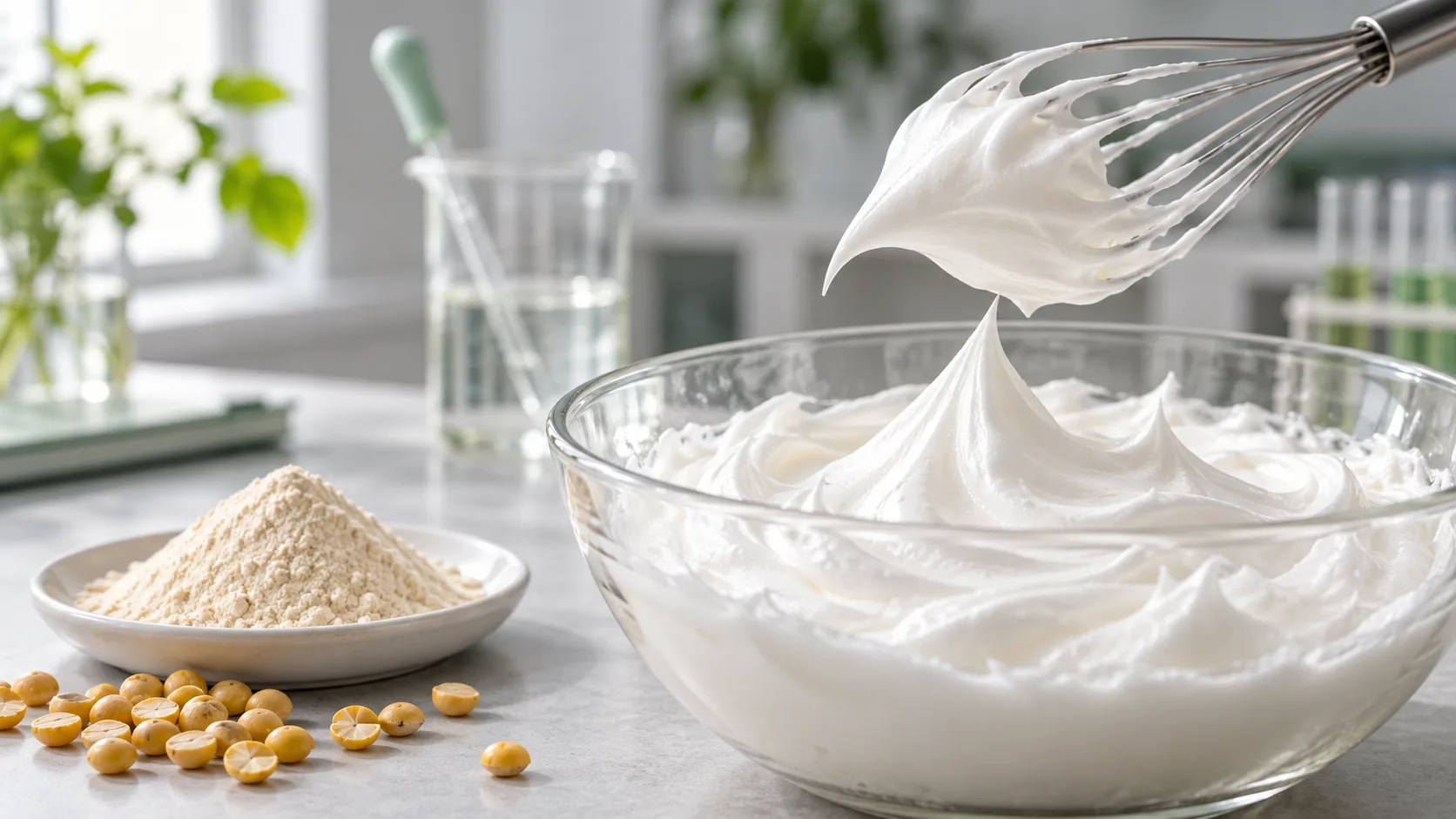
Think about the last airy chocolate mousse or cloud-soft sponge cake you enjoyed. Chances are an egg white or dairy protein did the heavy lifting, trapping millions of tiny air bubbles and holding them in place. Replacing that performance with a plant protein is one of the trickiest jobs in reformulation, which is exactly why pea protein isolate foaming/whipping functionality has become such a hot topic for R&D teams.
The good news? Pea protein can foam, and with the right formulation and processing choices, it can foam well. This guide walks through the science behind pea protein isolate foaming properties, explains why some foams collapse, and shares practical levers for building stable, clean label aerated products, from vegan meringues to dairy-free whipped toppings.
Can Pea Protein Be Whipped? The Short Answer and the Fine Print
Can pea protein be whipped, and does pea protein foam? Yes on both counts. When you whisk a pea protein solution, proteins migrate to the surface of each new air bubble, partially unfold, and link into a thin elastic film. That film turns a liquid into a foam, and it sits at the heart of the pea protein functional properties used in aerated foods.
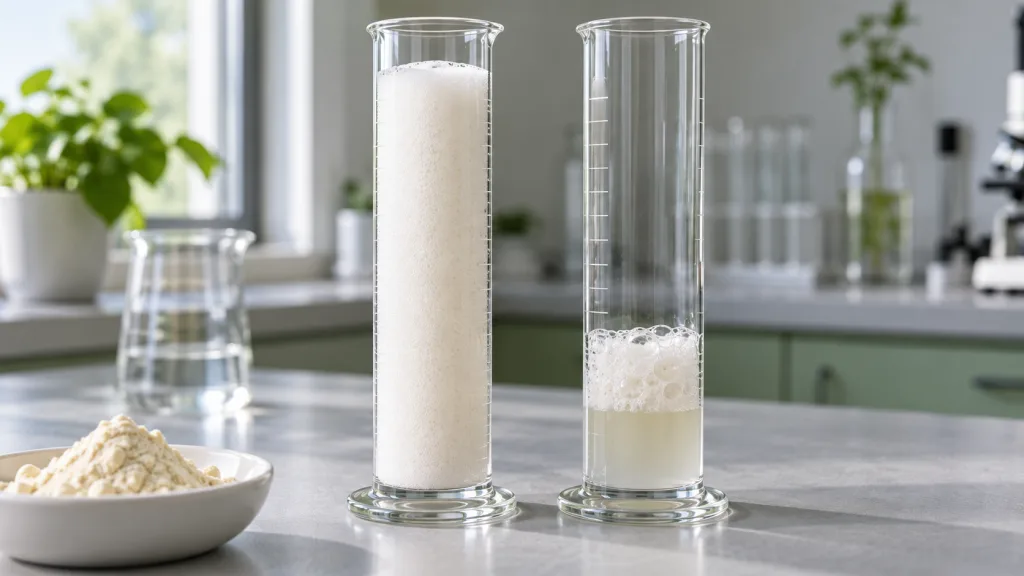
Formulators usually judge performance with two numbers. Pea protein foaming capacity describes how much air a protein can incorporate, often reported as pea protein overrun, the percentage increase in volume after whipping. Pea protein foam stability describes how long that structure lasts before liquid drains away and bubbles start to merge.
The fine print is that these two numbers don’t always move together. A comparison of soy, pea, lentil, and chickpea isolates against dairy proteins found that the plant proteins generally had lower foaming capacity but higher foam stability (Tang et al., 2023). In other words, pea protein may not whip as high as egg white straight out of the bag, but the foam it builds can be surprisingly durable.
The Science Behind Pea Protein Isolate Foaming Properties
To understand pea protein whipping, it helps to zoom in on the molecules themselves. Pea protein isolate is mostly made of storage globulins, plus a smaller water-soluble albumin fraction, and each behaves differently at an air-water interface. Getting that balance right is often the difference between a fluffy foam and a flat one.
Surface Activity and Interfacial Properties
Pea protein surface activity depends on how quickly proteins reach a new bubble and how easily they unfold once they arrive. Pea globulins are large, compact structures, which can limit their ability to adsorb at the air-water interface (Odelli et al., 2022). Smaller, more flexible proteins get there faster and lower surface tension more efficiently.
Once adsorbed, pea protein interfacial properties decide whether bubble walls behave like a stretchy membrane or a brittle shell. A cohesive, viscoelastic film resists thinning and rupture, which is why interfacial behavior is such a useful predictor of how plant protein foams will perform over time (Amagliani et al., 2021).
Legumin, Vicilin, and Pea Albumin Foaming
Legumin vicilin foaming properties differ because of their size and structure. Legumin (11S) is a larger hexamer, while vicilin (7S) is a smaller trimer that tends to be more flexible at interfaces. Their ratio varies with pea variety and extraction method, so two isolates with identical protein content can foam very differently.
Pea albumin foaming is the quiet overachiever here. Albumins are smaller and stay soluble across a wide pH range, and reviews of plant protein foams highlight them as promising foaming agents in their own right (Amagliani et al., 2021). Some standard isolation processes partly wash this fraction away, which makes it a useful question to raise with your supplier.
Why Does Pea Protein Foam Collapse?
Every foam is on borrowed time, because bubbles are inherently unstable. Liquid drains downward under gravity, neighboring bubbles merge, and gas diffuses from small bubbles into larger ones. A strong protein film slows all three processes, but pea protein foams face a few specific hurdles worth understanding before you troubleshoot a failed batch.
The most common causes of collapse include:
- Low solubility: insoluble aggregates struggle to reach the interface, so they contribute little to foam formation.
- Processing history: heat and drying during commercial extraction can denature and aggregate proteins, reducing their functional performance.
- Fat interference: residual lipids or added oils compete at the interface and weaken the protein film.
- Unfavorable pH: near the isoelectric point, proteins clump together and lose mobility.
- Over-whipping: excessive shear can stretch bubble films past their breaking point.
The link between pea protein solubility and foaming is especially important. Reviews note that the relatively poor functional performance of commercial pea protein has limited its use in food systems, which is why modification strategies have attracted so much research (Ge et al., 2020). The upside is that most of these limitations can be addressed through smart formulation and processing.
How pH Shapes Pea Protein Foaming
The pea protein pH effect on foaming is one of the biggest levers you control. Pea proteins have an isoelectric point of around pH 4.5, where their net charge is close to zero. Solubility drops sharply in this zone, so fewer proteins are available to coat new bubbles, and foaming capacity typically falls.
Move away from the isoelectric point toward neutral or mildly alkaline conditions, and proteins carry more charge, repel one another, and dissolve better. In one pH-dependency study, pH influenced the structure and functional properties of plant and dairy proteins more than the protein source itself, especially under acidic conditions (Tang et al., 2023).
That has real consequences on the production floor. Acidic products such as fruit mousses or lemon meringues may need a modified isolate, a polysaccharide partner, or careful sequencing where protein is whipped before acid is added. Neutral systems like vanilla whipped toppings tend to be more forgiving. Always test foaming at the final product pH, not just in plain water.
How to Make Pea Protein Foam Stable: Processing Levers
If you’re wondering how to make pea protein foam stable, start with the protein itself. Several well-studied treatments can reshape pea proteins so they reach the interface faster and build stronger films. Improving foam stability of pea protein often means trading a little of one property for more of another, so testing combinations is key.
Enzymatic Hydrolysis
Research on enzymatic hydrolysis pea protein foam systems shows that cutting proteins into smaller peptides can raise solubility and foaming capacity. The catch is that heavily hydrolyzed peptides tend to form weaker films, so stability can suffer. Controlled, limited hydrolysis is usually the sweet spot, since pea protein hydrolysate foaming depends heavily on the degree of hydrolysis (García Arteaga et al., 2020).
Ultrasound and High-Pressure Homogenization
Ultrasound treated pea protein foaming has been studied extensively. High-intensity ultrasound changed the structure of pea protein isolate and improved its foaming properties (Xiong et al., 2018). Work on high-pressure homogenization pea protein points in a similar direction, breaking up insoluble aggregates and improving solubility, one of several physical modifications reviewed for pea protein (Ge et al., 2020).
Pea Protein and Polysaccharide Foam Stabilization
Proteins build the bubble walls, but polysaccharides help keep them standing. Pea protein and polysaccharide foam stabilization works in two main ways: thickening the liquid between bubbles so drainage slows, and interacting with proteins at the interface to reinforce the film. Protein-polysaccharide pairing is widely seen as a promising route for plant-based foams (Amagliani et al., 2021).
A pea protein xanthan gum foam is the classic starting point. Even small additions of xanthan raise the viscosity of the liquid phase, which slows drainage and bubble movement. Pectin, guar, and carrageenan are other common partners, and each interacts differently with pea proteins depending on pH and charge, so a short screening trial pays off.
Recent research shows how far this approach can go. A non-dairy whipping cream that replaced part of its fat with a pea protein–pectin emulsion gel matched a commercial whipped cream for overrun, hardness, and foam stability at a 20% substitution level (Yin et al., 2026). That’s an encouraging signal for any dairy-free whipped cream ingredient strategy.
Pea Protein vs Egg White, Aquafaba, and Other Plant Proteins
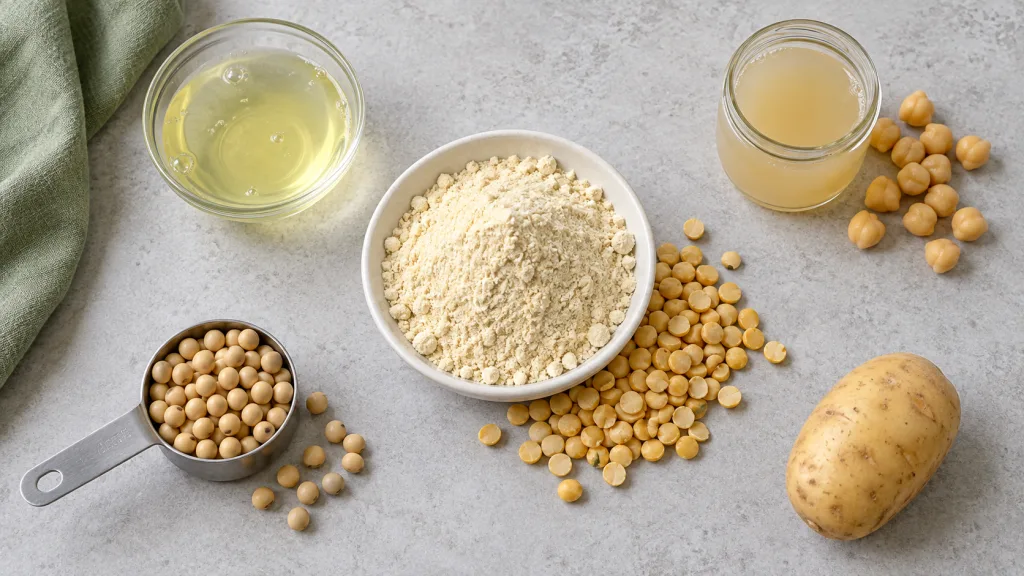
What is the best plant protein for foaming? Honestly, it depends on your priorities: whipping height, stability, flavor, allergen status, or cost. The foaming capacity and foam stability of pulse proteins vary widely with source, extraction, and processing, so the comparisons below are general tendencies rather than fixed rules.
- Pea protein vs egg white foaming: egg white is still the benchmark for fast aeration and heat-set structure. Pea protein needs formulation support to match it, but brings vegan and allergen advantages.
- Aquafaba vs pea protein: aquafaba whips impressively, but its composition varies from batch to batch, which complicates industrial standardization. Pea protein isolate offers a consistent, spec-controlled powder.
- Pea protein vs soy protein functionality: soy foams well and is cost-effective, but carries a major allergen declaration and a stronger flavor in some uses.
- Pea protein vs potato protein foaming: potato protein is known for excellent foaming, though supply is more limited and prices are often higher.
- Chickpea protein vs pea protein foaming: both are pulse proteins with similar strengths and limitations, so availability and flavor often decide.
So, can pea protein replace egg whites? In many applications, yes, especially when paired with a hydrocolloid. For most egg white alternatives for food manufacturers, pea protein strikes a practical balance of functionality, neutral flavor, and scalability. That’s why it so often anchors a plant protein foaming agent system or vegan egg white replacer blend.
Where Pea Protein Aeration Shines: Key Applications
Pea protein aeration is already finding its way into a wide range of products. Here’s how it typically fits across popular categories, along with the supporting ingredients formulators tend to pair with it. Treat these as starting points for bench trials rather than fixed recipes, since every base behaves a little differently.
- Egg replacement in cakes and sponges: as a pea protein egg replacer for baking, it adds air during mixing and structure during baking, often alongside starch or fiber for a soft crumb.
- Plant-based meringue pea protein formulations: success depends on solubility, sugar timing, and drying temperature, and modified or hydrolyzed isolates often perform best.
- Egg-free mousse formulation: pea protein supports a light, stable texture, especially when combined with a hydrocolloid.
- Vegan whipped topping formulation: here pea protein emulsifying and foaming properties work together, stabilizing fat droplets and air cells to hold piped shapes.
- Plant-based ice cream overrun: proteins help stabilize air cells during freezing for a smooth, scoopable texture.
- Plant-based aerated confectionery, including pea protein in marshmallows: protein supports whipping in sugar-rich systems that traditionally relied on gelatin or egg white.
- Vegan nougat / macaron egg substitute: these demanding, egg-white-heavy confections usually need a highly soluble isolate plus a stabilizing partner.
Across all of these, your choice of sugar or syrup matters too, because it affects viscosity, foam density, and drainage. Adding sugar too early can slow whipping, while adding it gradually once a foam forms usually builds a glossier, sturdier structure. Satoria’s Rice Syrup and Tapioca Syrup are worth considering for the sugar phase of marshmallows and nougat.
Sourcing Functional Pea Protein for Aerated Products
Not every isolate is built for aeration, so choosing a pea protein isolate supplier deserves the same care as the formulation itself. Functional pea protein for bakery and confectionery should be judged on the properties that matter for foam, not just protein percentage. Before committing, check:
- Solubility profile across the pH range of your product
- Particle size and dispersibility, which affect how fast protein reaches the interface
- Flavor neutrality, especially for delicate meringues and whipped toppings
- Batch-to-batch consistency, supported by technical data sheets and trial samples
- Certifications such as Halal, Kosher, Non-GMO, and recognized food safety standards
Satoria Nutrisentials produces Pea Protein & Pea Protein Isolate from yellow peas, with a hypoallergenic, non-GMO, vegan-friendly profile, neutral flavor, and good solubility. Those traits make it a natural candidate when you need a clean label foaming agent or an allergen-free egg replacer, and it is available for non-GMO pea protein isolate bulk orders.
For blended systems, Satoria’s Rice Protein Isolate can round out the amino acid profile and suit hypoallergenic product lines, while Resistant Dextrin adds soluble fiber to aerated desserts with minimal impact on viscosity. If you’re evaluating an egg replacer ingredient manufacturer for a longer-term program, Satoria also offers OEM & Toll Manufacturing services.
Unleash the Full Whipping Potential of Your Plant-Based Products
Building a stable plant-based foam is part science, part craft, and it starts with an ingredient that gives you a reliable foundation. Satoria Nutrisentials pairs innovative, healthy food ingredients with manufacturing practices built on HACCP, ISO, Halal, and Non-GMO standards, and keeps your unique formula confidential from first trial to full production.
Not sure where to begin? That’s completely normal for a first aerated project. Share your target product, pH, and overrun goals with Satoria’s team. Together you can shortlist the right isolate, discuss supporting ingredients such as syrups or fibers, and plan bench trials that move quickly from concept to a scalable, export-ready aerated product.
If you’re developing an egg-free mousse, a vegan whipped topping, or your next aerated confection, explore Satoria’s Pea Protein & Pea Protein Isolate and request samples or a product catalogue. Put it through your own whipping trials, and let the results guide your next formulation.
References
- Amagliani, L., Silva, J. V. C., Saffon, M., & Dombrowski, J. (2021). On the foaming properties of plant proteins: Current status and future opportunities. Trends in Food Science & Technology, 118, 261–272. https://doi.org/10.1016/j.tifs.2021.10.001
- García Arteaga, V., Apéstegui Guardia, M., Muranyi, I., Eisner, P., & Schweiggert-Weisz, U. (2020). Effect of enzymatic hydrolysis on molecular weight distribution, techno-functional properties and sensory perception of pea protein isolates. Innovative Food Science & Emerging Technologies, 65, 102449. https://doi.org/10.1016/j.ifset.2020.102449
- Ge, J., Sun, C.-X., Corke, H., Gul, K., Gan, R.-Y., & Fang, Y. (2020). The health benefits, functional properties, modifications, and applications of pea (Pisum sativum L.) protein: Current status, challenges, and perspectives. Comprehensive Reviews in Food Science and Food Safety, 19(4), 1835–1876. https://doi.org/10.1111/1541-4337.12573
- Odelli, D., Sarigiannidou, K., Soliani, A., Marie, R., Mohammadifar, M. A., Jessen, F., Spigno, G., Vall-llosera, M., de Carvalho, A. F., Verni, M., & Casanova, F. (2022). Interaction between fish skin gelatin and pea protein at air-water interface after ultrasound treatment. Foods, 11(5), 659. https://doi.org/10.3390/foods11050659
- Tang, Q., Roos, Y. H., & Miao, S. (2023). Plant protein versus dairy proteins: A pH-dependency investigation on their structure and functional properties. Foods, 12(2), 368. https://doi.org/10.3390/foods12020368
- Xiong, T., Xiong, W., Ge, M., Xia, J., Li, B., & Chen, Y. (2018). Effect of high intensity ultrasound on structure and foaming properties of pea protein isolate. Food Research International, 109, 260–267. https://doi.org/10.1016/j.foodres.2018.04.044
- Yin, R., Cao, Q., Mao, K., Wang, P., Chen, F., Zhang, L., & Zhang, X. (2026). Impact of pea protein–pectin emulsion gels containing soybean oil on the whipping performance of non-dairy whipping cream. Foods, 15(16), 2929. https://doi.org/10.3390/foods15162929
Featured News
Category
Get a Promo and Keep Updated