
Gelatin-Free Halal & Vegan Gummy Formulation: A B2B Guide to Compliant, Chewy Confections
Gelatin-Free Halal & Vegan Gummy Formulation: A B2B Guide to Compliant, Chewy Confections
September 30, 2026
General - Articles
Why Gelatin-Free Halal & Vegan Gummy Formulation Is Suddenly Everyone’s Brief
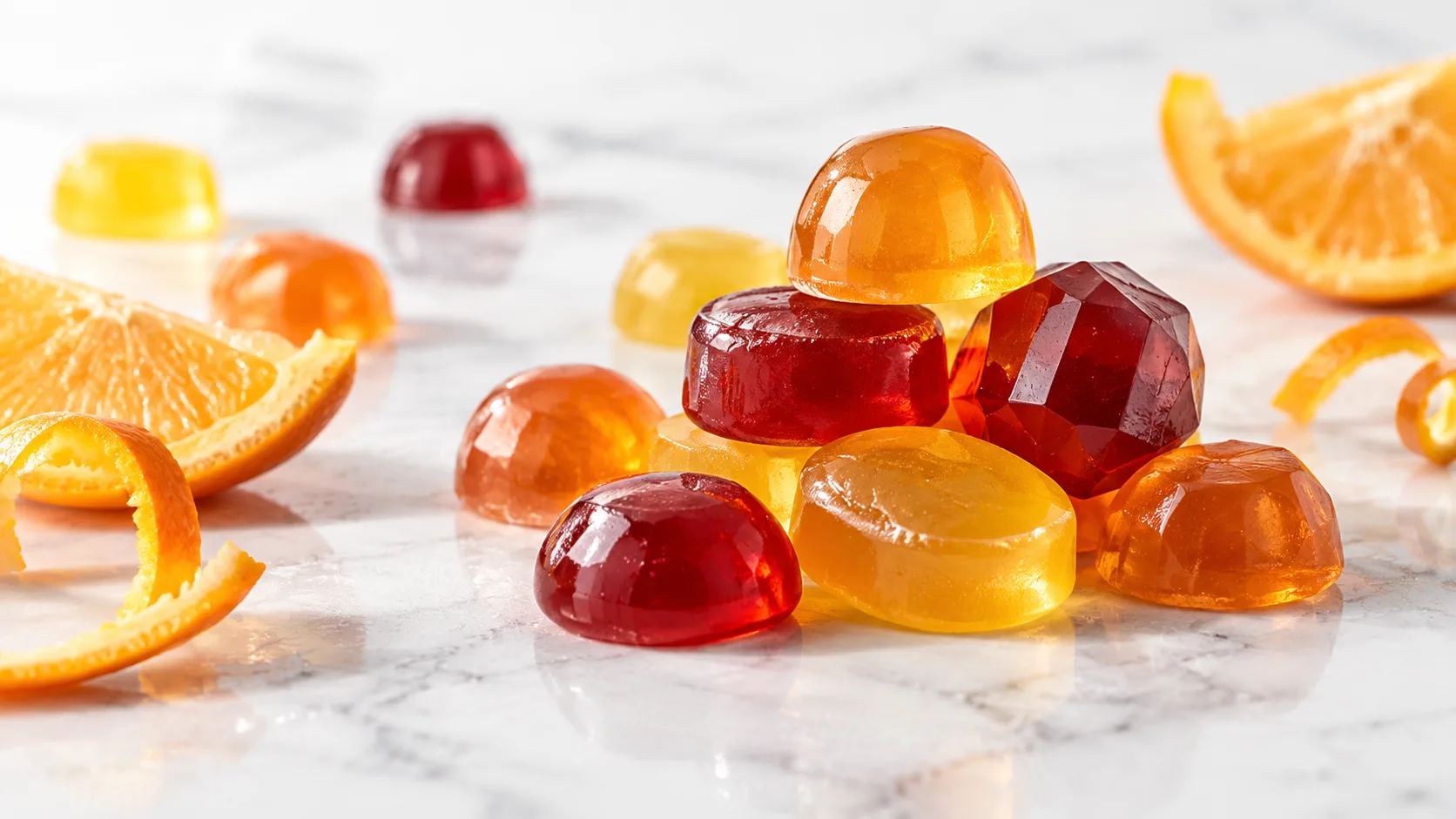
Ask any brand manager what their supplement pipeline looks like right now, and gummies come up almost immediately. They’re easy to dose, pleasant to eat, and forgiving on flavor masking in a way capsules never are. But the moment “halal” and “vegan” both land on the same brief, the classic gelatin base becomes a liability rather than a shortcut.
Gelatin-free halal & vegan gummy formulation sits at the intersection of two fast-growing buyer groups: halal-certified nutraceutical brands expanding into GCC, Southeast Asian, and European markets, and plant-based supplement brands chasing the vegan VMS (vitamin, mineral, supplement) boom. Getting the gelling system right is the difference between a gummy that ships globally and one that stalls at customs or on a store shelf.
This guide walks through what actually changes when you pull gelatin out of a gummy — the science, the sourcing, and the formulation trade-offs — and where functional ingredients can quietly do double duty.
None of this is purely academic, either. A recipe that “mostly” works in a small trial run often falls apart at production scale, where sugar ratios, mold speed, and shipping conditions all put extra pressure on whatever gelling system you’ve chosen. Getting the fundamentals right early saves a costly reformulation later.
The Gelatin Problem: Why Halal and Vegan Buyers Won’t Compromise
Gelatin is a workhorse gelling agent, but it’s an animal-derived protein, typically sourced from porcine or bovine skin, bone, and connective tissue. That single fact creates two separate compliance headaches for formulators chasing halal gummy ingredients.
For halal certification, gelatin is treated as a questionable (mashbooh) ingredient by default. Even gelatin from permissible animals like cattle only qualifies if the animal was slaughtered according to Islamic law, and porcine-derived gelatin is haram outright, with no real workaround for routine commercial use (Ahmad Anuar et al., 2023). For a brand exporting to the GCC, Malaysia, or Indonesia, that ambiguity alone is often reason enough to reformulate.
For vegan buyers, the calculus is simpler but no less firm: gelatin is animal protein, full stop, regardless of slaughter method. A gummy line built on gelatin automatically excludes both audiences, even though their underlying dietary logic is different.
The upside is that the same gelatin alternative for gummies tends to satisfy both groups simultaneously. Plant-derived hydrocolloids — pectin, agar, carrageenan — are halal by default because they never touch an animal, which is exactly why they’ve become the default swap for brands formulating for inclusive, overlapping markets rather than picking one audience over the other.
Pectin vs Gelatin Gummies: What Actually Changes in the Recipe
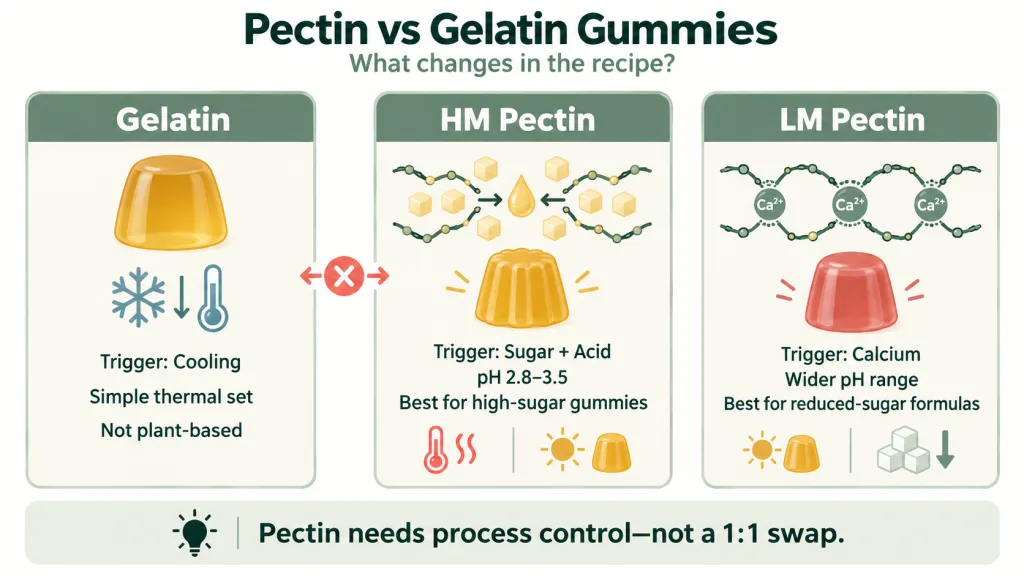
Pectin has become the go-to answer for pectin gummy formulation for supplements, and it’s easy to see why: it delivers a clean bite and a texture close enough to gelatin that most consumers don’t notice the switch. But it doesn’t behave like gelatin, and treating it as a one-for-one substitute is where most first attempts go wrong.
Gelatin sets on cooling, full stop. Pectin needs the right combination of sugar, acid, and sometimes calcium to gel at all, which means your process — not just your ingredient list — has to change. Get the pH or the sugar level wrong and you’ll end up with a batch that never sets, or one that sets too fast to mold properly.
High-Methoxyl vs Low-Methoxyl Pectin, Explained Simply
High-methoxyl (HM) pectin gels through sugar and acid alone, typically at a pH around 2.8 to 3.5, which suits traditional high-sugar gummies well (Arnon et al., 2025). Low-methoxyl (LM) pectin instead relies on calcium ions bridging pectin chains in what’s called an “egg-box” structure, and it can gel across a wider pH range with far less sugar — a real advantage for sugar-reduced or active-ingredient-heavy formulas where acidity is harder to control.
Choosing between them isn’t cosmetic. It determines whether your active ingredients survive processing, whether your gummy holds its shape in a hot-climate export container, and whether your sugar-reduction claim actually holds up on the label.
Building a Halal-Certified Hydrocolloid System Beyond Pectin
Pectin rarely works alone in a serious formulation. Most commercial gelatin-free gummy formulation blends pectin with a second hydrocolloid to fine-tune chew, clarity, and heat stability, and the choice of partner matters just as much for compliance as it does for texture.
Carrageenan, extracted from red seaweed, adds rapid setting and a softer, more elastic chew, and it’s increasingly used in starchless molding systems where speed matters on the production line. Agar-agar, also seaweed-derived, brings a firmer set and strong heat tolerance, which helps gummies survive shipping through warmer climates without softening or sweating in the pouch.
Konjac is worth a mention too, particularly for brands already working with functional rice or fiber positioning — its glucomannan content adds both gelling strength and a genuine fiber claim, though particle size needs care to avoid a choking-hazard-sized bite. All three are plant-derived, which makes them halal-certified hydrocolloid options by default, with no slaughter method or animal source to verify or document.
The real formulation skill is in the ratio. Pectin brings the clean citrus-fruit gel structure; a second hydrocolloid fine-tunes what pectin alone can’t do — usually chew resilience or set speed — without pushing the recipe back toward animal-derived shortcuts.
Formulating Vegan VMS Gummies Without Losing Texture or Stability
Vitamin, mineral, and supplement gummies are unforgiving in a way plain confectionery isn’t, because the active ingredients themselves interfere with gelling. Minerals shift pH. Vitamin C is acidic enough to weaken a pectin network if it’s not buffered correctly. B-vitamins can carry off-notes that flavor systems have to work around.
This is exactly where low-methoxyl pectin tends to outperform its high-methoxyl counterpart in vegan VMS gummies — its wider pH tolerance gives formulators more room to accommodate acidic or mineral-heavy actives without the batch failing to set. It also opens the door to lower sugar loads, which matters for brands positioning gummies as a genuinely better-for-you format rather than candy with vitamins bolted on.
Heat stability deserves equal attention. Pectin’s higher melting point compared to gelatin means gummies hold their shape at room temperature and through warmer shipping lanes — a meaningful advantage for brands exporting to the GCC, Southeast Asia, or anywhere cold-chain logistics aren’t guaranteed. That single property often justifies the reformulation cost on its own, independent of the halal or vegan claim.
Getting there usually takes a few formulation passes: testing calcium sequestration timing, checking active-ingredient compatibility at target pH, and confirming the gel sets consistently across a full production run rather than just a lab-scale batch.
Getting to a Clean-Label, Sugar-Free Vegan Gummy Base
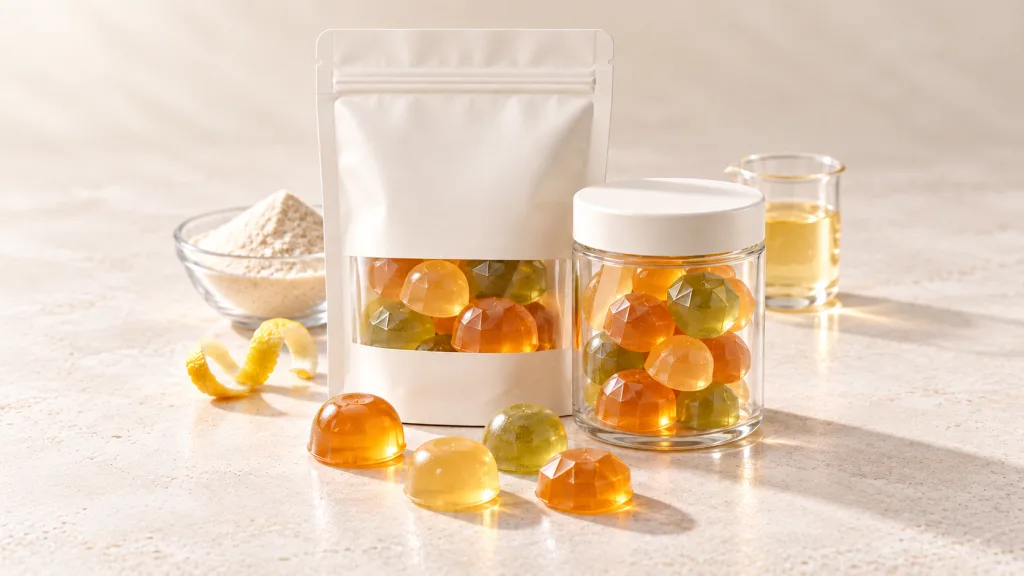
Clean label gummy ingredients and sugar reduction are usually requested together, and pectin actually makes that combination easier rather than harder — low-methoxyl grades gel without needing the heavy sugar load that high-methoxyl pectin and gelatin both depend on for structure.
That gap still has to be filled with something, though, since sugar and syrups don’t just sweeten a gummy — they retain moisture and keep the chew from turning hard or brittle on the shelf. Natural syrups such as rice syrup or tapioca syrup are common choices here: both offer allergen-free, non-GMO sweetness with genuine moisture-retention properties, and their neutral-to-mild flavor profiles don’t fight with fruit or vitamin flavoring the way some alternative sweeteners can.
For brands pushing further toward a genuinely sugar-free vegan gummy base, a 1:1 sugar-replacement blend built around dietary fiber — rather than a single intense sweetener — tends to hold texture and mouthfeel closer to a conventional gummy, while adding a prebiotic fiber benefit the label can actually talk about. That’s a meaningfully different pitch than “sugar-free” alone, and it plays well with the same health-conscious audience already drawn to halal and vegan claims.
The formulation lesson holds across all of these swaps: clean label doesn’t mean simple, and every substitution needs to be tested for how it interacts with your chosen gelling system, not evaluated in isolation.
Adding Function Without Losing Chew: Fiber Fortification and pH Stability
Once the base recipe is stable, most B2B briefs ask for one more thing: a functional claim that survives processing. Fiber fortification is the most common request, and it’s also the one most likely to break a gummy’s texture if the wrong fiber source is chosen.
The gelling environment inside a pectin gummy is acidic by design, usually somewhere in the pH 2 to 6 range depending on the pectin grade, and it’s often processed at real heat during cooking and molding. A fiber ingredient that isn’t stable across that pH window, or that degrades under heat, will either fail to deliver its labeled dose or quietly change the gummy’s set and mouthfeel batch to batch.
Resistant dextrin is one of the more forgiving options here precisely because it’s built for exactly that kind of processing stress. Independent trials have shown daily resistant dextrin intake supports beneficial gut bacteria and short-chain fatty acid production without disrupting digestive tolerance at commonly used doses (Guerin-Deremaux et al., 2010; Barber et al., 2022), which lines up with its formal classification as a prebiotic fiber under the current scientific consensus (Gibson et al., 2017). It’s also colorless and essentially tasteless, so it fortifies fiber content without dragging flavor or clarity down — a real concern in a category where consumers expect a bright, fruity gummy, not a chalky one.
Sourcing for Gelatin-Free Gummy Manufacturing at Scale
Formulating a working prototype in a lab is one milestone. Sourcing consistent, halal-certified, food-grade ingredients at commercial volume is a separate challenge, and it’s usually where projects stall.
A bulk gelatin-free gummy ingredients supplier needs to offer more than a single hydrocolloid. Consistent pectin grade-to-grade, documented halal and non-GMO status, and stable supply through demand spikes all matter more once you’re running production lots rather than lab batches. For brands targeting GCC, European, or Southeast Asian export, halal certification on every functional ingredient — not just the headline gelling agent — is what actually clears customs and retail gatekeeping.
This is also where OEM and private label vegan gummy formulation partnerships earn their keep. Rather than managing pectin suppliers, sweetener suppliers, and fiber suppliers separately, many brands now work with a single halal vegan gummy manufacturer that can source, formulate, and toll-manufacture under one roof — which cuts both lead time and the number of halal certificates a compliance team has to chase down.
Whether you’re an established supplement brand adding a gummy SKU or a new entrant building the category from scratch, the sourcing side of gelatin-free gummy manufacturing rewards planning early rather than retrofitting compliance after the recipe is locked. Certification paperwork, ingredient traceability, and consistent batch performance all take longer to sort out than most timelines allow for, so building that runway in from the start is usually the difference between a smooth launch and a delayed one.
Formulate Your Gelatin-Free, Halal & Vegan Gummy Line with Confidence
If this has clarified the gelling science but raised new questions about your own formulation, that’s the normal next step — pectin ratios, active-ingredient compatibility, and sweetener systems all behave differently depending on what you’re putting in the gummy.
Satoria Nutrisentials works with F&B and supplement manufacturers on exactly this kind of functional ingredient sourcing, from fiber fortification with Resistant Dextrin by Fiberfit™ to natural, moisture-retaining sweeteners like Rice Syrup, Tapioca Syrup, and the sugar-free SweetSentials blend — all backed by halal, HACCP, and ISO-certified manufacturing, with your formula kept strictly confidential throughout. Our OEM and toll manufacturing team can help translate a lab-scale gummy concept into a production-ready recipe without you having to manage half a dozen separate suppliers.
Explore our full ingredient range or consult your formulation needs directly with our team to see where a gelatin-free halal & vegan gummy fits into your product line.
References
- Ahmad Anuar, N. A., Tukiran, N. A., & Jamaludin, M. A. (2023). Gelatin in halal pharmaceutical products. Malaysian Journal of Syariah and Law, 11(1), 64–78. https://doi.org/10.33102/mjsl.vol11no1.344
- Arnon, R., Henley, S. C., & Schwan, C. L. (2025). Pectin for home food preservation: Types, uses, and tips (Circular 1373). University of Georgia Cooperative Extension. https://fieldreport.caes.uga.edu/publications/C1373/pectin-for-home-food-preservation/
- Barber, C., Sabater, C., Ávila-Gálvez, M. Á., Vallejo, F., Bendezu, R. A., Guérin-Deremaux, L., Guarner, F., Espín, J. C., Margolles, A., & Azpiroz, F. (2022). Effect of resistant dextrin on intestinal gas homeostasis and microbiota. Nutrients, 14(21), 4611. https://doi.org/10.3390/nu14214611
- Gibson, G. R., Hutkins, R., Sanders, M. E., Prescott, S. L., Reimer, R. A., Salminen, S. J., Scott, K., Stanton, C., Swanson, K. S., Cani, P. D., Verbeke, K., & Reid, G. (2017). Expert consensus document: The International Scientific Association for Probiotics and Prebiotics (ISAPP) consensus statement on the definition and scope of prebiotics. Nature Reviews Gastroenterology & Hepatology, 14, 491–502. https://doi.org/10.1038/nrgastro.2017.75
- Guerin-Deremaux, L., Ringard, F., Desailly, F., & Wils, D. (2010). Effects of a soluble dietary fibre NUTRIOSE® on colonic fermentation and excretion rates in rats. Nutrition Research and Practice, 4(6), 470–476. https://doi.org/10.4162/nrp.2010.4.6.470
Featured News
Category
Get a Promo and Keep Updated