
Resistant Dextrin as a Binder in Energy Bites: A Formulator’s Guide to Low-Sugar, High-Fiber Bars
Resistant Dextrin as a Binder in Energy Bites: A Formulator’s Guide to Low-Sugar, High-Fiber Bars
October 20, 2026
Resistant Dextrin - Articles
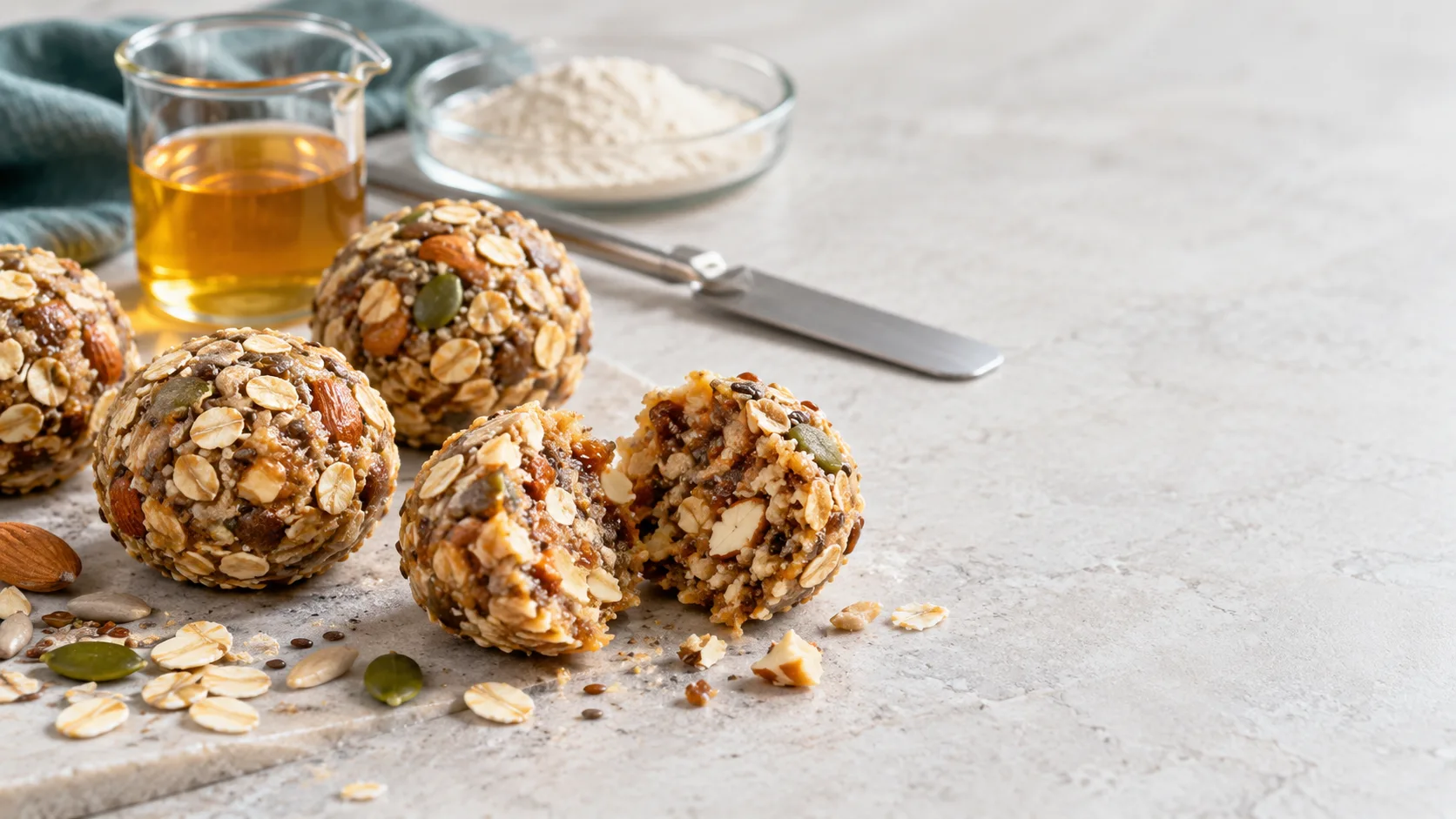
Energy bites and snack bars sell on a simple promise: real ingredients, steady energy, and something you can eat on the move. Behind that promise sits a formulation problem most brands know well. The ingredient that holds everything together is usually sugar. Honey, glucose syrup, brown rice syrup, and date paste give bites their chew and their shape, and they also push the sugar line on the nutrition panel higher than many buyers now accept.
Resistant dextrin has become one of the most useful tools for closing that gap. It is a soluble dietary fiber made from starch, it tastes close to neutral, and it dissolves easily into syrups and doughs. Used well, it lets formulators replace part of the sugar syrup in a binder with fiber, without losing the texture that makes an energy bite worth eating. Used badly, it produces crumbly bites that fall apart in the pack.
This guide explains where resistant dextrin fits in an energy bite binder system, what it can and cannot do on its own, and how to manage texture, shelf life, and labeling when you build a lower-sugar, higher-fiber product.
Why the Binder Is the Hardest Part of Sugar Reduction
In a no-bake energy bite or a cold-formed bar, the binder does three jobs at once. It glues particulates such as oats, nuts, seeds, and protein crisps into a cohesive mass. It controls moisture, which decides whether the product stays soft or turns hard. And it contributes a large share of the sweetness.
Sugar syrups do all three jobs cheaply and reliably. They are sticky at the right viscosity, they hold water tightly, and they taste good. When you pull sugar out, you lose more than sweetness. You lose tack, you shift the water balance, and you change how the product ages on the shelf. That is why simply swapping a syrup for a sweetener rarely works, and why fiber-based binder systems have attracted so much development work from ingredient suppliers and bar manufacturers.
What Resistant Dextrin Brings to a Binder System
A clean-tasting, process-friendly soluble fiber
Resistant dextrin is produced by heating starch, typically corn or tapioca, under controlled acidic conditions so that the glucose chains rearrange into branched structures that human digestive enzymes cannot fully break down (Włodarczyk & Śliżewska, 2021). The result is a white powder that dissolves readily in water.
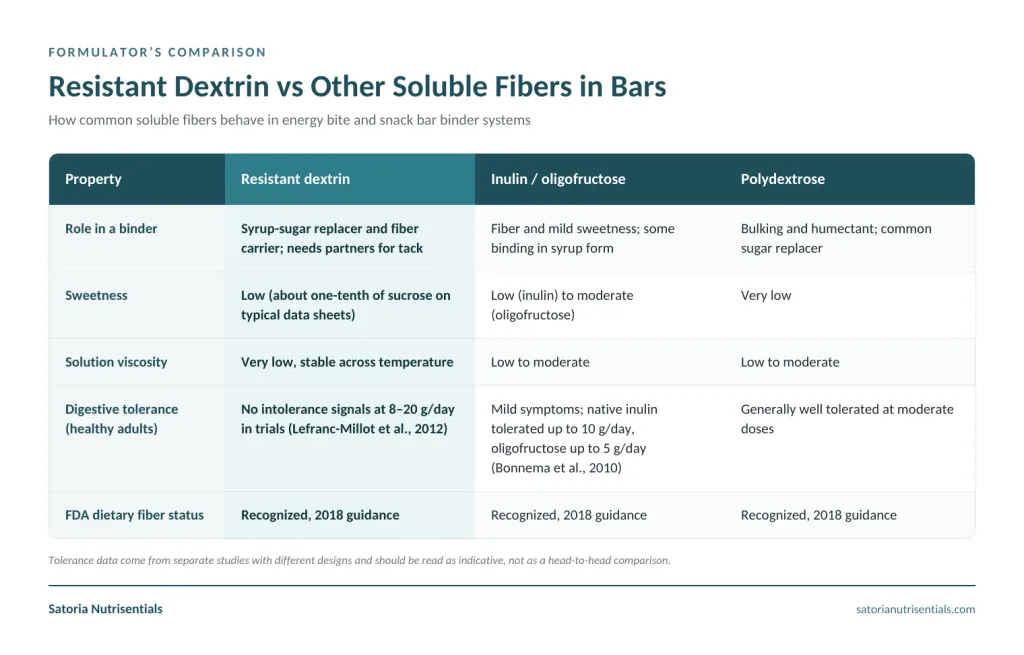
Typical technical data sheets describe several properties that matter in bar and bite production. Sweetness is low, roughly one-tenth that of sucrose. Solution viscosity is very low and changes little with temperature or shear. The ingredient is stable under heat and acidic conditions, so it survives syrup cooking and fruit-based formulations without breaking down. For a formulator, this means resistant dextrin can be added at meaningful levels without making the product taste “fibery” or turning a syrup into an unworkable paste.
A recognized dietary fiber
In June 2018, the US Food and Drug Administration issued guidance listing resistant maltodextrin/dextrin among eight isolated non-digestible carbohydrates that may be declared as dietary fiber on Nutrition Facts and Supplement Facts labels (US Food and Drug Administration, 2018). For brands selling into the United States, this means the fiber resistant dextrin adds to an energy bite can count toward the declared dietary fiber total. Other markets have their own rules, so regional requirements should always be checked before making a claim.
Good digestive tolerance
Fiber-enriched snacks have a reputation problem: too much of the wrong fiber causes bloating and gas. Resistant dextrin performs well here. In two randomized, placebo-controlled trials with healthy adults, a resistant dextrin given at 8 to 20 g per day showed no signs of gastrointestinal intolerance at any dose while shifting gut bacteria in a favorable direction (Lefranc-Millot et al., 2012). A separate study of a resistant maltodextrin at 15 g per day reported only very minor tolerance effects (Fastinger et al., 2008). Earlier dose-ranging work found resistant dextrin well tolerated at considerably higher intakes (van den Heuvel et al., 2004).
By comparison, a study of chicory inulin products found that native inulin was well tolerated up to 10 g per day and oligofructose up to 5 g per day, with flatulence and bloating the most common complaints above that (Bonnema et al., 2010). For a bite designed to deliver a meaningful fiber dose in a single serving, that tolerance margin is a practical advantage.
Can Resistant Dextrin Work as a Binder on Its Own?
This is the most important question to answer honestly, because it determines whether a reformulation succeeds. On its own, resistant dextrin is a weak binder. The same low viscosity that makes it easy to process means a resistant dextrin solution does not have the tack of honey or glucose syrup. Replace the whole syrup with a resistant dextrin solution and the particulates will not hold together well.
Resistant dextrin works best as one part of a binder system. Its job is to take over a share of the syrup solids, add fiber, and help manage moisture, while other ingredients supply the stickiness and structure. Industry patents on low-sugar bar binders follow the same logic, combining soluble fibers with protein and fat rather than relying on a single fiber to do all the work. Think of resistant dextrin as a syrup-sugar replacer and fiber carrier, not as a one-for-one glue.
Building a Resistant Dextrin Binder System
Pair it with a reduced amount of syrup
The most common approach is partial replacement. Keep a portion of a sticky syrup, such as rice syrup or tapioca syrup, and dissolve resistant dextrin into it to replace part of the syrup solids. The syrup supplies tack; the resistant dextrin dilutes the sugar and adds fiber. Start with modest replacement levels and increase step by step while checking cohesion, because the point at which the mass stops holding together varies with particulate size and fat content.
Use protein as a structural partner
Plant proteins such as rice protein isolate and pea protein absorb water and build body in a binder paste. Combined with resistant dextrin, they help recover some of the firmness lost when sugar is reduced, while also lifting the protein content of the bite. Protein choice matters for shelf life, as discussed below, so test more than one option.
Let fat and nut butters do some of the gluing
In energy bites especially, nut and seed butters are natural binders. They coat particulates and set firm as they cool. A binder built on nut butter, a reduced syrup fraction, and resistant dextrin can deliver good cohesion with far less sugar than a syrup-only system, provided the fat level fits the nutrition target.
Consider humectants for soft textures
Glycerol and similar humectants keep bites soft by holding water in the matrix. They are often needed when sugar is removed, since sugar itself is a strong humectant. Resistant dextrin contributes to water binding, but on its own may not fully replace sugar’s softening effect.
Managing Texture and Shelf Life
Keep water activity in range
Most high-protein bars are formulated as intermediate-moisture foods with a water activity at or below about 0.65 (Loveday et al., 2009). Changing the binder changes how water is distributed, so water activity should be measured on every trial batch, not assumed from the previous formula. Fiber, protein, and humectant levels all shift the result.
Watch for hardening over time
Hardening is the most common shelf-life complaint in bars and bites. Research on model protein bars found that hardening was driven mainly by moisture moving from the protein phase toward sugars and polyols such as glucose and glycerol, together with changes in the bar’s microstructure, rather than by chemical reactions (Loveday et al., 2009; Loveday et al., 2010). The type of protein made a large difference: in one study, bars made with whey protein isolate stayed soft, while calcium caseinate bars firmed up within days (Loveday et al., 2010).
The practical lesson for resistant dextrin systems is to run accelerated and real-time storage tests that measure texture, not just microbial stability. Because you are rebalancing sugars, fiber, protein, and humectants all at once, the hardening profile of the new formula may differ from the original even if day-one texture looks identical.
Resistant Dextrin vs Other Soluble Fibers in Bars
Several soluble fibers compete for the same role in bar and bite binders. The table below summarizes how resistant dextrin compares with two common alternatives.
Labeling and Claims Considerations
- Fiber declaration. In the US, resistant maltodextrin/dextrin may be declared as dietary fiber under FDA’s 2018 guidance. Check the equivalent rules in each destination market.
- Fiber content claims. Thresholds for “source of fiber” or “high fiber” claims differ by region, so calculate per-serving fiber against the rules where the product will be sold.
- Sugar claims. Reducing added sugar in the binder may open “reduced sugar” or “no added sugar” claims, but these depend on the full formula, including sugars from fruit and other ingredients.
- Certifications. For exports to the GCC, Southeast Asia, and other halal-sensitive markets, confirm that the resistant dextrin and every other binder component carry the certifications your buyers require.
A Practical Path to Pilot Trials
A structured trial plan saves time when reformulating an existing bite or bar:
- Start from your current binder and replace a modest share of the syrup solids with resistant dextrin dissolved into the remaining syrup.
- Hold particulates constant in the first round, so changes in cohesion can be traced to the binder.
- Measure cohesion, water activity, and sweetness on every batch, and adjust protein, fat, or humectant levels to recover texture.
- Increase the replacement level in steps until cohesion or sensory quality drops, then step back to the last acceptable formula.
- Run storage trials to check for hardening before scaling up.
Frequently Asked Questions
Can resistant dextrin be used as a binder in energy bites?
Yes, but as part of a binder system rather than on its own. It replaces part of the sugar syrup and adds fiber, while syrups, proteins, nut butters, or humectants provide the tack and structure.
Does resistant dextrin make energy bites hard?
Not inherently. Hardening in bars is mainly linked to moisture migration and protein behavior. Any reformulation should include storage testing, because changing the binder changes how water moves through the product.
Is resistant dextrin better tolerated than inulin?
Studies in healthy adults have found resistant dextrin well tolerated at doses where inulin-type fibers more often cause mild bloating and flatulence. Individual tolerance varies, and the studies were not direct comparisons.
Does resistant dextrin count as dietary fiber on US labels?
Yes. FDA’s 2018 guidance lists resistant maltodextrin/dextrin among the non-digestible carbohydrates that may be declared as dietary fiber.
Will resistant dextrin change the taste of my product?
Usually very little. It has low sweetness and a neutral flavor, so most of the taste change in a reformulated bite comes from the sugar you remove, not from the fiber you add.
Conclusion
Resistant dextrin gives energy bite and bar manufacturers a practical way to cut sugar in the binder while adding a well-tolerated, label-friendly fiber. Its strengths are neutral taste, easy processing, and good digestive tolerance. Its limitation is that it does not glue particulates together on its own. Formulators who treat it as a partner ingredient, combined with a reduced syrup fraction, protein, fat, or humectants, and who test water activity and shelf-life texture carefully, are the ones most likely to land a lower-sugar product that holds together from the factory to the consumer.
If you are planning a reduced-sugar or high-fiber bite and want to compare resistant dextrin grades or binder approaches, our food technology team is happy to discuss your formulation goals. Explore our Resistant Dextrin range or learn about our OEM & Toll Manufacturing services.
References
- Bonnema, A. L., Kolberg, L. W., Thomas, W., & Slavin, J. L. (2010). Gastrointestinal tolerance of chicory inulin products. Journal of the American Dietetic Association, 110(6), 865–868.
- Fastinger, N. D., Karr-Lilienthal, L. K., Spears, J. K., Swanson, K. S., Zinn, K. E., Nava, G. M., Ohkuma, K., Kanahori, S., Gordon, D. T., & Fahey, G. C., Jr. (2008). A novel resistant maltodextrin alters gastrointestinal tolerance factors, fecal characteristics, and fecal microbiota in healthy adult humans. Journal of the American College of Nutrition, 27(2), 356–366. https://doi.org/10.1080/07315724.2008.10719712
- Lefranc-Millot, C., Guérin-Deremaux, L., Wils, D., Neut, C., Miller, L. E., & Saniez-Degrave, M. H. (2012). Impact of a resistant dextrin on intestinal ecology: How altering the digestive ecosystem with NUTRIOSE®, a soluble fibre with prebiotic properties, may be beneficial for health. Journal of International Medical Research, 40(1), 211–224. https://doi.org/10.1177/147323001204000122
- Loveday, S. M., Hindmarsh, J. P., Creamer, L. K., & Singh, H. (2009). Physicochemical changes in a model protein bar during storage. Food Research International, 42(7), 798–806.
- Loveday, S. M., Hindmarsh, J. P., Creamer, L. K., & Singh, H. (2010). Physicochemical changes in intermediate-moisture protein bars made with whey protein or calcium caseinate. Food Research International, 43(5), 1321–1328. https://doi.org/10.1016/j.foodres.2010.03.013
- US Food and Drug Administration. (2018). The declaration of certain isolated or synthetic non-digestible carbohydrates as dietary fiber on Nutrition and Supplement Facts labels: Guidance for industry (Docket No. FDA-2018-D-1323). https://www.fda.gov/media/113663/download
- van den Heuvel, E. G. H. M., Wils, D., Pasman, W. J., Bakker, M., Saniez, M. H., & Kardinaal, A. F. M. (2004). Short-term digestive tolerance of different doses of NUTRIOSE® FB, a food dextrin, in adult men. European Journal of Clinical Nutrition, 58(7), 1046–1055.
- Włodarczyk, M., & Śliżewska, K. (2021). Efficiency of resistant starch and dextrins as prebiotics: A review of the existing evidence and clinical trials. Nutrients, 13(11), 3808. https://doi.org/10.3390/nu13113808
Featured News
Category
Get a Promo and Keep Updated