
Resistant Dextrin in Dried Fruit Snacks & Fruit Leather: A Formulator’s Guide to Fiber Enrichment and Sugar Reduction
Resistant Dextrin in Dried Fruit Snacks & Fruit Leather: A Formulator’s Guide to Fiber Enrichment and Sugar Reduction
October 19, 2026
Resistant Dextrin - Articles
Introduction
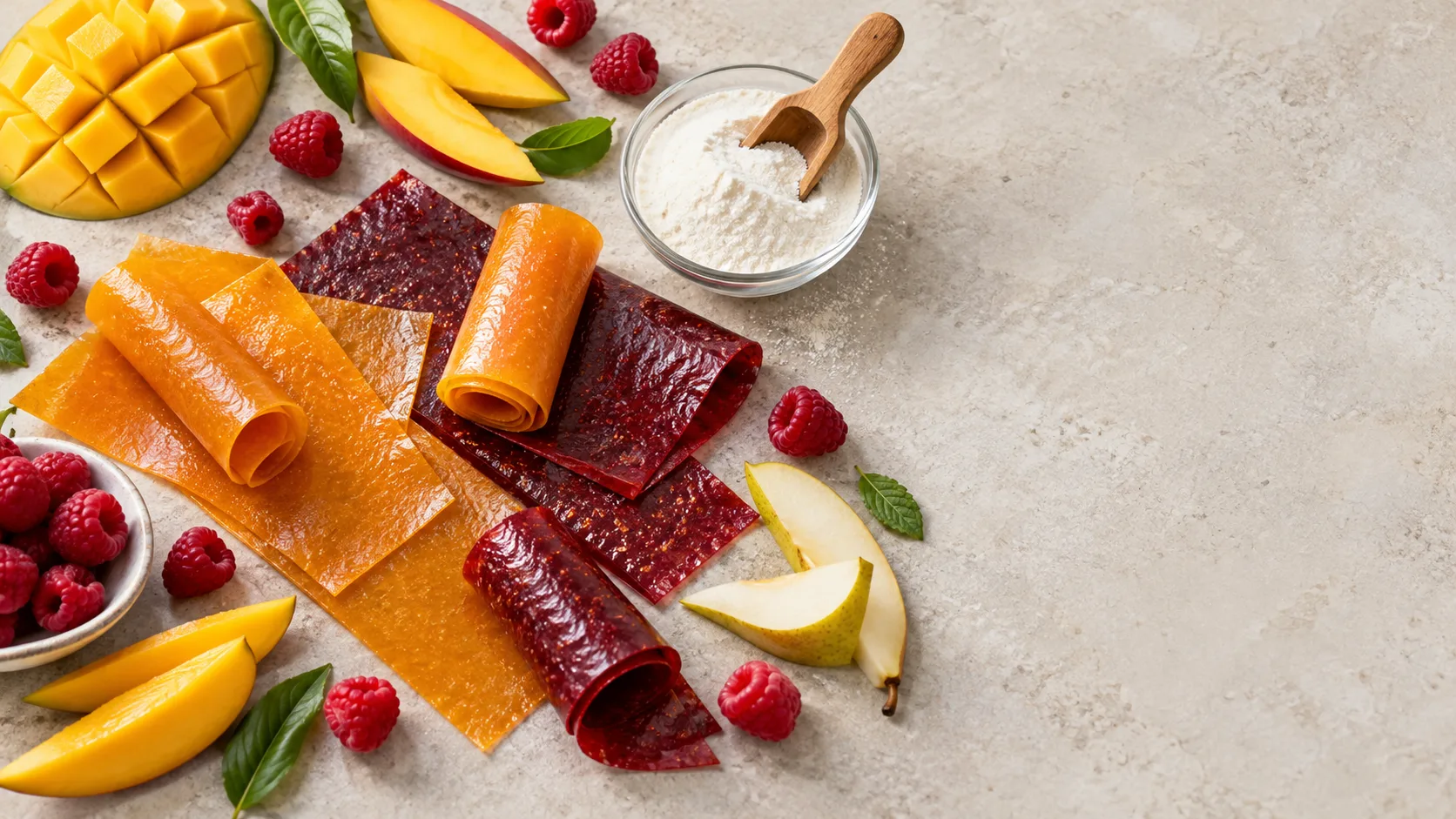
Fruit leather and dried fruit snacks carry a health halo, yet most are little more than concentrated fruit sugar pressed into a chewy sheet. Drying removes water but keeps the sugar, and much of the fruit’s original fiber is lost when it is pureed, strained or reconstituted from juice concentrate.
For snack brands, that gap is now a commercial problem. Parents read labels, retailers push “better-for-you” ranges, and fiber has become one of the most sought-after nutrients on pack. Only around 5% of Americans reach their recommended daily fiber intake (Quagliani & Felt-Gunderson, 2017), so a fruit snack that delivers meaningful fiber stands out on shelf.
The challenge is that sugar does structural work in fruit leather. It binds water, sets texture and controls chewiness. Pull it out and the product turns brittle, sticky or bland.
This guide explains how resistant dextrin, a soluble, prebiotic dietary fiber, lets formulators raise fiber and cut sugar in fruit leather and dried fruit snacks without losing the eating quality consumers expect. It covers usage levels, processing behaviour, how it compares with other fibers, and the label claims it can support.
Why Fruit Leather and Dried Fruit Snacks Need a Fiber Upgrade
The sugar-to-fiber gap in conventional fruit snacks
Fruit leather is made by drying a thin layer of fruit puree or juice concentrate into a flexible sheet (Nowicka et al., 2025). As water evaporates, sugars concentrate. Many commercial fruit snacks also add sugar, glucose syrup or juice concentrate to build body and extend shelf life.
The result is a product where sugar dominates the nutrition panel and fiber is often below 1 g per serving. Whole fruit naturally pairs its sugar with fiber; a processed fruit snack frequently does not.
Consumer demand for gut-friendly, low-sugar snacks
Three trends are pushing brands to reformulate:
- Sugar reduction: front-of-pack warnings, sugar taxes and added-sugar labeling make high-sugar snacks harder to sell.
- Gut health: shoppers increasingly look for prebiotic and fiber claims, not just “made with real fruit.”
- Kids’ nutrition: parents want lunchbox snacks that are lower in sugar and higher in fiber, without a taste penalty their children will notice.
Researchers are actively developing fiber-enriched fruit leathers. Recent studies have added fructooligosaccharides from chicory and Jerusalem artichoke (Nowicka et al., 2025) and used high-fiber fruit by-products such as dragon fruit peel (Das et al., 2025). The common goal is a fruit snack that behaves like a functional food rather than a confection.
What Resistant Dextrin Brings to Fruit-Based Snacks
Resistant dextrin is a soluble dietary fiber made by heat- and acid-treating starch (commonly corn or tapioca), then refining it. The process rearranges glucose linkages so human digestive enzymes cannot fully break them down. The fiber passes to the large intestine, where gut bacteria ferment it (Lefranc-Millot et al., 2012).
For fruit snack formulators, four properties matter most.
Soluble, prebiotic fiber with a neutral taste
Commercial grades typically contain 85–90% or more dietary fiber on a dry basis. In randomized controlled trials, a resistant dextrin showed prebiotic effects on gut bacteria with no signs of digestive intolerance at intakes up to 20 g per day (Lefranc-Millot et al., 2012). It has a clean, neutral flavour, so the fruit stays front and centre. That is a real advantage over chicory-based inulin and FOS powders, whose bitter notes lowered taste scores in fruit leather trials (Nowicka et al., 2025).
A bulking agent that replaces sugar solids
Resistant dextrin has roughly one-tenth the sweetness of sucrose and contributes far fewer calories. It can replace part of the sugar or glucose syrup in a recipe while keeping total solids, so the dried sheet keeps its body. Patent literature describes this approach directly: fruit spreads and jams fortified with digestion-resistant dextrin to deliver at least 3 g of fiber per small serving without changing flavor, appearance or consistency (Ashkenazi, 2011).
Low viscosity
Unlike gums or high-molecular-weight inulin, resistant dextrin forms low-viscosity solutions. It dissolves into fruit puree without thickening it, so spreading, sheeting and depositing behave much like the original sugar-based formula.
Metabolic benefits that support positioning
Clinical research links resistant dextrin and resistant maltodextrin intake with reduced post-meal glucose response, improved satiety and support for healthy lipid levels (Astina & Sapwarobol, 2019). These outcomes give brands a credible story for low-glycemic and gut-friendly positioning, subject to local claim rules.
Formulation Guide: Using Resistant Dextrin in Fruit Leather
The right inclusion level depends on your fiber target, serving size and the fiber already present in the fruit. The figures below are practical starting points for bench trials, not fixed specifications.
Recommended usage levels and fiber targets
Work backwards from the claim you want. A resistant dextrin with about 90% fiber needs roughly 1.1 g of ingredient for every 1 g of fiber you add.
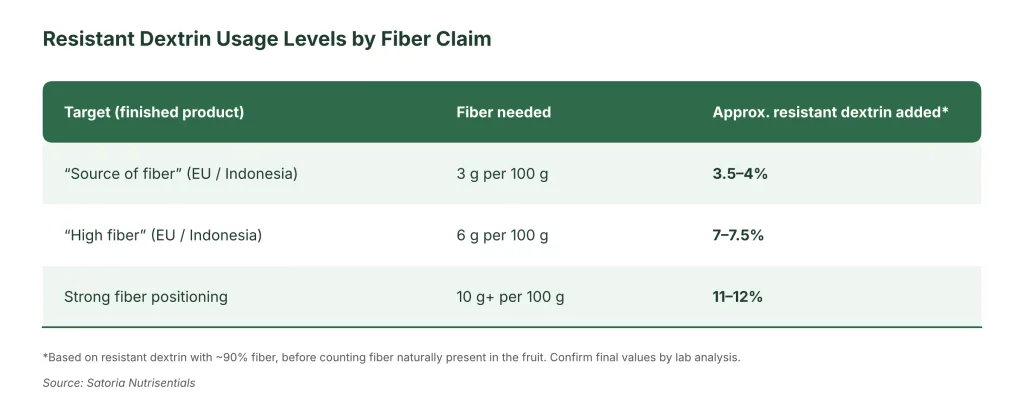
*Before counting fiber from the fruit itself. Confirm final values by lab analysis (AOAC 2009.01 or 2011.25 capture low-molecular-weight soluble fibers such as resistant dextrin).
For reference, patented fruit spread formulas used around 17–18% resistant maltodextrin in the input mix to reach 3 g of fiber per 17–18 g serving (Ashkenazi, 2011).
Partial sugar and syrup replacement
Start by replacing 20–30% of added sugar or glucose syrup with resistant dextrin, then push higher once texture is stable. Because resistant dextrin is only mildly sweet, keep sweetness in balance with:
- naturally sweet fruit bases such as pear, apple, mango or banana,
- a reduced level of rice syrup or tapioca syrup for chew and binding,
- a natural sugar alternative such as an erythritol-stevia blend, if you need to recover sweetness.
Managing Brix, solids and water activity
Fruit leathers are shelf-stable because of low water activity. Values below 0.6 are generally considered microbiologically stable for at least 6 months (Nowicka et al., 2025).
Resistant dextrin has a higher molecular weight than sucrose, fructose or glucose. Gram for gram it lowers water activity less than the sugars it replaces. Expect to dry slightly longer, or keep a small amount of a humectant (glycerol, sorbitol or syrup), to hit the same water activity target. Measure water activity on every trial, not just Brix.
Texture and chewiness
Sugar contributes plasticity; pectin and fruit solids contribute structure. When sugar is reduced, use resistant dextrin to keep total solids up, then fine-tune chew with pectin level and drying end-point. Avoid relying on long-chain inulin alone: apple leathers enriched with inulin were harder than those made with shorter-chain fructans (García-García et al., 2019).
Controlling stickiness and hygroscopicity
Stickiness in fruit leather is driven mainly by fructose and glucose, which have low glass transition temperatures and pick up moisture readily. Replacing part of these sugars with a higher-molecular-weight carbohydrate such as resistant dextrin can raise the glass transition temperature of the matrix and reduce surface tack. Pair this with moisture-barrier packaging and a light dusting or interleaving film for rolled products.
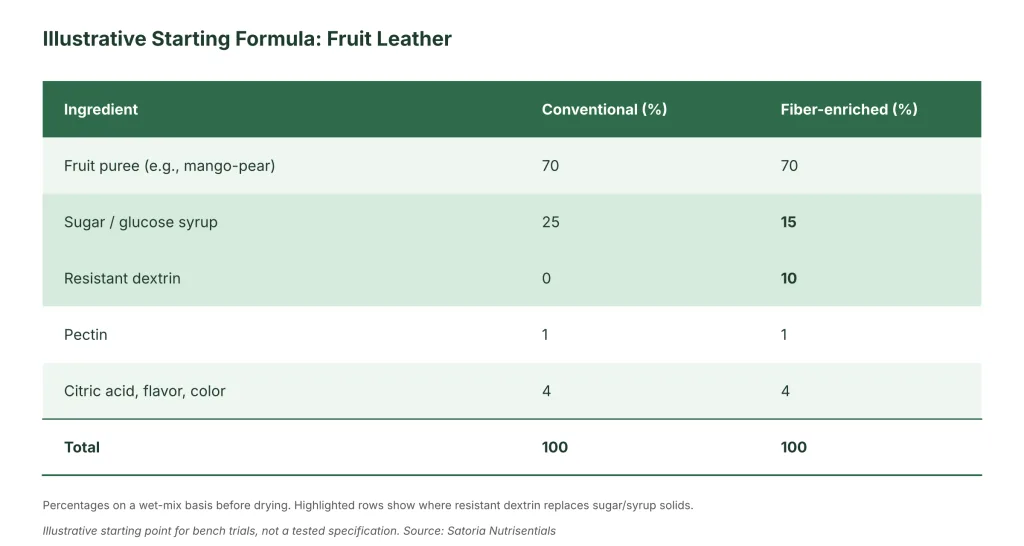
Percentages are on a wet-mix basis before drying. Fiber per 100 g of finished leather will be higher than the mix percentage because water is removed during drying.
Processing Considerations for Dried Fruit Snacks
Resistant dextrin fits into existing fruit leather lines without new equipment. A few points help it perform consistently.
Heat and acid stability
Fruit purees typically sit at pH 3–4, and leathers are cooked and then dried for hours. Fiber that hydrolyses under these conditions would lose its fiber value before it reaches the pack. Digestion-resistant dextrins are inherently stable to high-heat, high-acid processing (Ashkenazi, 2011), so the fiber declared on the label survives cooking and drying.
Add resistant dextrin to the puree before concentration so it dissolves fully. Pre-blend it dry with pectin and any powdered sweeteners to avoid lumps.
Drying, color and browning
Typical air-drying runs at 55–70 °C until the surface is no longer tacky; one recent study dried 3 mm sheets at 60 °C (Nowicka et al., 2025). Resistant dextrin has very few reducing ends compared with fructose and glucose, so it contributes little to Maillard browning. Reducing free sugars can help keep bright fruit colors through drying and storage.
Fiber additions can shift color slightly, depending on the fruit. Darker berry bases hide changes; pale peach or apple bases show them most (Nowicka et al., 2025).
Shelf life and packaging
- Hold water activity at or below the target agreed in development, ideally under 0.6.
- Use moisture-barrier film; dried fruit snacks soften and stick if they pick up humidity, especially in tropical markets.
- Run accelerated shelf-life tests on texture, color and water activity, since sugar reduction changes how the product ages.
Resistant Dextrin vs Other Fibers for Fruit Snacks
For acidic, heat-processed fruit snacks, resistant dextrin offers the best balance of process stability, neutral taste and digestive tolerance. Inulin is the most common alternative but is the least suited to low-pH cooking.
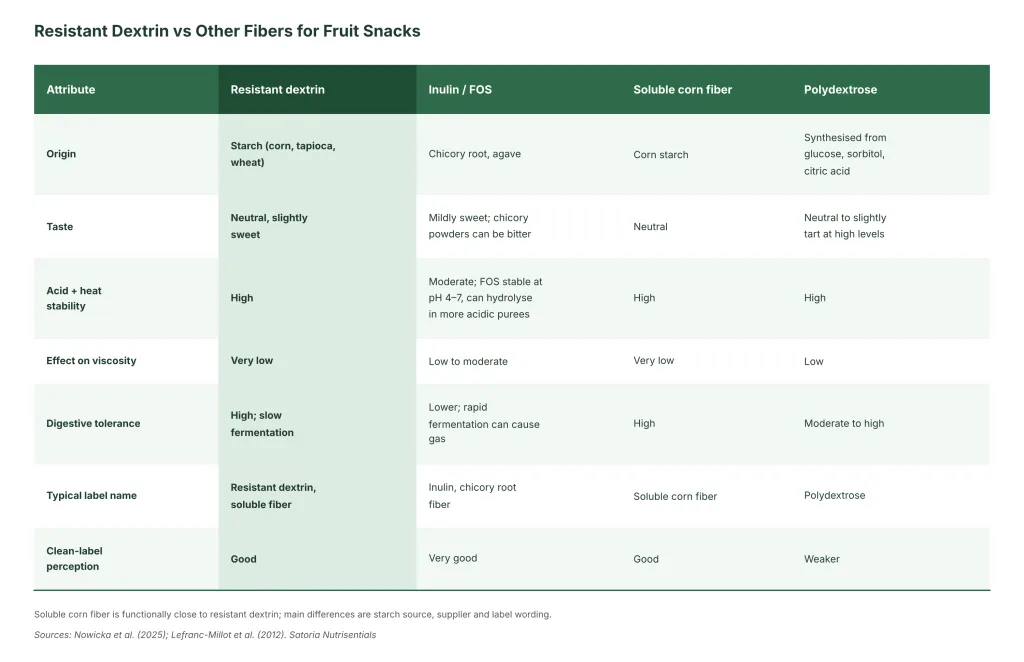
Sources: Nowicka et al. (2025) for FOS pH stability and chicory bitterness; Lefranc-Millot et al. (2012) for resistant dextrin tolerance. Soluble corn fiber is functionally close to resistant dextrin; the main differences are starch source, supplier and label wording.
For brands targeting halal or non-GMO markets, starch source matters. Tapioca-based resistant dextrin avoids corn GMO and wheat allergen questions.
Label Claims and Regulatory Notes
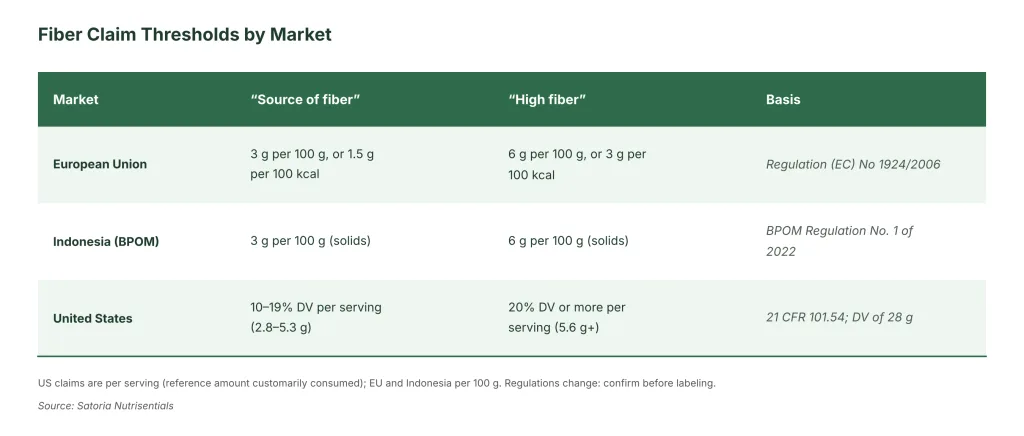
Resistant dextrin counts as dietary fiber on the label in the major export markets, so the fiber it adds can support on-pack claims. Claim thresholds differ by market.
United States
In June 2018, FDA confirmed that resistant maltodextrin/dextrin meets its definition of dietary fiber, so it can be declared as fiber on the Nutrition Facts label (U.S. Food and Drug Administration, 2018). US claims are calculated per serving (the reference amount customarily consumed), not per 100 g, so check the reference amount for your product category.
Reduced-sugar claims
Most markets require a reduced-sugar claim to show at least 25% less sugar than a reference product (30% in the EU). Replacing sugar with resistant dextrin helps reach this, but the comparison and wording rules vary by market.
Halal, non-GMO and clean label
Resistant dextrin is plant-derived and can be produced under halal, kosher and non-GMO certification, which matters for GCC, Southeast Asian and US natural-channel buyers. Ask your supplier for the starch source and certificates as part of your specification.
Regulations change. Confirm current thresholds and wording with local regulatory advisers before finalising labels.
Frequently Asked Questions
How do you add fiber to fruit leather without changing the taste?
Use a soluble fiber with a neutral flavour, such as resistant dextrin, and dissolve it into the puree before cooking. Unlike chicory powders, it does not add bitter notes.
Can you reduce sugar in fruit snacks without losing chewiness?
Yes, if you replace sugar solids rather than simply removing them. Resistant dextrin keeps total solids up, while pectin level and drying end-point fine-tune the chew.
How much resistant dextrin should I use in fruit snacks?
About 3.5–4% of the finished product supports a “source of fiber” claim in the EU and Indonesia, and 7–7.5% supports “high fiber.” Always confirm with lab analysis of the finished product.
Does resistant dextrin affect color or flavor?
It has a clean taste and contributes little to browning. Small color shifts can appear in pale fruit bases, so check color during shelf-life testing.
Is resistant dextrin suitable for kids’ fruit snacks?
Resistant dextrin is widely used in foods for general consumption and is well tolerated at food-use levels. Follow local rules on fiber claims and serving sizes for children’s products.
How do you make fruit leather less sticky?
Reduce free fructose and glucose, partly replace them with a higher-molecular-weight carbohydrate such as resistant dextrin, dry to a low water activity and use moisture-barrier packaging.
Conclusion
Fruit leather and dried fruit snacks can deliver far more than concentrated sugar. Resistant dextrin lets formulators raise fiber to claimable levels, replace part of the added sugar and keep the chew, color and clean fruit flavour consumers expect. Its stability in hot, acidic purees means the fiber on the label is the fiber in the pack.
The practical path is simple: set your fiber target, start with partial sugar replacement, and track water activity and texture through shelf-life testing.
If you are developing a fiber-enriched fruit snack, Satoria Nutrisentials’ technical team can share specifications and samples of Resistant Dextrin for your bench trials. For sweetness and binding, explore Rice Syrup, Tapioca Syrup and SweetSentials. For a related chewy-confection guide, read Gelatin-Free Halal & Vegan Gummy Formulation. Brands looking for a manufacturing partner can learn more about OEM & Toll Manufacturing.
References
- Ashkenazi, Y. (2011). Fruit compositions with soluble dietary fiber (U.S. Patent Application No. 2011/0200733). B&G Foods, Inc. https://patents.justia.com/patent/20110200733
- Astina, J., & Sapwarobol, S. (2019). Resistant maltodextrin and metabolic syndrome: A review. Journal of the American College of Nutrition, 38(4), 380–385. https://doi.org/10.1080/07315724.2018.1523028
- Das, U., Bin Hasan, M., Hussain, T., Rahman, A., Mahmood, A., Marma, S., et al. (2025). Physicochemical, nutritional, and sensory attributes of high fiber fruit leather of red dragon fruit-peel and mango. Journal of Food Quality and Hazards Control, 12(1), 27–36. https://doi.org/10.18502/jfqhc.12.1.18364
- García-García, A. B., Ochoa-Martínez, L. A., Lara-Ceniceros, T. E., Rutiaga-Quiñones, O. M., Rosas-Flores, W., & González-Herrera, S. M. (2019). Changes in the microstructural, textural, thermal and sensory properties of apple leathers containing added agavins and inulin. Food Chemistry, 301, 124590. https://doi.org/10.1016/j.foodchem.2019.03.143
- Lefranc-Millot, C., Guérin-Deremaux, L., Wils, D., Neut, C., Miller, L. E., & Saniez-Degrave, M. H. (2012). Impact of a resistant dextrin on intestinal ecology: How altering the digestive ecosystem with NUTRIOSE®, a soluble fibre with prebiotic properties, may be beneficial for health. Journal of International Medical Research, 40(1), 211–224. https://doi.org/10.1177/147323001204000122
- Nowicka, P., Marcińczak, M., Szydłowska, M., & Wojdyło, A. (2025). Functional fruit snacks enriched with natural sources of fructooligosaccharides: Composition, bioactive compounds, biological activity, and consumer acceptance. Molecules, 30(12), 2507. https://doi.org/10.3390/molecules30122507
- Quagliani, D., & Felt-Gunderson, P. (2017). Closing America’s fiber intake gap: Communication strategies from a Food and Fiber Summit. American Journal of Lifestyle Medicine, 11(1), 80–85. https://doi.org/10.1177/1559827615588079
- U.S. Food and Drug Administration. (2018). The declaration of certain isolated or synthetic non-digestible carbohydrates as dietary fiber on Nutrition and Supplement Facts labels: Guidance for industry. https://www.fda.gov/media/113663/download
Featured News
Category
Get a Promo and Keep Updated