
Rice Protein Isolate in Fermented Plant-Based Yogurt and Kefir Alternatives: A Formulator’s Guide
Rice Protein Isolate in Fermented Plant-Based Yogurt and Kefir Alternatives: A Formulator’s Guide
October 27, 2026
Protein & Nutritional Enhancers - Articles
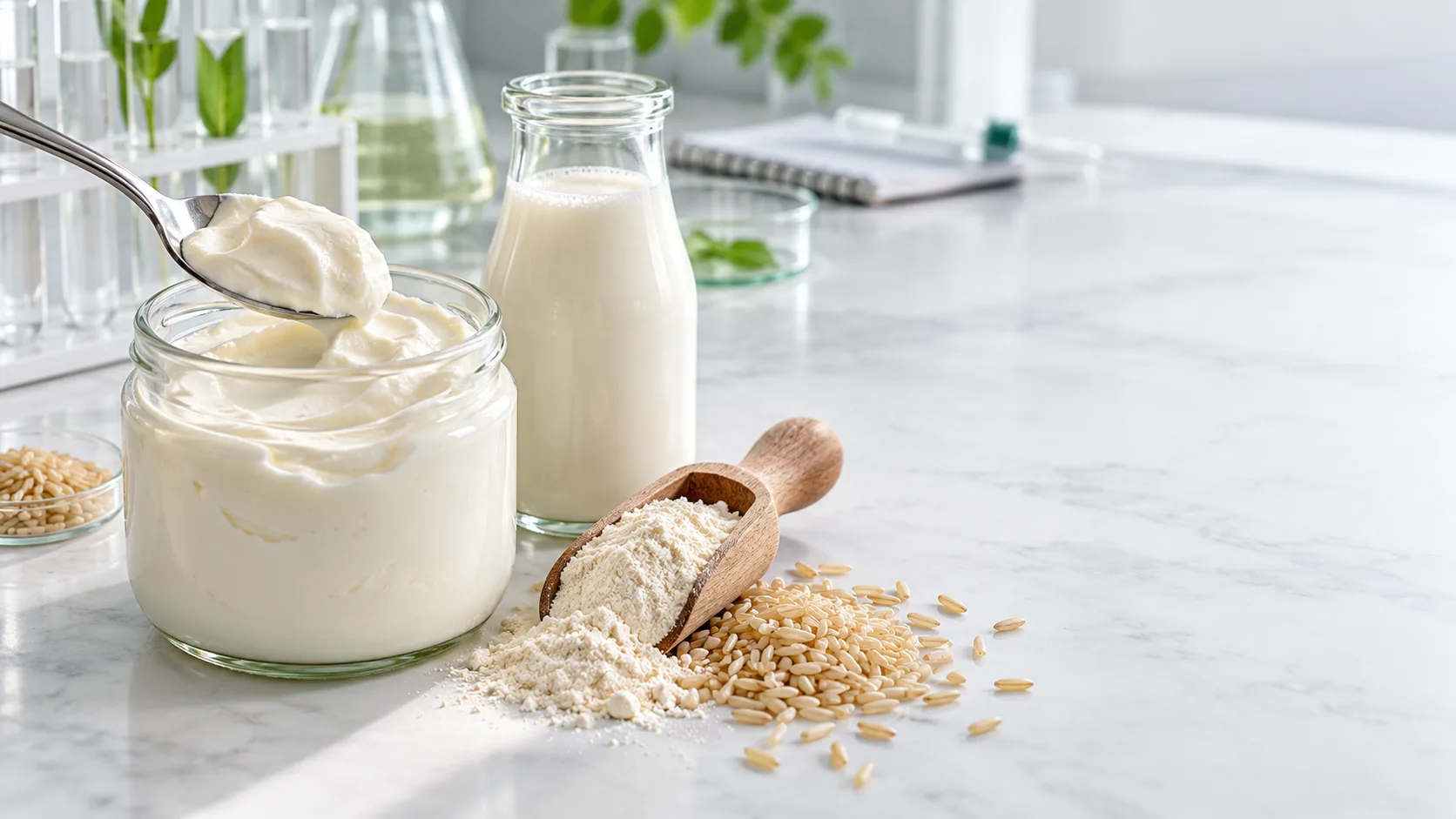
Walk down any chilled aisle and you’ll see it: oat, coconut, almond and soy ferments now crowd the shelf where dairy yogurt once sat alone. Shoppers love the idea. But flip the pot over and the protein line is often disappointing, and that gap is exactly where a smart formulator can stand out.
This guide looks at rice protein isolate in fermented plant-based yogurt and kefir alternatives with clear eyes. We’ll cover what it does well, where it struggles during fermentation, and the practical fixes that turn a thin, weepy gel into a spoonable, high-protein product people actually want to buy again.
Why Plant-Based Fermented Dairy Alternatives Need a Protein Upgrade
Demand for plant-based fermented dairy alternatives keeps climbing, driven by lactose intolerance, milk allergies and sustainability goals. Nutrition, though, hasn’t always kept pace with the marketing. A survey of 249 non-dairy yogurts on the US market found that only about one-third delivered 5 g or more of protein per serving (Craig & Brothers, 2021).
A later comparison against dairy yogurts told a similar story. Plant-based options had less sugar and sodium and more fiber, which is great news. However, they also carried significantly less protein, calcium and potassium, and the researchers pointed to fortification as the clearest route to closing that gap (D’Andrea et al., 2023).
That’s where non-dairy yogurt protein fortification comes in. A concentrated, neutral-tasting isolate lets brands lift protein without abandoning their base, whether it’s coconut, oat or rice milk. The catch? Protein doesn’t sit quietly in a fermented product: it shapes the gel, interacts with the cultures and decides whether whey pools on top by day ten.
What Rice Protein Brings to Dairy-Free Yogurt
Rice protein isolate is extracted from brown rice, usually with enzymes that separate the protein from the starch. A good isolate, such as Satoria’s rice protein isolate, exceeds 80% protein and has a neutral flavour. That matters in a delicate, tangy product like yogurt, where nobody wants an earthy note competing with the fruit layer.
An Allergen-Free Protein for Plant-Based Yogurt
For many brands, the biggest draw of rice protein for dairy-free yogurt is what it doesn’t contain. It is naturally free from dairy, soy, gluten, peanuts and tree nuts, so it works well as a hypoallergenic yogurt alternative protein. If you’re building a soy-free and nut-free yogurt protein system for allergy-aware shoppers, rice is one of the simplest starting points.
Nutritionally, rice protein performs better than its reputation suggests. In one trial with resistance-trained adults, 48 g of rice protein isolate after training produced gains in lean mass and strength similar to the same dose of whey (Joy et al., 2013). Its amino acid profile is lower in lysine, though, a detail we’ll come back to when blending.
Clean label matters too. A single-ingredient isolate reads simply as “rice protein” on a pack, which suits clean label plant-based yogurt formulation far better than a long list of modified ingredients. Shoppers recognise it instantly, and retail buyers reviewing free-from ranges tend to appreciate a short, familiar ingredient list just as much.
The Honest Challenge: How Rice Protein Behaves During Fermentation
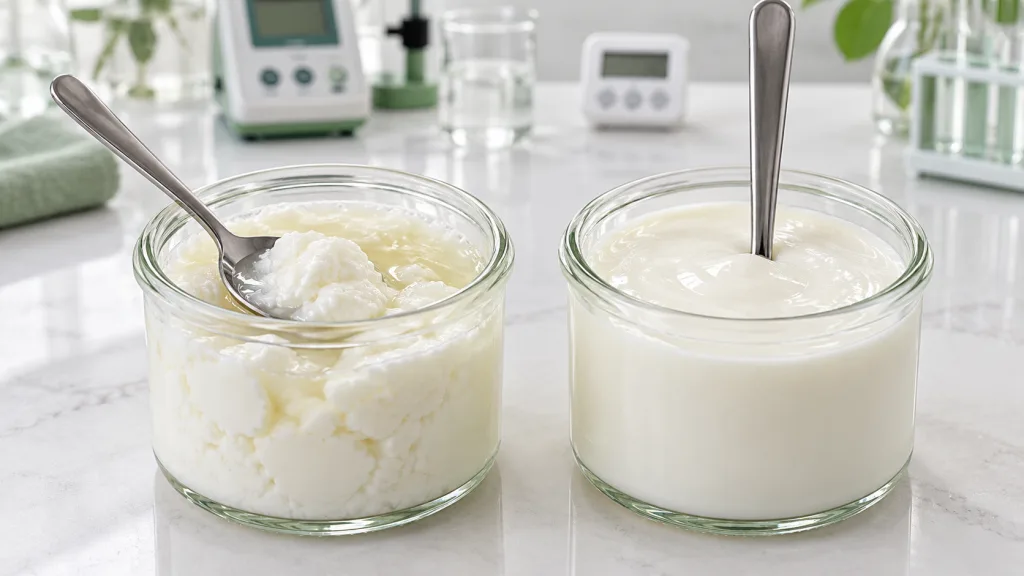
Here’s the part many ingredient articles skip. Rice protein is not a natural gel-former the way milk casein is. Reviews of the category also note that plant-based yogurt alternatives still face real hurdles in texture, shelf life and sensory quality compared with dairy, so expectations need to be realistic from day one (Montemurro et al., 2021).
Does Rice Protein Ferment Well With Yogurt Cultures?
It ferments, but more slowly. A 2025 study tested rice protein isolate in high-protein, set-type hybrid yogurts fermented with S. thermophilus and L. bulgaricus. Rice protein samples took about five hours to reach target acidity, versus roughly 3.5 hours for soy, and started with lower LAB viability (Méndez-Galarraga et al., 2025).
Texture was the bigger issue. The rice protein yogurts formed weaker gels and showed more syneresis, with spontaneous whey separation reaching up to 15%. Encouragingly, every sample still held above 7 log CFU/g after 14 days of chilled storage. Culture survival wasn’t the problem; gel structure was.
Why does this happen? Native rice protein has limited solubility at neutral pH, so fewer protein molecules are available to unfold and link into a continuous gel network as acidity rises. Water-holding capacity drops, viscosity suffers and whey escapes. The good news is that each of these weaknesses has a known, practical fix.
How to Reduce Syneresis and Improve Gel Strength in Non-Dairy Yogurt
Think of fixing rice protein texture as a three-part job: make the protein more functional, support the network, and fill the gaps with a partner protein. Most successful formulations pull at least two of these levers together rather than relying on one. Here’s how to approach the first two; protein blending gets its own section below.
Pre-Treat or Hydrolyse the Protein
Partial enzymatic hydrolysis is one of the most promising tools. In a 2024 study, adding 1% rice protein hydrolysate to set yogurt gave firmness and cohesiveness equal to the control, a dense microstructure and the highest S. thermophilus counts (Abdel-Hamid et al., 2024). That trial used a dairy base, so treat it as directional rather than a direct template.
Reviews of plant-based kefir point the same way, recommending enzymatic pre-treatment and controlled heat treatment to make plant substrates friendlier to cultures (Yerlikaya et al., 2025). Full hydration and high-shear homogenisation before inoculation also help the isolate disperse evenly, which gives the starter culture a smoother, more uniform base to acidify.
Use Hydrocolloids and Stabilizers Wisely
Small amounts of hydrocolloids can rescue water-holding capacity and mouthfeel. One rice-based yogurt-like product reached a compact, uniform gel with just 0.03% xanthan gum, although it also used a little polymerised whey protein, so a fully vegan version needs its own trials (Wang et al., 2021).
Pectin, gellan, guar and modified starches are other common stabilizers. Your choice depends on the format: set-type yogurt needs the strongest network, stirred yogurt needs a smooth, shear-tolerant body, and drinkable yogurt mainly needs to stay uniform in the bottle. Run small dose ladders and track syneresis over the full shelf life, not just on day one.
Rice Protein vs Pea Protein in Plant-Based Yogurt
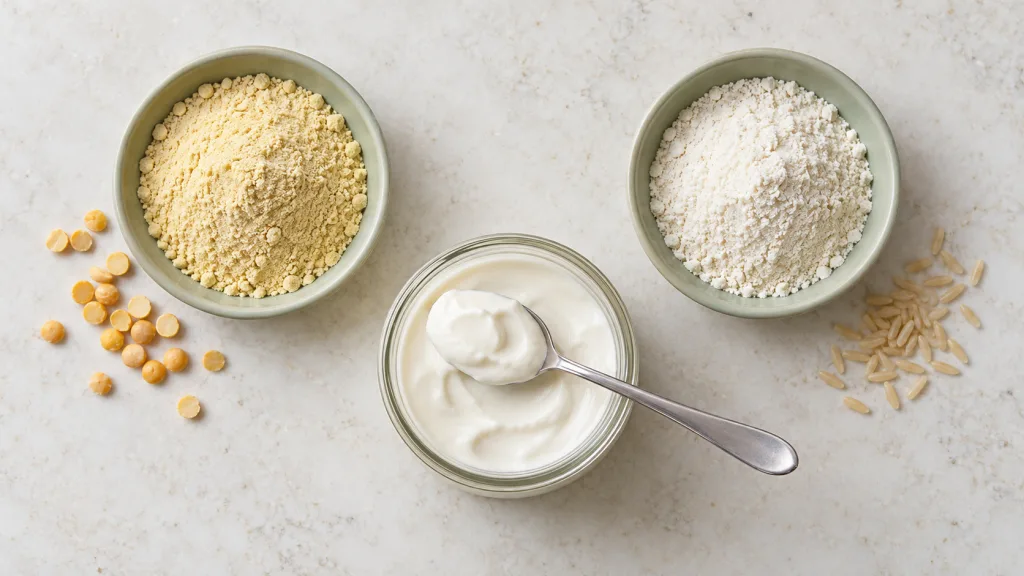
So, should you pick rice or pea? Often the best answer is both. Pea protein tends to bring stronger emulsifying and gelling behaviour, while rice protein contributes a lighter flavour and a smoother mouthfeel. Each one covers the other’s blind spots, which is why blends show up so often in commercial dairy alternatives.
The amino acid story is just as neat. Rice protein is relatively low in lysine but carries a good amount of methionine, while pea protein is rich in lysine and lower in the sulfur amino acids. Combine them as complementary proteins and you improve the overall amino acid profile, and with it the PDCAAS of the finished yogurt.
A quick side-by-side helps when planning trials:
- Flavour: rice is milder; pea protein isolate can carry light earthy notes that cultures and flavours need to mask.
- Gel support: pea generally gels more readily; rice benefits from hydrolysis or blending.
- Amino acids: rice brings methionine; pea brings lysine.
- Allergen profile: both avoid dairy, soy and nuts, so blends still suit free-from ranges.
Start with a pea-led blend if gel strength is your priority, or a rice-led blend if flavour is. Then fine-tune the ratio against texture analysis and sensory panels, because sensory acceptance ultimately decides whether a technically sound yogurt earns a repeat purchase.
Building a Rice Protein Kefir Alternative
Kefir is a different beast from yogurt. It’s drinkable, lightly effervescent and fermented by a mixed community of lactic acid bacteria and yeasts, from either traditional kefir grains or defined starter cultures. That complexity makes vegan kefir formulation especially sensitive to what’s in the base.
A 2025 review of plant-based kefir highlighted several hurdles. Plant milks lack lactose, the sugar kefir microbes prefer, and have weaker buffering capacity than cow’s milk, so pH can fall sharply and stall growth. Lower protein can also reduce microbial robustness and speed up phase separation in storage (Yerlikaya et al., 2025).
A rice protein kefir alternative tackles that protein gap head-on, and rice bases already have a head start. The same review noted that rice- and oat-based kefirs tend to have a lighter flavour and creamier texture, with well-made plant kefirs holding probiotic counts around 10⁶ to 10⁷ CFU/mL during storage.
A few practical tips for your first trials:
- Add a fermentable carbohydrate, such as rice syrup, because the isolate itself supplies little sugar for the cultures.
- Choose a stabilizer suited to low viscosity, since syneresis in a drink shows up as visible layering.
- Allow adaptation time if you use live grains, as plant substrates often need several passages.
Going Synbiotic: Prebiotic Fiber in Dairy-Free Yogurt
Fermented products already carry live cultures, so adding a fermentable fiber is a logical next step. An expert panel from the International Scientific Association for Probiotics and Prebiotics defines a synbiotic as live microorganisms combined with a substrate that host microbes selectively use, together delivering a health benefit (Swanson et al., 2020).
That last part matters. Any health claim needs evidence in the target population, so treat a synbiotic plant-based yogurt as a formulation goal first and a marketing claim second. Regulators in most markets will expect substantiation, and building the evidence early saves painful label changes later.
Researchers have already shown the concept in rice systems. A synbiotic rice-based yogurt-like product combining rice protein, inulin and probiotic Bifidobacterium and L. acidophilus kept both cultures above 10⁶ CFU/mL for eight weeks (Wang et al., 2021). That’s an encouraging signal for a fiber-enriched kefir alternative or spoonable yogurt.
Soluble fibers like resistant dextrin are worth testing as your prebiotic fiber in dairy-free yogurt. Resistant dextrin dissolves easily and adds fiber with minimal impact on flavour or viscosity. Run culture compatibility trials, though, since every strain responds a little differently, and check that the fiber doesn’t shift acidification time or final pH in your base.
Frequently Asked Questions
How Do You Increase Protein in Plant-Based Yogurt?
Add a concentrated isolate, such as rice or pea protein, to the base before heat treatment, then homogenise well so it hydrates fully. Adjusting stabilizers alongside the protein keeps texture on track as levels rise. Blending two complementary proteins also helps, because you can raise protein further without pushing one ingredient past the point where it affects flavour or mouthfeel.
What Is the Best Protein for Dairy-Free Yogurt Texture?
No single protein wins every test. Soy and pea generally gel more readily, while rice offers a cleaner taste and an allergen-friendly label. A rice-and-pea blend supported by a hydrocolloid is a practical middle ground for high-protein plant-based yogurt, giving you a firmer gel without sacrificing a clean flavour.
Can Rice Protein Work in Set-Type, Stirred and Drinkable Yogurt?
Yes. Set-type yogurt asks the most of gel strength, so it benefits most from blending and hydrolysis. Stirred and drinkable formats are more forgiving and can often rely on rice protein plus a modest stabilizer system. Drinkable yogurt is often the easiest place to launch a first rice protein product.
Unleash the Potential of Your Next Plant-Based Ferment
Getting a rice protein isolate plant-based yogurt or kefir right takes careful trials, but the payoff is worth it: a clean-label, allergen-friendly product with protein numbers shoppers notice. The right ingredient partner can shorten that journey considerably, from first bench trial to a stable, scalable formula.
Satoria Nutrisentials supplies rice protein isolate for food manufacturers, produced in Indonesia under HACCP and ISO-aligned quality systems, with halal and non-GMO certification across its portfolio. You can explore the rice protein isolate specifications, pair it with pea protein, or test resistant dextrin for a synbiotic angle. Because pea protein sits in the same range, you can source both halves of a blend from one bulk rice protein isolate manufacturer.
Want a ready-to-use powder rather than separate ingredients? Satoria’s OEM and toll manufacturing services cover spray-dried products, with your formula kept confidential. Curious how rice protein performs in other non-dairy formats? Read our guide to rice protein isolate in sports recovery RTD shakes, then request a sample for your next trial.
References
- Abdel-Hamid, M., Hamed, A. M., Walker, G., & Romeih, E. (2024). Yogurt fortified with various protein hydrolysates: Texture and functional properties. Food Chemistry, 461, 140861. https://researchrepository.ul.ie/articles/journal_contribution/Yogurt_fortified_with_various_protein_hydrolysates_Texture_and_functional_properties/26840602
- Craig, W. J., & Brothers, C. J. (2021). Nutritional content and health profile of non-dairy plant-based yogurt alternatives. Nutrients, 13(11), 4069. https://doi.org/10.3390/nu13114069
- D’Andrea, A. E., Kinchla, A. J., & Nolden, A. A. (2023). A comparison of the nutritional profile and nutrient density of commercially available plant-based and dairy yogurts in the United States. Frontiers in Nutrition, 10, 1195045. https://doi.org/10.3389/fnut.2023.1195045
- Joy, J. M., Lowery, R. P., Wilson, J. M., Purpura, M., De Souza, E. O., Wilson, S. M., Kalman, D. S., Dudeck, J. E., & Jäger, R. (2013). The effects of 8 weeks of whey or rice protein supplementation on body composition and exercise performance. Nutrition Journal, 12, 86. https://doi.org/10.1186/1475-2891-12-86
- Méndez-Galarraga, M. P., Curutchet, A., Budelli, E., Oliveira-Rizzo, C., Di Paolo, A., & Rodríguez Arzuaga, M. (2025). Microbiological and physical evaluation of nonfat set-type hybrid yogurts formulated with soy and rice proteins. Future Foods, 12, 100835. https://doi.org/10.1016/j.fufo.2025.100835
- Montemurro, M., Pontonio, E., Coda, R., & Rizzello, C. G. (2021). Plant-based alternatives to yogurt: State-of-the-art and perspectives of new biotechnological challenges. Foods, 10(2), 316. https://doi.org/10.3390/foods10020316
- Swanson, K. S., Gibson, G. R., Hutkins, R., Reimer, R. A., Reid, G., Verbeke, K., Scott, K. P., Holscher, H. D., Azad, M. B., Delzenne, N. M., & Sanders, M. E. (2020). The International Scientific Association for Probiotics and Prebiotics (ISAPP) consensus statement on the definition and scope of synbiotics. Nature Reviews Gastroenterology & Hepatology, 17(11), 687–701. https://doi.org/10.1038/s41575-020-0344-2
- Wang, C., Li, D., Wang, H., & Guo, M. (2021). Formulation and storage properties of symbiotic rice-based yogurt-like product using polymerized whey protein as a gelation agent. CyTA – Journal of Food, 19(1), 511–520. https://doi.org/10.1080/19476337.2021.1923573
- Yerlikaya, O., Ertem Oztekin, H., & Balta, Y. (2025). Plant-based milk alternatives in kefir production: A review. Journal of Food Safety and Food Quality, 76(6), 45815. https://doi.org/10.31083/JFSFQ45815
Featured News
Category
Get a Promo and Keep Updated