
Dry Konjac Rice: A B2B Guide to High-Fibre, Prebiotic Porang Rice
Dry Konjac Rice: A B2B Guide to High-Fibre, Prebiotic Porang Rice
October 22, 2026
Functional Rice - Articles
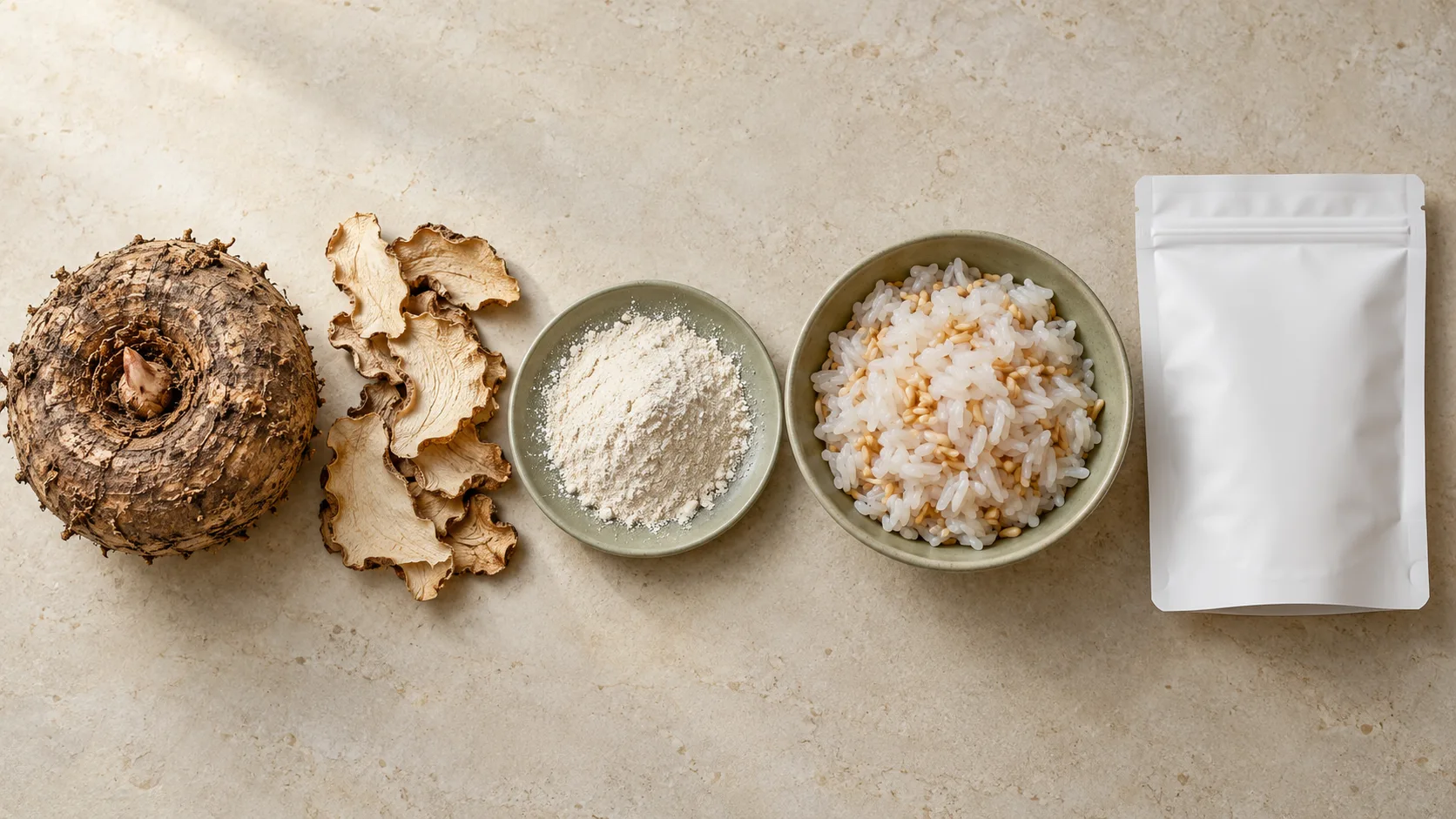
Rice is a daily staple across Asia and a growing part of diets elsewhere, but most white rice provides very little dietary fibre. That gap is the opportunity behind dry konjac rice. It is a rice-shaped grain made from rice flour and konjac flour, prepared simply by steeping in hot water. In Indonesia it is often sold as beras porang. Fortified with a prebiotic fibre such as resistant dextrin, it can bring a serving of rice much closer to the fibre levels nutrition guidelines call for, without asking consumers to give up the rice they know.
This guide is written for brand owners, product developers and sourcing teams. It explains what dry konjac rice is and how it differs from wet shirataki rice. It also covers why the rice flour, konjac and resistant dextrin combination works, which claims hold up, and what to ask a konjac rice manufacturer.
What Is Dry Konjac Rice?
Dry konjac rice is a shelf-stable grain made from a blend of flours, formed into rice-shaped kernels and dried. The key functional ingredient is konjac glucomannan (KGM), a highly viscous soluble fibre from the corm of Amorphophallus plants. Blended with rice flour, konjac helps the grains hold their shape, adds fibre and gives a satisfying bite. The consumer prepares it like an instant grain: pour over hot water, cover, and let it steep until tender.
Konjac, shirataki, porang and analogue rice: clearing up the terms
- Konjac is the common name for the plant and its flour.
- Shirataki rice usually means a wet product: konjac gel shaped into grains and packed in liquid. It is very low in energy, but it needs rinsing and draining and has a springy texture.
- Porang is the Indonesian name for Amorphophallus muelleri, a konjac species grown at scale in Java. Porang corms can contain up to about 75% glucomannan (Open Agriculture, 2022). “Beras porang” and “nasi porang” are the most common Indonesian search terms for this category.
- Analogue rice (“beras analog” in Indonesian) is the broader technical term for rice-shaped grains made from flours rather than harvested whole. Dry konjac rice is one type.
Why the dry format is different
Dry konjac rice is a different product from wet shirataki rice, not a variation of it. Because rice flour is the base, it eats and smells like rice rather than konjac gel. Because it is dry, it ships light, stores at ambient temperature and has no liquid to drain. For buyers, that means simpler logistics and a product that fits into everyday meals rather than diet-only occasions.
Not a Low-Carb Rice: A High-Fibre Rice
This is the most important point to get right in positioning. Dry konjac rice made on a rice flour base has energy and carbohydrate content close to ordinary white rice. It should not be marketed as low-carb, low-calorie or keto.
Its advantage is fibre. White rice is one of the largest sources of energy in many Asian diets, yet it contributes very little dietary fibre. Replacing part of the starch with konjac glucomannan and resistant dextrin lets a familiar staple carry meaningful fibre into the daily diet. This suits consumers who want better digestion and a fuller-feeling meal without changing what they eat.
This positioning is also more honest and easier to defend. It avoids the disappointment of “diet rice” that does not taste like rice, and it gives the label a fibre content claim that can be measured and verified.
Inside the Formulation: Rice Flour, Konjac and Resistant Dextrin
Rice flour: the eating quality
Rice flour provides the familiar flavour, colour and soft texture of rice. Consumers do not need to “get used to” the product, which is the main barrier for wet konjac rice.
Konjac flour: structure and fibre
Konjac glucomannan absorbs large amounts of water and forms a strong network. In a grain, it helps the kernels hold their shape through drying and rehydration and adds soluble fibre. Glucomannan is recognised as a dietary fibre by the U.S. Food and Drug Administration, based on evidence that it helps reduce blood cholesterol (U.S. Food and Drug Administration, 2020).
Resistant dextrin: the prebiotic fibre
Resistant dextrin is a soluble fibre made by heat and enzyme treatment of starch. Most of it passes undigested through the small intestine and is fermented by gut bacteria in the colon. Human studies have linked resistant dextrin intake to changes in gut microbiota composition and to short-chain fatty acid production (Global Prebiotic Association, n.d.). This matches the scientific definition of a prebiotic: a substrate selectively used by host microorganisms that confers a health benefit (Gibson et al., 2017). Resistant dextrin is also on the FDA’s list of non-digestible carbohydrates that count as dietary fibre (U.S. Food and Drug Administration, 2020). Because it is neutral in taste and highly soluble, it raises fibre content without changing how the rice tastes.
Almost no expanding agents
Some instant and analogue rice products rely on added expanding or texturising agents to speed up rehydration. A formulation built on rice flour, konjac and resistant dextrin needs almost none. That keeps the ingredient list short and recognisable, which matters for clean-label positioning and for buyers who review every additive.
Formulation Challenges: Odour, Texture and Water
Odour
Traditional konjac gel is set with an alkali, which can leave a fishy or earthy smell. In a dry, rice-flour-based grain, the konjac proportion and processing are different, so the product smells like rice. Buyers should still ask for sensory data, especially when comparing suppliers.
Texture after steeping
The main technical challenge for any dry instant grain is rehydration. Grains must soften all the way through without a hard core, and they must not turn mushy or sticky. Grain size, porosity and the ratio of rice flour to konjac all affect the result. Ask suppliers for the recommended water ratio and steeping time, then test them in your target use, whether that is a cup meal, a bento or a food-service kitchen.
Water
Because the product is dry, the excess water problem seen with wet konjac rice does not arise. The water used for steeping is absorbed into the grain, so there is nothing to drain.
Processing, Shelf Life and Preparation
Dry analogue rice is typically made by mixing the flours with water, forming the dough into rice-shaped kernels (often by extrusion) and drying them to a low moisture content. Low water activity is what keeps the product stable at room temperature, so no retort processing or cold chain is needed. Packaging with a good moisture barrier protects texture and shelf life, particularly in humid tropical markets.
Preparation is simple: add hot water, cover and steep according to pack directions. That makes the format suitable for:
- Instant cup and bowl meals
- Office, travel and dormitory meals where a stove or rice cooker is not available
- Food-service kitchens that need consistent portions quickly
- E-commerce and export, where light, dry products cut shipping costs
What You Can (and Cannot) Claim
Fibre content claims
Fibre claims are defined by nutrient thresholds that are broadly harmonised across major markets. Under the Codex Alimentarius guidelines and EU Regulation (EC) No 1924/2006, a “source of fibre” claim requires at least 3 g of fibre per 100 g (or 1.5 g per 100 kcal). A “high fibre” claim requires at least 6 g per 100 g (or 3 g per 100 kcal) (Codex Alimentarius Commission, 1997; European Parliament and Council of the European Union, 2006). Indonesia’s BPOM applies the same thresholds for “sumber serat” and “tinggi serat” claims (Badan Pengawas Obat dan Makanan, 2022). Always calculate the claim on the basis the regulation specifies, and confirm the analytical method used to measure fibre.
The word “prebiotic”
Using “prebiotic” on a label is treated differently across markets. In the EU, the term is generally regarded as an implied health claim, and no prebiotic health claim has been authorised. In other markets, the rules vary. A safe approach is to lead with the fibre content claim and describe resistant dextrin factually in B2B and educational content. Check “prebiotic” on-pack wording with regulatory advisers for each destination market.
Glucomannan-specific claims
The EU has authorised health claims for glucomannan related to weight loss and blood cholesterol, but they require 3 to 4 g of glucomannan per day under specific conditions of use (European Commission, 2012). A rice product will rarely meet these conditions per serving, so these claims should generally not be used.
Claims to avoid
Because energy and carbohydrate are close to white rice, avoid “low-carb”, “low-calorie”, “keto” and weight-loss wording. Disease-related wording such as “for diabetics” also needs careful legal review in every market.
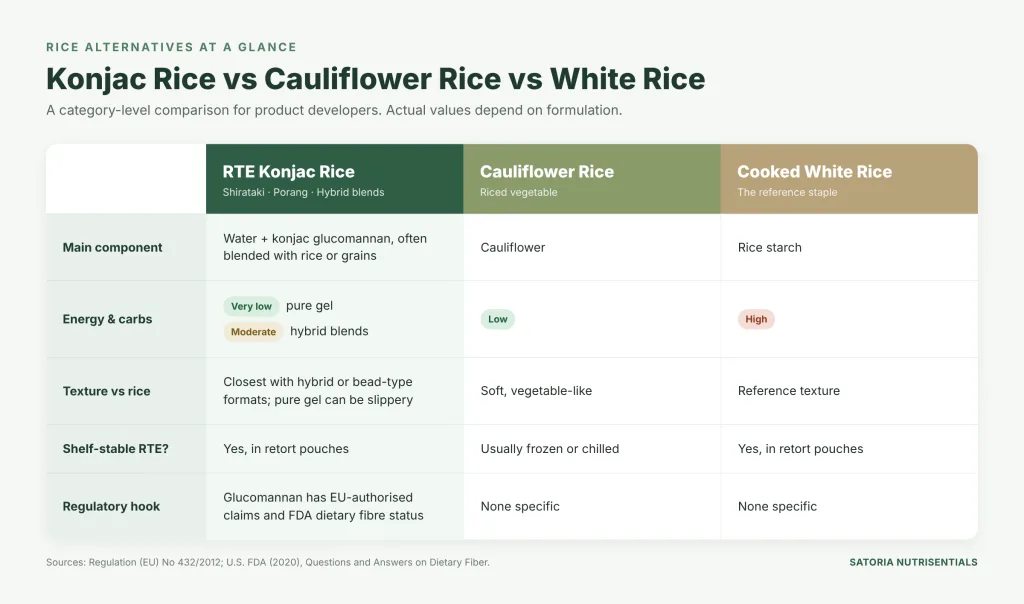
Dry Konjac Rice vs White Rice vs Wet Shirataki Rice
The table below compares the three formats at category level. Actual values depend on the formulation.
Sourcing Checklist: Private Label and OEM Konjac Rice
When you shortlist a konjac rice supplier or co-packer, these questions separate capable partners from traders:
- Composition and fibre per 100 g: a full specification with an analysed fibre value that supports the claim you plan to make.
- Raw material origin: species (A. konjac or A. muelleri), glucomannan content of the flour, and the source and grade of resistant dextrin.
- Rehydration performance: recommended water ratio, steeping time and texture data.
- Additive profile: a clear list of any processing aids or expanding agents.
- Moisture and shelf life: moisture or water activity specification, packaging barrier and shelf-life studies.
- Certifications: food safety (e.g., FSSC 22000, BRCGS or ISO 22000), halal, kosher and non-GMO where relevant.
- Regulatory support: nutrition panel calculation and claim review for each destination market.
Halal certification deserves attention for Southeast Asian, GCC and many European retail channels. In Indonesia, halal certification is mandatory under a national framework, so confirm that certificates are current and cover the finished product, not just the flours.
Indonesia’s Porang Supply Chain
Indonesia has become an important source of glucomannan raw material. Porang grows in the forests of Java, Sumatra, Kalimantan and Sulawesi, and its cultivation has been promoted as a national export commodity. Most porang has historically been exported as dried chips. Processing it domestically into flour and finished foods such as dry konjac rice captures more value and shortens the supply chain. For brand owners in Asia-Pacific, sourcing from a producer close to the raw material can simplify traceability, halal assurance and logistics.
Frequently Asked Questions
Is dry konjac rice low in calories or carbs?
Not when it is made on a rice flour base. Its energy and carbohydrate content are close to white rice. The difference is that it is much higher in dietary fibre.
How do you prepare dry konjac rice?
Pour hot water over the grains, cover and let them steep according to the pack directions. There is no need to boil, rinse or drain.
What does resistant dextrin do in konjac rice?
Resistant dextrin is a soluble fibre that is fermented by gut bacteria in the colon. It raises the fibre content of the rice without changing its taste or texture.
Is dry konjac rice the same as shirataki rice?
No. Shirataki rice is a wet konjac gel packed in liquid and is very low in energy. Dry konjac rice is a rice-flour-based grain that tastes like rice and is positioned on its fibre content.
Conclusion
Dry konjac rice reframes konjac from a diet substitute into a better everyday staple. By combining rice flour for familiar eating quality, konjac for structure and fibre, and resistant dextrin as a prebiotic fibre, it delivers a high-fibre rice that consumers do not have to compromise on. For product developers, success depends on honest positioning around fibre rather than calories, verified fibre claims for each market, and rehydration performance that matches real use.
Exploring a high-fibre rice for your portfolio? Satoria Nutrisentials’ technical team can share specification data and discuss formulation options and documentation for your target markets.
References
- Badan Pengawas Obat dan Makanan. (2022). Peraturan Badan Pengawas Obat dan Makanan Nomor 1 Tahun 2022 tentang Pengawasan Klaim pada Label dan Iklan Pangan Olahan. BPOM RI.
- Codex Alimentarius Commission. (1997). Guidelines for use of nutrition and health claims (CXG 23-1997). FAO/WHO.
- European Commission. (2012). Commission Regulation (EU) No 432/2012 establishing a list of permitted health claims made on foods, other than those referring to the reduction of disease risk and to children’s development and health. Official Journal of the European Union, L 136, 1–40.
- European Parliament and Council of the European Union. (2006). Regulation (EC) No 1924/2006 on nutrition and health claims made on foods. Official Journal of the European Union, L 404, 9–25.
- Gibson, G. R., Hutkins, R., Sanders, M. E., Prescott, S. L., Reimer, R. A., Salminen, S. J., Scott, K., Stanton, C., Swanson, K. S., Cani, P. D., Verbeke, K., & Reid, G. (2017). Expert consensus document: The International Scientific Association for Probiotics and Prebiotics
Featured News
Category
Get a Promo and Keep Updated