
Oat Fiber vs Resistant Dextrin: Which Soluble Fiber Ingredient Is Right for Your Formulation?
How to Choose the Right Keto Friendly Sweetener Manufacturer for Your Product Line
May 18, 2026
Natural Sweeteners - Articles

The global market for keto-friendly products has exploded — and with it, the demand for ingredients that actually deliver on the promise of zero sugar and zero compromise. Whether you’re launching a new line of functional beverages, reformulating a snack bar, or building out a sugar-free supplement range, one decision can make or break your product: the sweetener you choose, and who manufactures it.
It’s not just about sweetness. It’s about glycemic impact, label claims, regulatory compliance, sensory performance, and supply chain reliability. Choosing the right keto friendly sweetener manufacturer is a strategic decision — one that touches everything from your product’s formulation to your customer’s trust.
So where do you start? This guide breaks down what to look for, what questions to ask, and what the science actually says about keto-compliant sweeteners in food and beverage manufacturing.
Why the Keto Sweetener You Source Matters More Than Ever
The ketogenic diet works by keeping carbohydrate intake low enough to maintain ketosis — a metabolic state in which the body burns fat for fuel instead of glucose. To stay in ketosis, net carbohydrate intake is typically kept below 20–50 grams per day. That means any sweetener used in keto-positioned products must have a negligible impact on blood glucose and insulin levels.
This rules out most conventional sugars and high-GI syrups. But it doesn’t rule out sweetness altogether. A growing body of research supports the use of specific sugar alcohols, natural high-intensity sweeteners, and fiber-based blends that deliver satisfying sweetness without spiking blood glucose.
According to a review published in Nutrients, erythritol — one of the most commonly used keto-friendly sweeteners — has a glycemic index of essentially zero and is almost entirely absorbed in the small intestine before fermentation, making it well-tolerated by most consumers. This kind of rigorous metabolic profile is what separates genuine keto ingredients from ones that just claim to be low-carb.
For food and beverage formulators, this means sourcing from a natural keto sweetener supplier who understands not just the ingredient, but the regulatory and metabolic context around it. Your manufacturer should be able to provide technical data sheets, glycemic index documentation, and evidence that their product won’t interfere with ketosis.
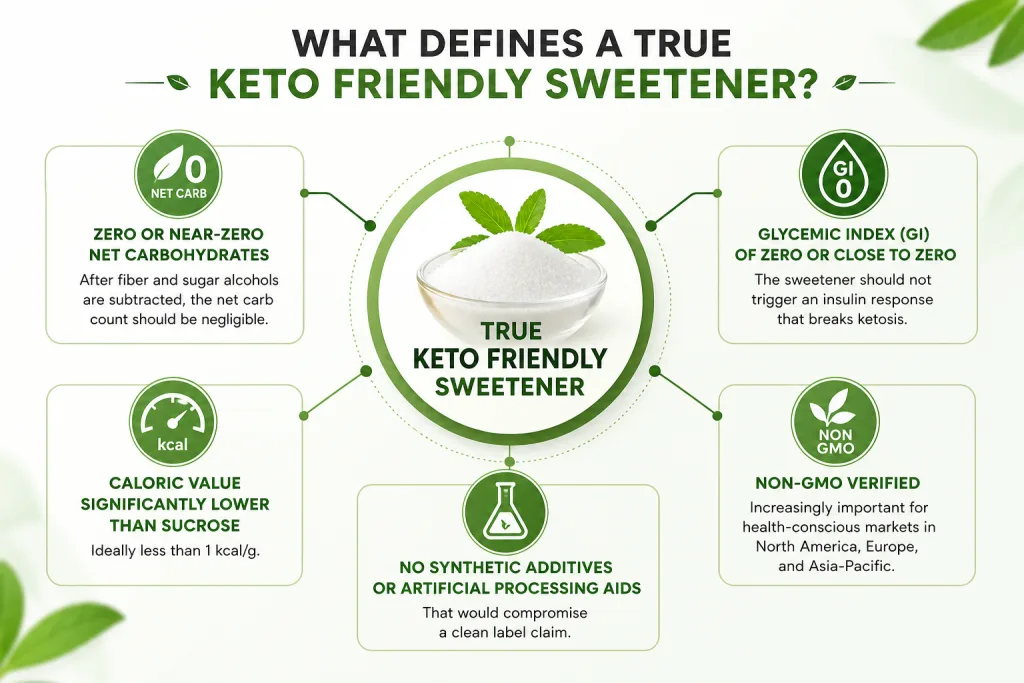
What Defines a True Keto Friendly Sweetener?
Not all low-carb or sugar-reduced sweeteners meet the keto standard. There are a few key properties that define a genuinely keto-compliant ingredient:
- Zero or near-zero net carbohydrates — after fiber and sugar alcohols are subtracted, the net carb count should be negligible.
- Glycemic Index (GI) of zero or close to zero — the sweetener should not trigger an insulin response that breaks ketosis.
- Caloric value that is significantly lower than sucrose — ideally less than 1 kcal/g.
- No synthetic additives or artificial processing aids that would compromise a clean label claim.
- Non-GMO verified — increasingly important for health-conscious markets in North America, Europe, and Asia-Pacific.
Erythritol, monk fruit extract, stevia, and allulose are among the most well-documented options. Each has its own performance profile — erythritol provides bulk and mouthfeel, stevia delivers high-intensity sweetness at low doses, and monk fruit offers a cleaner aftertaste profile than some synthetic alternatives.
When evaluating a low carb sweetener ingredient supplier, ask whether they can provide documentation on each of these criteria. A reputable manufacturer will have no problem sharing third-party lab results and technical specifications that back up their label claims.
Certifications That Should Be Non-Negotiable
One of the clearest signals of a credible keto friendly sweetener manufacturer is their certification stack. Certifications aren’t just paperwork — they’re evidence of consistent manufacturing practices, third-party auditing, and commitment to food safety standards that protect both your brand and your customers.
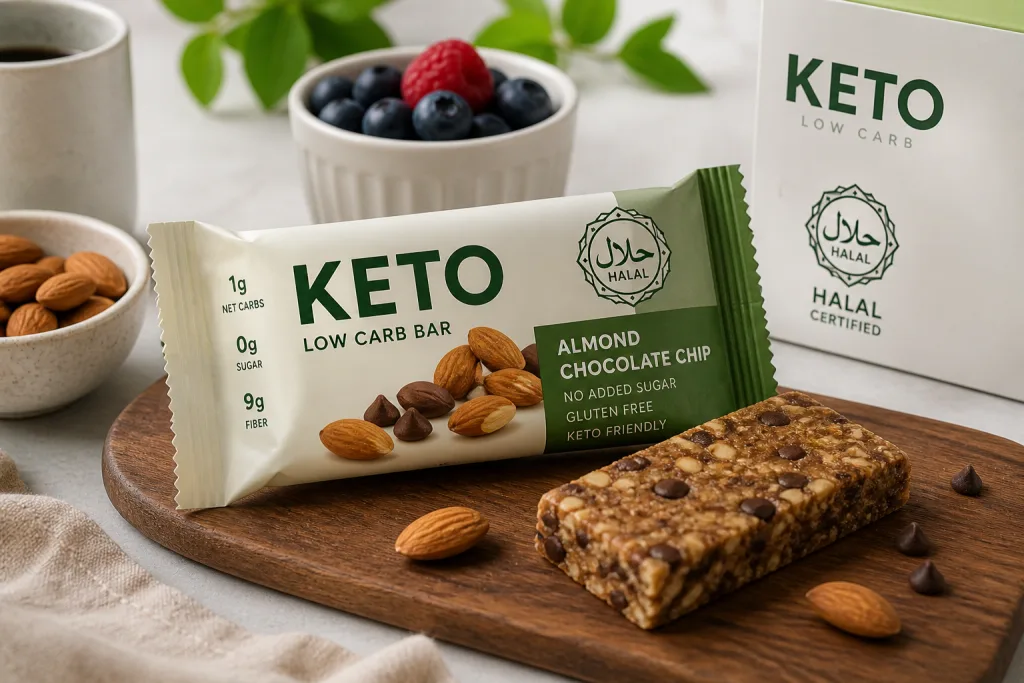
Halal Certification
For brands targeting Muslim-majority markets — including the massive and growing Southeast Asian consumer base — sourcing from a halal keto sweetener manufacturer is essential. Halal certification ensures that the ingredient has been produced, handled, and stored in compliance with Islamic dietary law. It’s not a niche consideration: the global halal food market was valued at over USD 2.4 trillion in 2024 and continues to grow rapidly.
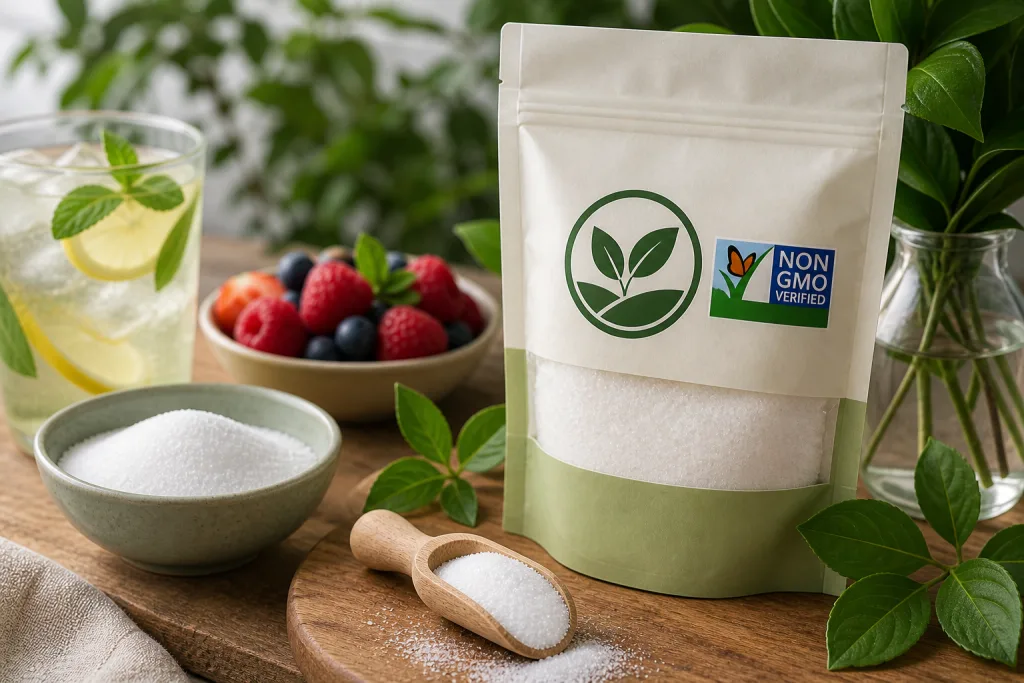
Non-GMO Verification
Clean label trends are reshaping consumer expectations across every category. Working with a non-GMO keto sweetener supplier means your product can carry the Non-GMO verified claim — a label feature that strongly influences purchase decisions, particularly among health-conscious and keto-following consumers. According to the Non-GMO Project, products bearing their verification mark see measurably higher trust and conversion rates in retail environments.

Food Grade & FSSC 22000
A sugar alternative manufacturer operating at food grade standard must adhere to GMP (Good Manufacturing Practices) and ideally carry FSSC 22000 or ISO 22000 certification. These internationally recognised frameworks validate a manufacturer’s food safety management system from raw material sourcing through to finished product dispatch. Without them, you’re taking a risk on supply chain traceability that could cost you in a recall scenario.
Look also for HACCP compliance, which ensures that critical control points throughout the manufacturing process are systematically monitored and documented. For a clean label sweetener ingredient manufacturer, these are not optional extras — they’re the baseline.
Formulation Considerations: Keto Sweeteners in Beverages vs. Solid Foods
Not all keto-friendly sweeteners perform equally across different applications. The physical and chemical behaviour of a sweetener changes significantly depending on whether it’s going into a liquid, a baked good, or a pressed supplement tablet. This is why working with a manufacturer who understands application science is so important.
Keto Sweetener for Beverage Formulation
When developing a keto sweetener for beverage formulation, solubility and heat stability are the two most critical technical parameters. Erythritol, for example, has a solubility of approximately 37 g per 100 mL at room temperature — manageable for most cold beverages but potentially limiting at higher concentrations. Blending it with a high-intensity sweetener like stevia or monk fruit can solve both the solubility and the intensity issues simultaneously.
In hot-fill or pasteurised beverage applications, stability under heat becomes paramount. Some sweeteners degrade or develop off-flavours when exposed to high temperatures for extended periods. A quality keto sweetener supplier will be able to advise on the thermal stability profiles of their ingredients and recommend blending strategies that maintain sweetness and mouthfeel post-processing.
Solid and Semi-Solid Applications
In bars, cookies, confections, or dairy alternatives, bulk and texture become the dominant concerns. Sugar provides more than sweetness in solid foods — it contributes structure, moisture retention, browning, and mouthfeel. A well-formulated keto sweetener blend can replicate many of these functions. Erythritol’s crystalline structure, for instance, can mimic granulated sugar in baked goods at a 1:1 substitution ratio, reducing reformulation effort significantly.
Prebiotic fiber-enhanced blends go a step further, adding gut health benefits alongside sweetness reduction. This dual functionality — sweetener plus functional fiber — is increasingly valued by product developers who want to deliver multiple health claims from a single ingredient.
Why Southeast Asia Is Emerging as a Leading Source for Keto Sweetener Ingredients
Over the past decade, Southeast Asia — and Indonesia in particular — has emerged as a significant hub for functional food ingredient manufacturing. The region benefits from proximity to raw material sources, competitive manufacturing costs, and increasingly sophisticated quality infrastructure. Many Indonesian manufacturers now hold international certifications including FSSC 22000, ISO 22000, and USDA Organic — making them credible partners for global brands.
Working with a sugar free sweetener supplier Indonesia offers specific advantages for brands targeting the Asia-Pacific market. Shorter supply chains reduce lead times and carbon footprint. Local regulatory knowledge (including BPOM compliance) simplifies market entry. And the growing expertise of Indonesian food scientists means that OEM and toll manufacturing services are now genuinely world-class.
That said, due diligence is still essential. When evaluating any regional supplier, request a full audit of their manufacturing facility, documentation of all claimed certifications, and references from existing clients in comparable categories. A reputable manufacturer will welcome this scrutiny.
The Clean Label Imperative: Why Non-GMO and Natural Sourcing Define the Future
Clean label is no longer a trend — it’s the expectation. Research published in the International Journal of Food Science consistently shows that consumers rank transparency of ingredients as a top purchasing driver, particularly in health and wellness categories. For keto products specifically, this means that your sweetener can’t just perform well scientifically — it has to look good on the label too.
A non-GMO keto sweetener supplier who can also substantiate claims around natural processing and traceability gives you a significant advantage in retail and e-commerce channels. Ingredients derived from tapioca, rice, or other plant sources with clear, traceable supply chains are preferred by premium health brands who know that ingredient storytelling sells.
For a clean label sweetener ingredient manufacturer, this means going beyond basic food safety compliance. It means proactively sharing sourcing documentation, GMO testing results, and process information that brands can use in their marketing and packaging. The best manufacturers understand that ingredient transparency is now part of the product itself.
Questions to Ask Before You Partner with a Keto Sweetener Supplier
Before committing to a keto sweetener supplier, there are a few non-negotiable questions every product developer and procurement manager should ask:
- Can you provide independent lab results confirming the glycemic index and net carbohydrate content of your sweetener?
- What certifications do you hold, and can you provide current, unexpired certificates for halal, non-GMO, ISO/FSSC 22000, and GMP?
- What is your minimum order quantity, and do you offer sample quantities for R&D formulation trials?
- Can you support OEM or toll manufacturing if we need a finished blend rather than a raw ingredient?
- What is your lead time and what contingency plans exist for supply disruptions?
- Do you have application scientists or food technologists who can support our formulation process?
These questions help separate genuine strategic partners from commodity distributors. The right manufacturer doesn’t just sell you a bag of ingredient — they invest in the success of your product.
Unlock Smarter Formulation with Satoria Nutrisentials’ Keto-Friendly Ingredients
If you’re building or reformulating products that need to meet keto, low-carb, or sugar-free standards — without sacrificing taste, texture, or label integrity — the ingredient partner you choose defines your outcome. Satoria Nutrisentials, based in Pasuruan, Indonesia, is one of Southeast Asia’s most comprehensively certified functional food ingredient manufacturers.
Their SweetSentials range is a standout for keto-positioned product development. It is formulated as a 1:1 sugar replacement, keto and low-carb friendly, enhanced with prebiotic fiber for gut health, non-GMO verified, gluten-free, and halal certified. It performs across beverages, dairy alternatives, snack bars, and cooking applications — making it one of the most versatile sugar alternative blends available from a regional manufacturer.
Satoria holds FSSC 22000, ISO 22000, HACCP, Halal, Non-GMO, FDA, and BPOM certifications — giving brands the full compliance stack they need for both domestic and export markets. Their on-site R&D lab and OEM capability mean you can move from formulation concept to finished product with a single integrated partner.
Ready to explore what’s possible? Connect with Satoria Nutrisentials to request a sample, discuss your formulation needs, or learn more about their full ingredient catalogue. The right sweetener for your keto product line may be closer than you think.
References
- Moshfegh, A. J., et al. (2023). Erythritol: A review of its metabolism, glycemic response, and tolerability. Nutrients, 15(4), 880. https://doi.org/10.3390/nu15040880
- Paoli, A., et al. (2013). Beyond weight loss: A review of the therapeutic uses of very-low-carbohydrate (ketogenic) diets. European Journal of Clinical Nutrition, 67, 789–796. https://doi.org/10.1038/ejcn.2013.116
- Ianiro, G., et al. (2021). Prebiotics and the microbiome: A gut feeling about sweeteners. Frontiers in Nutrition, 8, 769032. https://doi.org/10.3389/fnut.2021.769032
- Non-GMO Project. (2024). The Non-GMO Project Standard. Retrieved from https://www.nongmoproject.org/gmo-facts/
- DRI International. (2024). Global Halal Food Market Report 2024–2030. Retrieved from https://www.dinarstandard.com/state-of-the-global-islamic-economy-report/
- Grembecka, M. (2015). Sugar alcohols — their role in the modern world of sweeteners: A review. European Food Research and Technology, 241, 1–14. https://doi.org/10.1007/s00217-015-2460-0
- Food Safety and Standards Authority of India. (2022). FSSC 22000 and ISO 22000: A comparative overview for food ingredient manufacturers. Retrieved from https://www.food.gov.uk/business-guidance/food-safety-management-systems
- Chambers, L., et al. (2015). Optimising foods and beverages for satiety, taste, and consumer acceptance. Trends in Food Science & Technology, 41(2), 149–160. https://doi.org/10.1016/j.tifs.2014.10.007
Featured News
Category
Get a Promo and Keep Updated