
Rice Protein Isolate for Non-Dairy Sports Recovery RTD Shakes: A Formulator’s Guide
Resistant Dextrin for Weight Management GLP-1: The Prebiotic Fiber Behind the Body’s Natural Appetite Hormone
May 15, 2026
Resistant Dextrin - Articles

By now, most people have heard of GLP-1 medications — brand names like Ozempic and Wegovy have become household words in the conversation around weight management. But here’s a question worth asking: what was your body doing with GLP-1 before the pharmaceutical industry handed us an injectable version?
Glucagon-like peptide-1 (GLP-1) is a hormone your gut produces naturally. It signals fullness to your brain, slows gastric emptying, and helps regulate blood sugar — everything we now pay a premium for in a weekly injection. The fascinating part? Certain food ingredients, particularly prebiotic fibers, have been shown to stimulate this hormone from within. And resistant dextrin is one of the most well-studied among them.
This article explores the science behind resistant dextrin for weight management GLP-1, what the research actually says, and why food and beverage manufacturers are paying close attention.
What Is GLP-1, and Why Does It Matter for Weight Management?
GLP-1, or glucagon-like peptide-1, is an incretin hormone secreted primarily by enteroendocrine L cells in the small intestine and colon. When food reaches the gut, these L cells respond by releasing GLP-1 into the bloodstream, where it acts on multiple organs simultaneously. The brain receives satiety signals, the pancreas increases insulin output, and the stomach slows the rate at which it empties its contents — a triple mechanism that makes GLP-1 one of the body’s most powerful appetite-regulating tools.
The weight-loss drugs making headlines today are GLP-1 receptor agonists: synthetic molecules engineered to mimic and dramatically amplify these natural effects. Their success has, paradoxically, sparked enormous interest in what the body can do on its own — and how dietary strategies, including the use of a natural GLP-1 booster food ingredient, might support this system. For food manufacturers, this represents a significant product development opportunity. Ingredients that nudge the body’s own GLP-1 production offer a compelling bridge between functional nutrition and the mainstream conversation around metabolic health.
How Resistant Dextrin Supports GLP-1 Secretion
So how exactly does a fiber ingredient influence a gut hormone? The answer lies in fermentation.
Resistant dextrin is a soluble, non-digestible dietary fiber derived from starch — typically corn or tapioca. Because it resists digestion in the small intestine, it arrives in the large intestine intact, where resident bacteria ferment it. This fermentation process produces short-chain fatty acids (SCFAs), including acetate, propionate, and butyrate. These SCFAs don’t just serve as energy for colonocytes — they also act as signaling molecules that bind to receptors on GLP-1-secreting L cells in the colonic epithelium.
Research published in the journal Diabetes (Tolhurst et al., 2012) demonstrated that SCFAs trigger GLP-1 secretion via the G-protein-coupled receptor FFAR2, stimulating L cells and raising cytosolic calcium in a way that directly triggers hormone release. A PubMed study (Hira et al., 2015) showed that resistant maltodextrin — the category to which resistant dextrin belongs — increased GLP-1 secretion and production in fasting rats while also improving glucose tolerance. Separate research (Hira et al., 2017) found that resistant maltodextrin supplementation in rats fed a high-fat, high-sucrose diet produced approximately a twofold increase in GLP-1 responses to oral glucose within just eight days, with reduced visceral fat accumulation compared to controls.
The pathway from fiber to satiety hormone looks like this:
- Resistant dextrin resists small intestinal digestion and arrives in the colon intact.
- Gut bacteria ferment the fiber, producing SCFAs — mainly acetate, propionate, and butyrate.
- SCFAs bind to FFAR2 and FFAR3 receptors on enteroendocrine L cells.
- L cells release GLP-1 into the bloodstream.
- GLP-1 signals satiety, slows gastric emptying, and supports blood glucose regulation.
This fiber-fermentation-hormone cascade is precisely what makes resistant dextrin GLP-1 secretion such a compelling research area — and such a promising formulation target.
Resistant Dextrin and Appetite Suppression: What the Science Shows
The connection between fiber fermentation and satiety isn’t theoretical — it’s been observed in both animal models and human studies. Resistant dextrin appetite suppression operates through two primary pathways: the direct hormonal route via GLP-1 (and the related satiety hormone peptide YY, or PYY), and the mechanical effect of a fiber slowing gastric transit.
Research from Hokkaido University (Hira et al., 2017) found that rats supplemented with resistant maltodextrin experienced approximately a 10% reduction in energy intake within just eight days. When luminal propionate concentrations were measured, they were significantly elevated in the large intestine — consistent with the SCFA-mediated GLP-1 mechanism. A broader review of dietary fiber and GLP-1 (Chambers et al., 2015) concluded that both fermentable and non-fermentable fibers can modify postprandial GLP-1 levels, with soluble, fermentable fibers showing the strongest effect in human subjects.
What makes resistant dextrin particularly interesting from a satiety perspective is that its effects appear to be sustained rather than acute. Unlike a direct glucose stimulus, which produces a sharp and short GLP-1 spike, fiber-driven GLP-1 production is more gradual and prolonged — because the fermentation process continues across hours. This sustained hormonal signaling may be more effective at moderating appetite over the course of a day, supporting the kind of moderate, sustained caloric reduction most often associated with successful weight management.
Resistant Dextrin as a Companion Ingredient for GLP-1 Medication Users
This is where the conversation gets particularly relevant for today’s formulation landscape. Millions of people around the world are now taking GLP-1 receptor agonist medications. These drugs are highly effective, but they come with a notable challenge: they suppress appetite so significantly that food diversity — and therefore fiber intake — can drop substantially.
A review published in PMC (2025) on dietary supplement considerations during GLP-1 receptor agonist treatment noted that reduced food volume and altered food choices can lead to micronutrient gaps and insufficient dietary fiber. Guidance from U.S. health agencies recommended that dietary supplements, including fiber, be considered to manage gastrointestinal side effects and support overall nutritional adequacy.
This creates a clear need for a GLP-1 friendly fiber ingredient in food and supplement products designed for this growing consumer segment. Resistant dextrin fits the profile well. It is gentle on the gut, with clinical data suggesting it has roughly twice the digestive tolerance of inulin — a significant advantage for users already managing GI sensitivity from their medications. It is soluble, colorless, tasteless, and heat-stable, making it easy to incorporate into a wide range of functional foods and beverages without disrupting product quality.
For food manufacturers, this represents a genuine white space: formulating high-fiber products that are accessible to GLP-1 medication users, support natural incretin activity, and address the constipation and gut flora disruption commonly reported with these drugs.
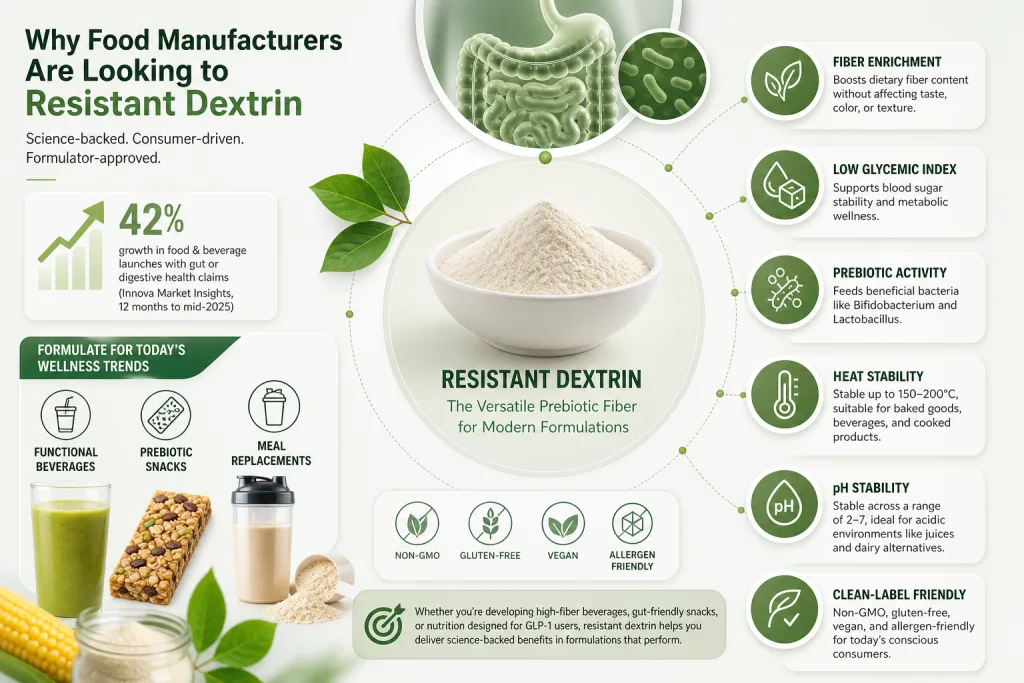
Why Food Manufacturers Are Looking to Resistant Dextrin
The commercial case for resistant dextrin as a formulation ingredient is built on both science and market timing. Consumer interest in fiber, gut health, and metabolic wellness has surged, with industry data showing a 42% growth in food and beverage launches carrying a gut or digestive health claim in the 12 months to mid-2025 (Innova Market Insights). At the same time, the mainstream adoption of GLP-1 medications has placed gut-supportive nutrition firmly at the center of the wellness conversation.
From a formulation standpoint, resistant dextrin offers a rare combination of functional benefits and processing versatility:
- Fiber enrichment without impacting taste, color, or texture
- Low glycemic index, supporting blood sugar stability
- Prebiotic activity, feeding beneficial bacteria like Bifidobacterium and Lactobacillus
- Heat stability up to 150–200°C, suitable for baked goods, beverages, and cooked products
- pH stability across a range of 2–7, enabling use in acidic environments like juices and dairy alternatives
- Non-GMO, gluten-free, and vegan, supporting clean-label positioning
Whether the goal is a high-fiber functional drink, a prebiotic snack bar, or a meal replacement designed for GLP-1 medication users, working with an established GLP-1 friendly fiber ingredient supplier ensures access to a consistently high-quality, compliant ingredient that performs across applications.
Incorporating Resistant Dextrin Into Your Product Range
For food and beverage manufacturers exploring fiber enrichment, resistant dextrin is about as formulation-friendly as ingredients get. It dissolves readily in both liquid and dry matrices, requires no special processing adjustments, and does not contribute bitterness or off-flavors. It can be used in products as varied as soups, dairy desserts, cereals, nutritional beverages, tabletop sweeteners, and analog meats.
The recommended inclusion levels vary by application and desired fiber claim, but because of its excellent digestive tolerance, formulators have more flexibility with resistant dextrin than with many competing fibers. Products can be meaningfully enriched without risking the bloating or flatulence complaints that often accompany inulin-heavy formulations — a particularly important consideration when developing products for GLP-1 medication users who are already managing gastrointestinal side effects.
The market timing, the science, and the formulation advantages are aligned. For manufacturers looking to develop products at the intersection of gut health, metabolic wellness, and GLP-1 support, resistant dextrin is a logical and well-evidenced starting point.
Start Formulating with the Right Fiber Ingredient
If you’re ready to bring innovative, health-forward products to market, the ingredient foundation matters as much as the concept. Satoria Nutrisentials’ Resistant Dextrin by Fiberfit™ is a world-class, food-grade prebiotic fiber ingredient available in both industrial quantities for large-scale manufacturing and retail-ready packaging — giving you the flexibility to develop and scale with confidence.
Manufactured to FSSC 22000, ISO 22000, HACCP, GMP, and Halal standards, and certified Non-GMO and USDA Organic, it’s built for manufacturers who take product quality as seriously as their consumers do. Whether you’re developing a new functional beverage, reformulating a snack line, or creating a product specifically designed to support the growing population of GLP-1 medication users, Satoria Nutrisentials can help you formulate with purpose.
Explore Satoria Nutrisentials’ Resistant Dextrin by Fiberfit™ and connect with the team to discuss your formulation needs today.
References
- Tolhurst, G., Heffron, H., Lam, Y. S., Parker, H. E., Habib, A. M., Diakogiannaki, E., Cameron, J., Grosse, J., Reimann, F., & Gribble, F. M. (2012). Short-chain fatty acids stimulate glucagon-like peptide-1 secretion via the G-protein–coupled receptor FFAR2. Diabetes, 61(2), 364–371. https://doi.org/10.2337/db11-1019
- Hira, T., Ikee, A., Kishimoto, Y., Kanahori, S., & Hara, H. (2015). Resistant maltodextrin promotes fasting glucagon-like peptide-1 secretion and production together with glucose tolerance in rats. British Journal of Nutrition, 114(1), 31–42. https://doi.org/10.1017/S0007114515001580
- Hira, T., Trakooncharoenvit, A., Taguchi, H., & Hara, H. (2017). Resistant maltodextrin or fructooligosaccharides promotes GLP-1 production in male rats fed a high-fat and high-sucrose diet, and partially reduces energy intake and adiposity. European Journal of Nutrition, 57(4), 1403–1415. https://pubmed.ncbi.nlm.nih.gov/28161724/
- Chambers, E. S., Morrison, D. J., & Frost, G. (2015). Control of appetite and energy intake by SCFA: what are the potential underlying mechanisms? Proceedings of the Nutrition Society, 74(3), 328–336. https://pmc.ncbi.nlm.nih.gov/articles/PMC4558455/
- Zhou, J., Martin, R. J., Tulley, R. T., Raggio, A. M., McCutcheon, K. L., Shen, L., Danna, S. C., Tripathy, S., Hegsted, M., & Keenan, M. J. (2008). Dietary resistant starch upregulates total GLP-1 and PYY in a sustained day-long manner through fermentation in rodents. American Journal of Physiology-Endocrinology and Metabolism, 295(5), E1160–E1166. https://pmc.ncbi.nlm.nih.gov/articles/PMC2584810/
- Zhao, L., Zhang, F., Ding, X., Wu, G., Lam, Y. Y., Wang, X., … & Zhang, C. (2018). Gut bacteria selectively promoted by dietary fibers alleviate type 2 diabetes. Science, 359(6380), 1151–1156. https://doi.org/10.1126/science.aao5774
- Baxter, N. T., Schmidt, A. W., Venkataraman, A., Kim, K. S., Waldron, C., & Martens, E. C. (2019). Dynamics of human gut microbiota and short-chain fatty acids in response to dietary interventions with three fermentable fibers. mBio, 10(1), e02566-18. https://doi.org/10.1128/mBio.02566-18
- Miró Blanch, J., & Yuste, S. (2025). Dietary supplement considerations during glucagon-like peptide-1 receptor agonist treatment: A narrative review. PMC. https://pmc.ncbi.nlm.nih.gov/articles/PMC12685510/
Featured News
Category
Get a Promo and Keep Updated