
Functional Still Water Formulation: A B2B Guide to Clean-Label Hydration Ingredients
The Best Nutriose Alternative Soluble Fiber for Manufacturers: A Practical Sourcing Guide
June 10, 2026
Resistant Dextrin - Articles
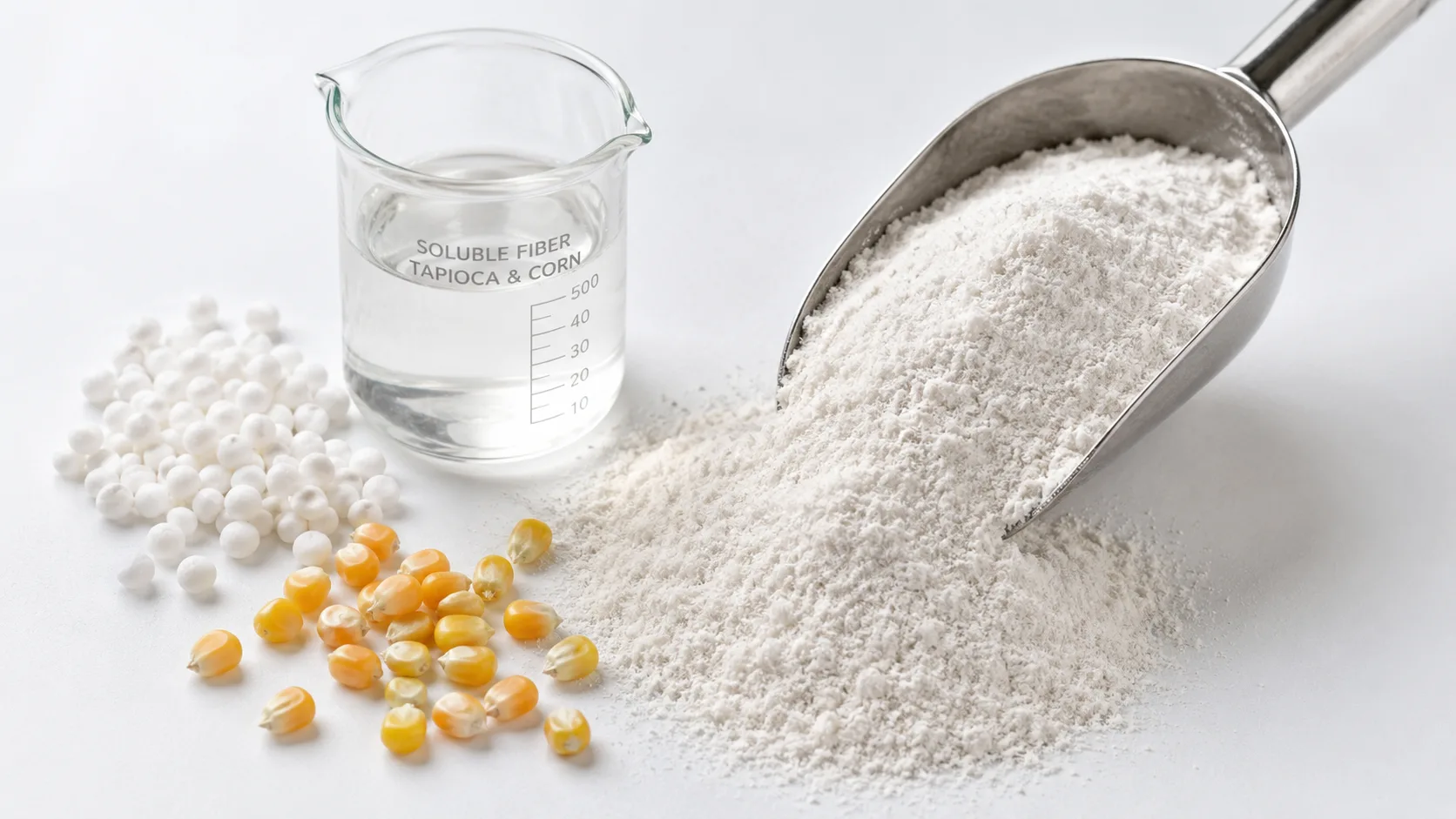
If you’re a food or beverage manufacturer actively searching for a Nutriose alternative, you’re not alone. Supply chain pressures, cost considerations, certification requirements, and a growing demand for clean label ingredients have prompted product developers and procurement teams worldwide to look beyond the usual options.
Nutriose — Roquette’s well-known range of soluble dietary fibers — has long been a reliable go-to in the industry. But as the functional food space evolves, manufacturers need more flexibility: multiple fiber formats, diverse sourcing origins, stronger certification portfolios, and the ability to work with a supplier that understands their specific production context.
This guide breaks down everything you need to know — what Nutriose is, how alternatives compare technically, what to look for in a supplier, and why resistant dextrin has emerged as the leading choice for manufacturers seeking a trusted, scalable, and compliant soluble fiber ingredient.
What Is Nutriose and Why Are Manufacturers Looking for Alternatives?
Nutriose is a brand of soluble dietary fiber produced by Roquette, typically derived from wheat or maize starch. It falls under the broader category of resistant dextrin — a partially hydrolyzed and re-polymerized starch that resists digestion in the small intestine, thereby acting as a prebiotic fiber. You may have come across Nutriose FM (a maize-derived variant) specifically, which is widely used in functional beverages, dairy products, and nutritional foods.
So why are manufacturers exploring a Nutriose FM alternative? Several reasons come up repeatedly in procurement conversations:
- Supply chain disruption — single-source dependency creates risk, especially in global manufacturing.
- Cost pressures — as ingredient costs rise, manufacturers look for equally effective options at better margins.
- Certification requirements — not all Nutriose variants are available with Halal, Non-GMO, or kosher certification in every market.
- Regional sourcing needs — manufacturers in Southeast Asia, the Middle East, and emerging markets often require a local or regional soluble dietary fiber supplier in bulk quantities.
The good news? The functional fiber category has matured enough that comparable — and in some ways superior — alternatives are now readily available.

Understanding Resistant Dextrin: The Science Behind the Fiber
Before comparing options, it helps to understand what makes a soluble fiber like resistant dextrin so effective. Resistant dextrin is produced through a controlled thermal and enzymatic process that modifies starch — typically from corn or tapioca — to create a fiber structure that resists digestion in the upper gastrointestinal tract. The result is a low-calorie, prebiotic soluble fiber with a remarkably clean sensory profile.
Scientifically, this matters because resistant dextrin behaves as a genuine dietary fiber, contributing to the daily recommended fiber intake while delivering functional benefits that go far beyond simple bulking. Research has consistently shown that regular consumption supports:
- Gut microbiome health — feeding beneficial bacteria (Bifidobacterium, Lactobacillus) as a prebiotic substrate.
- Blood glucose management — slowing glucose absorption and blunting post-meal glycemic spikes.
- Cholesterol reduction — contributing to lower LDL and total cholesterol levels.
- Weight management support — promoting satiety and reducing fat absorption.
From a processing standpoint, resistant dextrin outperforms many other soluble fibers. It is colorless, nearly tasteless, and remains stable across a wide pH range (2–8) and at high temperatures (up to 150–200°C for an hour). For manufacturers, that means it can be incorporated into acidic beverages, heat-processed baked goods, and dairy products without compromising the final product’s appearance or flavour profile.
Nutriose vs Resistant Dextrin: How Do They Actually Compare?
This is where many sourcing decisions get made. On a technical level, Nutriose is itself a form of resistant dextrin — so when we talk about a Nutriose alternative, we’re really talking about whether other resistant dextrin soluble fiber suppliers can match or exceed its performance. Based on the published science and industry benchmarking, the answer is a clear yes, provided you’re working with a reputable manufacturer.
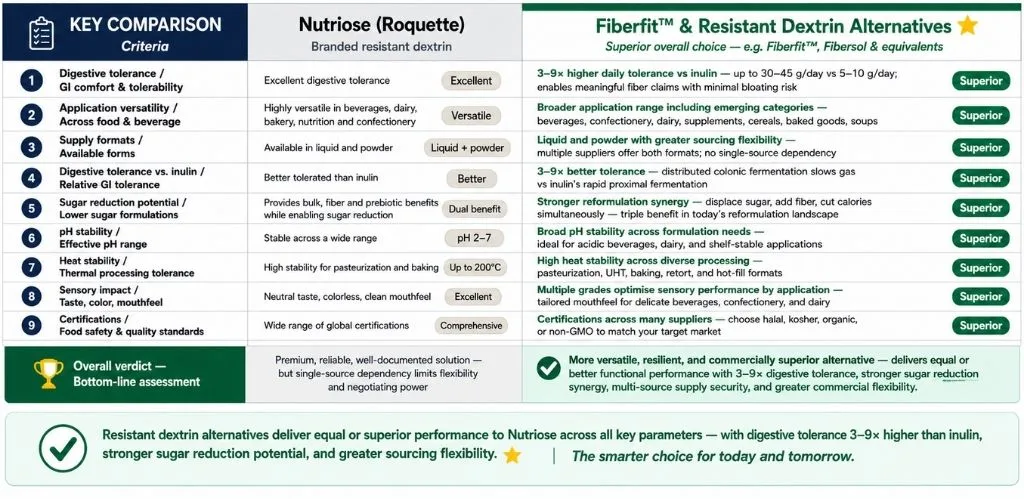
Key comparison points to consider:
Digestive Tolerance
Resistant dextrin has excellent digestive tolerance — approximately twice that of inulin, which is notorious for causing bloating and discomfort at higher doses. This makes it a practical choice for products targeting everyday consumption, not just occasional use. A Fibersol alternative soluble fiber from the resistant dextrin category shares this advantage (Fibersol is another well-known resistant dextrin brand, produced by ADM/Matsutani), making the broader category accessible from multiple sourcing directions.
Application Versatility
Both Nutriose and high-quality resistant dextrin alternatives perform well across beverages, confectionery, dairy, nutritional supplements, cereals, baked goods, soups, condiments, and meat analogues. The critical differentiator is the supplier’s ability to offer both liquid and powder forms — giving formulation teams flexibility for wet and dry processing lines alike.
Sugar Reduction Potential
One underappreciated advantage of resistant dextrin is its role as a sugar reduction ingredient. By displacing sugar in formulations while contributing dietary fiber, manufacturers can simultaneously reduce caloric density and elevate the nutritional profile of a product — a dual benefit that is increasingly valuable as reformulation pressure intensifies across global markets.
What to Look For in a Nutriose Alternative Supplier
Not all resistant dextrin soluble fiber suppliers are equal. When evaluating alternatives, procurement and R&D teams should assess suppliers across several dimensions to ensure consistency, compliance, and long-term reliability.
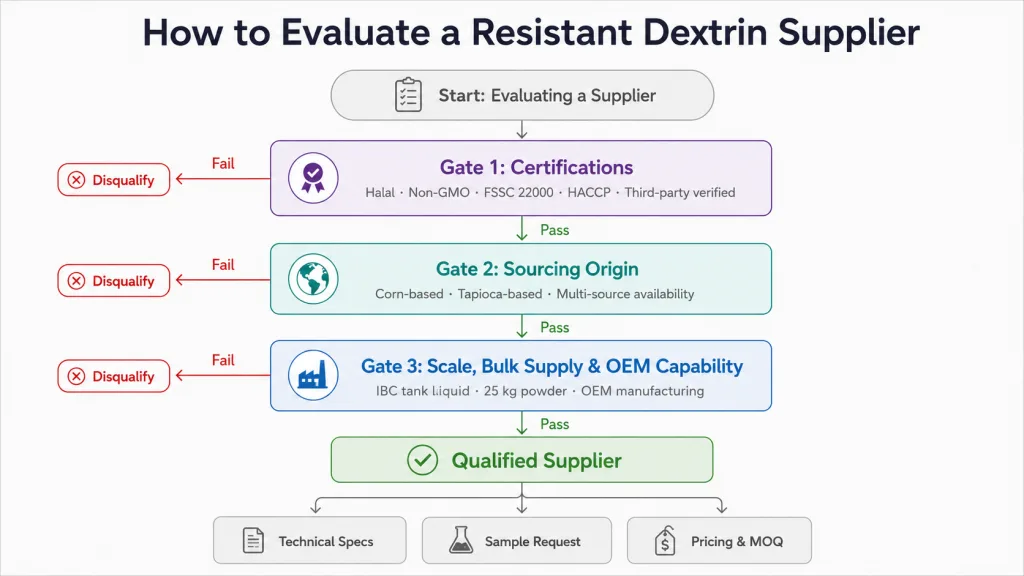
Certifications That Open Markets
For manufacturers supplying products globally, certifications are non-negotiable. A credible resistant dextrin alternative supplier should hold, at minimum: Halal certification (critical for OIC markets and increasingly expected across Asia, the Middle East, and beyond), Non-GMO verification, FSSC 22000 or ISO 22000 food safety management certification, and HACCP accreditation. Look specifically for a halal soluble fiber ingredient supplier and non-GMO soluble fiber supplier with documented third-party certification — not just self-declaration.
Sourcing Origin: Corn vs Tapioca
A quality soluble fiber supplier for manufacturers should be able to offer resistant dextrin from multiple starch sources. Soluble corn fiber and soluble tapioca fiber represent the two most common bases, each with slightly different functional properties and market positioning. Tapioca-derived fiber, in particular, is gaining traction in Asia-Pacific markets due to its neutral taste profile and local agricultural supply chains. Having a reliable soluble tapioca fiber supplier or soluble corn fiber supplier in your procurement portfolio provides resilience if one supply chain faces pressure.
Scale, Bulk Supply, and OEM Capability
If you’re manufacturing at industrial scale, you need more than a sample bag. Look for a soluble dietary fiber supplier in bulk who can supply in IBC tank liquid format (for wet processing plants) and large paper bag quantities for powder lines. For brands that want a finished fiber-enriched product under their own label, working with a soluble fiber OEM manufacturer adds significant value — handling formulation, processing, and packaging under one roof.
Why Southeast Asia Is Emerging as a Key Fiber Sourcing Hub
There’s a compelling case for sourcing from a soluble fiber supplier Indonesia. Southeast Asia has strong agricultural foundations in tapioca (cassava) production — Indonesia and Thailand together produce a substantial share of the world’s cassava starch, the primary feedstock for tapioca-derived resistant dextrin. This geographic advantage translates to supply chain stability, competitive pricing, and faster shipping lead times for buyers across Asia-Pacific, the Middle East, and beyond.
Beyond raw material access, Indonesian manufacturers operating under world-class food safety standards — FSSC 22000, ISO 22000, HACCP, Halal, and Non-GMO — offer a compelling combination of quality, compliance, and cost efficiency. For global brands building resilient ingredient supply chains, adding a Southeast Asian resistant dextrin alternative supplier to the roster is increasingly a strategic decision, not just a backup plan.
Clean Label, Consumer Trends, and Why Fiber Enrichment Is No Longer Optional
The demand for clean label soluble fiber ingredients is accelerating. Consumers today are reading labels more carefully than ever, and they’re actively seeking products that provide transparent, recognisable ingredients that deliver tangible health benefits. This creates a clear imperative for manufacturers: fiber enrichment is no longer a niche positioning strategy — it’s a mainstream formulation requirement.
Several converging trends are driving this:
- Gut health as a mainstream wellness priority — microbiome awareness has moved from specialist health circles to everyday consumer consciousness.
- GLP-1 and metabolic health — the growing focus on blood sugar regulation and appetite management is creating formulation opportunities for fiber-rich functional foods.
- Sugar reduction mandates — regulatory pressure and voluntary reformulation commitments are pushing brands toward fiber-based sugar displacement strategies.
- High-fiber product labelling — products that meet dietary fiber content claims command premium shelf positioning and consumer trust.
Resistant dextrin, used as a fiber enrichment ingredient, ticks all these boxes. It contributes measurable dietary fiber content, supports gut and metabolic health, displaces sugar, and carries a clean, minimal ingredient label. For the fiber enrichment ingredient manufacturer, it represents one of the highest-value additions to a product formulation toolkit.
Resistant Dextrin by Fiberfit: A World-Class Nutriose Alternative Built for Manufacturers
When evaluating a credible Nutriose alternative supplier, Satoria Nutrisentials’ Resistant Dextrin — available under the Fiberfit brand — is worth examining closely. Produced at a certified manufacturing facility in Pasuruan, East Java, Indonesia, it is derived from corn or tapioca starch and delivers the full profile of benefits associated with high-quality resistant dextrin.
What distinguishes the Fiberfit soluble fiber offering from a practical sourcing standpoint:
- Available in both liquid (IBC tank, 1400 kg) and powder (25 kg paper bag) formats — supporting wet and dry manufacturing processes.
- Certified Halal, Non-GMO, FSSC 22000, ISO 22000, HACCP, FDA, and BPOM — meeting the compliance requirements of global, export-oriented brands.
- pH-stable (range 2–8) and heat-resistant up to 200°C — offering genuine versatility across product categories.
- Colorless, odorless, and tasteless — preserving the sensory integrity of host formulations.
- Supported by OEM and toll manufacturing services — for brands that want a complete production solution, not just an ingredient.
Satoria also offers retail-facing fiber products. Fiberfit® as a commercial product makes it a rare vertically integrated player in this space — positioned to serve both B2B ingredient buyers and consumer product brands looking for a finished soluble fiber supplement. Whether you need bulk industrial quantities or a consumer-ready format, the capability is in-house.
Ready to Unlock Your Culinary Potential with a Reliable Resistant Dextrin Supplier?
If you’re actively looking for a Nutriose alternative soluble fiber for your next product launch or formulation project, the next step is straightforward: get the technical and commercial details that matter to your specific production context. The right resistant dextrin supplier should be able to provide food-grade specifications, certifications, sample quantities, and a pricing structure that reflects your volume requirements.
Satoria Nutrisentials’ team of food scientists and ingredient specialists works directly with manufacturers across beverages, dairy, baked goods, nutritional foods, and more. Whether you’re replacing an existing fiber ingredient, adding a new fiber enrichment claim to your product, or building a clean label formulation from the ground up — explore the Resistant Dextrin by Fiberfit range and reach out to discuss your specific manufacturing needs.
References
- Slavin, J. (2013). Fiber and prebiotics: Mechanisms and health benefits. Nutrients, 5(4), 1417–1435. https://doi.org/10.3390/nu5041417
- Livesey, G., & Tagami, H. (2009). Interventions to lower the glycemic response to carbohydrate foods with a low-viscosity fiber (resistant maltodextrin): Meta-analysis of randomized controlled trials. American Journal of Clinical Nutrition, 89(1), 114–125. https://doi.org/10.3945/ajcn.2008.26842
- Nakamura, Y., & Takase, S. (2009). Effects of resistant maltodextrin on gut microflora and defecation in healthy volunteers: A randomised, double-blind, placebo-controlled, crossover study. Journal of Nutritional Science and Vitaminology, 55(5), 458–465. https://doi.org/10.3177/jnsv.55.458
- Tungland, B. C., & Meyer, D. (2002). Nondigestible oligo- and polysaccharides (dietary fiber): Their physiology and role in human health and food. Comprehensive Reviews in Food Science and Food Safety, 1(3), 90–109. https://doi.org/10.1111/j.1541-4337.2002.tb00009.x
- World Health Organization. (2020). Healthy diet. WHO. https://www.who.int/news-room/fact-sheets/detail/healthy-diet
- Dahl, W. J., & Stewart, M. L. (2015). Position of the Academy of Nutrition and Dietetics: Health implications of dietary fiber. Journal of the Academy of Nutrition and Dietetics, 115(11), 1861–1870. https://doi.org/10.1016/j.jand.2015.09.003
- Cho, S. S., & Dreher, M. L. (Eds.). (2001). Handbook of dietary fiber. Marcel Dekker. https://www.ncbi.nlm.nih.gov/nlmcatalog/101111660
- National Institutes of Health, Office of Dietary Supplements. (2023). Dietary fiber fact sheet for health professionals. NIH. https://ods.od.nih.gov/factsheets/DietaryFiber-HealthProfessional/
Featured News
Category
Get a Promo and Keep Updated