
Ultra-Processed Food Reformulation Strategies: A Practical Roadmap for F&B Manufacturers
Ultra-Processed Food Reformulation Strategies: A Practical Roadmap for F&B Manufacturers
September 15, 2026
General - Articles
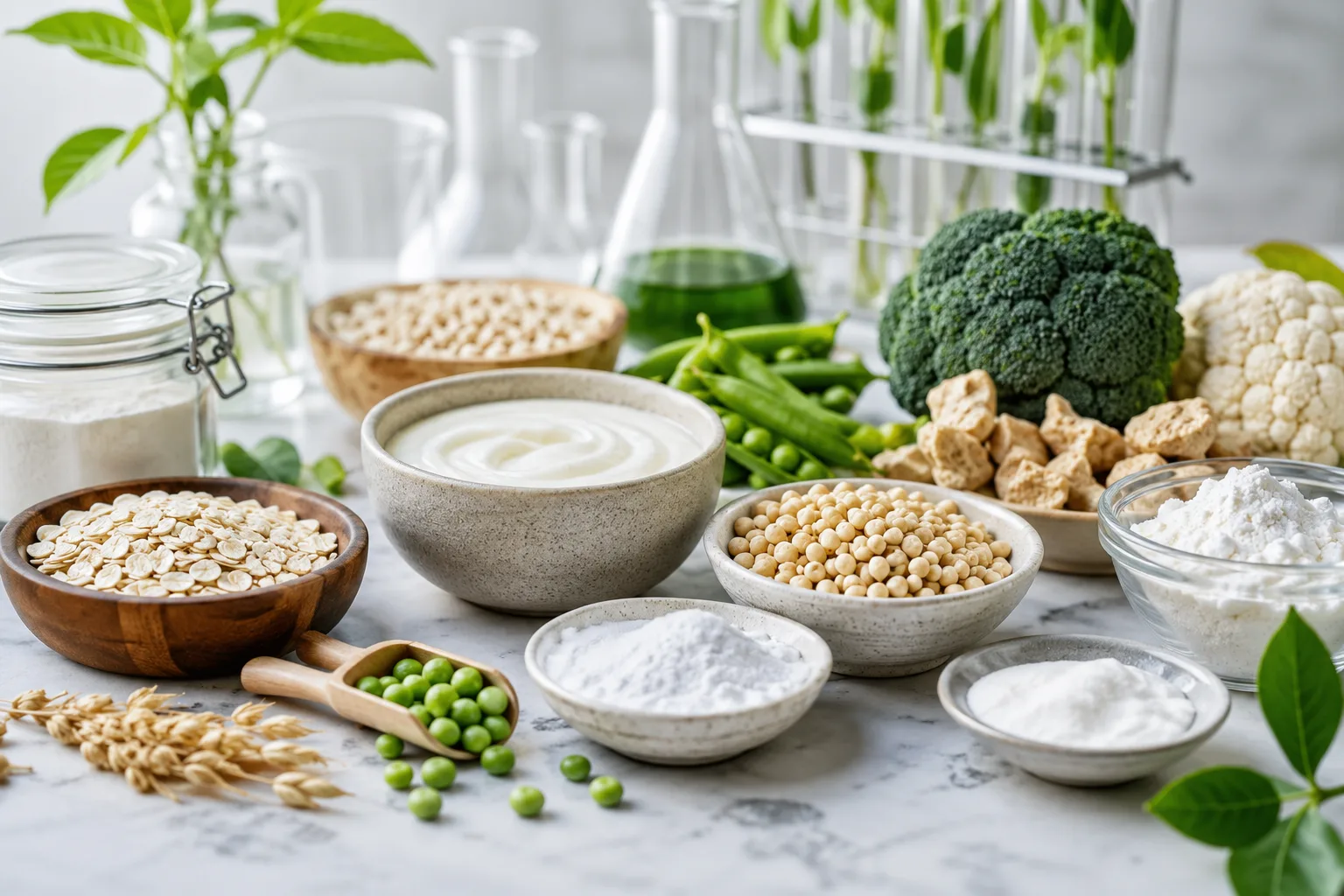
Why Ultra-Processed Food Reformulation Is Suddenly Urgent
For years, ultra-processed food reformulation sat quietly on the innovation roadmap, somewhere between “nice to have” and “someday.” That’s no longer the case. In November 2025, The Lancet published a landmark series involving 43 international researchers, confirming that high UPF consumption is linked to obesity, type 2 diabetes, and cardiovascular disease, and calling for coordinated global policy action on production, marketing, and availability.
At the same time, U.S. regulators are moving from talk to text. The FDA and USDA’s joint Request for Information drew more than 5,000 comments as agencies work toward a federal definition of ultra-processed foods, one that could reshape front-of-pack labeling nationwide. Add in state-level legislation, MAHA-driven scrutiny of synthetic additives, and shifting consumer expectations, and reformulating processed foods has become a genuine business priority rather than a marketing talking point.
Consumer sentiment backs this up. Industry surveys circulating ahead of 2026’s major food science conferences show that roughly half of shoppers now view ultra-processed foods as unhealthy, and a clear majority say they prioritize recognizable ingredients and full ingredient transparency when choosing what to buy. That’s a demand signal formulation teams can’t easily ignore.
For food and beverage manufacturers, this creates both risk and opportunity. Products built on legacy formulations may soon face new labeling requirements or consumer pushback. But brands that get ahead of the curve, through clean label reformulation and smarter ingredient replacement for food manufacturers, stand to win shelf space and buyer trust. This article breaks down practical food reformulation strategies your team can start evaluating today.
What “Ultra-Processed” Actually Means for Formulators
Here’s the tricky part: nobody fully agrees on what “ultra-processed” means. The NOVA classification system, widely used in public health research and referenced throughout The Lancet series, groups foods by degree and purpose of processing rather than by nutrient content alone. Meanwhile, several U.S. states, including Arizona, Utah, and Florida, have proposed additive-based definitions instead, focused on specific ingredients rather than processing techniques.
HHS has recently started favoring the term “highly processed foods” in some contexts, signaling that the eventual federal definition may land somewhere between these two philosophies. For your formulation team, this ambiguity is actually useful information: rather than chasing one narrow definition that could shift again before it’s finalized, the safer long-term strategy is prioritizing UPF reformulation ingredients that address the underlying concerns common to nearly every framework under discussion, cosmetic additives, industrial processing aids, and a long, unrecognizable ingredient list.
That’s the throughline connecting clean-label consumer demand, MAHA scrutiny, and front-of-pack labeling proposals. Whatever the final legal definition turns out to be, products with fewer synthetic additives and more functional, recognizable ingredients are better positioned either way, and less likely to require a second reformulation once the rule actually lands.
Core Reformulation Strategies Worth Prioritizing
Not every reformulation lever delivers equal value, and few manufacturers have the budget to overhaul an entire portfolio at once. Based on where regulatory and consumer pressure is concentrated right now, four categories of food reformulation strategies deserve the most attention.
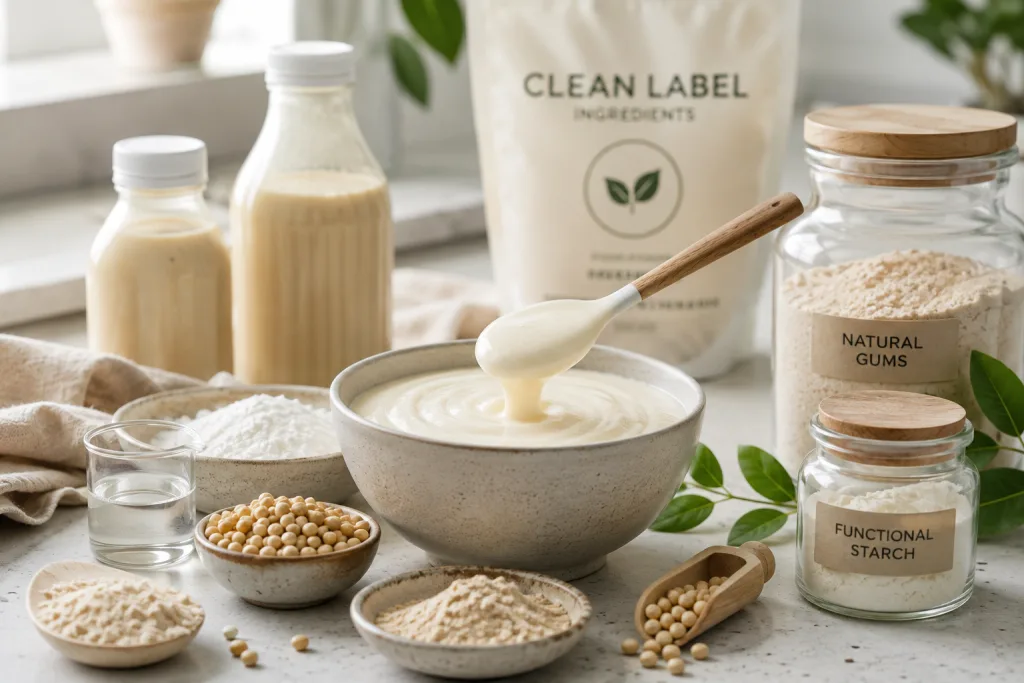
Clean Label Emulsifier Alternatives
Emulsifiers are a growing flashpoint. A 2021 study published in Microbiome found that of 20 commonly used dietary emulsifiers tested, most altered gut microbiota composition in ways associated with intestinal inflammation, though effects varied considerably by compound, and a separate 2021 review in Nutrition Reviews reached similar conclusions about the state of the evidence. That’s prompting manufacturers to look at clean label emulsifier alternatives such as functional starches, gums, and protein-based systems that can replicate texture and stability without synthetic surfactants.
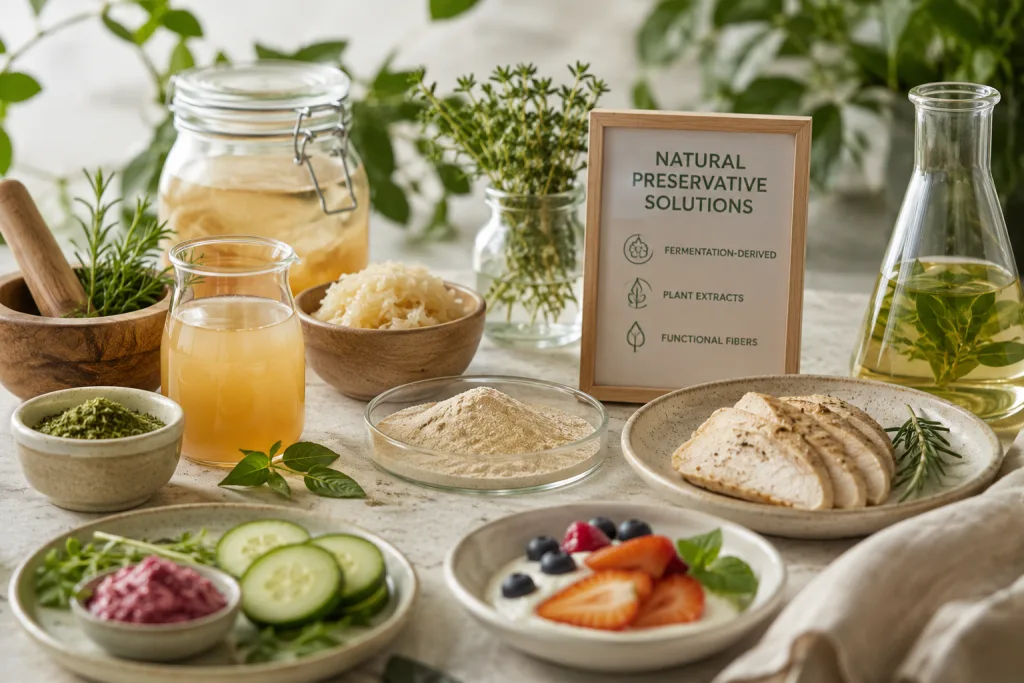
Natural Preservative Replacement
Natural preservative replacement for processed food is advancing quickly, with fermentation-derived ingredients, plant extracts, and functional fibers increasingly able to extend shelf life without nitrites, sulphites, or synthetic antioxidants. The tradeoff to watch is always sensory performance: a preservative swap that changes texture, color, or flavor can quietly undo the reformulation’s commercial value, even when the label improves.
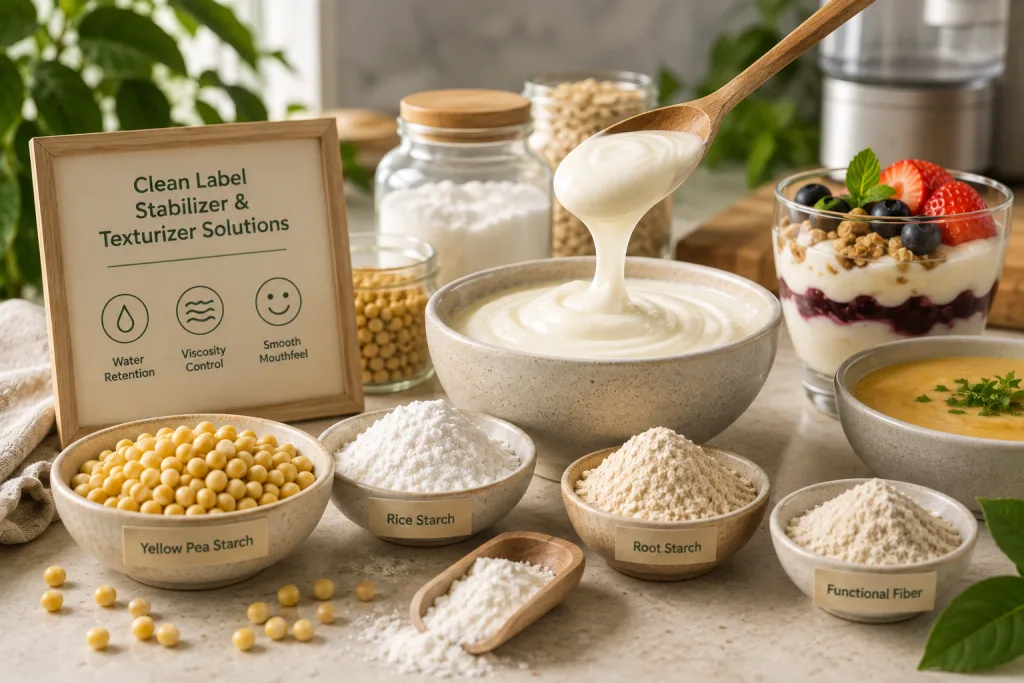
Clean Label Stabilizer and Texturizer Solutions
Replacing artificial additives in food formulation often starts with texture, since that’s where consumers notice a swap first. Clean label stabilizer solutions and natural texturizers for food manufacturers, built from rice, pea, or root-based starches and fibers, can hold water, control viscosity, and maintain mouthfeel across a wide pH and temperature range, closing the gap that used to require synthetic gums.
Sugar and Sodium Reduction Without Losing Function
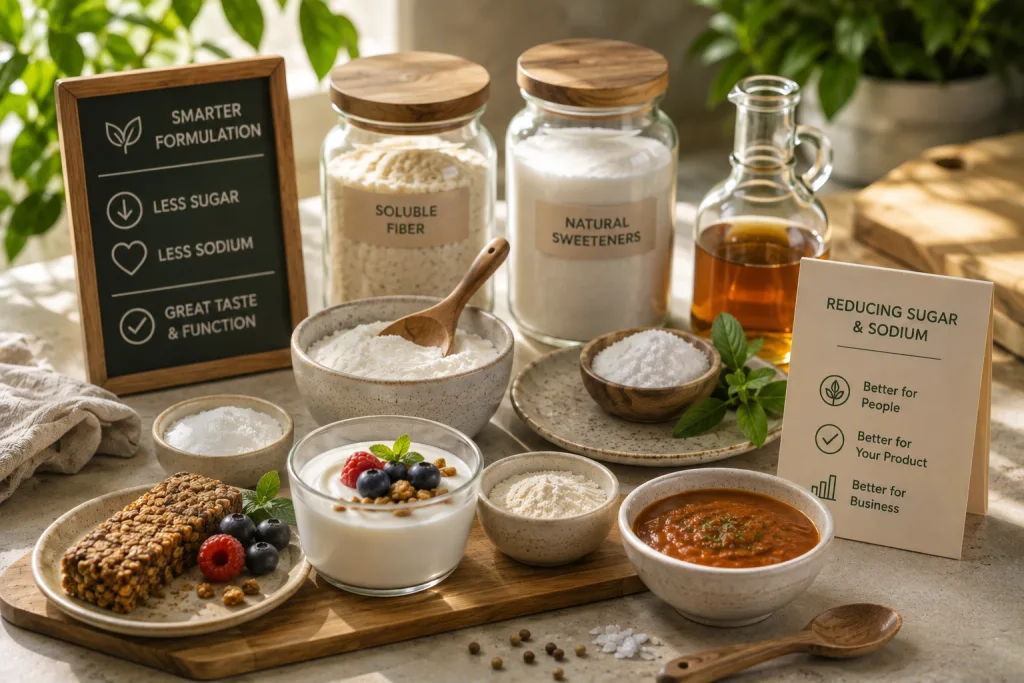
Sugar reduction ingredient solutions remain central to reformulation briefs. WHO’s reformulation policy brief notes that typical sugar-reduction commitments range from roughly 4% to 15%, achievable through soluble fiber, natural sweetener blends, and bulking agents that preserve texture, browning, and mouthfeel without relying on added sugar’s full functional load.
Balancing Reformulation With Cost and Sensory Performance
None of this matters if the reformulated product doesn’t taste right, hold together on the production line, or hit a workable cost target. The most common reason a promising ultra-processed food reformulation stalls out isn’t ingredient availability, it’s a sensory panel that flags an off-note or a texture change consumers notice immediately, even when the nutrition panel improves.
That’s why pilot-scale testing matters more than it used to. Before committing to a full production run, it’s worth trialing clean label reformulation at small batch sizes across a realistic shelf-life window, not just a single taste test at day zero. Emulsifiers, stabilizers, and preservatives often behave differently after two, four, or twelve weeks of storage than they do fresh off the line.
Cost is the other constraint formulation teams can’t ignore. Many natural texturizer for food manufacturers options carry a higher per-kilogram price than the synthetic additives they replace, but often at lower use-rates or with added functional claims that support premium pricing. Framing reformulation as a cost problem alone misses the point: a resistant dextrin or pea protein swap that also earns a “source of fiber” or “high protein” claim can offset the ingredient cost difference through pricing and shelf placement, not just through savings.
Getting this balance right usually means involving your ingredient supplier early, not after a formulation is already locked. A supplier that offers technical support, application data, and small-batch samples can shorten the number of pilot rounds needed before a reformulated product is ready for full-scale production.
Reformulating for Regulatory Compliance
Reformulation and regulation are converging fast, and manufacturers who wait for final rules risk being caught flat-footed with a formulation that no longer fits the market. HHS and USDA submitted a federal proposed definition of ultra-processed foods for review in August 2026, alongside a proposed GRAS reform requiring manufacturers to notify the FDA when they determine an added ingredient is Generally Recognized as Safe, rather than relying solely on internal determinations.
Separately, HHS leadership has signaled interest in overhauling front-of-pack labeling once the UPF definition is finalized, potentially moving toward a traffic-light or warning-label style system already used in Chile, Mexico, and Israel. School food ingredient restrictions are advancing even faster: several states have already passed or proposed rules restricting specific additives in school meals, effectively forcing reformulation ahead of any federal timeline, and setting a precedent that broader retail regulation is likely to follow.
For ingredient buyers, MAHA compliant food ingredients and FDA highly processed food definition ingredients are becoming procurement criteria, not just marketing language. Building ingredient supplier compliance solutions into your sourcing process now, rather than after a rule is finalized, gives your formulation and regulatory teams room to test, document, and validate before a deadline forces a rushed swap under time pressure.
Choosing the Right Functional Ingredient Replacement
Not all reformulation ingredients are created equal, and the right choice depends heavily on the product category, target claim, and processing conditions. A few functional ingredient solutions B2B buyers are increasingly leaning on include:
- Resistant dextrin, a soluble prebiotic fiber that supports resistant dextrin reformulation across baked goods, beverages, and dairy, while also functioning as a sugar and fat replacer with a neutral flavor profile
- Pea and rice protein isolates, which support pea protein clean label reformulation and rice protein food manufacturer solutions in bars, beverages, and meat analog formulation
- Konjac-based ingredients, useful for konjac ingredient reformulation in low-glycemic rice and noodle alternatives aimed at weight-management positioning
- Prebiotic fiber blends, positioned as a genuine prebiotic fiber ultra-processed alternative for gut-health-forward product lines, including low-FODMAP formats
- Synbiotic combinations, appealing to B2B brands sourcing a synbiotic ingredient supplier B2B partner for combined fiber-and-probiotic claims
Each of these ingredient categories does more than remove something undesirable; done well, reformulation adds a functional or nutritional benefit the original formulation lacked entirely, which is a stronger commercial story on pack than simply “now with less of X.”
Reformulation in Practice Across Categories
Reformulation looks different depending on what you’re making, so it helps to see the logic applied across a few categories. In frozen desserts, soluble fiber can replace some of the bulking and freezing-point functions traditionally handled by sugar, while simultaneously improving the fiber content declared on the label, a genuine two-for-one improvement.
In plant-based meat analog formulation, combining pea protein with resistant dextrin can improve moisture retention and bite texture, addressing two of the most common consumer complaints about plant-based products in one ingredient system, without adding a long list of stabilizers.
Beverage categories are seeing their own shift. Prebiotic soda has moved from a niche category into a genuine growth segment, and OEM clean label ingredient solutions built around resistant dextrin let beverage brands add a functional fiber claim without the processing complexity of building a formulation from scratch. Across each of these examples, the pattern holds: successful reformulation pairs an ingredient replacement for food manufacturers with a genuine functional upgrade, not just a subtraction from the ingredient list.
Working With the Right B2B Ingredient Partner
Reformulation projects live or die on supplier reliability. A food ingredient manufacturer for reformulation needs to offer more than a spec sheet; it needs consistent bulk supply, documented certifications, and the flexibility to support both large-scale production runs and smaller pilot batches while a new formulation is being validated.
For manufacturers selling into regulated or faith-based markets, a halal certified functional ingredients supplier with recognized certifications matters as much as raw functional performance, particularly for brands expanding into the functional ingredient manufacturer GCC market or other markets with strict import requirements around certification and traceability. Private label functional food ingredients and OEM or toll manufacturing support also matter for brands that want to move quickly without building new production infrastructure in-house.
Quality systems matter just as much as certifications on paper. Look for suppliers operating under recognized food safety management frameworks, alongside GMP and halal compliance, so your reformulated product carries the documentation your own retail or export partners will eventually ask for. Whether you’re sourcing a bulk functional ingredient supplier Asia option to diversify your supply chain, or evaluating a new B2B functional ingredient supplier for a single reformulation project, confidentiality and consistency should sit alongside price and functionality on your evaluation checklist.
Ready to Start Your Reformulation Project?
If your team is mapping out ultra-processed food reformulation strategies for the year ahead, the ingredient conversation is a good place to start. Satoria Nutrisentials manufactures functional ingredients, including Resistant Dextrin, Rice and Pea Protein Isolate, and Rice and Pea Maltodextrin, engineered specifically to support clean label reformulation without compromising taste, texture, or shelf stability.
Explore the full product range to see which functional ingredients fit your next formulation brief, or reach out about OEM and toll manufacturing support if you’re building a new product from the ground up. Our team can walk you through certifications, documentation, and bulk supply options for your specific market and timeline.
References
- Naimi, S., Viennois, E., Gewirtz, A. T., & Chassaing, B. (2021). Direct impact of commonly used dietary emulsifiers on human gut microbiota. Microbiome, 9(1), 66. https://doi.org/10.1186/s40168-020-00996-6
- Cox, S., Sandall, A., Smith, L., Rossi, M., & Whelan, K. (2021). Food additive emulsifiers: A review of their role in foods, legislation and classifications, presence in food supply, dietary exposure, and safety assessment. Nutrition Reviews, 79(6), 726–741. https://doi.org/10.1093/nutrit/nuaa038
- Monteiro, C. A., Louzada, M. L. C., Steele-Martinez, E., Cannon, G., Andrade, G. C., Baker, P., … Touvier, M. (2025). Ultra-processed foods and human health: the main thesis and the evidence. The Lancet. https://doi.org/10.1016/S0140-6736(25)01565-X
- Scrinis, G., Popkin, B. M., Corvalan, C., Duran, A. C., Nestle, M., Lawrence, M., … Khandpur, N. (2025). Policies to halt and reverse the rise in ultra-processed food production, marketing, and consumption. The Lancet. https://doi.org/10.1016/S0140-6736(25)01566-1
- World Health Organization. (2022). Reformulation of food and beverage products for healthier diets: Policy brief. https://www.who.int/publications/i/item/9789240039919
- World Health Organization. (2026). Healthy diet [Fact sheet]. https://www.who.int/news-room/fact-sheets/detail/healthy-diet
- U.S. Department of Agriculture. (2025, July 23). HHS, FDA and USDA address the health risks of ultra-processed foods [Press release]. https://www.usda.gov/node/64926
Featured News
Category
Get a Promo and Keep Updated