
Oat Fiber vs Resistant Dextrin: Which Soluble Fiber Ingredient Is Right for Your Formulation?
Oat Fiber vs Resistant Dextrin: Which Soluble Fiber Ingredient Is Right for Your Formulation?
September 21, 2026
Resistant Dextrin - Articles
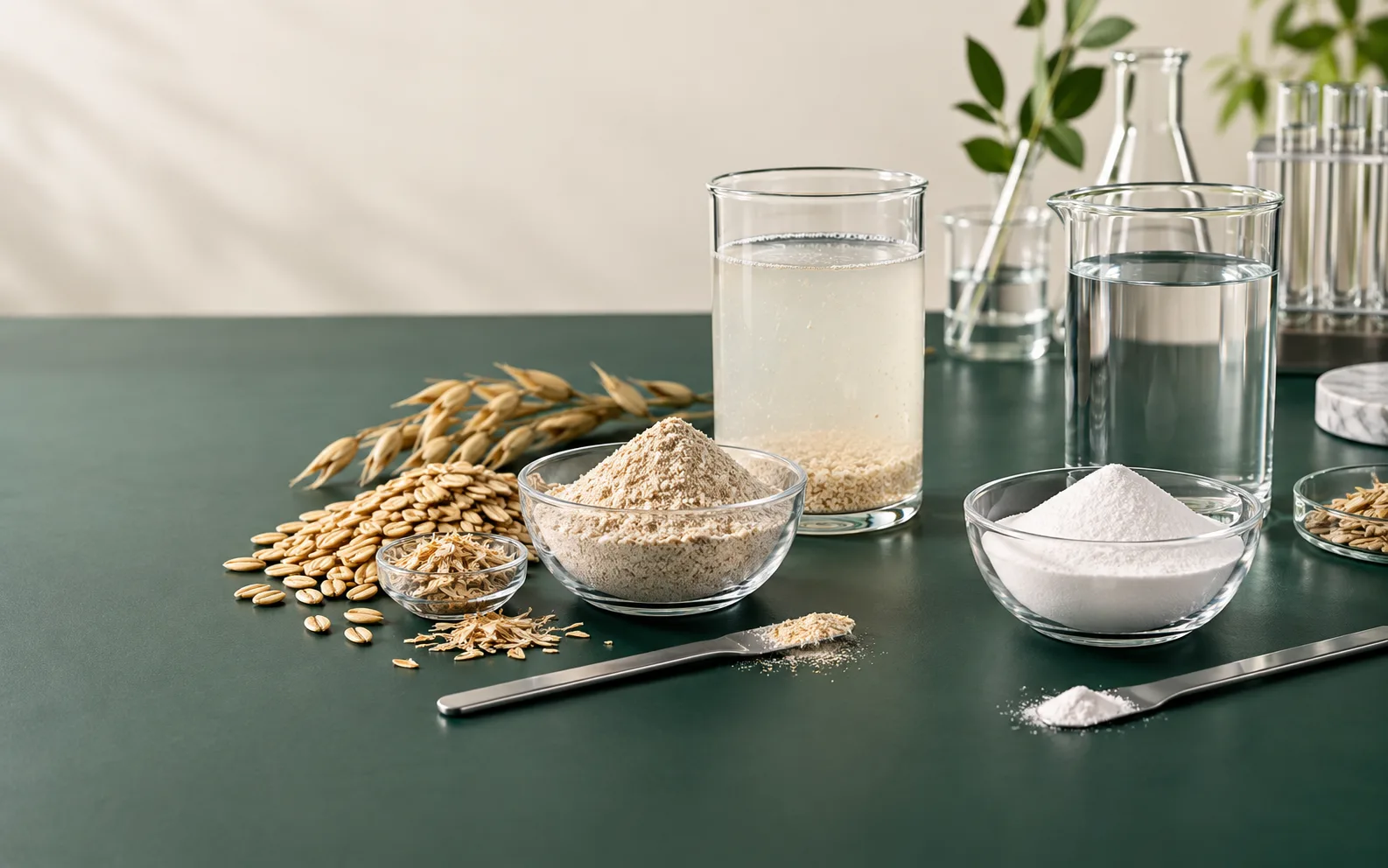
If your latest reformulation brief just says “add fiber” and leaves the rest up to you, you already know the hard part isn’t finding a fiber — it’s finding the right one. The oat fiber vs resistant dextrin decision comes up in nearly every fiber-fortification project, and the two ingredients behave very differently once they hit a production line. Both are legitimate, recognized dietary fibers, but knowing where they diverge can save your team a failed pilot batch.
What Is Oat Fiber?
Oat fiber is produced by cleaning and dehulling oats, then milling the fibrous hull into a fine powder. Unlike oat bran or beta-glucan, which come from the inner groat, oat fiber is derived almost entirely from the hull and is overwhelmingly insoluble, made up mostly of cellulose. That structural difference matters: insoluble fibers like oat fiber pass through the digestive tract largely intact, adding bulk rather than dissolving into a gel.
In food manufacturing, oat fiber is prized as a low-calorie bulking agent and moisture-management tool. It has a light, fairly neutral taste and strong water-binding capacity, which makes it a common choice in baked goods, meat products, and reduced-calorie snacks where manufacturers want to add fiber without contributing sweetness or extra calories. Because it doesn’t dissolve, though, oat fiber can add a coarse or gritty mouthfeel at higher inclusion rates — something formulators working on premium bakery or beverage lines need to account for early, well before a pilot batch reveals it the hard way.
What Is Resistant Dextrin?
Resistant dextrin takes a very different path to becoming a fiber. It’s produced by heating starch — typically from corn, wheat, or tapioca — and treating it with enzymes such as α-amylase and glucoamylase. This process rearranges the starch’s glucose bonds into configurations the body’s digestive enzymes can’t break down, creating a fully soluble, indigestible fiber recognized as safe by the FDA.
The result is a soluble fiber ingredient that dissolves completely and clearly in water, with fiber content typically running between 70 and 90 percent by standard fiber-testing methods. Resistant dextrin carries a neutral taste, low viscosity even at high inclusion levels, and strong thermal stability — properties that make it far easier to drop into liquid or delicate formulations than most insoluble fibers. It’s this combination of solubility and processing tolerance, more than fiber content alone, that has made resistant dextrin a go-to ingredient for beverage, dairy, and functional food manufacturers pursuing a fiber or sugar-reduction claim.
Soluble Fiber vs Insoluble Fiber: The Core Difference
The oat fiber vs resistant dextrin comparison ultimately comes down to a soluble fiber vs insoluble fiber ingredient comparison. Insoluble fibers like oat fiber don’t dissolve in water; they retain their particle structure, bind water mechanically, and add bulk and texture. That’s genuinely useful in products where structure matters — think meat products or dense baked goods — but it also means oat fiber can cloud beverages and change baking behavior in ways that are hard to mask.
Soluble fibers like resistant dextrin dissolve into the water phase and behave more like a functional sugar replacer than a bulking agent. For formulators weighing resistant dextrin vs oat fiber solubility side by side, the practical takeaway is straightforward: if a finished product needs to stay clear, smooth, or low-viscosity, soluble wins. If the goal is bulk, crumb structure, or bite, insoluble has the edge.
Texture, Taste, and Processing Performance
Texture is often where a promising formulation quietly falls apart. Oat fiber’s coarse, cellulose-rich structure gives baked goods a heartier bite and helps retain moisture, but push the inclusion rate too high and a gritty or dry finish shows up — a trade-off well documented in food-science literature on whole-grain insoluble fibers. It’s a strong choice when a hearty, fiber-forward positioning is genuinely the goal, and a weaker one when a clean, smooth mouthfeel matters more.
Resistant dextrin behaves almost invisibly by comparison. Because it’s fully water-soluble and low-viscosity even at meaningful dosages, it can be added to beverages, sauces, and dairy without thickening the product or leaving sediment behind. That’s precisely why a fiber ingredient with low viscosity for beverages is close to a non-negotiable requirement in functional drink development. For dry-mix and bakery applications where some bulk is welcome, oat fiber’s texture becomes an asset rather than a liability — the right pick genuinely depends on what you’re building.
Gut Health, Blood Sugar, and Cholesterol: What the Research Shows
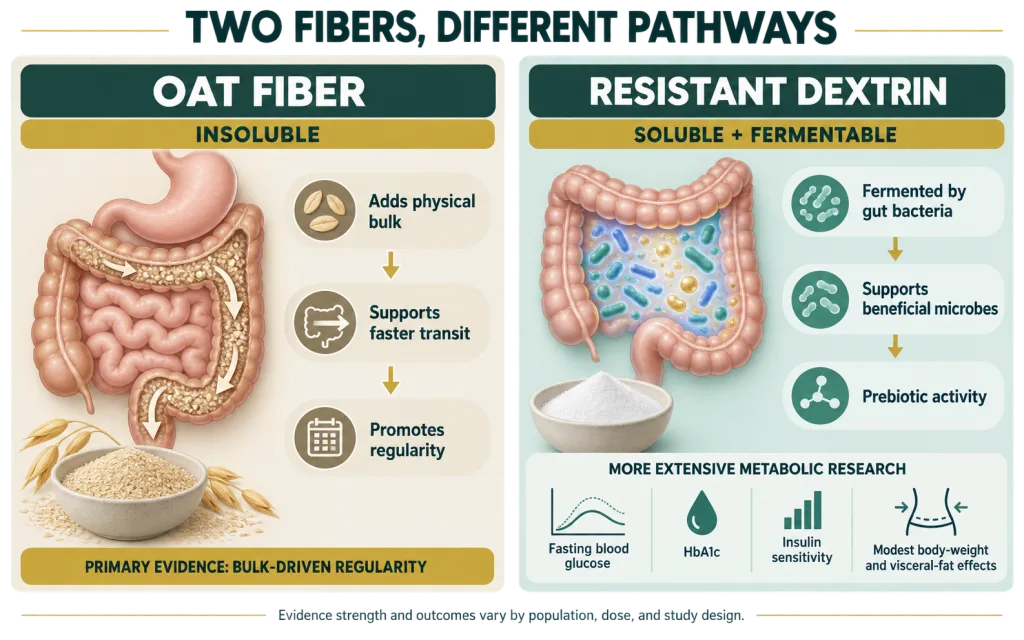
Both fibers support digestive health, but through different mechanisms. Oat fiber’s insoluble cellulose adds bulk and speeds transit time, supporting regularity — a benefit tied to its physical structure rather than fermentation. Resistant dextrin, by contrast, is fermented by gut bacteria in the colon, acting as a prebiotic substrate that supports beneficial microbial populations.
On the question of whether resistant dextrin is better than oat fiber for gut health, the evidence base leans toward resistant dextrin having the more extensively documented metabolic effects. Multiple systematic reviews and meta-analyses of randomized controlled trials have found that resistant dextrin supplementation measurably improves fasting blood glucose, HbA1c, and insulin sensitivity markers in people with type 2 diabetes, and separate meta-analyses have linked it to modest reductions in body weight and visceral fat in overweight adults. That depth of resistant dextrin glycemic index and metabolic research isn’t something oat fiber’s insoluble fraction has been studied for to the same extent, since its primary documented benefit is bulk-driven regularity rather than glucose or lipid metabolism.
Regulatory and Label Considerations
Since 2018, the FDA has maintained a defined list of ingredients that can be declared as dietary fiber on a Nutrition Facts label, following earlier confusion after the agency initially narrowed its fiber definition. Resistant maltodextrin and resistant dextrin are explicitly named on that list, alongside ingredients like inulin, polydextrose, and high-amylose resistant starch, giving formulators a clear, defensible regulatory basis for a fiber claim.
Oat fiber’s regulatory position is a bit more nuanced. It typically qualifies as dietary fiber either because it’s intrinsic and intact in the oat plant, or because it falls under the FDA’s “mixed plant cell wall fibers” category — a designation added later specifically to cover ingredients like oat and pea fiber. Both pathways are valid for an oat fiber dietary fiber claim, but the mixed plant cell wall fiber category has required additional documentation from manufacturers. Resistant dextrin’s GRAS status and its place on the FDA’s isolated fiber list tend to make label substantiation more straightforward for buyers who need documentation ready for retailer or regulatory review.
Choosing by Application: Beverages, Bakery, Snacks, and Meat Analogs
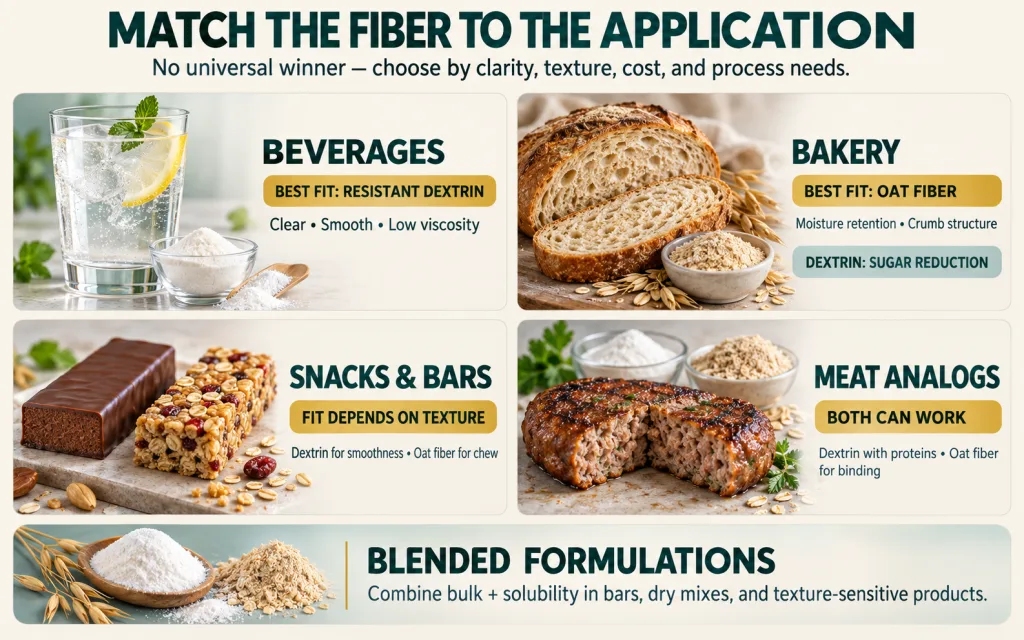
Rather than picking an overall “winner,” most experienced formulators match the fiber to the application, and cost, dosage, and process constraints usually settle the debate faster than any single lab test. A resistant dextrin premium is easier to justify in a product where clarity or mouthfeel is central to the brand promise, while oat fiber’s lower cost per ton makes it the practical default whenever bulk density is genuinely useful. Here’s how the two typically stack up across common F&B categories:
- Beverages and functional drinks: resistant dextrin for beverage formulation is generally the stronger fit, since it stays clear and doesn’t thicken; oat fiber’s insoluble particles are difficult to keep in suspension.
- Bakery and baked goods: oat fiber supports soluble fiber for bakery fortification through moisture retention and crumb structure, while resistant dextrin works well for sugar reduction without changing texture.
- Snacks and bars: a clean-label fiber ingredient for snacks needs a neutral taste and low viscosity, which favors resistant dextrin; oat fiber suits denser, chewier bar formats.
- Meat analogs and processed meat: resistant dextrin for meat analog formulation supports moisture retention alongside functional proteins, while oat fiber’s water-binding capacity is also useful in traditional processed meats.
None of these are hard rules — plenty of formulations blend both fibers to get bulk and solubility in the same product, particularly in bars and dry mixes where a small resistant dextrin addition can smooth out oat fiber’s grittier edges without diluting the overall fiber claim.
Sourcing at Scale: What B2B Buyers Should Ask Suppliers
Formulation performance is only half the decision — sourcing reliability is the other. When evaluating a resistant dextrin supplier or an oat fiber wholesale supplier, ask about non-GMO status, allergen and cross-contact controls, certificates of analysis for fiber content and heavy metals, and batch-to-batch consistency of particle size or viscosity. A resistant dextrin manufacturer bulk supply chain should be able to document GRAS status, halal and kosher certification where relevant, and stability across shipping and storage conditions.
Cost is another factor buyers weigh heavily. On an oat fiber vs resistant dextrin cost per ton basis, oat fiber is often the lower-cost option since it requires less processing, while resistant dextrin’s enzymatic processing typically carries a premium reflecting its solubility and functional versatility. For brands sourcing through OEM or toll manufacturing partners, working with a functional fiber ingredient for OEM manufacturing that can supply bulk dietary fiber ingredient B2B volumes alongside formulation support — rather than just raw material — often shortens time to market. A prebiotic fiber ingredient supplier in Asia can also be worth prioritizing when a supply chain already runs through the region, where sourcing and logistics costs tend to be more favorable.
Making the Right Call for Your Formulation
So, what is the difference between oat fiber and resistant dextrin when it actually comes down to picking one? Oat fiber is the stronger choice when a formulation needs bulk, moisture retention, and a lower-cost fiber boost in bakery, snack, or processed meat applications where texture change isn’t a concern. Resistant dextrin is generally the best fiber ingredient for food fortification when a product needs to stay clear, smooth, or low-viscosity — beverages, dairy, sauces, and anything targeting a sugar-reduction or metabolic health claim backed by clinical research. Anyone searching for an oat fiber alternative for F&B formulation specifically because grittiness or cloudiness is holding a product back will usually find resistant dextrin is the direct answer. Many formulators end up using both across a broader portfolio, matching each ingredient to the application where its strengths actually show up.
Ready to Source a Fiber Ingredient That Performs at Scale?
Whether a formulation calls for the clean solubility of resistant dextrin or a bulkier insoluble fiber, getting the sourcing right matters as much as getting the science right. Satoria NutriSentials manufactures resistant dextrin at scale under HACCP, ISO, and Halal-certified conditions, with OEM and toll manufacturing support for teams that want formulation guidance alongside ingredient supply. From initial trial samples through full production volumes, the same quality assurance system covers every batch, so a formulation that performs in a small-scale test doesn’t need to be re-validated when it scales to a commercial run.
Explore the full functional ingredient range or request a product catalogue to see how resistant dextrin could fit your next fiber-fortification project.
References
- Chen, W., Zhang, T., Ma, Q., Zhu, Y., & Shen, R. (2022). Structure characterization and potential probiotic effects of sorghum and oat resistant dextrins. Foods, 11(13), 1877. https://www.ncbi.nlm.nih.gov/pmc/articles/PMC9265775/
- Clearing up fiber claims. (2018, October 17). Food Business News. https://www.foodbusinessnews.net/articles/12707-clearing-up-fiber-claims
- Dietary fiber – Navigating the FDA’s definition. Eurofins USA. https://www.eurofinsus.com/food-testing/resources/dietary-fiber-navigating-the-fda-s-definition/
- Effects of resistant dextrin for weight loss in overweight adults: A systematic review with a meta-analysis of randomized controlled trials. (2017). https://www.ncbi.nlm.nih.gov/pmc/articles/PMC5434557/
- Effects of resistant dextrin on glycemic traits: A systematic review and meta-analysis of randomized controlled trials. (2025). Nutrition Journal. https://pmc.ncbi.nlm.nih.gov/articles/PMC13072545/
- The effect of resistant dextrin on glucose regulation markers in patients with type 2 diabetes: A systematic review and meta-analysis of randomized controlled trials. (2025). BMC Nutrition. https://link.springer.com/article/10.1186/s40795-025-01080-8
- Physicochemical and functional properties of soluble and insoluble dietary fibers in whole grains and their health benefits. (2025). Foods. https://www.mdpi.com/2304-8158/14/14/2447
- Using oat fiber: Nutritional profile and role in food production. (2025, February 24). Palmer Holland. https://www.palmerholland.com/News-and-Insights/Using-Oat-Fiber-Nutritional-Profile-and-Role-in-Fo
Featured News
Category
Get a Promo and Keep Updated