
Resistant Dextrin in Reduced-Sugar Chocolate & Nut Spreads: A Formulator’s Guide to Sugar Replacement and Fiber Enrichment
Resistant Dextrin in Reduced-Sugar Chocolate & Nut Spreads: A Formulator’s Guide to Sugar Replacement and Fiber Enrichment
October 29, 2026
Resistant Dextrin - Articles

Walk down any breakfast aisle and you’ll see it. The cocoa hazelnut spread is still a family favorite, yet it is also one of the first products shoppers flag as “too sweet.” Brands want to keep the indulgence and lose the sugar. Using resistant dextrin in reduced-sugar chocolate & nut spreads has become one of the most practical ways to do exactly that.
This guide is written for R&D teams, product developers and brand owners. We’ll look at why sugar is so hard to take out of a spread, how resistant dextrin behaves in a chocolate spread, how it compares with other fibers, and what it means for your label. Along the way, you’ll find realistic starting points, not just theory.
Why Sugar Reduction in Sweet Spreads Is So Hard
Here’s what most people outside R&D don’t realize: in a chocolate or nut spread, sugar isn’t just sweetness. It’s structure. A Nutella-style spread is a fat-continuous system, meaning fine particles of sugar, cocoa powder and milk powder are suspended in a continuous oil phase. Sugar is usually the largest of those solids, often a third or more of the whole formula.
Researchers studying cocoa–hazelnut spreads note that sucrose shapes particle volume, flow, viscosity, spreadability and physical stability, not only taste (Kardes et al., 2026). Pull it out and the whole jar behaves differently. That’s why sugar reduction in sweet spreads is more of an engineering challenge than a simple sweetener swap.
Take sugar out carelessly and three problems usually appear:
- Texture drift: the spread turns runny or stiff, or loses its smooth, glossy spreadability.
- Sweetness gaps: high-intensity sweeteners restore sweetness but provide none of the bulk.
- Stability issues: a weaker solid network can encourage oil separation over shelf life.
What you need is a bulking agent for sugar reduction, something that fills the space sugar leaves behind without adding sugar or off-flavors, and ideally while supporting calorie reduction. That’s exactly where soluble fiber earns its place.
What Resistant Dextrin Brings to a Chocolate or Nut Spread
Resistant dextrin is a soluble dietary fiber made from starch through controlled heat and acid treatment, followed by enzymatic refinement. The result is a low-calorie, highly soluble ingredient with good thermal stability that our digestive enzymes largely can’t break down (Wu et al., 2024). Instead, it reaches the colon, where it acts as a prebiotic fiber that feeds beneficial bacteria and supports gut health.
For a formulator, its appeal in a spread is refreshingly practical:
- Bulking without sugar: it replaces part of the sucrose solids, helping keep the solid-to-fat balance intact.
- Neutral taste and color: it doesn’t compete with cocoa, hazelnut, peanut or almond flavors.
- Mild sweetness: it is only lightly sweet, so it pairs naturally with a separate sweetener system.
- Fiber you can declare: in the US, resistant maltodextrin/dextrin is among the non-digestible carbohydrates FDA recognizes as dietary fiber for labeling (U.S. Food and Drug Administration [FDA], 2018).
- Good digestive tolerance: a long-term human study found daily intakes of 30–45 g were well tolerated (Pasman et al., 2006).
In short, resistant dextrin in chocolate spread development is a two-for-one. It supports sugar reduction while turning the product into a fiber enriched, prebiotic chocolate spread. The same logic applies to a resistant dextrin hazelnut spread or a resistant dextrin nut spread built on peanut butter or almond butter, making it a convenient soluble fiber for nut butter and nut spreads.
Replacing Sucrose in Fat-Continuous Spreads: Texture, Viscosity and Mouthfeel
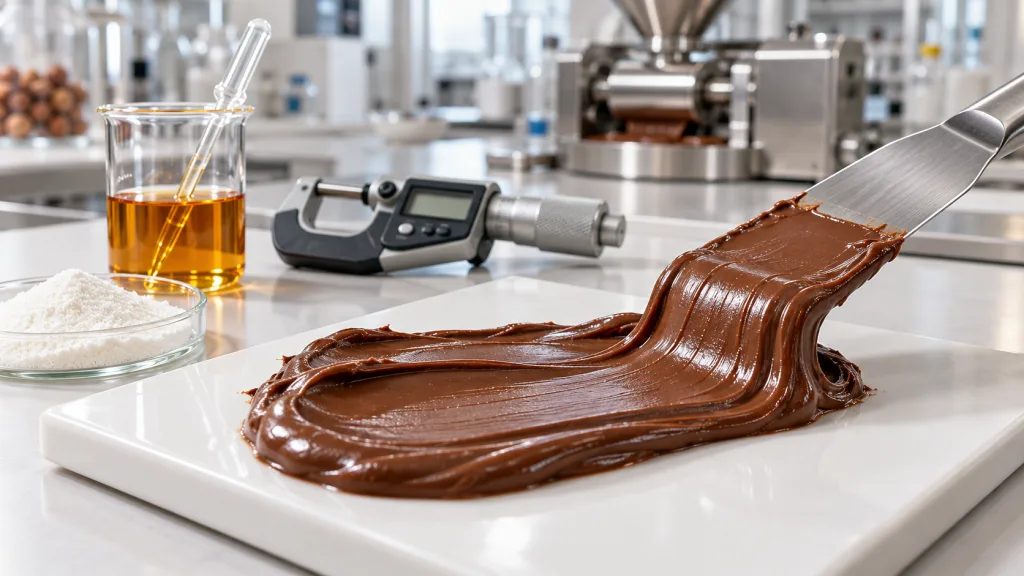
So how do you actually put it in the jar? The first rule is to replace, not remove. In a low sugar hazelnut spread formulation, resistant dextrin powder takes over part of the sucrose on a roughly weight-for-weight basis, keeping total solids steady. Use the powder form, since a fat-continuous spread has almost no water to carry a syrup.
Start With Partial Replacement
Studies on sugar replacement in cocoa hazelnut spread point the same way. When all the sugar in a cocoa hazelnut spread was replaced with an inulin–stevia blend, spreadability dropped (Berk et al., 2024). A 2026 study using FOS and IMO found low-to-moderate replacement preserved quality far better than full replacement (Kardes et al., 2026). A 30–50% sucrose replacement is a sensible first trial.
Control Particle Size to Avoid Grittiness
Particle size and refining in reduced-sugar spreads deserve real attention. Particles above roughly 35 µm can feel sandy on the tongue (Kardes et al., 2026). Add resistant dextrin before the ball mill or roll refiner so it is ground together with the sugar, cocoa and milk solids, then confirm fineness with a micrometer.
Tune Viscosity With Emulsifiers
Expect some shift in yield stress and plastic viscosity when you swap solids. Lecithin and PGPR remain your main levers here. Small emulsifier adjustments often bring spread viscosity and texture with soluble fiber back in line with the full-sugar control.

Sweetness, Stability and Shelf Life in Fiber-Fortified Spreads
Rebuilding the Sweetness
Because resistant dextrin is only mildly sweet, the missing sweetness has to come from somewhere. Pairing resistant dextrin with stevia or monk fruit in spreads is a common approach: the fiber supplies bulk and body, while a tiny dose of high-intensity sweetener restores the sweetness. Run taste panels early, since cocoa can amplify any lingering aftertaste.
A ready-made blend can shorten bench trials. Satoria’s SweetSentials is a 1:1 sugar alternative that combines natural sweetness with dietary fiber, which can help teams working toward a no added sugar chocolate spread formulation. As with any blend, check its full composition against the claims you plan to make.
Water Activity and Oil Separation
Fat-continuous spreads are naturally low in moisture, and that’s a real advantage. In the 2026 cocoa–hazelnut study, every formulation stayed between 0.21 and 0.24 water activity, well below the 0.40 threshold often cited for confectionery stability (Kardes et al., 2026). Resistant dextrin does attract moisture, though, so store it dry and keep humidity off the line.
Oil separation and stability in low sugar nut spreads usually come down to the solid network and the fat phase. Keep total solids close to the original recipe, consider a stabilizing fat if your nut paste is very fluid, and run accelerated shelf-life tests before you scale up.
Resistant Dextrin vs Inulin, Polydextrose, FOS and IMO
Many high fiber chocolate spread products on the market lean on other fibers, so the trade-offs are worth understanding. Each fiber behaves differently in a fat-continuous matrix, and the right choice depends on your label, your market and your consumer.
- Resistant dextrin vs inulin in spreads: inulin works and has been tested with stevia in cocoa hazelnut spread, but it darkened color and changed texture as levels rose (Berk et al., 2024). It can also cause more gas at higher intakes, which matters for a daily breakfast food.
- Resistant dextrin vs polydextrose: both are recognized as dietary fiber in the US (FDA, 2018). Polydextrose is a synthetic glucose polymer, while resistant dextrin is starch-derived, which many brands prefer for a clean label sugar reduction story.
- Resistant dextrin vs FOS / IMO for sugar reduction: FOS lowered estimated glycemic index the most in one spread study but hurt firmness and taste at high levels, while IMO protected texture better (Kardes et al., 2026). IMO is not on FDA’s list of fibers that can be declared as dietary fiber, which limits US fiber claims (FDA, 2018).
Digestive tolerance of fiber in confectionery is often the deciding factor. People don’t eat one spoonful of spread; they eat it on toast every morning. Resistant dextrin’s tolerance record (Lefranc-Millot et al., 2012; Pasman et al., 2006) makes it a strong candidate, and a practical Fibersol or Nutriose alternative for spreads when supply security and regional sourcing matter.
Beyond the Jar: Reduced Sugar Filling Creams for Biscuits and Wafers
Spreads and fillings are close cousins. The cream inside a sandwich biscuit or wafer is also a fat-continuous system built on sugar, fat and fine powders, so the same principles apply. A reduced sugar filling cream for biscuits and wafers can use resistant dextrin to replace part of the sucrose while adding fiber to a snack that rarely offers any.
Fillings bring one extra hurdle: some are deposited warm or pass through a baking step. Satoria’s Resistant Dextrin is specified as heat-stable at 150–200 °C for up to an hour and stable across pH 2–7, so it holds up under typical biscuit processing. Start with the same 30–50% replacement range, then adjust hardness through fat choice.
For brands without their own line, Satoria’s OEM & Toll Manufacturing service covers biscuits and spray-dried products, with your formula kept confidential. That makes it easier to move from a bench-top concept to a finished, reduced-sugar product on shelf, with one partner handling both the fiber and the manufacturing.
Labels, Claims and the Glycemic Story
Reformulation pays off only when the label can tell the story clearly. Claim rules differ by market and the thresholds aren’t always intuitive, so it helps to design the formula around them from day one. These are the claims most brands target when launching a reduced sugar chocolate spread:
- Reduced sugar claim requirements: in the EU, a “reduced sugars” claim needs at least 30% less sugar than similar products (Regulation (EC) No 1924/2006, 2006). In the US, “reduced sugar” requires at least 25% less than a reference food (21 C.F.R. § 101.60).
- “Source of fiber” and “high fiber” claims for spreads: EU thresholds are 3 g and 6 g of fiber per 100 g respectively. A 30–50% sucrose swap can often reach these levels, depending on your fiber grade.
- No added sugars: in the EU, this claim means no mono- or disaccharides or other sweetening foods were added, so every part of your sweetener system needs checking.
There’s also a public health tailwind. WHO recommends keeping free sugars below 10% of daily energy intake, with further benefits below 5% (World Health Organization [WHO], 2015), and sugar taxes keep spreading. On glycemic response of reduced-sugar spreads, a meta-analysis found resistant maltodextrin can lower the glycemic response to carbohydrate foods (Livesey & Tagami, 2009). That supports a low glycemic positioning, but any blood-sugar claim on pack needs local regulatory review first.
Unleash Your Spread’s Potential With Smarter Sugar Reduction
Cutting sugar from a chocolate or nut spread is a balancing act between taste, texture, stability and the claims you want on pack. The good news? With the right fiber, a staged replacement plan and careful refining, a delicious kids’ breakfast spread with less sugar and more fiber is well within reach.
If you’re looking for a resistant dextrin supplier in Indonesia, Satoria Nutrisentials manufactures Resistant Dextrin from corn or tapioca starch, available in 25 kg powder bags for bulk production. It is non-GMO and produced in facilities certified for Halal, FSSC 22000 and HACCP, which supports brands selling into export markets.
That makes Satoria a practical halal resistant dextrin supplier for brands that need consistent bulk volumes. Because Satoria runs its own manufacturing plant, it can support you at every stage, from supplying a single ingredient to developing biscuit and filling products through an OEM partnership. Your unique formula stays confidential throughout.
Curious how resistant dextrin and SweetSentials could fit your next spread or filling? Explore our guides on using resistant dextrin as a binder in energy bites and fiber enrichment in dried fruit snacks, then talk to Satoria’s team about samples and specifications for your formulation.
References
- Berk, B., Cosar, S., Mazı, B. G., & Oztop, M. H. (2024). Textural, rheological, melting properties, particle size distribution, and NMR relaxometry of cocoa hazelnut spread with inulin-stevia addition as sugar replacer. Journal of Texture Studies, 55(2), e12834. https://doi.org/10.1111/jtxs.12834
- Code of Federal Regulations. (n.d.). 21 C.F.R. § 101.60 – Nutrient content claims for the calorie content of foods. Electronic Code of Federal Regulations. https://www.ecfr.gov/current/title-21/chapter-I/subchapter-B/part-101/subpart-D/section-101.60
- Kardes, M., Tekin-Cakmak, Z. H., Bekiroglu, H., Baycar, A., Karasu, S., Yilmaz, M. T., Kasapoglu, M. Z., & Sagdic, O. (2026). Effect of using fructooligosaccharide and isomaltooligosaccharides in cocoa–hazelnut spread as sugar substitute and prebiotic on estimated glycemic index and quality parameters. Foods, 15(13), 2402. https://doi.org/10.3390/foods15132402
- Lefranc-Millot, C., Guérin-Deremaux, L., Wils, D., Neut, C., Miller, L. E., & Saniez-Degrave, M. H. (2012). Impact of a resistant dextrin on intestinal ecology: How altering the digestive ecosystem with NUTRIOSE®, a soluble fibre with prebiotic properties, may be beneficial for health. Journal of International Medical Research, 40(1), 211–224. https://doi.org/10.1177/147323001204000122
- Livesey, G., & Tagami, H. (2009). Interventions to lower the glycemic response to carbohydrate foods with a low-viscosity fiber (resistant maltodextrin): Meta-analysis of randomized controlled trials. The American Journal of Clinical Nutrition, 89(1), 114–125. https://doi.org/10.3945/ajcn.2008.26842
- Pasman, W., Wils, D., Saniez, M. H., & Kardinaal, A. (2006). Long-term gastrointestinal tolerance of NUTRIOSE FB in healthy men. European Journal of Clinical Nutrition, 60(8), 1024–1034. https://doi.org/10.1038/sj.ejcn.1602418
- Regulation (EC) No 1924/2006 of the European Parliament and of the Council of 20 December 2006 on nutrition and health claims made on foods. (2006). Official Journal of the European Union, L 404, 9–25. https://eur-lex.europa.eu/legal-content/EN/ALL/?uri=CELEX:32006R1924
- U.S. Food and Drug Administration. (2018). The declaration of certain isolated or synthetic non-digestible carbohydrates as dietary fiber on Nutrition and Supplement Facts labels: Guidance for industry. https://www.fda.gov/media/113663/download
- World Health Organization. (2015). Guideline: Sugars intake for adults and children. https://www.who.int/publications/i/item/9789241549028
- Wu, X., Zhang, J., Yan, X., Wu, X., Zhang, Q., & Luan, M. (2024). An in-depth overview of the structural properties, health benefits, and applications of resistant dextrin. Journal of Food Processing and Preservation, 2024, 8055063. https://doi.org/10.1155/2024/8055063
Featured News
Category
Get a Promo and Keep Updated