
Plant-Based Sweetened Condensed Milk with Coconut Cream Powder: A B2B Guide for North American and European Food Manufacturers 3
Plant-Based Sweetened Condensed Milk with Coconut Cream Powder: A B2B Guide for North American and European Food Manufacturers 3
November 20, 2026
Coconut Cream Powder - Articles
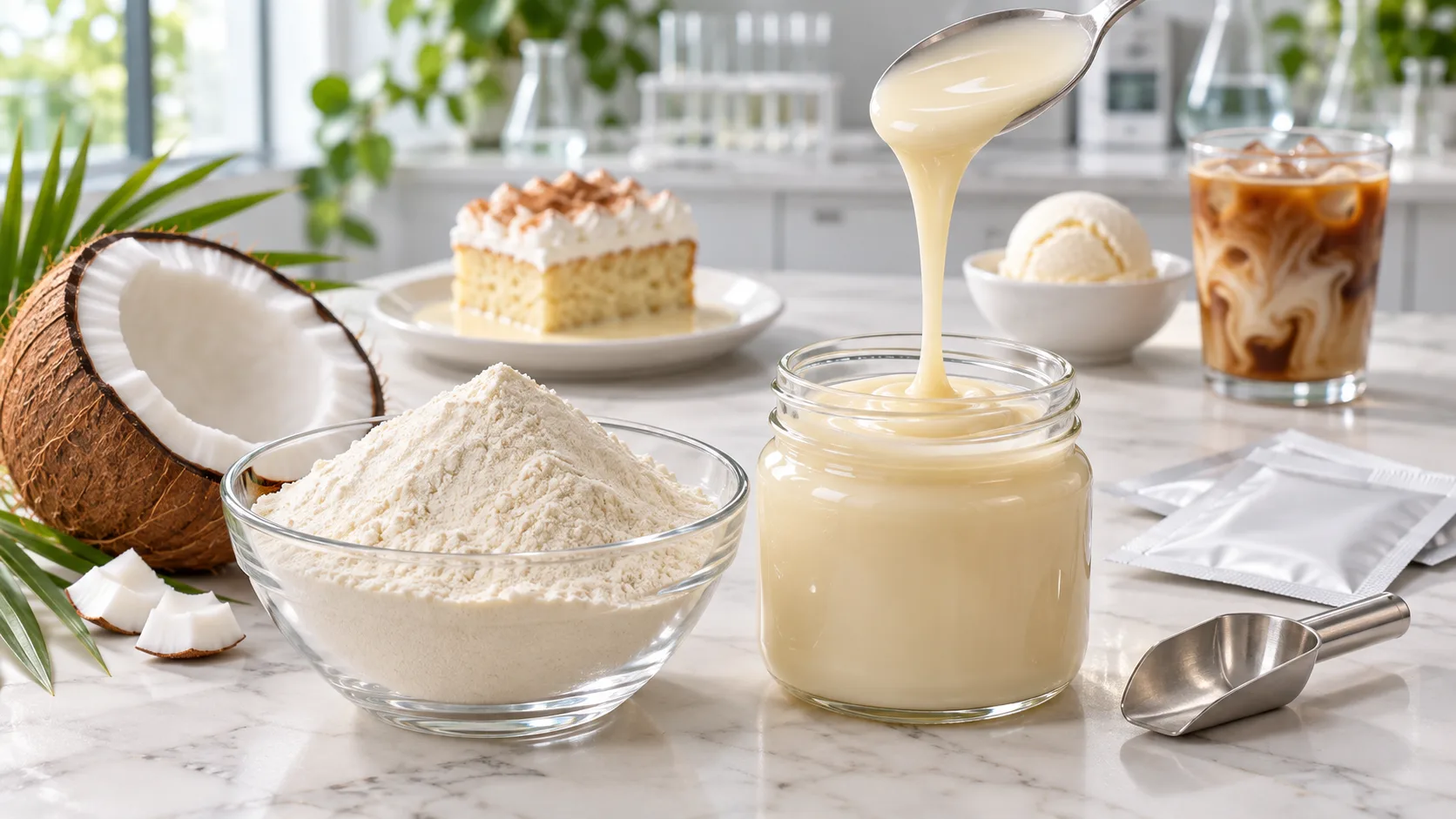
Sweetened condensed milk quietly holds up some of the West’s most loved desserts: tres leches cake, key lime pie, homemade fudge, dulce de leche, and the sweet coffee drinks on every café menu. Now imagine delivering all of that richness without a drop of dairy. That is the promise of plant-based sweetened condensed milk with coconut cream powder, and food manufacturers across the USA, Canada, and Europe are paying close attention.
Demand for dairy-free indulgence has moved well beyond specialty stores. Retail buyers want vegan, allergen-aware versions of familiar products, and foodservice operators want ingredients that are simple to store and scale. In this guide, we unpack how a coconut-based, powdered dairy-free sweetened condensed milk is built, where it performs best, and which labeling rules matter in each market.
What Is Vegan Condensed Milk Made Of?
Traditional sweetened condensed milk is cow’s milk with most of its water removed and a generous amount of sugar added. That sugar does double duty. It sweetens, and it lowers water activity enough to keep the product shelf-stable for months. The result is the thick, glossy, caramel-tinged texture bakers and dessert makers rely on.
A vegan condensed milk follows the same logic but swaps the dairy base for a plant source. Coconut is the most popular choice for good reason. Coconut milk is a natural oil-in-water emulsion, stabilized by its own proteins and phospholipids, which gives it a creaminess that oat, soy, or almond bases struggle to match on their own (Seow & Gwee, 1997).
A typical sweetened condensed coconut milk is built from just a few components:
- Coconut cream or coconut cream powder for body, fat, and flavor
- A sweetener system, from cane sugar to reduced-sugar blends
- Water for liquid formats, or a carrier for powdered formats
- Optional plant proteins or stabilizers to keep the emulsion stable
Short ingredient lists like this are exactly what clean-label shoppers in North America and Europe look for, which is a big part of the category’s appeal.
Why Coconut Cream Powder Makes a Smarter Base
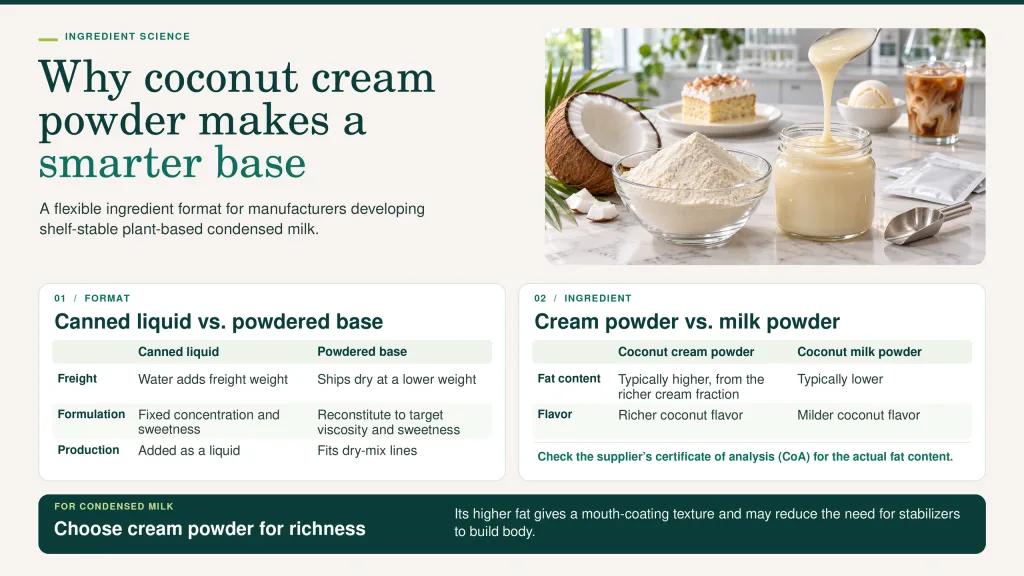
Most retail coconut condensed milks are liquid and canned. That works on supermarket shelves, but it creates headaches for manufacturers: heavy freight, limited flexibility, and a product that has to be used exactly as supplied. For importers bringing ingredients across oceans, shipping water is an expensive habit.
A powdered base built on coconut cream powder flips that equation. Manufacturers can reconstitute it to the exact viscosity and sweetness they need, and it slots neatly into dry-mix lines. For anyone positioning a shelf-stable plant-based dairy alternative, that flexibility is a real competitive edge.
Coconut Cream Powder vs Coconut Milk Powder
The two terms are often used interchangeably, but they are not the same ingredient. Coconut cream powder comes from the richer, higher-fat cream fraction, while coconut milk powder usually carries less fat and a milder flavor. Specifications vary widely between suppliers, so always check the certificate of analysis.
For condensed milk applications, the higher fat of coconut cream powder is usually the better fit. It delivers the mouth-coating richness consumers expect, which means less work for stabilizers further down the formula.
The Hidden Dairy Problem in Some Coconut Powders
Here is a detail that catches many formulators off guard. Coconut milk is a high-fat emulsion, and spray drying it is genuinely tricky. Fat can smear, oxidize, or stick to the dryer chamber, so producers add carriers such as maltodextrin plus an emulsifier to keep the powder free-flowing (Abdullah et al., 2021).
The catch? One of the most widely used emulsifiers in coconut milk powder is sodium caseinate, a protein derived from cow’s milk. Some commercial coconut powders also contain milk solids. A product can say “coconut” on the front and still fail a vegan audit, or trigger a mandatory milk allergen declaration, on the back.
If you are developing a lactose-free condensed milk alternative or an allergen-friendly dairy alternative, ask every potential supplier three direct questions:
- Which emulsifier is used, and is it plant-derived?
- Which carrier is used, and at what inclusion level?
- Is the line shared with dairy powders, and how is cross-contact controlled?
Clear, documented answers at this stage can save you an expensive reformulation, or a product recall, later.
Building a Powdered Sweetened Condensed Coconut Milk
So what does a well-designed coconut condensed milk powder look like? Think of it as four functional layers, each solving a specific problem.
The Core Building Blocks
- Fat and body: coconut cream powder provides richness, flavor, and natural creaminess.
- Emulsification: plant proteins such as pea protein or rice protein isolate can replace sodium caseinate, keeping the formula fully vegan.
- Carrier and bulk: rice maltodextrin helps the powder flow, dissolve evenly, and resist caking.
- Sweetness: cane sugar for a classic profile, or tapioca syrup, rice syrup, and sugar-replacement blends for cleaner or lower-sugar positioning.
Each choice shapes the finished label. A formula built on coconut, rice, and pea can support palm-oil-free, soy-free, and gluten-free condensed milk claims, provided your testing and supply chain back them up. That combination is the foundation of a credible clean-label condensed milk alternative for Western retail.
Process matters too. Research on spray-dried coconut milk shows that drying temperature and emulsifier level both affect fat stability, particle size, and solubility, with very high temperatures tending to hurt powder quality (Abdullah et al., 2021). Pilot trials are well worth the investment.
Formulating a Reduced-Sugar Condensed Milk for Western Markets
Let’s be honest: condensed milk has a sugar problem. Conventional versions are often more than half sugar by weight. That sits awkwardly with the WHO recommendation to keep free sugars below 10% of daily energy intake, ideally below 5% (World Health Organization, 2015). In the USA, the added sugars line on the Nutrition Facts label also puts that number in plain sight for shoppers.
The challenge is that sugar is structural here. Remove it carelessly and you lose viscosity, gloss, preservation, and that signature slow drizzle. A successful reduced-sugar condensed milk replaces sugar with ingredients that rebuild bulk and body, not just sweetness.
This is where soluble fibers earn their place. Resistant dextrin is a low-calorie, heat-stable soluble fiber with documented prebiotic effects, and it adds solids without much sweetness (Włodarczyk & Śliżewska, 2021). Paired with a sugar-replacement blend, it can cut sugar while raising the fiber content on the panel, a combination that resonates strongly with health-conscious buyers.
Most brands find a partial sugar reduction, validated through sensory panels, easier to win with than a zero-sugar product. Indulgence is what consumers are paying for, after all.
Labeling Rules in the USA, Canada, and Europe
Getting the formula right is only half the job. Each market treats dairy terms and allergens differently, and naming mistakes are costly to fix after launch.
United States
Milk is one of nine major food allergens, so any caseinate or milk solids must be declared. Good news for coconut: since January 2025, FDA no longer treats coconut as a tree nut for allergen labeling, although it must still appear in the ingredient list (U.S. Food and Drug Administration [FDA], 2025). FDA’s draft guidance on plant-based milk alternatives also accepts plant-qualified “milk” names (FDA, 2023).
Canada
Milk is a priority food allergen in Canada and must be clearly declared, including when it appears inside sub-ingredients such as caseinates (Health Canada, n.d.). Any “non-dairy” or “dairy-free” claim should be fully validated before it reaches the label.
European Union
EU law reserves terms such as “milk” and “cream” for animal products, and the Court of Justice confirmed in 2017 that plant-based foods generally cannot use them, even with a plant qualifier (Court of Justice of the European Union, 2017). Names involving “condensed milk” therefore need careful review with regulatory counsel for each EU market.

Where It Performs: Bakery, Frozen Desserts, Confectionery and Beverages
A good coconut condensed milk powder is remarkably versatile. Here is where it tends to shine for Western manufacturers.
Bakery
As a condensed milk substitute for bakery, it works in pie fillings, tres leches soaks, glazes, and bar cookies. Wondering how to replace condensed milk in baking? Reconstitute the powder to match the solids of the dairy version, then use it one-for-one. As a coconut milk powder ingredient for bakery, it also stores far more easily than cans.
Frozen Desserts
Dairy-free condensed milk for ice cream adds body, controls ice crystals, and lowers the freezing point for a softer scoop. Coconut fat brings natural richness that many plant-based frozen desserts lack.
Confectionery
Vegan condensed milk for confectionery is the backbone of dairy-free fudge, caramels, and dulce de leche-style spreads, where high solids create that classic chewy, set texture.
Coffee and Tea Beverages
As a plant-based creamer for coffee and tea beverages, it recreates the sweet, creamy profile of Vietnamese-style iced coffee and Thai iced tea, two drinks that are now café staples across North America and Europe.
Is Coconut Condensed Milk Healthy? An Honest Look
It is a fair question, and it deserves a straight answer. Coconut condensed milk is lactose-free, dairy-free, and cholesterol-free, which makes it genuinely useful for people with lactose intolerance. For them, lactose can cause bloating, cramps, and diarrhea (National Institute of Diabetes and Digestive and Kidney Diseases [NIDDK], 2018).
But plant-based does not automatically mean light. Coconut fat is mostly saturated, and a meta-analysis of clinical trials found that coconut oil raised LDL cholesterol compared with non-tropical vegetable oils (Neelakantan et al., 2020). Responsible brands should avoid implying otherwise on pack.
So how does coconut condensed milk vs dairy condensed milk really compare? Think of both as indulgent ingredients rather than health foods. The coconut version wins on lactose, cholesterol, and vegan suitability. Brands can tip the balance further by trimming sugar and adding fiber, turning a treat into a smarter treat.
Clear, honest labeling builds the kind of trust that keeps buyers coming back. Let the lactose-free and vegan credentials do the talking, and leave the health halo out of it.
Choosing a Coconut Cream Powder Supplier for Export Markets
Plant-based condensed milk market trends point firmly upward, with bakery and confectionery leading demand. Whether you need a vegan condensed milk supplier, a plant-based condensed milk OEM or private label partner, or dairy-free condensed milk in bulk or wholesale volumes, the selection criteria are similar.
- Certifications: FSSC 22000, ISO 22000, HACCP, kosher, and halal signal mature food-safety systems that Western retailers and auditors expect.
- Market access: FDA facility registration and export experience make customs and compliance smoother.
- Transparent specs: fat content, emulsifier source, carrier level, and moisture should all be documented.
- Spray-drying capacity: in-house drying gives tighter control over particle size and batch consistency.
- Formulation support: a partner that can co-develop protein, fiber, and sweetener systems saves months.
Halal vegan condensed milk is a particular opportunity in Europe, the UK, and North America, where halal-conscious consumers want certified dairy-free options. Non-dairy condensed milk for food manufacturers is only as good as its batch-to-batch consistency, so request samples and run your own application trials.
Partner with Satoria NutriSentials for World-Class Dairy-Free Innovation
If this guide has sparked a product idea, Satoria NutriSentials is a natural place to take it further. Through its OEM and private-label services, Satoria offers coconut cream powder alongside large-scale spray-drying capacity for creamers and milk-style powders, produced in facilities certified to FSSC 22000, ISO 22000, HACCP, halal, and kosher standards.
Just as importantly, the supporting ingredients sit under one roof. Pea protein and rice protein isolate for plant-based emulsification, rice maltodextrin as a carrier, tapioca syrup for clean sweetness, and resistant dextrin or SweetSentials for reduced-sugar formulas help you build a complete condensed milk system.
Ready to develop your own plant-based sweetened condensed milk for North American or European shelves? Contact the Satoria NutriSentials team to request samples, technical documentation, and formulation guidance for your next innovation.
Whether you are reformulating an existing dessert line or launching a new private-label range, starting with a partner that understands both the ingredients and the export paperwork makes the path to market faster and far less stressful.
References
- Abdullah, Z., Taip, F. S., Mustapa Kamal, S. M., & Abdul Rahman, R. Z. (2021). The effect of drying temperature and sodium caseinate concentration on the functional and physical properties of spray-dried coconut milk. Journal of Food Science and Technology, 58(8), 3174–3182. https://doi.org/10.1007/s13197-020-04820-9
- Court of Justice of the European Union. (2017). Purely plant-based products cannot, in principle, be marketed with designations such as ‘milk’, ‘cream’, ‘butter’, ‘cheese’ or ‘yoghurt’ (Press Release No. 63/17, Case C-422/16, TofuTown). https://curia.europa.eu/jcms/upload/docs/application/pdf/2017-06/cp170063en.pdf
- Health Canada. (n.d.). Milk: A priority food allergen. Government of Canada. https://www.canada.ca/en/health-canada/services/food-nutrition/reports-publications/food-safety/milk-priority-food-allergen.html
- National Institute of Diabetes and Digestive and Kidney Diseases. (2018). Lactose intolerance. National Institutes of Health. https://www.niddk.nih.gov/health-information/digestive-diseases/lactose-intolerance
- Neelakantan, N., Seah, J. Y. H., & van Dam, R. M. (2020). The effect of coconut oil consumption on cardiovascular risk factors: A systematic review and meta-analysis of clinical trials. Circulation, 141(10), 803–814. https://doi.org/10.1161/CIRCULATIONAHA.119.043052
- Seow, C. C., & Gwee, C. N. (1997). Coconut milk: Chemistry and technology. International Journal of Food Science & Technology, 32(3), 189–201. https://doi.org/10.1046/j.1365-2621.1997.00400.x
- U.S. Food and Drug Administration. (2023). Labeling of plant-based milk alternatives and voluntary nutrient statements: Draft guidance for industry. https://www.fda.gov/regulatory-information/search-fda-guidance-documents/draft-guidance-industry-labeling-plant-based-milk-alternatives-and-voluntary-nutrient-statements
- U.S. Food and Drug Administration. (2025). Questions and answers regarding food allergens, including the food allergen labeling requirements of the Federal Food, Drug, and Cosmetic Act (Edition 5): Guidance for industry. https://www.fda.gov/regulatory-information/search-fda-guidance-documents/guidance-industry-questions-and-answers-regarding-food-allergen-labeling-edition-5
- Włodarczyk, M., & Śliżewska, K. (2021). Efficiency of resistant starch and dextrins as prebiotics: A review of the existing evidence and clinical trials. Nutrients, 13(11), 3808. https://doi.org/10.3390/nu13113808
- World Health Organization. (2015). Guideline: Sugars intake for adults and children. https://www.who.int/publications/i/item/9789241549028
Featured News
Category
Get a Promo and Keep Updated