
Controlling Erythritol Crystallization with Resistant Dextrin: A Formulator’s Guide to Smooth, Stable Sugar-Free Products
Controlling Erythritol Crystallization with Resistant Dextrin: A Formulator’s Guide to Smooth, Stable Sugar-Free Products
November 16, 2026
Erythritol - Articles
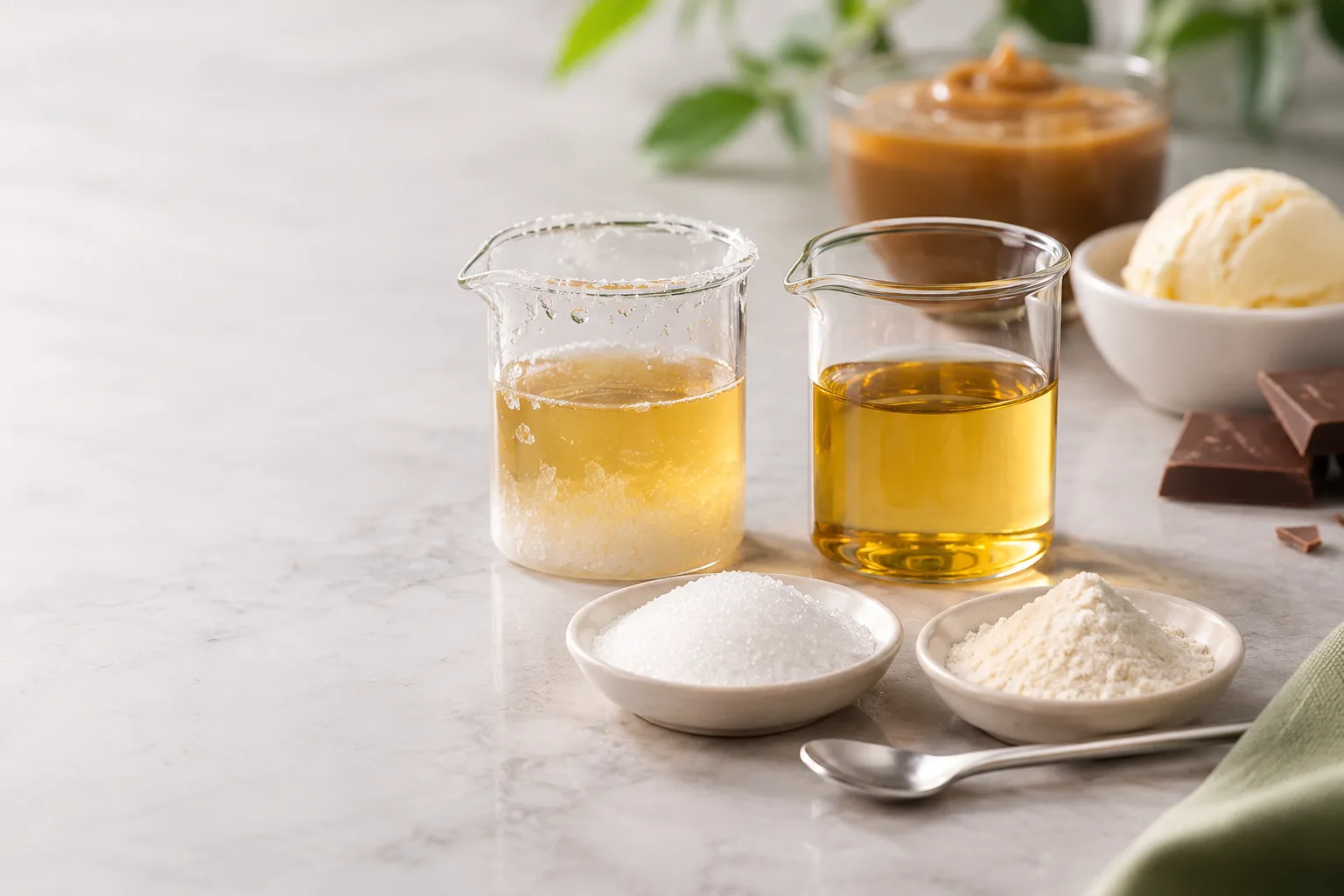
You’ve nailed the sweetness, the calorie count looks great, and the first batch tastes like a win. Then, a few weeks into shelf-life testing, the syrup turns cloudy, the glaze goes sandy, or the ice cream starts to crunch. If that sounds familiar, you’ve met erythritol crystallization, one of the most common reasons sugar-free products disappoint after launch.
The good news? It’s a predictable, controllable problem. This guide explains why erythritol behaves the way it does, how resistant dextrin can help keep it in check, and how to apply that thinking across syrups, frozen desserts, chocolate, baked goods, confectionery, and beverages. We’ll also be honest about where the evidence is strong and where bench testing still has the final word.
Why Erythritol Crystallization Happens
Erythritol is a four-carbon sugar alcohol with a lot going for it: near-zero calories, no meaningful effect on blood glucose, and better digestive tolerance than many other polyols (Mazi & Stanhope, 2023). Its small, compact molecule is also the source of its biggest formulation headache. Those molecules pack neatly into a crystal lattice, so erythritol is always looking for an excuse to come out of solution.
Erythritol Supersaturation Is the Main Driver
Crystallization starts when a solution holds more dissolved erythritol than it can stably carry at a given temperature. Research from Fraunhofer IVV found that crystallization increased with the supersaturation level, while cooling rate mainly changed crystal size and shape rather than how much erythritol crystallized (Tyapkova et al., 2012). In other words, concentration matters more than almost anything else.
Erythritol Solubility in Water and Temperature
Erythritol solubility in water is noticeably lower than that of sucrose, and it rises and falls sharply with temperature (Krajangsod et al., 2018). That’s why a syrup that looks perfect at the end of a hot fill can quietly become supersaturated once it cools on a warehouse shelf or in a refrigerator. Add evaporation, moisture loss, or temperature cycling, and the system edges further past its limit.
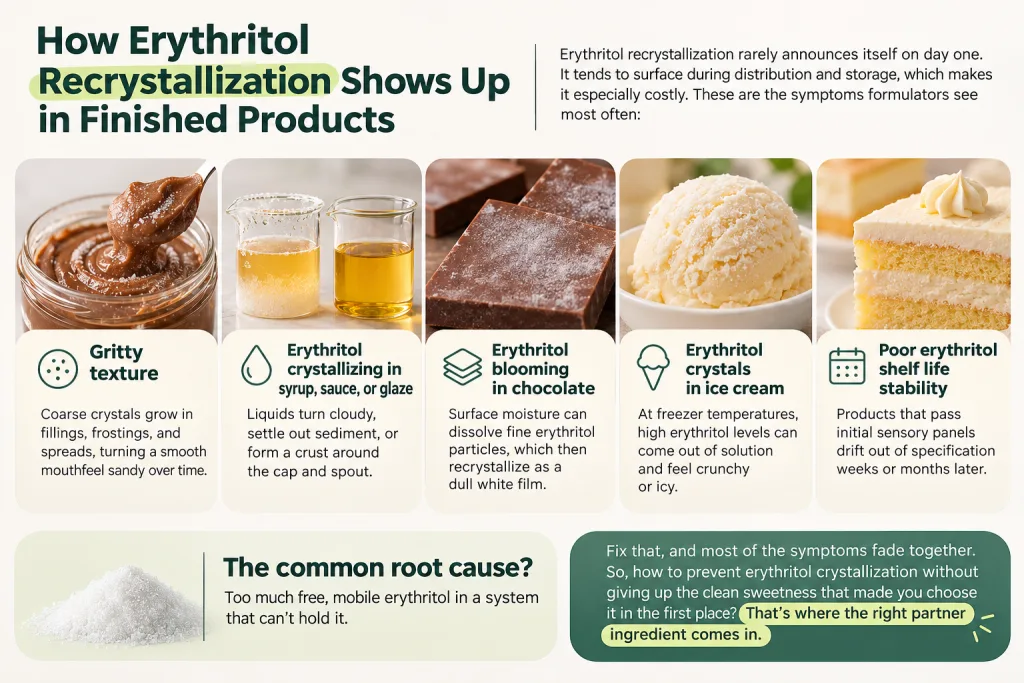
How Erythritol Recrystallization Shows Up in Finished Products
Erythritol recrystallization rarely announces itself on day one. It tends to surface during distribution and storage, which makes it especially costly. These are the symptoms formulators see most often:
- Gritty texture. Coarse crystals grow in fillings, frostings, and spreads, turning a smooth mouthfeel sandy over time.
- Erythritol crystallizing in syrup, sauce, or glaze. Liquids turn cloudy, settle out sediment, or form a crust around the cap and spout.
- Erythritol blooming in chocolate. Surface moisture can dissolve fine erythritol particles, which then recrystallize as a dull white film.
- Erythritol crystals in ice cream. At freezer temperatures, high erythritol levels can come out of solution and feel crunchy or icy.
- Poor erythritol shelf life stability. Products that pass initial sensory panels drift out of specification weeks or months later.
Each of these shares the same root cause: too much free, mobile erythritol in a system that can’t hold it. Fix that, and most of the symptoms fade together. So, how to prevent erythritol crystallization without giving up the clean sweetness that made you choose it in the first place? That’s where the right partner ingredient comes in.
The Cooling Effect: A Related Problem Worth Solving at the Same Time
Erythritol has a strongly negative heat of solution. When solid crystals dissolve on the tongue, they absorb heat and create a distinct cooling sensation. A Cargill patent puts the heat of solution of crystalline erythritol at about −42.9 cal/g and notes the unpleasant cold feeling it can cause in sugar-free chocolate (Vercauteren, 2008).
That cooling works beautifully in mint gum. In a caramel sauce, a chocolate bar, or a soft cookie, it can read as a flavour defect. Because the effect comes from crystalline erythritol dissolving in the mouth, anything that reduces the amount of crystalline erythritol in a product also tends to soften it.
The same patent describes using fibers to reduce the cooling effect of polyols such as erythritol. That makes a soluble fiber to reduce erythritol cooling effect a smart two-for-one: the ingredient that helps manage crystallization can also support erythritol cooling effect reduction. Fewer ingredients doing more work is always a win.
How Resistant Dextrin Works as an Erythritol Anti-Crystallization Agent
Resistant dextrin is a low-calorie, water-soluble dietary fiber made from starch, valued for its high solubility, low molecular weight, and good thermal stability (Wu et al., 2024). Unlike erythritol, it’s a mixture of branched glucose chains of different lengths, so it doesn’t stack into a tidy crystal lattice. That structural variety is exactly what makes it useful here.
Think of resistant dextrin less as a magic additive and more as a well-chosen teammate. In a resistant dextrin erythritol blend, it helps in several overlapping ways:
- It lowers the erythritol load. Replacing part of the erythritol with fiber pulls concentration back toward, or below, saturation. This is the single most reliable lever.
- It works as a bulking agent for erythritol systems. The fiber restores the solids, body, and mouthfeel lost when erythritol is reduced, so the product doesn’t feel thin.
- It slows molecular movement. Dissolved fiber thickens the continuous phase slightly, so erythritol molecules reach growing crystals more slowly.
- It raises the glass transition of the matrix. The glass transition temperature of sugar alcohols like erythritol sits far below room temperature, which keeps them mobile. Larger carbohydrate molecules push the blend’s glass transition upward.
- It interferes at the crystal surface. Like the doctoring agents confectioners have used for generations, dissimilar molecules can disrupt orderly crystal growth.
One honest caveat: published research testing resistant dextrin specifically as a crystallization inhibitor for polyols is still limited. The mechanisms above draw on broader polyol crystallization kinetics, where added carbohydrates reliably slow crystal formation, so validate every blend with your own storage trials.
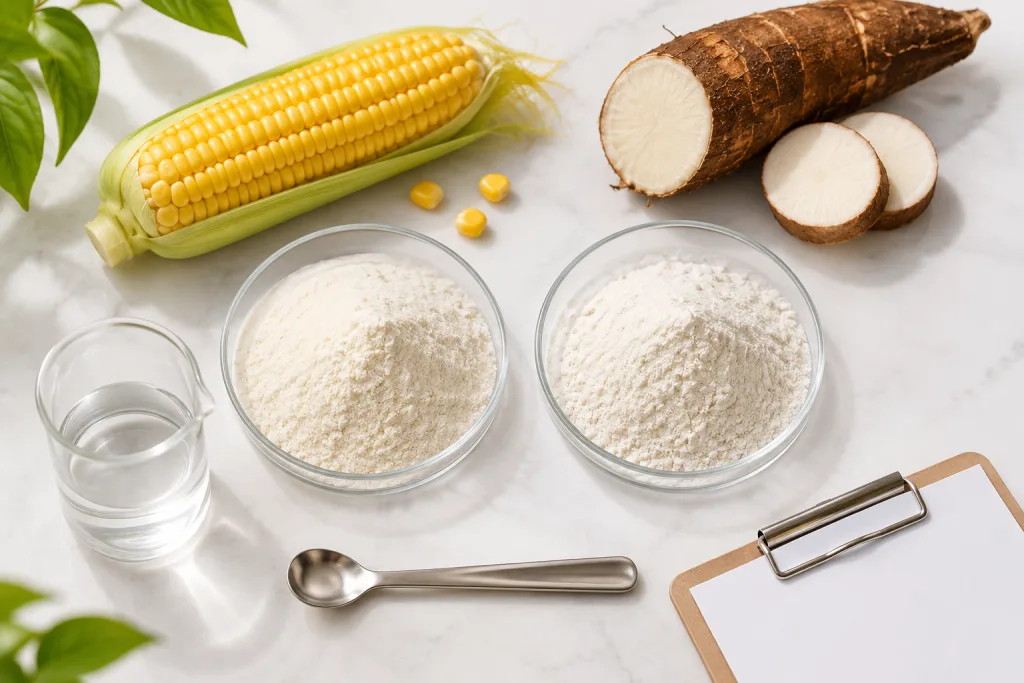
Soluble Corn Fiber vs Resistant Dextrin: Is There Really a Difference?
If you’ve compared spec sheets, you’ve probably wondered whether soluble corn fiber and resistant dextrin are competing ingredients. In practice, the terms overlap heavily. Both describe soluble fibers made by heat, acid, or enzyme treatment of starch, which rearranges glucose linkages so that human digestive enzymes can’t fully break them down.
“Soluble corn fiber” names a source, while “resistant dextrin” names an ingredient class that can come from corn, tapioca, wheat, or other starches. The differences that matter for crystallization control show up on the spec sheet, so compare these three points:
- Total dietary fiber content, since higher fiber means fewer residual sugars adding sweetness and browning.
- Low mono- and disaccharide levels, which matter for sugar-free and no-added-sugar label claims.
- Heat and pH stability, so the fiber survives baking, retorting, or acidic beverage systems.
Choose on performance and documentation, not on the name printed on the bag. A reliable certificate of analysis matters more than the label.
Application Notes: Syrups, Frozen Desserts, and Beverages
Erythritol in Sugar-Free Syrups and Sauces
Liquids are where erythritol crystallization appears fastest, because there’s nothing to hide behind. Keep erythritol well below saturation at the coldest temperature the product will see, including refrigerated storage. Let resistant dextrin carry the remaining solids and body, then pair erythritol with a high-intensity sweetener to bring sweetness back up.
Erythritol in Frozen Desserts
Erythritol’s low molecular weight gives strong freezing point depression, which helps scoopability. At high doses, though, it can crystallize during frozen storage. Splitting the bulk between erythritol and resistant dextrin moderates that risk while adding fiber. Ou guide to sugar reduction in ice cream covers the wider formulation picture.
Keto-Friendly Beverage Formulation
At drinking strength, erythritol usually stays dissolved. The risk lives upstream, in concentrates, syrups, and powders that are reconstituted cold. Resistant dextrin dissolves clearly and holds up at low pH, making it a practical partner for keto-friendly beverage formulation and fiber-enriched drink concepts.
Application Notes: Chocolate, Baked Goods, and Confectionery
Sugar-Free Chocolate with Erythritol
In chocolate, erythritol is used as finely milled crystals, so the goals shift: limit cooling, control particle size, and guard against moisture-driven surface bloom. Replacing part of the erythritol with resistant dextrin can soften the cooling sensation. Our formulator’s guide to reduced-sugar chocolate and nut spreads explores the pairing further.
Erythritol in Keto Baking and Sugar-Free Baked Goods
Erythritol doesn’t brown like sucrose, and in soft cookies or cakes it can recrystallize as products cool, creating a crunchy or sandy bite. Resistant dextrin helps hold a softer texture and tolerates baking temperatures well. Pairing the two is a sensible route for erythritol in keto baking and other sugar-free baked goods.
Sugar-Free Hard Candy and Coating Formulation
Hard candies and panned coatings need a controlled structure, not a runaway one. Erythritol on its own crystallizes quickly enough to clog coating lines and turn candy opaque. Confectionery patents describe blending erythritol with anti-crystallizing agents to keep it workable, which makes resistant dextrin a logical candidate to screen.
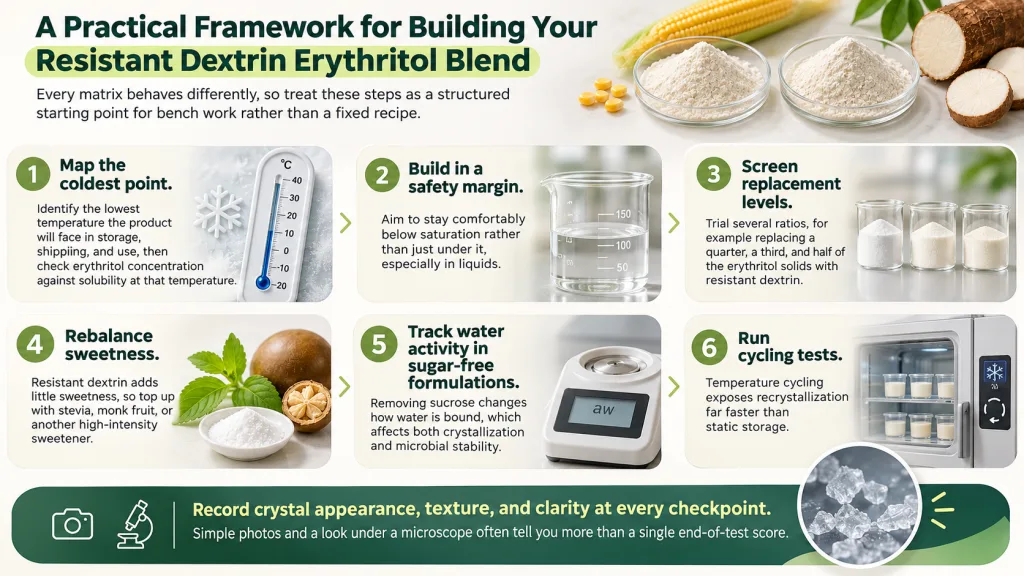
A Practical Framework for Building Your Resistant Dextrin Erythritol Blend
Every matrix behaves differently, so treat these steps as a structured starting point for bench work rather than a fixed recipe.
- Map the coldest point. Identify the lowest temperature the product will face in storage, shipping, and use, then check erythritol concentration against solubility at that temperature.
- Build in a safety margin. Aim to stay comfortably below saturation rather than just under it, especially in liquids.
- Screen replacement levels. Trial several ratios, for example replacing a quarter, a third, and half of the erythritol solids with resistant dextrin.
- Rebalance sweetness. Resistant dextrin adds little sweetness, so top up with stevia, monk fruit, or another high-intensity sweetener.
- Track water activity in sugar-free formulations. Removing sucrose changes how water is bound, which affects both crystallization and microbial stability.
- Run cycling tests. Temperature cycling exposes recrystallization far faster than static storage.
Record crystal appearance, texture, and clarity at every checkpoint. Simple photos and a look under a microscope often tell you more than a single end-of-test score.
What Health-Conscious Consumers Gain from This Approach
Using resistant dextrin as a sugar replacer partner does more than fix texture. It adds soluble fiber, which most diets fall short on, and a review of clinical trials found resistant dextrins can support beneficial gut bacteria, satiety, and metabolic markers (Włodarczyk & Śliżewska, 2021). Reviews also highlight its prebiotic and blood glucose benefits (Wu et al., 2024).
There’s a balance point to keep in mind, too. Lowering the erythritol share reduces the total sugar alcohol load per serving. It also reflects ongoing scientific discussion: one observational study linked higher circulating erythritol with cardiovascular event risk. Causation hasn’t been established, and the authors call for long-term safety studies, but many brands now prefer moderate erythritol levels (Witkowski et al., 2023).
For brands building sugar reduction ingredient solutions, that mix of better texture, added fiber, and a more moderate polyol load tells a cleaner, more credible story. Shoppers reading labels closely will notice the difference.
Unleash the Full Potential of Your Sugar-Free Formulations
Controlling erythritol crystallization isn’t about finding one miracle ingredient. It’s about building a system where every component has a clear job. Erythritol brings clean, low-calorie sweetness, while resistant dextrin brings body, fiber, and stability. Get that balance right, and the smooth texture you see on day one is the texture your customers enjoy months later.
Satoria NutriSentials is an Indonesia-based resistant dextrin manufacturer producin Resistant Dextrin by Fiberfit™ from corn or tapioca starch, with heat and pH stability for demanding processes. As an erythritol supplier in Indonesia, Satoria also offers SweetSentials, a ready-made blend of sweetness and dietary fiber. Its facilities hold Halal, FSSC 22000, HACCP, and Non-GMO certifications.
Whether you need a halal erythritol supplier or non-GMO resistant dextrin in bulk, one partner can support your whole sweetener system. Talk to Satoria’s food scientists about your matrix, request samples, or download the product catalogue to start your bench trials with confidence.
References
- Krajangsod, S., Chotikamas, S., Tawai, A., & Sriariyanun, M. (2018). Measurement and thermodynamic modelling of erythritol solubility in aqueous solvents. Oriental Journal of Chemistry, 34(1), 265–275. https://doi.org/10.13005/ojc/340129
- Mazi, T. A., & Stanhope, K. L. (2023). Erythritol: An in-depth discussion of its potential to be a beneficial dietary component. Nutrients, 15(1), 204. https://doi.org/10.3390/nu15010204
- Tyapkova, O., Bader-Mittermaier, S., & Schweiggert-Weisz, U. (2012). Factors influencing crystallization of erythritol in aqueous solutions: A preliminary study. Journal of Food Research, 1(4), 207–217. https://doi.org/10.5539/jfr.v1n4p207
- Vercauteren, R. L. M. (2008). Reducing the sensory cooling effect of polyols (Patent No. WO2008125344A1). World Intellectual Property Organization. https://patents.google.com/patent/WO2008125344A1/en
- Witkowski, M., Nemet, I., Alamri, H., Wilcox, J., Gupta, N., Nimer, N., Haghikia, A., Li, X. S., Wu, Y., Saha, P. P., Demuth, I., König, M., Steinhagen-Thiessen, E., Cajka, T., Fiehn, O., Landmesser, U., Tang, W. H. W., & Hazen, S. L. (2023). The artificial sweetener erythritol and cardiovascular event risk. Nature Medicine, 29(3), 710–718. https://doi.org/10.1038/s41591-023-02223-9
- Włodarczyk, M., & Śliżewska, K. (2021). Efficiency of resistant starch and dextrins as prebiotics: A review of the existing evidence and clinical trials. Nutrients, 13(11), 3808. https://doi.org/10.3390/nu13113808
- Wu, X., Zhang, J., Yan, X., Wu, X., Zhang, Q., & Luan, M. (2024). An in-depth overview of the structural properties, health benefits, and applications of resistant dextrin. Journal of Food Processing and Preservation, 2024, 8055063. https://doi.org/10.1155/2024/8055063
Featured News
Category
Get a Promo and Keep Updated