
Resistant Dextrin in Drinkable Jelly Formulation: A Formulator’s Guide to High-Fiber, Low-Sugar Jelly Drinks
Resistant Dextrin in Drinkable Jelly Formulation: A Formulator’s Guide to High-Fiber, Low-Sugar Jelly Drinks
November 19, 2026
Resistant Dextrin - Articles
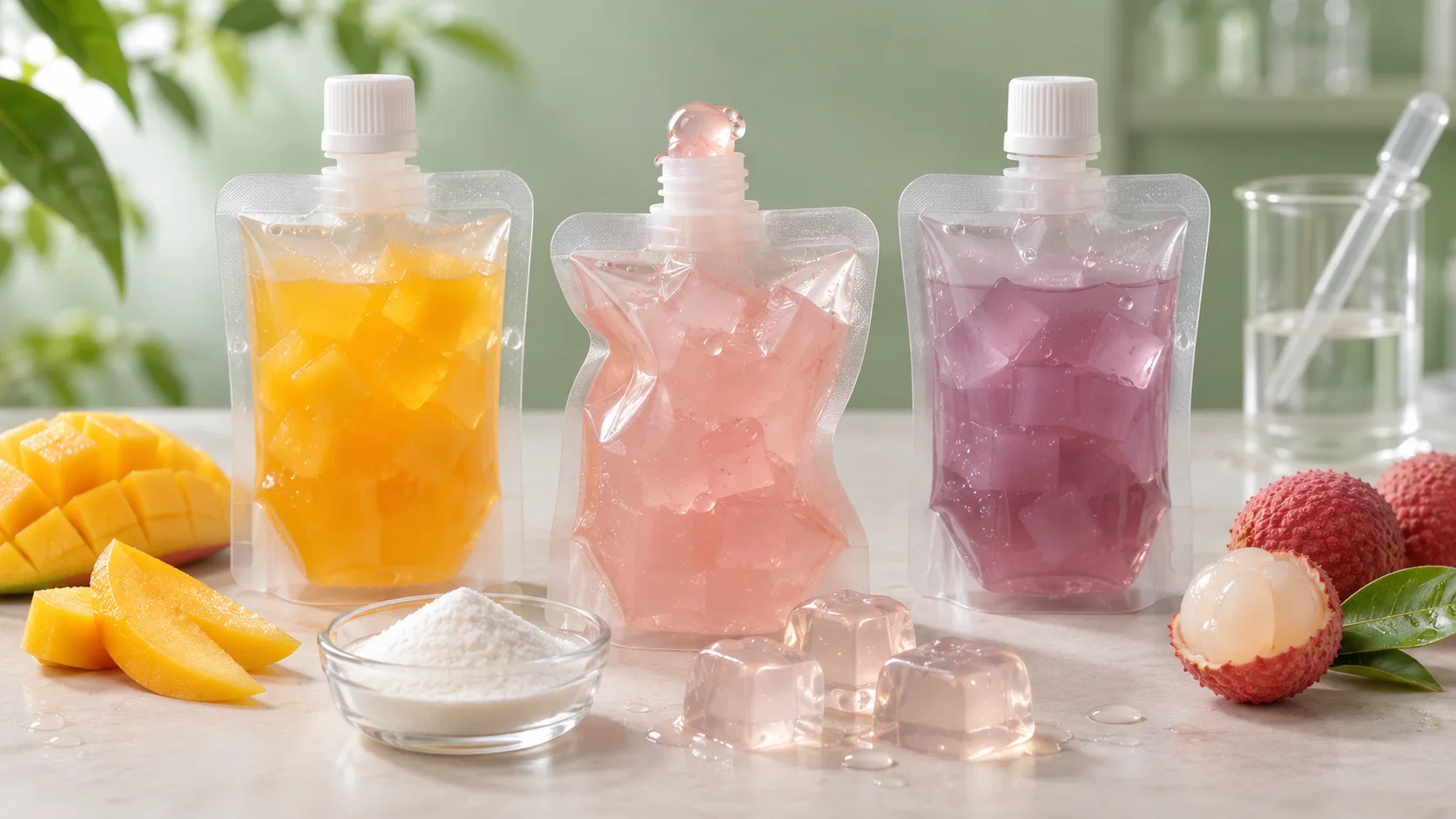
Squeeze a spout pouch, take a sip, and you get something halfway between a drink and a snack. That bouncy, slurpable texture is why the functional jelly drink has grown from a convenience-store novelty into a serious category across Asia and beyond. The catch? Many jelly drinks still lean heavily on sugar, and very few deliver fiber worth talking about.
That gap is exactly where resistant dextrin in drinkable jelly formulation earns its place. This guide explains how a resistant dextrin jelly drink behaves in acid, heat and gel systems, how much soluble fiber in jelly drinks is realistic per pouch, how it compares with other fibers, and what you can honestly say on the label.
Why the Jelly Beverage Trend Needs a Better Fiber Story
The jelly beverage trend has always been about sensation: the slurp, the wobble, the cool bite on a hot afternoon. Konjac jelly drinks from Japan and Korea made the format famous, and brands now sell the pouch jelly drink as an on-the-go fiber snack drink, a low-calorie hunger fix or a post-workout treat.
Consumers, however, are reading labels more closely. Sugar is the most common objection to drinkable jelly, and WHO’s recommendation to keep free sugars below 10% of daily energy has pushed reformulation across the beverage aisle (World Health Organization, 2015). At the same time, WHO advises adults to eat at least 25 g of dietary fiber a day, a target many people miss (World Health Organization, 2023).
Put those two pressures together and the opportunity is clear. A high fiber drinkable jelly with less sugar gives brands a credible health story without sacrificing the texture people buy the format for. It also positions jelly alongside other fiber-enriched functional beverages rather than next to candy. The real question is which fiber can survive a hot-filled, acidic gel without spoiling it.
What Makes Resistant Dextrin a Strong Fit for Jelly Drinks
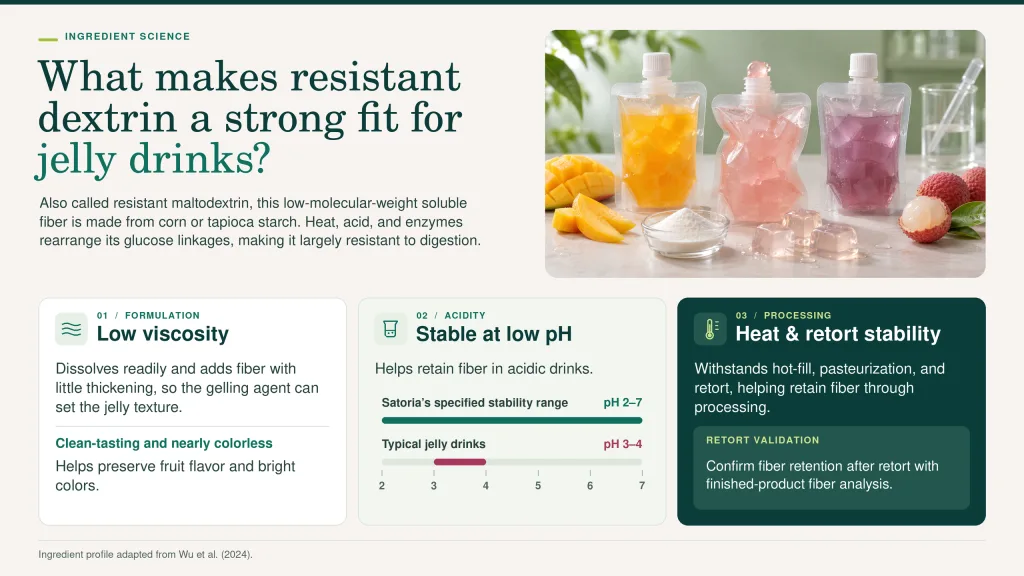
Resistant dextrin, also called resistant maltodextrin, is a low-molecular-weight soluble fiber made from corn or tapioca starch through controlled heat, acid and enzyme treatment. The process rearranges glucose linkages so human enzymes cannot digest most of the molecule, leaving a highly soluble fiber with low viscosity and good thermal stability (Wu et al., 2024).
For a resistant dextrin drinkable jelly, or any resistant maltodextrin jelly drink, that profile is ideal. As a low viscosity soluble fiber for beverages, it adds fiber without thickening the liquid phase or competing with your gelling agent. It is also clean-tasting and nearly colorless, which means fiber fortification without texture change, flavor drift or dull fruit colors.
Resistant Dextrin Acid Stability
Most jelly drinks sit between pH 3 and 4 for flavor and microbial safety. Resistant dextrin acid stability is a major advantage here, because it does not break down meaningfully in acidic conditions. The fiber you declare on day one is the fiber your consumer drinks at the end of shelf life. Satoria’s resistant dextrin, for instance, is specified as stable from pH 2 to 7.
Heat and Retort Stability
Jelly drinks are usually hot-filled into spout pouches or pasteurized after filling. Resistant dextrin heat stability means it tolerates these steps without losing fiber, making it a practical hot-fill jelly drink fiber. Retort stability is similarly robust, but always confirm your own process with fiber analysis on finished product.
Building the Gel: Resistant Dextrin with Carrageenan, Konjac, Gellan and Agar
Resistant dextrin does not gel on its own, and that is good news. It leaves texture decisions to your hydrocolloid system. The main gelling agents for drinkable jelly each bring something different (Saha & Bhattacharya, 2010):
- Carrageenan: clear, firm gels at low cost, though kappa types tend to weep water over time.
- Konjac glucomannan: elasticity and chew, plus strong synergy with kappa-carrageenan.
- Gellan gum: very low use levels, clean flavor release and good particle suspension.
- Agar: a heat-stable, brittle set that is usually blended for a softer, drinkable texture.
A resistant dextrin konjac jelly formulation typically pairs konjac with carrageenan, because the blend forms a more elastic, less brittle gel than either alone. In a resistant dextrin and carrageenan gel, the fiber simply sits in the water phase, carrying solids without disrupting that network.
Does Resistant Dextrin Affect Gel Strength?
At typical fortification levels the effect is small, because resistant dextrin is non-gelling and does not compete for water the way starches or proteins can. At higher loads it raises total soluble solids, which can shift set temperature and firmness slightly. Check texture at your target dose and fine-tune gelling agent in small steps rather than reformulating from scratch.
Syneresis Control in Jelly Drinks
Weeping is the quiet enemy of jelly drink quality. Syneresis control in jelly drinks starts with the right carrageenan-to-konjac ratio and correct potassium or calcium levels, but soluble solids matter too. When resistant dextrin replaces part of the sugar, it keeps total solids closer to your full-sugar benchmark, which helps the gel hold its water.
How Much Resistant Dextrin per Serving in a Jelly Drink?
There is no single rule for resistant dextrin dosage in beverages, because it depends on pouch size, fiber target and market. The easiest approach is to work backwards from the claim you want to make:
- EU nutrition claims: “source of fibre” needs at least 3 g per 100 g, while “high fibre” needs at least 6 g per 100 g.
- US nutrient content claims: “good source” means at least 2.8 g per serving (10% Daily Value), and “excellent source” means 5.6 g (20% DV).
- Glycemic research: trials have typically used 4 to 10 g of resistant maltodextrin, and around 6 g in drinks lowered the glycemic response to starchy meals by roughly 20% (Livesey & Tagami, 2009).
Remember to adjust for purity. Commercial resistant dextrin typically contains 80 to 90% dietary fiber, so a 5 g fiber target needs slightly more ingredient. Digestive tolerance is rarely the limiting factor: one dose-escalation study found no diarrhea in healthy adults at single doses up to about 1 g per kg of body weight (Kishimoto et al., 2013), far above any jelly drink serving.
Sugar Reduction in Jelly Drinks Without Losing the Bounce
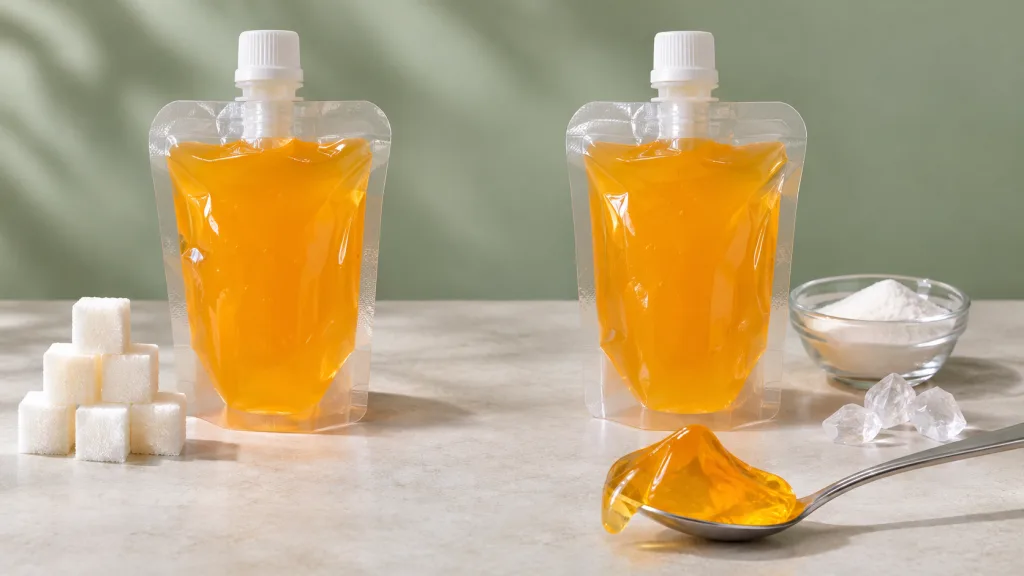
Sugar in a jelly drink does more than sweeten. It builds body, rounds out mouthfeel and helps the gel hold water. Remove it without a replacement and the drink tastes thin and weeps in the pouch.
This is where resistant dextrin earns its keep as a bulking agent for sugar reduction. It replaces much of the solids that sugar provides while contributing roughly 2 kcal per gram or less, so a low sugar drinkable jelly keeps its body and stays within calorie targets. Pair it with erythritol or a high-intensity sweetener and you have a credible list of low calorie jelly drink ingredients.
There is a glycemic upside, too. Resistant dextrin is barely digested in the small intestine, and a crossover trial with tapioca resistant maltodextrin showed lower post-meal glucose and insulin responses than digestible maltodextrin (Astina & Sapwarobol, 2020). That supports a low glycemic jelly drink concept, as long as you test the finished recipe rather than assume it.
Resistant Dextrin vs Other Soluble Fibers in Jelly Drinks
Formulators rarely choose a fiber in isolation. Here is how resistant dextrin compares with common alternatives in an acidic, heat-processed jelly:
- Resistant dextrin vs inulin in beverages: inulin adds mild sweetness, but fructans can partly hydrolyze under low-pH heat processing, and higher doses are more likely to cause bloating.
- Resistant dextrin vs FOS: a similar story. FOS is sweeter but less stable in acid and heat, and it is high in FODMAPs.
- Resistant dextrin vs polydextrose: both are stable bulking fibers, though polydextrose can add a faint off-note at high use levels.
- Soluble corn fiber vs resistant dextrin: closely related starch-derived fibers; differences come down to fiber purity, residual sugars and supplier specifications.
- Tapioca resistant dextrin vs corn resistant dextrin: functionally almost identical. Tapioca suits brands avoiding corn on the label, while corn offers broad availability and cost efficiency.
Want to go deeper on taste neutrality? Our guide on how to add fiber to beverages without changing taste covers sensory testing across drink formats.
Health Positioning: Gut Health, Satiety and Blood Glucose
A prebiotic jelly drink formulation gives brands more to talk about than “contains fiber.” Resistant dextrin reaches the colon largely intact, where gut bacteria ferment it into short-chain fatty acids. That is why it fits naturally into a prebiotic fiber jelly drink, a gut health jelly drink or a digestive health functional jelly (Wu et al., 2024).
Satiety is a tempting angle for a format already sold as a snack replacement, but be measured. One acute trial found tapioca resistant maltodextrin lowered glucose and insulin without changing appetite (Astina & Sapwarobol, 2020). A 12-week study, meanwhile, found a nutrition drink containing it was well tolerated and lowered HbA1c (Astina et al., 2022). Position a satiety fiber drink or blood glucose friendly fiber beverage carefully, and let your own data lead.
Dietary fiber health claims for beverages are tightly regulated. “Source of fiber” and “high fiber” claims are usually straightforward, while statements about blood glucose or gut function need approved wording or a framework such as Japan’s FOSHU system. Our article on how Japan’s FOSHU system is shaping the resistant dextrin market explains how that works.
Regulatory and Sourcing Checklist for Fiber Jelly Drink Formulation
Strong formulation can be undone by weak paperwork. Before scaling a fiber jelly drink formulation, confirm these points with your resistant dextrin supplier:
- Safety status: resistant dextrin GRAS notices on file with the US FDA, including one for tapioca-derived resistant dextrin intended for beverages (U.S. Food and Drug Administration, n.d.).
- Japanese recognition: resistant dextrin FOSHU history, where indigestible dextrin has long been used in products for regularity and blood glucose.
- Faith-based certification: halal resistant dextrin for Indonesia, Malaysia and the GCC, plus kosher where required.
- GMO status: non-GMO soluble fiber for beverages, backed by sourcing documentation.
- Batch consistency: fiber content, residual sugars, moisture and microbial limits that stay stable lot to lot.
If you are building a private label fiber jelly drink or briefing a jelly drink OEM, ask whether your soluble fiber ingredient for beverage manufacturers comes in both powder and syrup. Syrup simplifies liquid batching, while powder suits dry premixes.
Frequently Asked Questions
Can resistant dextrin be used in jelly drinks?
Yes. Its solubility, low viscosity and acid-heat stability make it one of the easiest fibers to add to carrageenan, konjac or gellan jelly drinks without changing taste or color.
How much resistant dextrin per serving in a jelly drink?
Most formulators target 3 to 6 g of fiber per pouch, depending on the claim. Adjust for the ingredient’s fiber content and confirm by lab analysis.
Does resistant dextrin affect gel strength?
Only slightly at typical levels. At higher doses it raises soluble solids, so fine-tune your gelling agent and cation levels during pilot trials.
Is resistant dextrin stable in acidic beverages?
Yes. Quality resistant dextrin holds its fiber content across roughly pH 2 to 7, as well as through hot-fill and pasteurization.
Which fiber works best in konjac jelly drinks?
For most konjac jelly drink recipes, resistant dextrin is the practical choice. It does not interfere with konjac-carrageenan gelation, adds no viscosity and keeps flavors clean.
Develop Tomorrow’s Jelly Drinks with the Right Fiber Partner
Drinkable jelly is one of the most exciting formats in functional beverages, and fiber is how it grows up. Whether you are refining a spout pouch jelly for convenience stores or a premium prebiotic line, the right ingredient partner can turn a promising bench sample into a product that holds up on shelf.
As a resistant dextrin manufacturer in Indonesia, Satoria NutriSentials produces Resistant Dextrin by Fiberfit™ from corn or tapioca, in both powder and liquid formats, under halal, kosher, non-GMO, FSSC 22000 and ISO-certified systems. For sugar reduction, SweetSentials and Erythritol pair naturally with it, and OEM and private labeling options are available with full formula confidentiality.
Explore the Resistant Dextrin range, download our product catalogue, or consult our food scientists about your jelly drink brief. Our team can share specifications, certification documents and application guidance so your R&D trials start on solid ground. Together, we can find the fiber format and dose that fit your formula.
References
- Astina, J., & Sapwarobol, S. (2020). Attenuation of glycaemic and insulin responses following tapioca resistant maltodextrin consumption in healthy subjects: A randomised cross-over controlled trial. Journal of Nutritional Science, 9, e29. https://pmc.ncbi.nlm.nih.gov/articles/PMC7372190/
- Astina, J., Saphyakhajorn, W., Borompichaichartkul, C., & Sapwarobol, S. (2022). Tapioca resistant maltodextrin as a carbohydrate source of oral nutrition supplement (ONS) on metabolic indicators: A clinical trial. Nutrients, 14(5), 916. https://doi.org/10.3390/nu14050916
- Kishimoto, Y., Kanahori, S., Sakano, K., & Ebihara, S. (2013). The maximum single dose of resistant maltodextrin that does not cause diarrhea in humans. Journal of Nutritional Science and Vitaminology, 59(4), 352–357. https://doi.org/10.3177/jnsv.59.352
- Livesey, G., & Tagami, H. (2009). Interventions to lower the glycemic response to carbohydrate foods with a low-viscosity fiber (resistant maltodextrin): Meta-analysis of randomized controlled trials. The American Journal of Clinical Nutrition, 89(1), 114–125. https://pmc.ncbi.nlm.nih.gov/articles/PMC6078158/
- Saha, D., & Bhattacharya, S. (2010). Hydrocolloids as thickening and gelling agents in food: A critical review. Journal of Food Science and Technology, 47(6), 587–597. https://doi.org/10.1007/s13197-010-0162-6
- U.S. Food and Drug Administration. (n.d.). GRAS notice inventory. https://www.fda.gov/food/generally-recognized-safe-gras/gras-notice-inventory
- World Health Organization. (2015). Guideline: Sugars intake for adults and children. https://www.who.int/publications/i/item/9789241549028
- World Health Organization. (2023). Carbohydrate intake for adults and children: WHO guideline. https://www.who.int/publications/i/item/9789240073593
- Wu, X., Zhang, J., Yan, X., Wu, X., Zhang, Q., & Luan, M. (2024). An in-depth overview of the structural properties, health benefits, and applications of resistant dextrin. Journal of Food Processing and Preservation, 2024, 8055063. https://doi.org/10.1155/2024/8055063
Featured News
Category
Get a Promo and Keep Updated