
Gelatin-Free Halal & Vegan Gummy Formulation: A B2B Guide to Compliant, Chewy Confections
Konjac Rice Manufacturer: A Buyer’s Guide to Sourcing Functional, Fiber-Rich Rice for Your Brand
August 14, 2026
Functional Rice - Articles
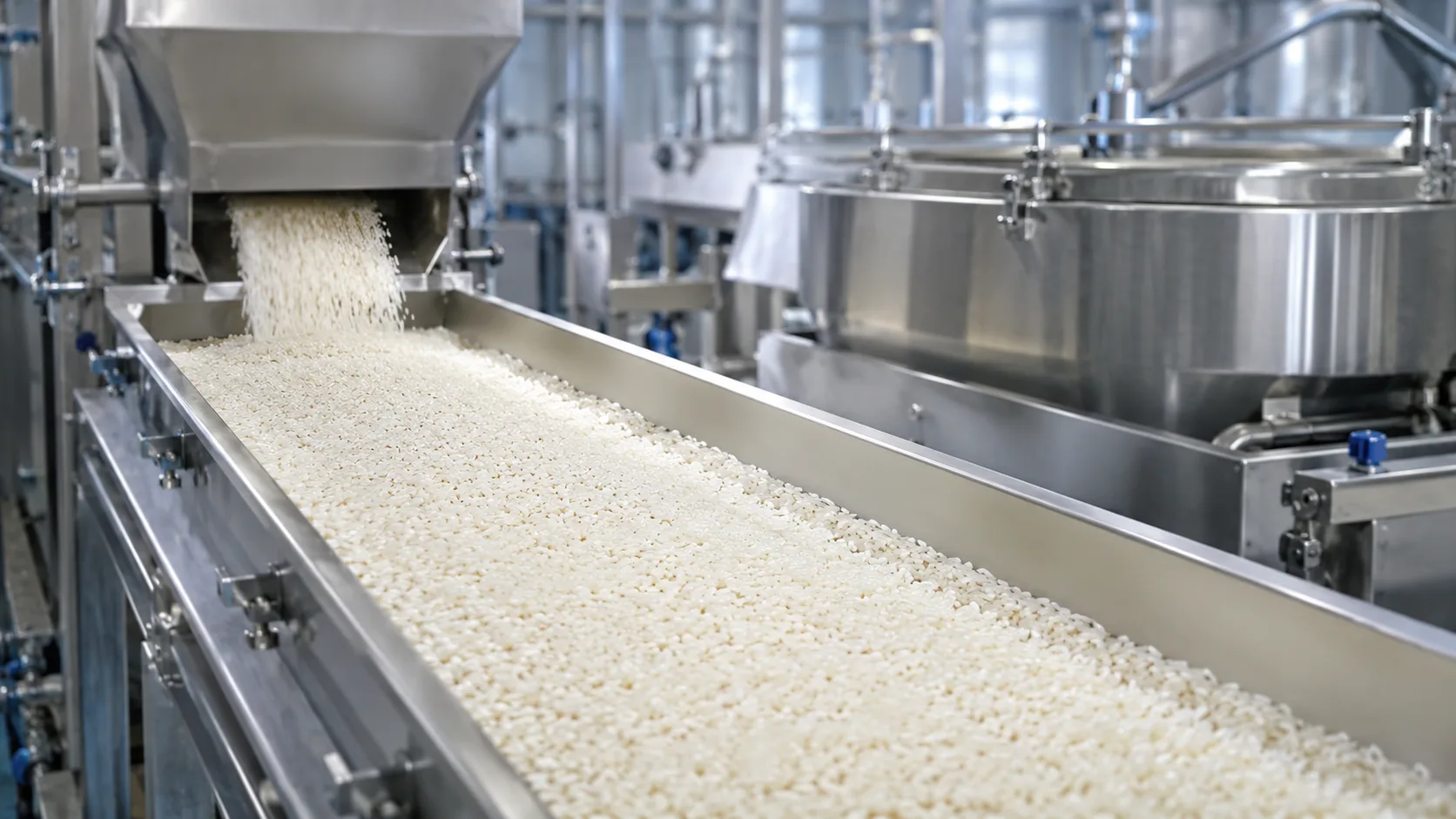
If you have spent any time researching rice alternatives for your product line, you have probably typed “konjac rice manufacturer” into a search bar more than once. It is a crowded space, and not every name that shows up actually manufactures anything — many are trading companies repackaging someone else’s output.
This guide walks through what konjac rice is, what the science says about its benefits, and how to evaluate a konjac rice supplier for OEM, private label, or bulk ingredient supply — plus where functional, protein-enriched versions of konjac rice fit into today’s F&B landscape.
What Sets a Konjac Rice Manufacturer Apart from a Generic Supplier
A konjac rice manufacturer controls the actual production process: converting konjac flour into the finished dry rice product through extrusion, shaping, drying, and quality checks. More vertically integrated manufacturers go a step further, processing the raw konjac root into flour in-house rather than relying on external sourcing — giving them tighter control over quality and supply consistency from root to final grain. A supplier, by contrast, might simply be reselling product made elsewhere, with no manufacturing capability at either stage.
Working directly with a functional rice manufacturer typically means shorter supply chains, more control over specifications, and someone who can actually explain how a product was made — not just what is printed on the spec sheet. It also usually means access to customization, which matters if you are trying to build a product that stands out rather than a private-label copy of what is already on the shelf.
For a genuinely konjac rice B2B relationship, ask directly whether the company operates its own manufacturing facility, what certifications that facility holds, and whether they can walk you through their production process. A manufacturer with nothing to hide will usually answer these questions in detail; a reseller often cannot.
Konjac Rice vs. White Rice: What the Research Actually Shows
The appeal of konjac rice starts with its nutritional profile. Made primarily from the root of the Amorphophallus konjac plant, it is naturally rich in glucomannan, a viscous, water-soluble dietary fiber. Unlike white rice, which is dense in digestible starch, konjac rice contributes minimal digestible carbohydrate while still delivering the texture and mouthfeel people expect from a bowl of rice.
That fiber content is not just a marketing point. Glucomannan has been studied extensively for its role in slowing gastric emptying, which supports feelings of fullness after a meal (Au-Yeung et al., 2018). Randomized trials have also linked glucomannan supplementation to measurable reductions in LDL cholesterol and related cardiovascular risk markers (Ho et al., 2017). For consumers moving away from refined carbohydrates without wanting to give up rice entirely, that combination of high fiber content and low digestible starch is the core sales pitch — and it happens to be backed by real evidence, not just wellness-industry enthusiasm.
Where konjac rice benefits diverge most sharply from white rice is in what nutritionists call “functional filling power.” Most adults fall well short of recommended fiber intake, and dietary fiber has been tied to reduced risk across a wide range of metabolic conditions (Ioniță-Mîndrican et al., 2022). A rice alternative that quietly closes part of that gap, without asking consumers to change how they eat, is a genuinely useful formulation tool — not just a diet trend.
Konjac Rice vs. Shirataki Rice: Same Root, Different Names
If you have researched this category at all, you have likely seen “konjac rice” and “shirataki rice” used almost interchangeably, and for good reason — they come from the same plant and share the same core ingredient, glucomannan. The naming difference is largely regional and historical: “shirataki” is the Japanese term traditionally applied to konjac-based noodles and, by extension, rice-shaped versions of the same product.
Where things get more interesting for B2B buyers is formulation quality between manufacturers. Traditional shirataki-style products can carry a faint alkaline odor from the calcium hydroxide used in the setting process. More advanced manufacturing techniques — including modern extrusion methods — can significantly reduce or eliminate that smell while producing a firmer, more rice-like grain that holds up better in cooking.
For a brand deciding what to put on a label, “konjac rice” tends to read as more approachable to a Western audience than “shirataki,” even though the underlying ingredient is functionally the same. The manufacturing method behind it, however, is where real product differentiation happens — and that is worth more scrutiny than the name on the package.
Is Konjac Rice Keto-Friendly? Understanding Its Low-Carb Profile
Konjac rice’s appeal for low-carb and ketogenic diets comes down to structure. Because it is built primarily from glucomannan fiber rather than starch, konjac rice contributes minimal digestible carbohydrate compared to conventional rice — which is part of why it shows up so often in keto and low-carb meal planning.
The broader research on konjac glucomannan supports more than just a low-carb story. Clinical trials have reported improvements in fasting glucose and lipid profiles associated with glucomannan supplementation, alongside the cholesterol benefits mentioned earlier (Ho et al., 2017). That growing body of peer-reviewed evidence is part of why glucomannan-based ingredients continue to draw interest from manufacturers formulating for metabolic-health-conscious consumers.
That said, specific claims — low glycemic index, diabetic-friendly, or otherwise — vary by market and require dedicated testing and regulatory validation before they can appear on packaging. Brands considering this kind of positioning should confirm exactly which claims their manufacturer can substantiate, rather than assuming every glucomannan-based product automatically qualifies
Why Pea Protein Konjac Rice Is the Category’s Next Step
Plain konjac rice has one limitation worth knowing about: it is naturally very low in protein, since glucomannan itself contributes essentially none. That’s why more advanced pea protein konjac rice formulations exist — pairing the fiber base with a plant-based protein source so the finished rice delivers both benefits in the same bite, rather than asking consumers to source them separately. For brands building ready-to-eat meals, meal-replacement lines, or wellness SKUs, that combination makes konjac rice a more complete nutritional building block than fiber alone, and it’s part of why “functional rice for healthy lifestyle” positioning is becoming more common across the category.
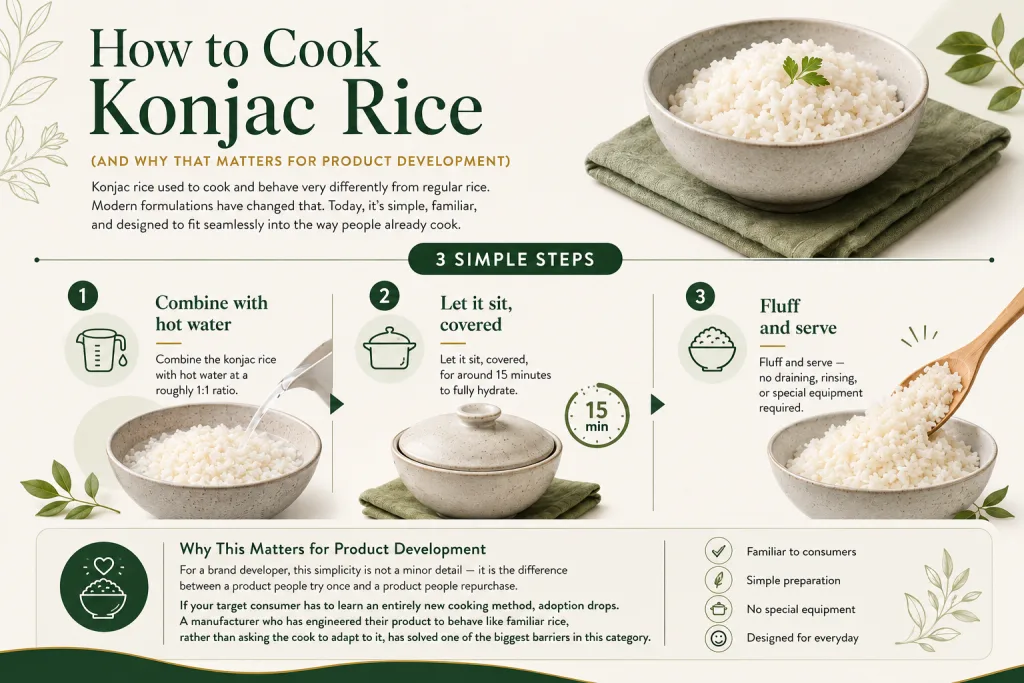
How to Cook Konjac Rice (And Why That Matters for Product Development)
One reason konjac rice has struggled to gain mainstream traction in some markets is that early versions cooked and behaved noticeably differently from regular rice — mushy texture, odd smell, unfamiliar preparation steps. Modern formulations have largely solved this, and the preparation process now looks close to what consumers already know:
- Combine the konjac rice with hot water at a roughly 1:1 ratio
- Let it sit, covered, for around 15 minutes to fully hydrate
- Fluff and serve — no draining, rinsing, or special equipment required
For a brand developer, this simplicity is not a minor detail — it is the difference between a product people try once and a product people repurchase. If your target consumer has to learn an entirely new cooking method, adoption drops. A manufacturer who has engineered their product to behave like familiar rice, rather than asking the cook to adapt to it, has solved one of the biggest barriers in this category.
What to Look for in a Konjac Rice OEM Partner
If you are evaluating konjac rice OEM options rather than just buying a finished retail product, the questions get more technical. Start with production capability: can the manufacturer adjust grain size, texture, color, or nutritional fortification to match your brand’s specific concept, or are you limited to their existing catalogue?
Private label konjac rice programs vary widely in flexibility. Some manufacturers require large minimum order quantities that only make sense for established brands; others offer more accessible entry points for smaller or newer companies testing the category. It is worth asking directly:
- What are the MOQs for bulk supply versus custom-printed private label packaging?
- Can formulations be adjusted for grain size, added protein, or fortification with vitamins and minerals?
- What packaging formats are supported — retail pouches, foodservice bulk, or both?
- What is the typical timeline from sample request to first production run?
Geography matters too. A konjac rice OEM Indonesia or broader Southeast Asia-based partner can offer real logistical advantages for brands targeting regional distribution — shorter shipping times, more familiarity with local retail and foodservice requirements, and often more competitive landed costs than importing from further afield. That regional proximity is increasingly valuable as more F&B brands look to diversify their sourcing beyond a single country of origin.
Certifications That Signal a Trustworthy Konjac Rice Supplier
Certifications are one of the fastest ways to separate a serious manufacturer from a reseller cutting corners, and they matter more in functional rice than in most food categories because so many buyers are formulating for health-conscious or dietary-restricted consumers.
Halal certified konjac rice is essential for any brand targeting Muslim-majority markets or halal-conscious consumers more broadly — and this should be backed by a documented certification, not just a verbal assurance. Similarly, Non-GMO konjac rice manufacturer status matters to the growing segment of consumers actively avoiding genetically modified ingredients, even in a category where GMO risk is relatively low to begin with.
Gluten-free konjac rice supplier status is particularly important given that konjac rice is often marketed specifically to consumers managing celiac disease or gluten sensitivity — a claim that needs to be backed by actual testing and facility controls, not just an assumption based on the raw ingredient. Finally, FDA/BPOM certified functional rice status matters enormously for any brand planning to sell into the U.S. or Indonesian markets respectively, since both agencies require specific facility registrations and compliance documentation before product can legally move through those markets.
Beyond these four, look for broader food safety credentials — HACCP, ISO 22000, or FSSC 22000 — which speak to the manufacturer’s overall quality management system rather than any single product claim.
Where Functional Rice Fits: Applications Across Categories
Functional konjac rice is no longer a niche keto product; the applications have broadened considerably as formulation quality has improved. Brands building konjac rice for ready-to-eat meals benefit from its shelf stability and consistent cook time, both of which simplify large-scale meal production. Konjac rice for meal replacement brands works particularly well when paired with added protein, since it lets a single SKU deliver both satiety and nutritional density.
Foodservice is another growing category. Konjac rice for foodservice & catering appeals to operators looking to offer a lower-carb, higher-fiber rice option without overhauling their entire menu or kitchen workflow — the preparation method stays familiar even as the nutritional profile changes. That same simplicity makes it a natural fit for konjac rice for corporate wellness programs, where employers are looking for easy, low-effort ways to support healthier eating without asking staff to change their habits dramatically.
Institutional settings round out the picture. Konjac rice for school and workplace nutrition programs is gaining interest as administrators look for ways to boost fiber intake across large numbers of meals, without introducing unfamiliar foods that reduce acceptance. Across nearly all of these use cases, the common thread is the same: functional benefits only matter commercially if the product still tastes, cooks, and feels like rice.
Rethink Rice for Your Brand’s Next Product Launch
Sourcing decisions in the functional food space come down to trust — trust that the manufacturer behind the label actually understands the science, controls their own production, and can back up every claim with real documentation. If you are exploring konjac rice as part of your next product launch, it is worth working with a manufacturer who treats fiber and protein as complementary parts of one formulation, not two separate afterthoughts.
Satoria Nutrisentials’ SatoRice brings together high dietary fiber and plant-based pea protein in a single functional rice, developed using advanced extrusion technology so it cooks, tastes, and behaves like the rice your customers already know. Whether you are formulating a ready-to-eat meal, a foodservice menu item, or a retail-ready SKU, exploring what a dedicated functional rice manufacturer can build alongside your team is a logical next step toward a smarter bowl of rice.
References
- Au-Yeung, F., Jovanovski, E., Jenkins, A. L., Zurbau, A., Ho, H. V. T., & Vuksan, V. (2018). The effects of gelled konjac glucomannan fibre on appetite and energy intake in healthy individuals: A randomised cross-over trial. British Journal of Nutrition, 119(1), 109–116. https://doi.org/10.1017/S0007114517003233
- Ghosh, A., Mohol, P., & Ghosh, S. (2025). Konjac glucomannan as an emerging nutritional strategy for obesity control via gut microbiota and metabolic regulation. Discover Food, 5(1), 1–25. https://doi.org/10.1007/s44187-025-00533-0
- Herreman, L., Nommensen, P., Pennings, B., & Laus, M. C. (2020). Comprehensive overview of the quality of plant- and animal-sourced proteins based on the digestible indispensable amino acid score. Food Science & Nutrition, 8(10), 5379–5391. https://doi.org/10.1002/fsn3.1809
- Ho, H. V. T., Jovanovski, E., Zurbau, A., Blanco Mejia, S., Sievenpiper, J. L., Au-Yeung, F., Jenkins, A. L., Duvnjak, L., Leiter, L., & Vuksan, V. (2017). A systematic review and meta-analysis of randomized controlled trials of the effect of konjac glucomannan, a viscous soluble fiber, on LDL cholesterol and the new lipid targets non-HDL cholesterol and apolipoprotein B. American Journal of Clinical Nutrition, 105(5), 1239–1247. https://ajcn.nutrition.org/article/S0002-9165(22)04891-2/fulltext
- Ioniță-Mîndrican, C.-B., Ziani, K., Mititelu, M., Oprea, E., Neacșu, S. M., Moroșan, E., Dumitrescu, D.-E., Roșca, A. C., Drăgănescu, D., & Negrei, C. (2022). Therapeutic benefits and dietary restrictions of fiber intake: A state of the art review. Nutrients, 14(13), 2641. https://doi.org/10.3390/nu14132641
Featured News
Category
Get a Promo and Keep Updated