
Reduced-Sugar 3-in-1 Instant Coffee and Milk Tea Premix: A Formulator’s Guide for US, Canadian and European Markets
Reduced-Sugar 3-in-1 Instant Coffee and Milk Tea Premix: A Formulator’s Guide for US, Canadian and European Markets
November 26, 2026
Natural Sweeteners - Articles
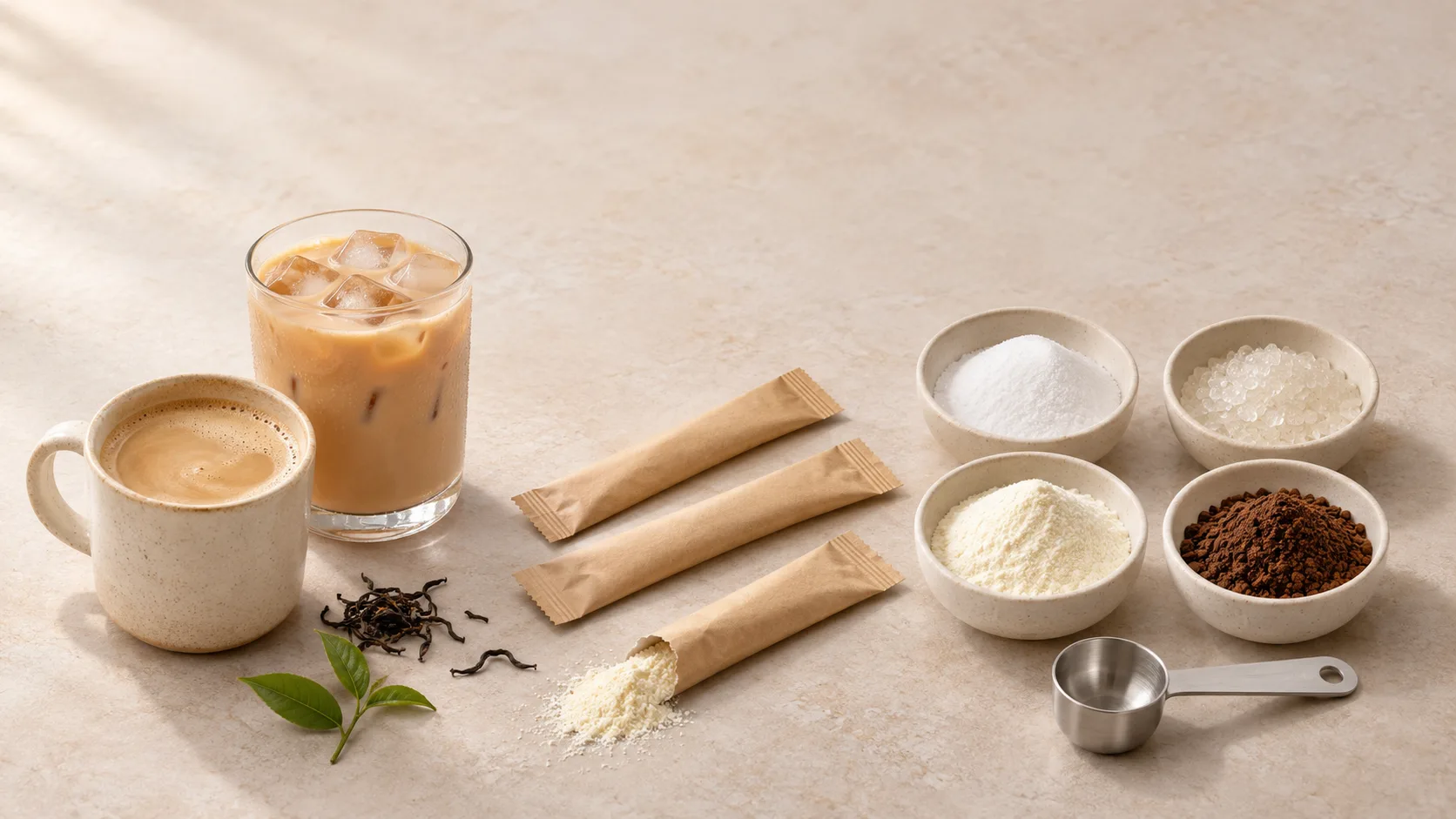
Tear open a classic coffee sachet and you’ll find three things: instant coffee, creamer and sugar. For decades, sugar did most of the heavy lifting. It gave the drink body, softened bitterness and filled the stick. Today, it’s the first thing many shoppers look for on the label.
For brands selling into North America and Europe, a reduced-sugar 3-in-1 instant coffee and milk tea premix is no longer a niche line extension. It’s fast becoming the price of entry. This guide covers what “reduced sugar” legally means in each market, how to rebuild a formula without sugar’s bulk, and what to look for in a manufacturing partner.
Why Sugar Has Become the Problem Ingredient in Instant Beverages
Ask a shopper how much sugar is in 3 in 1 coffee and most will guess low. The ingredient list often tells a different story. Because ingredients are listed in descending order by weight, sugar frequently appears first or second on a classic sachet.
Public health guidance is clear on why that matters. The World Health Organization recommends keeping free sugars below 10% of total energy intake, with a further cut to below 5% offering extra benefit (World Health Organization [WHO], 2015). A few sachets a day can take a real bite out of that budget.
So, is 3 in 1 coffee healthy? It can fit into a balanced diet, but the traditional formula leans heavily on sugar for taste and texture. That’s why demand keeps shifting toward healthier instant coffee alternatives that keep the convenience and lose the sugar load.
Several forces are shaping sugar reduction trends in beverages 2026:
- Mandatory front-of-pack warnings in some markets
- Restrictions on promoting high-sugar products in others
- Shoppers who read labels and want shorter, familiar ingredient lists
- Growing interest in fiber and gut health
The result is steady pressure on every brand to cut sugar without making the drink thin, bitter or chalky.
What “Reduced Sugar” Really Means in Each Market
Here’s where many brands stumble. “Reduced sugar” sounds like marketing language, but in most target markets it’s a regulated claim with exact conditions.
United States
A reduced sugar claim FDA-style requires at least 25% less sugar per reference amount than an appropriate reference food (U.S. Food and Drug Administration [FDA], n.d.). The FDA has not defined a “low sugar” claim, so a low sugar 3 in 1 coffee mix needs careful wording on US packs.
European Union and the UK
The EU sets a higher bar. A reduced sugars nutrition claim EU-style needs at least a 30% reduction versus similar products, and the energy value must be equal to or lower than the comparison product (European Parliament & Council of the European Union, 2006). The same regulation defines the no added sugar claim beverages brands often want, which rules out any added sugars or ingredients used for sweetness.
In short, the reduced sugar claim FDA vs EU gap is 25% versus 30%. Design for 30% and one formula can serve both.
In England, UK HFSS rules for hot beverage mixes also deserve a look, because milk-based drinks with added sugar are among the categories facing promotion and placement limits (Department of Health and Social Care [DHSC], 2023). In parts of mainland Europe, retailers increasingly expect a strong Nutri-Score instant coffee rating, so model your score early.
Canada
Since January 1, 2026, most prepackaged foods that meet set thresholds for sugars, sodium or saturated fat must display a front-of-package symbol (Health Canada, 2022). Staying clear of Canada front-of-package labelling high in sugars warnings is now a formulation goal in its own right.
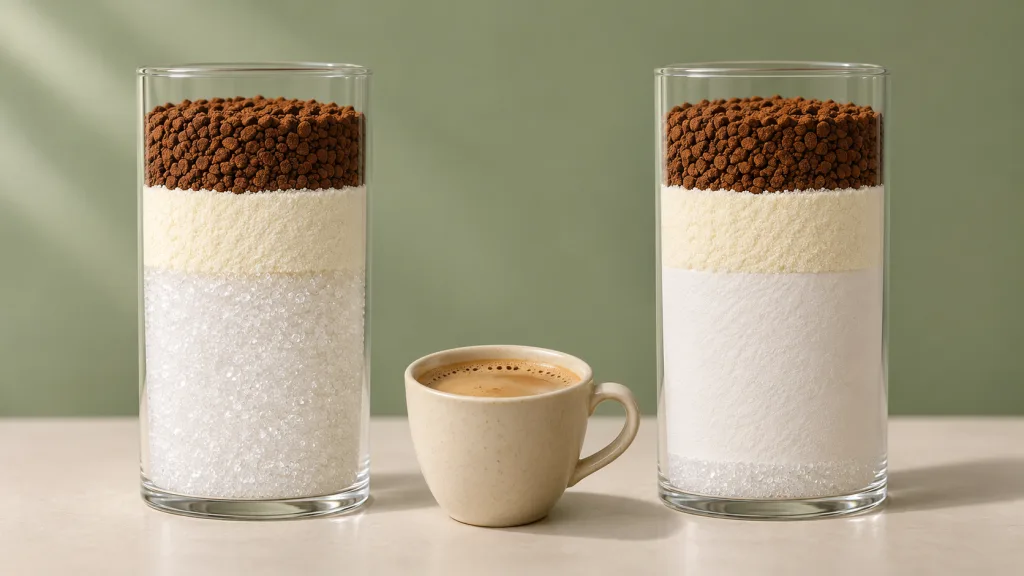
The Real Challenge: Sugar Does More Than Sweeten
Remove sugar from a sachet and you lose far more than sweetness. You lose bulk, mouthfeel, solubility and the familiar body of the cup. That’s why sugar reduction in instant beverages is really a bulking problem first and a sweetness problem second.
A good sugar replacer for powdered beverages needs to:
- Dissolve quickly in hot and cold water
- Taste neutral, so coffee and tea notes stay front and center
- Survive heat during processing
- Flow freely without caking in the stick
This is where soluble fiber earns its place. Resistant dextrin in coffee works well because it is tasteless, colorless and low in viscosity. It adds body without thickening the drink the way a gum would. As a soluble fiber for instant coffee mix formulas, it can replace a meaningful share of sugar’s weight while adding fiber to the nutrition panel.
The science behind the interest is solid, too. A meta-analysis of 37 randomized controlled trials found that resistant maltodextrin lowered the blood glucose response to carbohydrate foods in a dose-dependent way (Livesey & Tagami, 2009). A 2025 meta-analysis in adults with type 2 diabetes linked resistant dextrin with a modest drop in HbA1c, although changes in fasting glucose were not significant (Rudiansyah et al., 2025).
That opens the door to fiber coffee, prebiotic coffee mix and gut health coffee concepts. Just remember that published evidence and a permitted on-pack health claim are two different things in every market.
Building the Formula, Layer by Layer
Think of a reduced-sugar premix as three systems working together: sweetness, bulk and creaminess. Get the balance right and nobody feels like they’re drinking a “diet” product.
The Sweetness System
Most brands pair a bulk sweetener with a small amount of high-intensity sweetener. Erythritol in instant coffee is popular for its clean taste and low calories, but it can leave a cooling aftertaste. A 2023 study also linked higher blood erythritol levels with cardiovascular events, though it showed association rather than cause (Witkowski et al., 2023). A ready-made blend such as SweetSentials, which pairs natural sweetness with dietary fiber, can simplify this step.
The Carrier and Bulk System
Maltodextrin is the classic carrier in spray-dried systems, but the body digests it much like sugar. A rice maltodextrin beverage carrier offers a clean-label, neutral-tasting option where some carrier is still needed. To cut glycemic load further, resistant dextrin can serve as a maltodextrin alternative for beverage powders.
The Creamer System
Low sugar non-dairy creamer formulation often starts with the creamer’s own glucose syrup solids, a hidden sugar source many brands overlook. A plant-based creamer powder built on pea protein offers a dairy-free option, though it needs careful pH and stabilizer work to avoid feathering in hot coffee.
Milk Tea, Chai and Bubble Tea: Same Rules, Different Flavors
Everything above applies to tea, with a few twists. Tea’s aroma is more delicate than coffee’s, so the sweetness system needs a lighter touch. Milky notes also matter more, which puts extra weight on creamer quality.
Demand is spreading across several formats:
- Low sugar milk tea powder for home and office use
- Reduced sugar milk tea premix for convenience retail
- Low sugar chai latte mix, which is how many North American shoppers think of milk tea
- Bubble tea bases for cafés and take-home kits
For cafés, a bubble tea powder supplier must deliver consistent dissolving and flavor, batch after batch. For retail, many brands want private label milk tea powder and private label chai powder they can launch quickly under their own name. Buyers sourcing 3 in 1 milk tea powder wholesale should ask any instant milk tea powder manufacturer how sugar is reduced, not just by how much.
Fiber adds another angle. High fiber milk tea and low calorie milk tea positioning both benefit from soluble fibers that stay invisible in the cup. Resistant dextrin’s stability across a wide pH range helps here, especially in fruit-flavored milk teas.
Formats, Channels and the Manufacturing Behind Them
The same formula can live in very different packs. UK and European buyers usually talk about sachets, while US buyers often say sticks. Instant coffee sachets private label programs and coffee mix sticks wholesale supply both depend on a powder that flows cleanly and doses accurately on high-speed filling lines.
Vending is another major channel, especially in European offices and transport hubs. A vending machine coffee premix has to dissolve in seconds, resist clumping in warm canisters and taste the same from the first cup to the last. Removing sugar can change all three, so test in real machines, not only in the lab.
Processing choices matter as well. A spray-dried beverage premix, where key components are dried together, usually gives better solubility and uniformity than a simple dry blend. It also helps lock in flavor and stops fine particles from separating during transport.
Finally, clean label instant coffee is becoming a buyer requirement rather than a bonus. Short ingredient lists, familiar names and no artificial colors make listings easier with retailers who screen every ingredient. An OEM instant coffee mix partner who handles both spray drying and clean-label sourcing can save months of development.
Speaking Each Market’s Language
Targeting the US, Canada and Europe means thinking beyond English. Shoppers search, read and buy in their own language, and labels must follow suit.
In Quebec and France, shoppers may search for café 3 en 1 réduit en sucre or thé au lait instantané faible en sucre. German shoppers might type Instantkaffee 3 in 1 zuckerreduziert or Milchtee Pulver zuckerarm. In Poland, where 3-in-1 sachets are a familiar supermarket staple, the phrase is kawa 3w1 mniej cukru.
Dutch, Italian and Spanish shoppers look for koffie 3 in 1 minder suiker, caffè solubile 3 in 1 ridotto contenuto di zuccheri and café 3 en 1 bajo en azúcar. One caution: a popular search phrase is not automatically a legal label claim. Every translated claim must still meet local rules.
Certification opens doors too. A halal certified coffee premix Europe’s retailers and foodservice buyers can trust widens your reach to Muslim consumers. In North America, importing instant coffee mix to the USA means FDA food facility registration, prior notice for each shipment and fully compliant English labeling. A manufacturer that already holds these credentials removes much of the risk.
How to Choose a 3-in-1 Coffee Premix Manufacturer
The right 3 in 1 coffee premix manufacturer can make or break a launch. Price matters, but formulation depth matters more when sugar is coming out of the recipe.
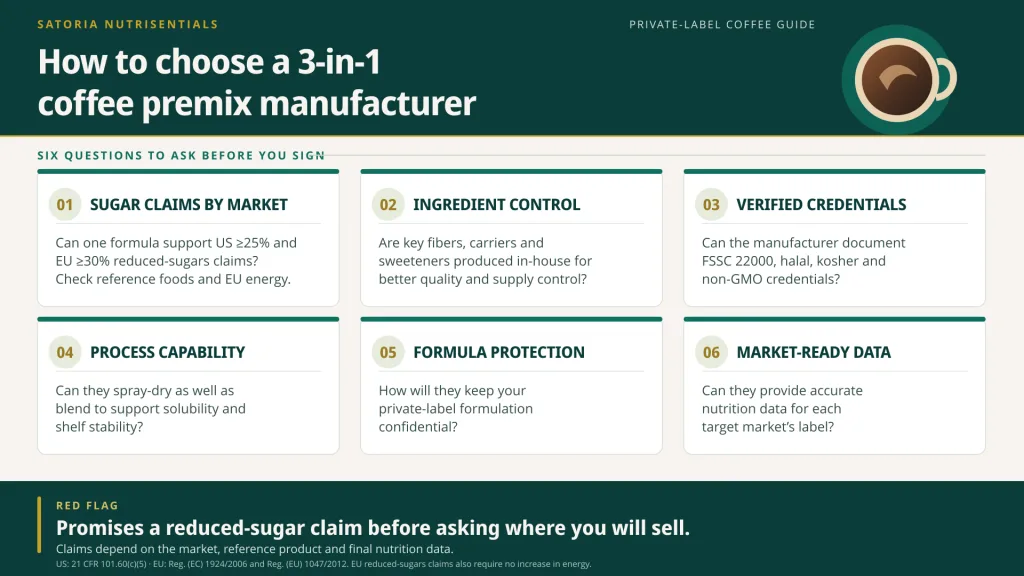
Before signing with a partner for private label 3 in 1 coffee, ask these questions:
- Can you build a reduced sugar 3 in 1 coffee that meets both the 25% US and 30% EU thresholds? One formula for two markets saves time and money.
- Do you make key ingredients in-house? Producing your own fibers, carriers and sweeteners means tighter control over quality and supply.
- Which certifications do you hold? Look for FSSC 22000, halal, kosher and non-GMO credentials.
- Can you spray-dry as well as blend? This directly affects solubility and shelf stability.
- How do you protect my formula? Confidentiality should be standard, not an add-on.
- Can you support nutrition data for each market? A less sugar instant coffee mix still needs accurate figures for every label.
Be wary of any partner who promises a low sugar 3 in 1 coffee mix without first asking where you plan to sell it. The right answer always depends on the market.
Integrated Manufacturing for Your Next Reduced-Sugar Beverage
Cutting sugar from a 3-in-1 premix isn’t about removing one ingredient. It’s about rebuilding sweetness, body and creaminess so every cup still feels like a small treat. That takes the right ingredients and the right process working together, ideally with one partner who understands both.
Satoria Nutrisentials brings both under one roof. Its range includes Resistant Dextrin for fiber and body, SweetSentials as a sugar alternative, Rice Maltodextrin as a clean-label carrier and Pea Protein for plant-based creamers. Through its OEM and toll manufacturing services, including spray-dried products, those ingredients can become a finished premix under your own brand, made to HACCP and ISO-based quality standards.
Planning a reduced-sugar coffee, milk tea or chai line for the US, Canada or Europe? Start by exploring Satoria’s functional ingredients and requesting samples or technical data. A short conversation with the R&D team today could save months of reformulation tomorrow.
References
- Department of Health and Social Care. (2023, September 29). Restricting promotions of products high in fat, sugar or salt by location and by volume price: Implementation guidance. GOV.UK. https://www.gov.uk/government/publications/restricting-promotions-of-products-high-in-fat-sugar-or-salt-by-location-and-by-volume-price/restricting-promotions-of-products-high-in-fat-sugar-or-salt-by-location-and-by-volume-price-implementation-guidance
- European Parliament & Council of the European Union. (2006). Regulation (EC) No 1924/2006 of the European Parliament and of the Council of 20 December 2006 on nutrition and health claims made on foods. Official Journal of the European Union, L 404, 9–25. https://eur-lex.europa.eu/eli/reg/2006/1924/oj
- Health Canada. (2022, June 30). Government of Canada unveils new front-of-package nutrition symbol [News release]. https://www.canada.ca/en/health-canada/news/2022/06/government-of-canada-unveils-new-front-of-package-nutrition-symbol.html
- Livesey, G., & Tagami, H. (2009). Interventions to lower the glycemic response to carbohydrate foods with a low-viscosity fiber (resistant maltodextrin): Meta-analysis of randomized controlled trials. The American Journal of Clinical Nutrition, 89(1), 114–125. https://doi.org/10.3945/ajcn.26842
- Rudiansyah, M., Salman, D. A., Doshi, H., Jyothi S., R., Shit, D., Sharma, S., & Nouri, M. (2025). The effect of resistant dextrin on glucose regulation markers in patients with type 2 diabetes: A systematic review and meta-analysis. BMC Nutrition, 11. https://doi.org/10.1186/s40795-025-01080-8
- U.S. Food and Drug Administration. (n.d.). 21 CFR 101.60 — Nutrient content claims for the calorie content of foods. Electronic Code of Federal Regulations. https://www.ecfr.gov/current/title-21/chapter-I/subchapter-B/part-101/subpart-D/section-101.60
- Witkowski, M., Nemet, I., Alamri, H., Wilcox, J., Gupta, N., Nimer, N., Haghikia, A., Li, X. S., Wu, Y., Saha, P. P., Demuth, I., König, M., Steinhagen-Thiessen, E., Cajka, T., Fiehn, O., Landmesser, U., Tang, W. H. W., & Hazen, S. L. (2023). The artificial sweetener erythritol and cardiovascular event risk. Nature Medicine, 29(3), 710–718. https://doi.org/10.1038/s41591-023-02223-9
- World Health Organization. (2015). Guideline: Sugars intake for adults and children. https://www.who.int/publications/i/item/9789241549028
Featured News
Category
Get a Promo and Keep Updated