
Resistant Dextrin in Instant Noodles: A Formulator’s Guide to High-Fiber, Low-GI Noodle Development
Resistant Dextrin in Instant Noodles: A Formulator’s Guide to High-Fiber, Low-GI Noodle Development
November 9, 2026
Resistant Dextrin - Articles
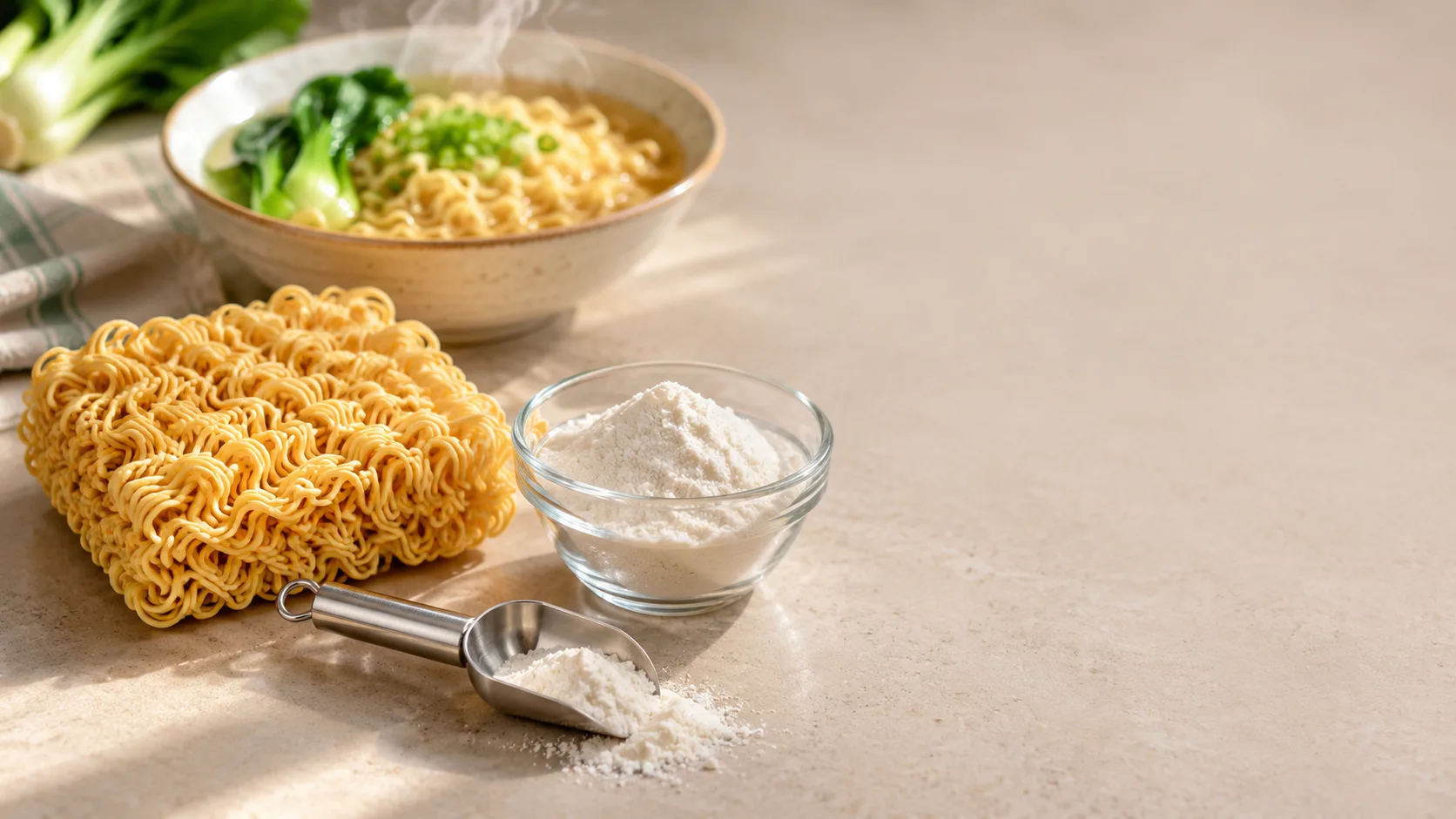
Instant noodles are one of the world’s most-loved convenience foods, and one of the most criticised. They’re quick, cheap and comforting, but short on fiber. So what if the noodle itself could do a little more for the people eating it?
That’s the opportunity resistant dextrin in instant noodles opens up. This guide covers why it works in noodles, how it compares with other fibers, where to add it, how much to use and what you can honestly claim.
Why Instant Noodles Are Ready for Fiber Enrichment
Most instant noodles are built on refined wheat flour, which contributes very little dietary fiber. The result fills the stomach without doing much for daily fiber needs.
That gap matters. The World Health Organization recommends that adults eat at least 25 grams of naturally occurring dietary fiber per day, alongside plenty of whole grains, vegetables, fruits and pulses (World Health Organization, 2023). Most people fall short, and many of them eat instant noodles every week.
Researchers have been working on fiber enriched instant noodles for years, testing everything from fruit peel fiber to buckwheat flour. One study found that adding insoluble fiber from mango and pomegranate peel lowered in vitro glucose release, although it also changed noodle hardness and structure (Bhatt & Gupta, 2023).
Consumer demand is following the science. Shoppers increasingly look for better-for-you instant noodles that still taste like the real thing. In Indonesia, where noodles are a daily staple, mi instan sehat (healthy instant noodles) has become a meaningful product category rather than a niche.
The challenge in any healthy instant noodles formulation is simple to state and harder to solve: add fiber without changing how the noodle tastes, looks or cooks. That’s exactly where a soluble fiber for noodles like resistant dextrin earns its place.
What Makes Resistant Dextrin a Good Fit for Noodles
Resistant dextrin is a soluble dietary fiber made from starch, usually corn or tapioca, through controlled heat and enzymatic treatment. The process creates glucose linkages that human digestive enzymes can’t easily break, so most of it passes through the small intestine and is fermented in the colon.
A 2024 review describes resistant dextrin as low in calories, highly soluble, low in molecular weight and thermally stable, which is why it’s widely used as a functional food additive (Wu et al., 2024). For noodles, those traits translate into practical advantages:
- Neutral taste and colour. It doesn’t add bitterness, graininess or a brown tint to the noodle.
- Low viscosity. It dissolves into the dough water without making the dough sticky or hard to sheet.
- Resistant dextrin heat stability. It holds up through steaming and frying, which typically runs at around 140–160°C for fried noodles.
- Clean label options. Non-GMO resistant dextrin and organic grades are available, which matter for export and premium positioning.
It’s also a recognised fiber in major markets. The US FDA lists resistant maltodextrin/dextrin among the non-digestible carbohydrates that can be declared as dietary fiber on the Nutrition Facts label (U.S. Food and Drug Administration, 2018).
In short, resistant dextrin for noodles lets you raise the fiber number on the label without asking consumers to accept a “health food” texture.
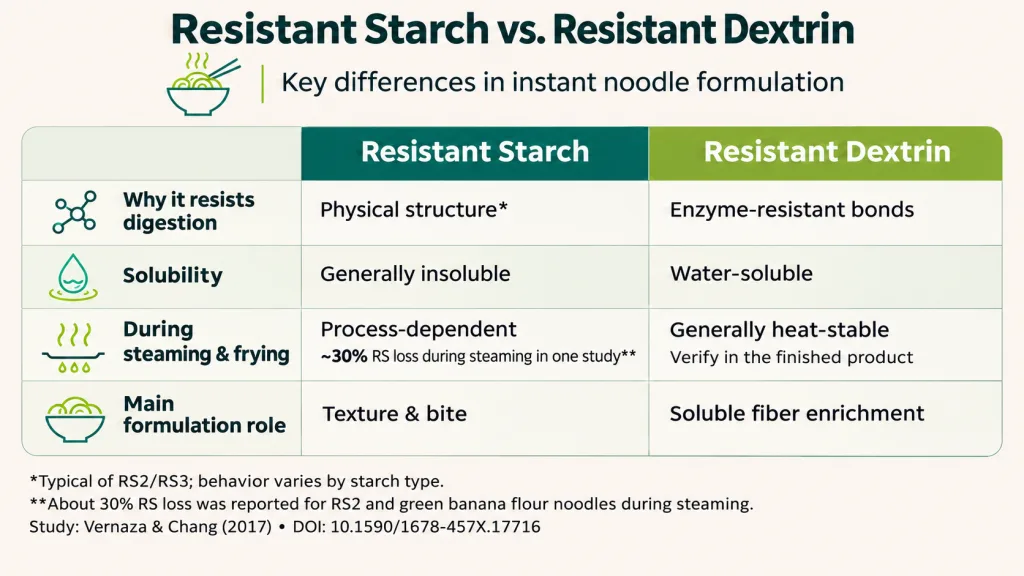
Resistant Dextrin vs Resistant Starch in Noodles
These two names sound almost identical, and they’re often confused in the literature. But for a noodle formulator, the difference is significant.
Resistant starch (RS) is starch that resists digestion because of its physical structure. It includes high-amylose corn starch (RS2), retrograded starch (RS3) and ingredients like green banana flour. The catch is that this structure can be damaged by heat and moisture.
Instant noodle processing is hard on resistant starch. In one study, noodles made with RS2 or green banana flour lost around 30% of their resistant starch during steaming alone, while RS3 lost about 18%. Frying reduced levels further (Vernaza & Chang, 2017).
Resistant dextrin works differently. Its resistance comes from its chemical bonds, not a fragile crystalline structure, so it isn’t “undone” the same way by cooking. That makes it a more predictable choice for fiber fortified noodles.
Here’s the short version of resistant dextrin vs resistant starch noodles:
- Resistant starch: can improve texture and firmness, but fiber content may drop during steaming and frying.
- Resistant dextrin: soluble, process-stable and easier to predict on the final nutrition panel.
- Together: some formulators combine both, using RS for bite and resistant dextrin for a reliable fiber number.
How Resistant Dextrin Compares With Inulin and Polydextrose
Resistant dextrin isn’t the only soluble fiber on the shelf. Inulin, polydextrose and soluble corn fiber are all common choices, so how do you decide?
Resistant dextrin vs inulin in noodles. Inulin is a well-known prebiotic, but it’s fermented quickly in the gut and is more often linked to bloating at higher doses. It can also add a mild sweetness. Resistant dextrin tends to be gentler and more neutral, which helps when the fiber is going into a staple food people eat often.
Resistant dextrin vs polydextrose. Polydextrose is a synthetic fiber valued for bulking and sugar reduction, and the FDA assigns it a caloric value of 1 kcal/g (U.S. Food and Drug Administration, 2018). It works well in confectionery, but its strengths matter less in savoury noodles.
Soluble corn fiber noodles. Soluble corn fiber is often a resistant dextrin by another name, depending on how it’s made. If you’re comparing suppliers, look at fiber content, source starch and certificates rather than the label name alone.
Many manufacturers also look for a Fibersol alternative for noodles, usually because they want a regional supplier, shorter lead times or a tapioca-based option. A locally produced resistant dextrin with matching specifications can fill that role without reformulation headaches.
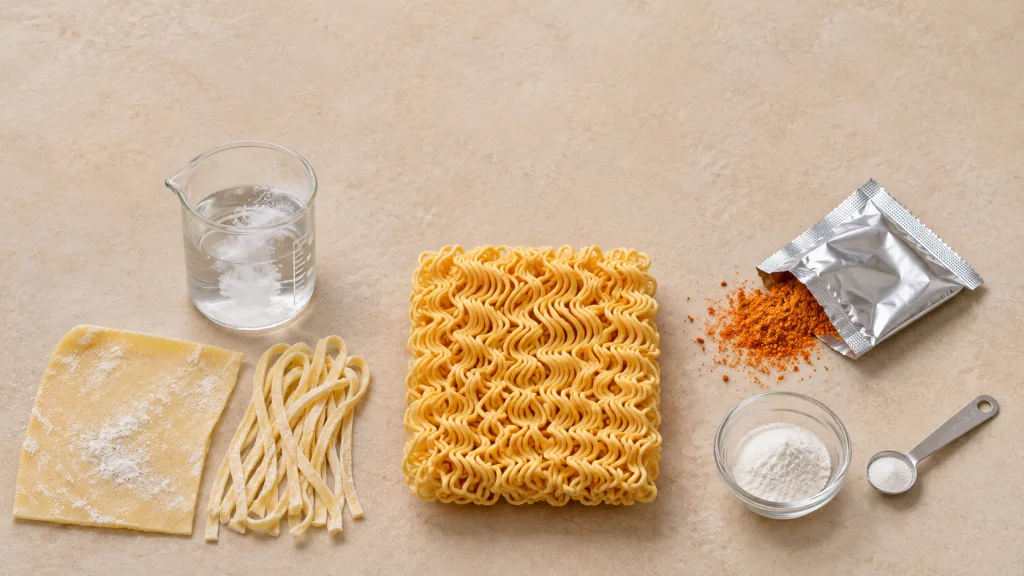
How to Add Fiber to Instant Noodles
There are two main places to add resistant dextrin: the noodle dough and the seasoning sachet. Each has its own trade-offs.
In the Noodle Dough
Adding fiber to the dough raises the fiber content of the noodle itself. Because resistant dextrin is soluble, the simplest method is to dissolve it in the alkaline water (kansui solution) before mixing.
Watch your water balance. Fiber can compete with gluten for water, so you may need to adjust hydration and mixing time. Check instant noodle texture fiber addition carefully: run trials for tensile strength, firmness, cooking loss and rehydration time against your control.
In the Seasoning Sachet
Seasoning powder fiber enrichment is often the easiest starting point. Resistant dextrin blends well with salt, flavour and spice powders, dissolves quickly in hot water and doesn’t thicken the broth noticeably. It can also partly replace maltodextrin as a carrier.
Fried vs Non-Fried Instant Noodles Fiber
The frying question comes up often. Fried vs non-fried instant noodles fiber results differ mainly for resistant starch, which loses more of its fiber value under harsher processing (Vernaza & Chang, 2017). Resistant dextrin is more stable in both formats.
On oil absorption, instant noodles fiber studies suggest some fibers can reduce fat uptake during frying; in one study, RS3 noodles absorbed the least oil (Vernaza & Chang, 2017). The evidence is specific to each fiber type, so measure fat content in your own trials rather than assuming a reduction.
Resistant Dextrin Dosage in Noodles and High-Fiber Claims
How much resistant dextrin do you actually need? The answer depends on your target claim and the fiber already in your base formula.
In Indonesia, the klaim tinggi serat BPOM threshold is at least 6 g of dietary fiber per 100 g of solid food, while a “source of fiber” claim needs at least 3 g per 100 g (Badan Pengawas Obat dan Makanan, 2022). Many other markets use similar figures.
Here’s a simple worked example for a high fiber claim noodles target:
- Measure the fiber already in your finished product, for example 2 g per 100 g.
- Calculate the gap: 6 g minus 2 g leaves 4 g per 100 g.
- Adjust for the fiber content of your ingredient. At roughly 90% fiber, you’d need about 4.5 g of resistant dextrin per 100 g of product.
- Add a small safety margin and confirm the final figure by lab analysis.
Always confirm by testing the finished product using an approved dietary fiber method, not just by calculation.
Digestive comfort is rarely a problem at these levels. In a controlled study, healthy men tolerated a wheat-based resistant dextrin well at up to 45 g per day (van den Heuvel et al., 2004), far above what a single serving of noodles would contain.
There’s a bonus, too. Because resistant dextrin contributes fewer calories than the flour it partly replaces, it can also support reduced calorie noodles positioning.
Low GI and Gut Health: What the Evidence Supports
Low GI instant noodles and gut health instant noodles are two of the most attractive positioning angles. They’re also the two where honesty matters most.
On blood sugar, the research on resistant dextrin is promising but mixed. In one randomised trial, women with type 2 diabetes who took 10 g of resistant dextrin daily for eight weeks saw lower fasting insulin and improved insulin resistance (Aliasgharzadeh et al., 2015). However, a 2025 meta-analysis noted that results across trials have been inconsistent (Rudiansyah et al., 2025).
What does that mean for low glycemic noodles? Adding resistant dextrin may help lower the glycemic response of a noodle, but it doesn’t guarantee it. The only way to make a low GI claim is to test the finished product’s GI using a recognised clinical method.
On gut health, resistant dextrin is fermented by colonic bacteria, which is why it’s widely described as a prebiotic fiber (Wu et al., 2024). That gives prebiotic fiber instant noodles real scientific grounding.
Still, check what each market allows you to say. “High in fiber” is usually straightforward. Prebiotic, blood sugar or gut health claims often need specific approval or wording, so involve your regulatory team early.
Formulating for Indonesia’s Mi Instan Market
Indonesia is one of the world’s largest instant noodle markets, which makes it a natural testing ground for mi instan tinggi serat (high-fiber instant noodles).
The trend is already visible. FoodNavigator reported in October 2026 that an Indonesian ingredient company is targeting Gen Z with added-fibre instant noodles and snacks, arguing that fiber can fit into the convenient, affordable foods young people already love.
For local formulators, a few points stand out:
- Dekstrin resisten untuk mi (resistant dextrin for noodles) fits existing production lines without major equipment changes.
- Serat pangan larut mi instan (soluble dietary fiber in instant noodles) keeps texture close to the products consumers know.
- Mi rendah indeks glikemik (low-GI noodles) is an appealing claim, but it must be backed by GI testing.
- Halal certification is essential for the domestic market and for export to Malaysia and the GCC.
Working with a supplier dekstrin resisten Indonesia (a local resistant dextrin supplier) can also simplify logistics, documentation and BPOM registration support compared with importing fiber from overseas.
Choosing a Resistant Dextrin Supplier for Noodle Manufacturers
When you’re choosing a functional noodle ingredient supplier, look for:
- Consistent fiber content with a certificate of analysis for every batch.
- Proven process stability, ideally with heat-stability data that covers steaming and frying conditions.
- The right certifications, including halal, kosher, non-GMO and food safety systems such as FSSC 22000.
- Bulk supply capacity and reliable lead times.
- Technical support for dosage trials and nutrition calculations.
This is where Satoria NutriSentials fits naturally. Its Resistant Dextrin by Fiberfit™ is made from corn or tapioca starch, comes in powder and liquid formats, and is listed as heat resistant at 150–200°C for up to an hour, which covers most noodle processes.
Satoria is a halal resistant dextrin supplier with kosher, non-GMO, FSSC 22000 and ISO certifications, so manufacturers sourcing bulk resistant dextrin in Indonesia get documentation ready for export. For protein-enriched lines, it pairs well with Satoria’s pea protein or rice protein isolate.
Looking for a noodle OEM manufacturer in Indonesia? Note that Satoria’s OEM and toll manufacturing service focuses on biscuits and spray-dried products, which can still help with spray-dried seasoning or fiber premixes for your line.
Build Your Next Better-for-You Noodle With Satoria NutriSentials
The path to a healthier instant noodle doesn’t have to mean a compromise on taste, texture or cost. With the right resistant dextrin noodle formulation, you can raise fiber, support better-for-you positioning and keep the bowl of noodles your customers already love.
Satoria NutriSentials helps F&B businesses and manufacturers develop innovative, healthy products with ingredients tailored to their needs. If you’re planning a high fiber instant noodles project, a good next step is to explore Resistant Dextrin by Fiberfit™, request product specifications or samples, and download the product catalogue to see the full range of functional ingredients.
Have a formulation question or a target claim in mind? Reach out to the Satoria NutriSentials team to talk through your noodle project. Together, you can match the right fiber grade, dosage and documentation to your production line, and turn a familiar comfort food into something that does a little more for the people who love it.
References
- Aliasgharzadeh, A., Dehghan, P., Pourghassem Gargari, B., & Asghari-Jafarabadi, M. (2015). Resistant dextrin, as a prebiotic, improves insulin resistance and inflammation in women with type 2 diabetes: A randomised controlled clinical trial. British Journal of Nutrition, 113(2), 321–330. https://doi.org/10.1017/S0007114514003675
- Badan Pengawas Obat dan Makanan. (2022). Peraturan Badan Pengawas Obat dan Makanan Nomor 1 Tahun 2022 tentang Pengawasan Klaim pada Label dan Iklan Pangan Olahan. https://peraturan.bpk.go.id/Download/218530/Peraturan%20BPOM%20Nomor%201%20Tahun%202022.pdf
- Bhatt, S., & Gupta, M. (2023). Formulation of instant noodles incorporated with insoluble dietary fiber from fruit peel: In vitro starch digestibility, biophysical, structural and textural characteristics. Applied Food Research, 3(2), 100326. https://doaj.org/article/b54982e1e0a24f3b9e29dc9e5191bd05
- Rudiansyah, M., et al. (2025). The effect of resistant dextrin on glucose regulation markers in patients with type 2 diabetes: A systematic review and meta-analysis of randomized controlled trials. BMC Nutrition, 11, 91. https://doi.org/10.1186/s40795-025-01080-8
- U.S. Food and Drug Administration. (2018). The declaration of certain isolated or synthetic non-digestible carbohydrates as dietary fiber on Nutrition and Supplement Facts labels: Guidance for industry. https://www.fda.gov/regulatory-information/search-fda-guidance-documents/guidance-industry-declaration-certain-isolated-or-synthetic-non-digestible-carbohydrates-dietary
- van den Heuvel, E. G. H. M., Wils, D., Pasman, W. J., Bakker, M., Saniez, M. H., & Kardinaal, A. F. M. (2004). Short-term digestive tolerance of different doses of NUTRIOSE FB, a food dextrin, in adult men. European Journal of Clinical Nutrition, 58(7), 1046–1055. https://doi.org/10.1038/sj.ejcn.1601930
- Vernaza, M. G., & Chang, Y. K. (2017). Survival of resistant starch during the processing of atmospheric and vacuum fried instant noodles. Food Science and Technology, 37(3), 425–431. https://scielo.br/j/cta/a/J8pxQCXzJGfLNDQH9PGSLhw/?lang=en
- World Health Organization. (2023). Carbohydrate intake for adults and children: WHO guideline. https://www.who.int/publications/i/item/9789240073593
- Wu, X., Zhang, J., Yan, X., Wu, X., Zhang, Q., & Luan, M. (2024). An in-depth overview of the structural properties, health benefits, and applications of resistant dextrin. Journal of Food Processing and Preservation, 2024, 8055063. https://doi.org/10.1155/2024/8055063
Featured News
Category
Get a Promo and Keep Updated