
NUTRALYS® Alternative: A Pea Protein Isolate Supplier Guide for US, Canadian & EU Manufacturers
NUTRALYS® Alternative: A Pea Protein Isolate Supplier Guide for US, Canadian & EU Manufacturers
November 27, 2026
Protein & Nutritional Enhancers - Articles
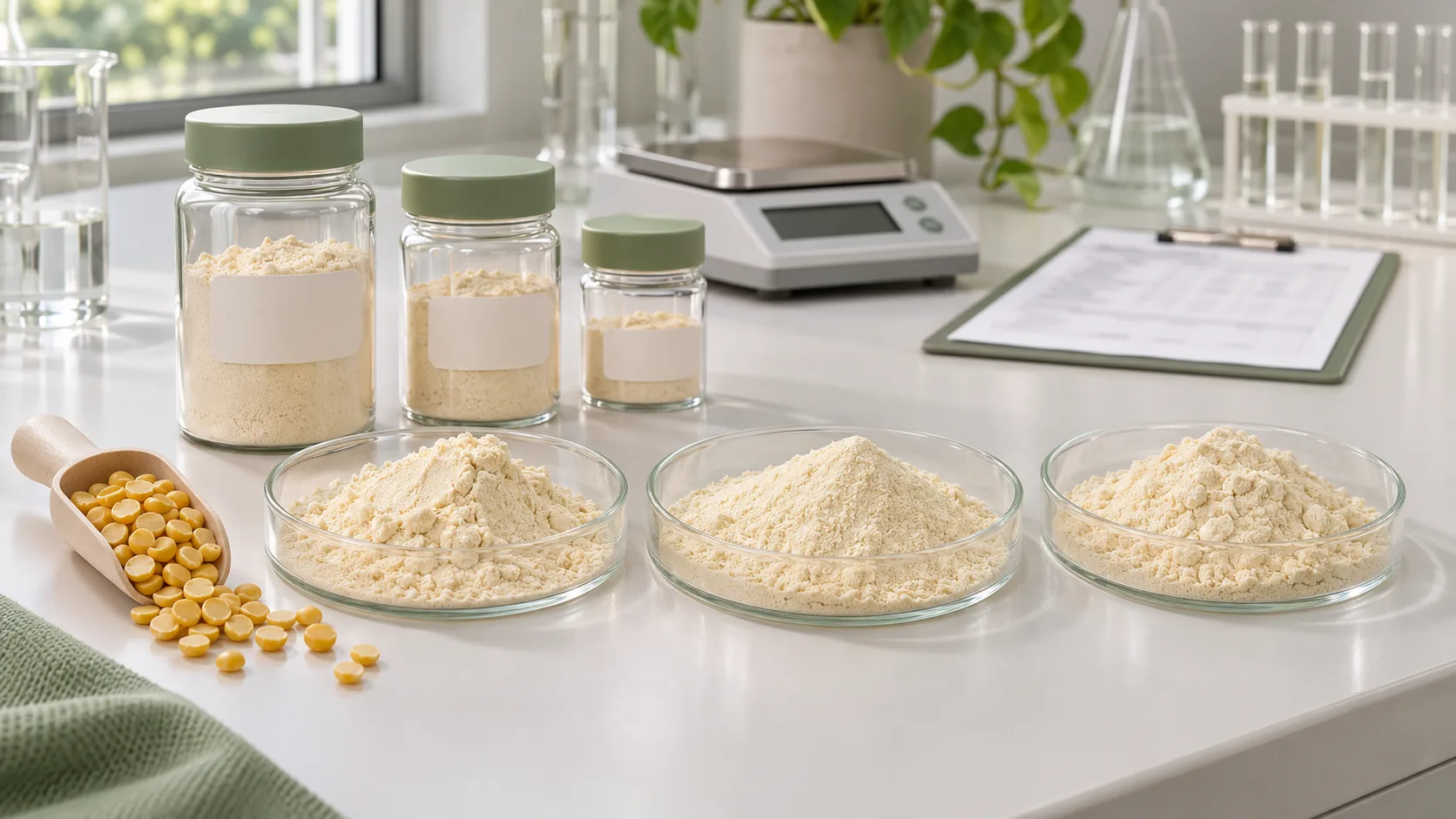
If your product line depends on pea protein, you’ve probably felt things shifting. Prices have moved, trade rules have tightened, and the supplier you specified years ago may no longer be your only sensible option. So how do you find a NUTRALYS alternative without giving up quality, compliance or consistency?
This NUTRALYS alternative: pea protein isolate supplier guide covers what actually matters when you source pea protein isolate for the US, Canadian and European markets. We’ll look at the supplier landscape, the new anti-dumping rules, the specs worth checking, and a practical checklist for your next supplier conversation.
Why Formulators Are Looking for a NUTRALYS Alternative
NUTRALYS® is Roquette’s well-known range of pea protein ingredients, and it set the benchmark for many plant-based launches. Roquette’s own documentation says its pea protein isolates are made in France and Canada and contain about 85% protein on a dry basis. For many brands, it was simply the name on the original spec sheet.
But few procurement teams want a single point of failure. Looking for a Roquette pea protein alternative usually isn’t about being unhappy with one product. It’s about resilience. Common reasons include:
- Supply security: a second qualified source protects you from plant outages, allocation and long lead times.
- Cost pressure: rising protein demand has pushed buyers to compare pea protein isolate price per kg across several suppliers.
- Application fit: a beverage, a bakery item and a meat analog need different functionality, and one range may not serve all three equally well.
- Certification needs: halal, kosher, organic or non-GMO requirements can narrow your options quickly.
In short, qualifying a NUTRALYS pea protein alternative is good risk management. It’s also much easier when you know exactly what to compare.
The Pea Protein Isolate Supplier Landscape: Roquette vs PURIS vs Cosucra and Beyond
When people search “Roquette vs PURIS vs Cosucra,” they’re usually mapping the big names before building a shortlist. Here’s a neutral snapshot of the established players buyers tend to compare:
- Roquette (France): the NUTRALYS® range, with production in Europe and North America.
- PURIS (USA): a Minnesota-based producer focused on North American peas. Many US buyers look for a PURIS pea protein alternative simply to add a second source.
- Cosucra (Belgium): known for its Pisane® pea protein, widely used in Europe. A Pisane pea protein alternative is a common search among EU formulators.
- Large ingredient groups: companies such as Cargill, ADM and Ingredion supply pea protein as part of broader portfolios.
Beyond these names, a growing number of pea protein isolate manufacturers in Asia, Latin America and Eastern Europe now serve export markets. That widens your choice. It also means checking documents more carefully, because quality and origin can vary a lot from one bulk pea protein isolate supplier to the next.
The takeaway? Brand recognition is a starting point, not a specification. Judge every candidate on the same data: protein content, functionality, certifications, origin and lot-to-lot consistency.
How Anti-Dumping Duties Are Reshaping Pea Protein Sourcing
Here’s the factor many sourcing guides overlook. Since 2024, all three of these markets have put trade remedies on high-protein pea protein from China. If you import, a pea protein anti-dumping duty can change your landed cost far more than any per-kilo price difference.
United States
In August 2024, the US Department of Commerce issued antidumping and countervailing duty orders on certain pea protein from China. Combined rates reach triple digits for many exporters. US Customs also treats in-scope Chinese pea protein as covered even when it’s blended with protein from other sources, so blending doesn’t avoid the duty.
Canada
The Canada Border Services Agency made final determinations of dumping and subsidizing in October 2024, following a complaint from domestic producers. Final duties apply to subject imports released from November 19, 2024.
European Union
The EU followed in 2026. After provisional measures in April, the European Commission imposed definitive anti-dumping duties of 40.5% to 67.1% on Chinese pea protein in September 2026, for five years.
The practical lesson? Duties follow the country where the protein was produced, not the port it ships from. A credible non-China pea protein supplier should prove origin with documents, not just claims. That’s why alternative pea protein sourcing and pea protein supply chain diversification are now board-level priorities.
Pea Protein Isolate vs Concentrate: The Specs That Actually Matter
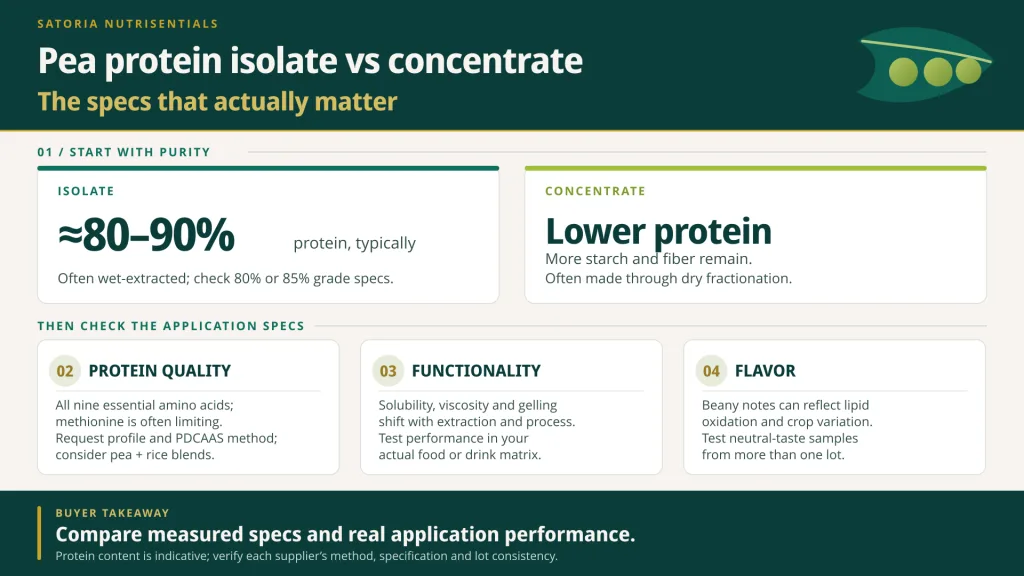
Before comparing suppliers, be clear on what you’re buying. In the pea protein isolate vs concentrate question, the difference is mostly purity. Isolates are typically refined to about 80–90% protein, while concentrates sit lower and carry more starch and fiber. That’s why buyers often look specifically for an 80% or 85% pea protein isolate supplier.
Amino Acid Profile and Protein Quality
Pea protein contains all nine essential amino acids, though it’s relatively low in methionine. A study of commercial plant protein isolates found that combining different plant proteins can bring the profile much closer to animal proteins. That’s the logic behind a pea and rice protein blend. When you review a pea protein isolate amino acid profile or PDCAAS value, ask how the supplier measured it.
Functionality
Pea protein isolate solubility, viscosity and gelling properties vary widely with extraction and processing, as major reviews of pea protein have shown. Wet-extracted isolates generally reach higher purity than dry-fractionated concentrates, but each process involves trade-offs.
Flavor
The “beany” note is the most common complaint. Research links it largely to lipid oxidation, and even harvest year and growing location can affect off-flavor compounds. So how do you reduce beany flavor in pea protein? Start by asking for a neutral-taste pea protein isolate and testing samples from more than one lot.
Matching Pea Protein Isolate to Your Application
No single isolate wins everywhere. The right grade depends on what you’re making:
- Plant-based meat and meat analogs: prioritize gelling, water binding and emulsification for bite and juiciness.
- Dairy alternatives and plant-based milk: look for a soluble pea protein isolate with low sedimentation and clean flavor.
- Protein shakes and RTD beverages: high-solubility pea protein with low viscosity keeps drinks smooth.
- Bakery: choose a low-flavor pea protein that won’t toughen the crumb.
- Protein bars and snacks: pick powders that wet quickly and don’t harden bars over shelf life.
- Sports and clinical nutrition: insist on consistent amino acid data and tight microbiological specs.
For sports nutrition, the evidence is encouraging. A randomized controlled trial found that pea protein supplementation produced muscle thickness gains comparable to whey over 12 weeks of resistance training. That’s useful context when you position pea protein isolate for sports nutrition to buyers who still default to dairy.
Always run bench trials in your actual formula. A spec sheet tells you what a powder is. Only your product tells you how it behaves.
How to Choose a Pea Protein Isolate Supplier: A Buyer’s Checklist
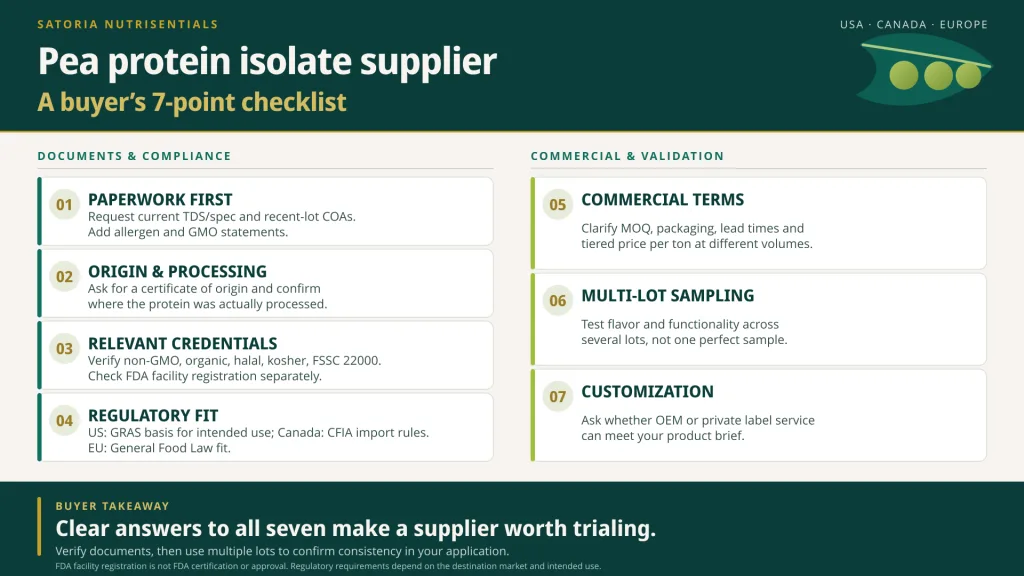
Ready to qualify a new pea protein isolate supplier for the USA, Canada or Europe? Use this checklist to keep conversations focused:
- Request the paperwork first. Ask for a current specification sheet or TDS, a pea protein isolate COA for recent lots, and allergen and GMO statements.
- Verify country of origin. Ask for a certificate of origin and where the protein was processed, not just where it ships from.
- Check certifications. Depending on your market, you may need non-GMO, organic, halal, kosher, FSSC 22000 or FDA facility registration.
- Confirm regulatory fit. For the US, ask about the GRAS basis; for Canada, check CFIA import requirements; for the EU, confirm compliance with general food law.
- Discuss commercial terms. Clarify pea protein isolate MOQ, packaging, lead times and price per ton at different volumes.
- Test samples from several lots. Consistency matters more than one perfect sample.
- Ask about customization. Some suppliers offer pea protein isolate OEM or private label pea protein services.
A supplier who answers all seven clearly is usually one worth trialing.
Where Satoria Nutrisentials Fits Into Your Sourcing Strategy
If you’re building a shortlist, Satoria Nutrisentials is worth a look. The company manufactures functional ingredients in East Java, Indonesia. Its pea protein and pea protein isolate are made from yellow peas for uses ranging from plant-based meat and dairy alternatives to shakes, bars and baked goods.
Satoria lists company-level certifications that include FSSC 22000, Halal, Kosher, Non-GMO, USDA Organic and FDA registration. If you need a halal pea protein isolate or a kosher pea protein isolate, ask which certificates cover the specific grade you’re evaluating.
There’s a formulation advantage too. Satoria also makes rice protein isolate, so you can source both halves of a pea and rice blend from one partner. Its guide to pea and rice protein blend ratio optimization explains how to balance the two for a complete amino acid profile.
As with any supplier, request the spec sheet, COA and certificate of origin before you start trials. Satoria’s team can also advise on which ingredient suits your application best.
Frequently Asked Questions
What is a good alternative to NUTRALYS pea protein?
Any pea protein isolate that matches your required protein content, functionality, certifications and documented origin. Shortlist two or three suppliers and compare lab data and bench results side by side.
Who are the biggest pea protein isolate manufacturers?
Roquette, PURIS, Cosucra, Cargill, ADM and Ingredion are among the best-known names, alongside a growing group of suppliers in Asia and elsewhere.
Is pea protein from China subject to tariffs in the US and EU?
Yes. The US has applied antidumping and countervailing duty orders since 2024, Canada has collected final duties since late 2024, and the EU imposed definitive anti-dumping duties in September 2026.
How do I choose a pea protein isolate supplier?
Start with documents: a TDS, recent COAs, certificates and proof of origin. Then trial samples from several lots in your own formula, and confirm MOQ, lead times and pricing before you commit.
Is pea protein isolate a complete protein?
It contains all nine essential amino acids but is relatively low in methionine. Blending it with rice protein helps balance the profile.
Find the Plant Protein Partner Tailored to Your Formulation Needs
Adding or switching a pea protein supplier doesn’t have to be a leap of faith. With clear specs, documented origin and the right certifications, you can build a protein supply chain for the US, Canada and Europe that’s more resilient, more compliant and better matched to your products.
The best next step is a simple one: put a second source through the same tests as your current one. Compare the paperwork side by side, run the bench trials in your real formula and taste the results. You’ll quickly see whether a new supplier can meet your standards, and you’ll have a backup ready if your main supply is ever disrupted.
Curious how Satoria’s isolate performs in your formula? Explore the Pea Protein & Pea Protein Isolate page or browse the full product range. When you’re ready, consult your needs with Satoria’s team to request specifications, documents and samples for your next bench trial.
NUTRALYS® is a registered trademark of Roquette Frères. Pisane® and PURIS are trademarks of their respective owners. Satoria Nutrisentials is not affiliated with Roquette, Cosucra or PURIS.
References
- Babault, N., Païzis, C., Deley, G., Guérin-Deremaux, L., Saniez, M.-H., Lefranc-Millot, C., & Allaert, F. A. (2015). Pea proteins oral supplementation promotes muscle thickness gains during resistance training: A double-blind, randomized, placebo-controlled clinical trial vs. whey protein. Journal of the International Society of Sports Nutrition, 12(1), 3. https://doi.org/10.1186/s12970-014-0064-5
- Canada Border Services Agency. (2024). Statement of reasons: Final decisions with respect to the dumping and subsidizing of pea protein originating in or exported from China (HPC 2024 IN). https://www.cbsa-asfc.gc.ca/sima-lmsi/i-e/hpc2024/hpc2024-fd-eng.html
- European Commission. (2026). Commission Implementing Regulation (EU) 2026/2101 of 24 September 2026 imposing a definitive anti-dumping duty and definitively collecting the provisional duty imposed on imports of pea protein originating in the People’s Republic of China. Official Journal of the European Union, L series. https://eur-lex.europa.eu/eli/reg_impl/2026/2101/oj
- Ge, J., Sun, C.-X., Corke, H., Gul, K., Gan, R.-Y., & Fang, Y. (2020). The health benefits, functional properties, modifications, and applications of pea (Pisum sativum L.) protein: Current status, challenges, and perspectives. Comprehensive Reviews in Food Science and Food Safety, 19(4), 1835–1876. https://doi.org/10.1111/1541-4337.12573
- Gorissen, S. H. M., Crombag, J. J. R., Senden, J. M. G., Waterval, W. A. H., Bierau, J., Verdijk, L. B., & van Loon, L. J. C. (2018). Protein content and amino acid composition of commercially available plant-based protein isolates. Amino Acids, 50(12), 1685–1695. https://doi.org/10.1007/s00726-018-2640-5
- Manouel, T., Gültekin Subaşı, B., & Abdollahi, M. (2024). Impacts of harvest year and cultivation location on off-flavor compounds and functionality of pea protein isolate. Foods, 13(21), 3423. https://doi.org/10.3390/foods13213423
- U.S. Department of Commerce, International Trade Administration. (2024). Certain pea protein from the People’s Republic of China: Antidumping and countervailing duty orders. Federal Register, 89(165), 68390–68394. https://www.govinfo.gov/content/pkg/FR-2024-08-26/pdf/2024-19082.pdf
Featured News
Category
Get a Promo and Keep Updated